W E L C O
M E
1
DEFINITION
 Action research is “learning by doing” -
a group of people identify a problem,
do something to resolve it, see how
successful their efforts were, and if not
satisfied, TRY AGAIN.
 Specifically, Action Research in
education can be defined as the
process of studying a school situation
to understand and improve the
quality of the educative process
(Johnson, 2012).
2
KEY FEATURES OF ACTION
RESEARCH
 The study is workplace-based, across professions and
disciplines
 The living ‘I’ is the centre of the enquiry
 Research questions can take the form, ‘How do I improve
my practice?’
 The work is done collaboratively and through negotiation
 It is underpinned by the core values of democracy,
inclusion, compassion, accountability, and self-
determination and self-development
 The work emphasizes the idea of educational influences in
learning
 The work links themes of creating knowledge and
improvement of practice
3
TYPES OF ACTION RESEARCH
 Traditional Action Research
 Contextual Action Research (Action
Learning)
 Radical Action Research
 Educational Action Research 4
METHODOLOGY
Action researchers can use any method of data
gathering, as long as they think it will give them
useful and reliable evidence of the impact of
their action. Some important considerations to
bear in mind:
 Does the method give a form of data which
relates to my question?
 Is it feasible in the available time?
 Have I made myself aware of its strengths and
limitations?
 Will it be an acceptable method for the other
people involved?
 Will it disrupt normal routines?
5
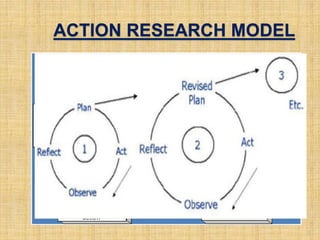
ACTION RESEARCH MODEL
6
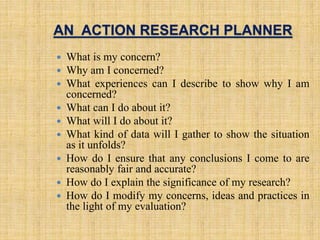
AN ACTION RESEARCH PLANNER
 What is my concern?
 Why am I concerned?
 What experiences can I describe to show why I am
concerned?
 What can I do about it?
 What will I do about it?
 What kind of data will I gather to show the situation
as it unfolds?
 How do I ensure that any conclusions I come to are
reasonably fair and accurate?
 How do I explain the significance of my research?
 How do I modify my concerns, ideas and practices in
the light of my evaluation?
7
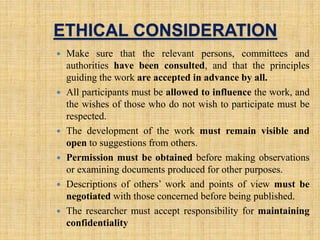
ETHICAL CONSIDERATION
 Make sure that the relevant persons, committees and
authorities have been consulted, and that the principles
guiding the work are accepted in advance by all.
 All participants must be allowed to influence the work, and
the wishes of those who do not wish to participate must be
respected.
 The development of the work must remain visible and
open to suggestions from others.
 Permission must be obtained before making observations
or examining documents produced for other purposes.
 Descriptions of others’ work and points of view must be
negotiated with those concerned before being published.
 The researcher must accept responsibility for maintaining
confidentiality
8
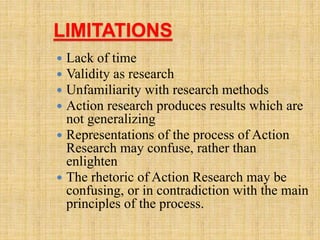
LIMITATIONS
 Lack of time
 Validity as research
 Unfamiliarity with research methods
 Action research produces results which are
not generalizing
 Representations of the process of Action
Research may confuse, rather than
enlighten
 The rhetoric of Action Research may be
confusing, or in contradiction with the main
principles of the process.
9
T H A N K S T
O A L L…Md. Shah Moazzem Hossain-11101
Hossen Mia-11104
Tayef Uddin-11106
Nazmul Islam-11108
Ali Hossain-11109
Md. Ikhlas Uddin-11116
Sadequr Rahman-11168
Farhana Sima-11187
Saki Redwana-11206
10

Action research

  • 1.
    W E LC O M E 1
  • 2.
    DEFINITION  Action researchis “learning by doing” - a group of people identify a problem, do something to resolve it, see how successful their efforts were, and if not satisfied, TRY AGAIN.  Specifically, Action Research in education can be defined as the process of studying a school situation to understand and improve the quality of the educative process (Johnson, 2012). 2
  • 3.
    KEY FEATURES OFACTION RESEARCH  The study is workplace-based, across professions and disciplines  The living ‘I’ is the centre of the enquiry  Research questions can take the form, ‘How do I improve my practice?’  The work is done collaboratively and through negotiation  It is underpinned by the core values of democracy, inclusion, compassion, accountability, and self- determination and self-development  The work emphasizes the idea of educational influences in learning  The work links themes of creating knowledge and improvement of practice 3
  • 4.
    TYPES OF ACTIONRESEARCH  Traditional Action Research  Contextual Action Research (Action Learning)  Radical Action Research  Educational Action Research 4
  • 5.
    METHODOLOGY Action researchers canuse any method of data gathering, as long as they think it will give them useful and reliable evidence of the impact of their action. Some important considerations to bear in mind:  Does the method give a form of data which relates to my question?  Is it feasible in the available time?  Have I made myself aware of its strengths and limitations?  Will it be an acceptable method for the other people involved?  Will it disrupt normal routines? 5
  • 6.
  • 7.
    AN ACTION RESEARCHPLANNER  What is my concern?  Why am I concerned?  What experiences can I describe to show why I am concerned?  What can I do about it?  What will I do about it?  What kind of data will I gather to show the situation as it unfolds?  How do I ensure that any conclusions I come to are reasonably fair and accurate?  How do I explain the significance of my research?  How do I modify my concerns, ideas and practices in the light of my evaluation? 7
  • 8.
    ETHICAL CONSIDERATION  Makesure that the relevant persons, committees and authorities have been consulted, and that the principles guiding the work are accepted in advance by all.  All participants must be allowed to influence the work, and the wishes of those who do not wish to participate must be respected.  The development of the work must remain visible and open to suggestions from others.  Permission must be obtained before making observations or examining documents produced for other purposes.  Descriptions of others’ work and points of view must be negotiated with those concerned before being published.  The researcher must accept responsibility for maintaining confidentiality 8
  • 9.
    LIMITATIONS  Lack oftime  Validity as research  Unfamiliarity with research methods  Action research produces results which are not generalizing  Representations of the process of Action Research may confuse, rather than enlighten  The rhetoric of Action Research may be confusing, or in contradiction with the main principles of the process. 9
  • 10.
    T H AN K S T O A L L…Md. Shah Moazzem Hossain-11101 Hossen Mia-11104 Tayef Uddin-11106 Nazmul Islam-11108 Ali Hossain-11109 Md. Ikhlas Uddin-11116 Sadequr Rahman-11168 Farhana Sima-11187 Saki Redwana-11206 10

Editor's Notes

  • #2 http://www.youtube.com/watch?v=EGiVWomMwkU