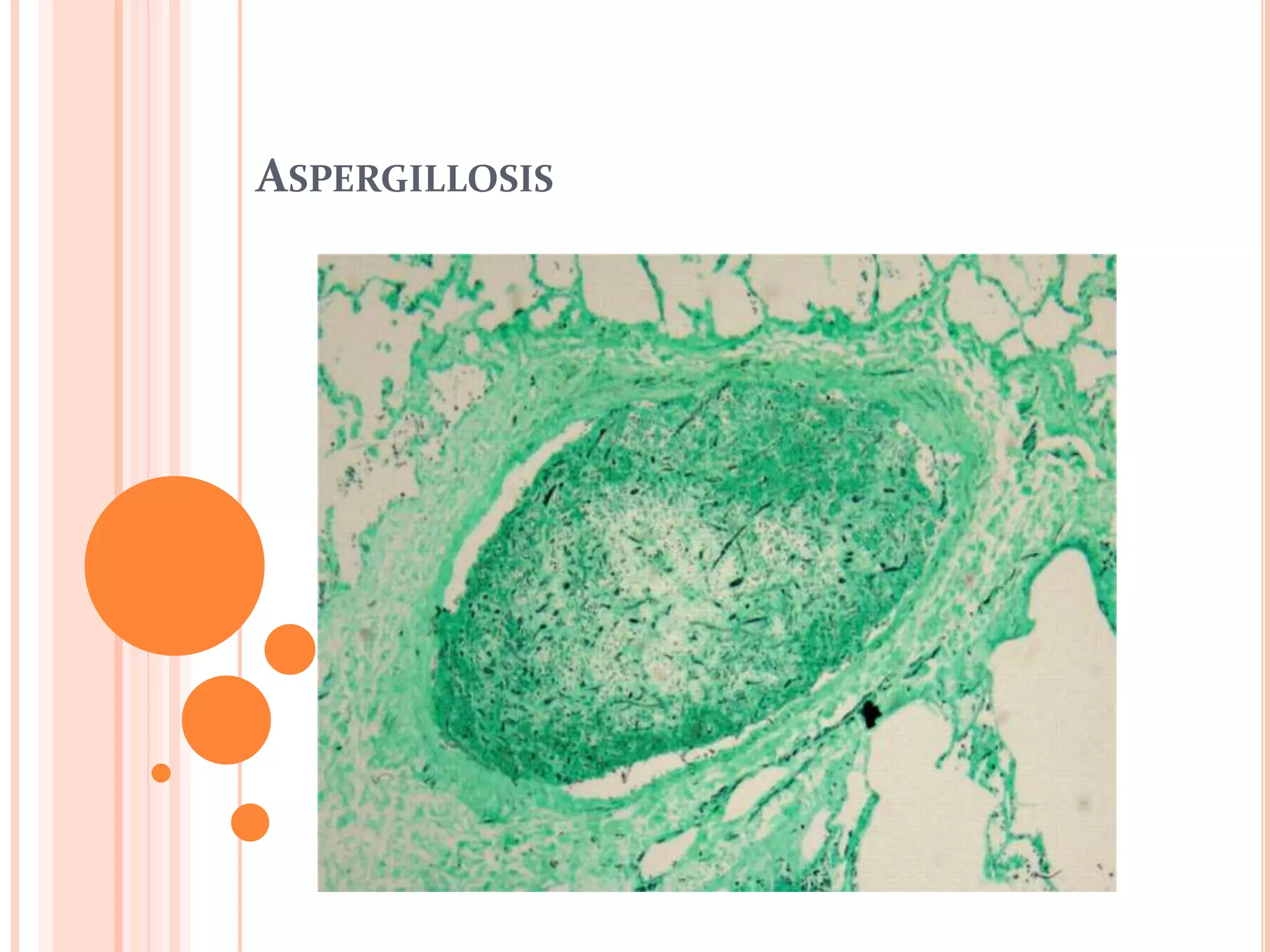
ASPERGILLOSIS
BACKGROUND 
 Aspergillus species are ubiquitous molds found in organic 
matter. 
 Although more than 100 species have been identified, the 
majority of human illness is caused byAspergillus fumigatus 
and Aspergillus niger and, less frequently, by Aspergillus 
flavus and Aspergillus clavatus 
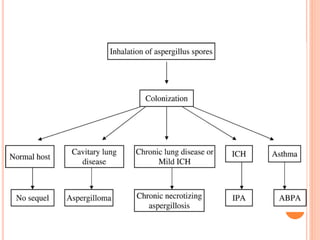
 The transmission of fungal spores to the human host is via 
inhalation. 
 Aspergillus may cause a broad spectrum of disease in the 
human host, ranging from hypersensitivity reactions to 
direct angioinvasion
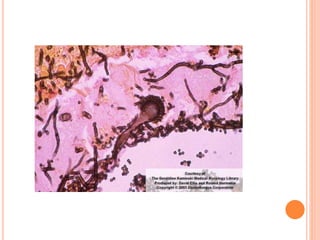
INVASIVE PULMONARY ASPERGILLOSIS 
 IPA was first described in 1953. 
 The incidence of IPA has increased during the past two 
decades due to widespread use of chemotherapy and 
immunosuppressive agents. 
 Groll et al. documented that the rate of invasive mycoses 
increased from 0.4 to 3.1% of all autopsies performed 
between 1978 and 1992 
 IPA occurs predominantly in immunocompromised patients.
RISK FACTORS 
 Prolonged neutropenia (<500 cells/mm3 for >10 days) or 
neutrophil dysfunction 
 Transplantation (highest risk is with lung and HSCT) 
 Prolonged (>3 weeks) and high-dose corticosteroid therapy. 
 Haematological malignancy (risk is higher with leukaemia) 
 Cytotoxic therapy 
 Advanced AIDS 
 Critically ill patients 
Am J Respir Crit Care Med 2006;173:707-17
 IPA is also becoming an important infectious disease in ICU 
patients without the classical risk factors for this condition. 
 Although many of the critically ill patients with IPA do not have 
the classic risk factors for IPA (neutropenia, leukaemia, HSCT), 
they usually have conditions that affect their immune system : 
-COPD 
-systemic corticosteroid therapy 
-Non-haematological malignancy, 
-liver failure, diabetes mellitus, or 
-extensive burns 
Crit Care 2005;9:R191-9.
CLINICAL MANIFESTATIONS 
 Patients present with symptoms that are usually non-specific 
( more than 80% cases involve the lung) and consistent with 
bronchopneumonia: 
- fever unresponsive to antibiotics, 
- cough, sputum production, and dyspnea 
- pleuritic chest pain 
- haemoptysis, 
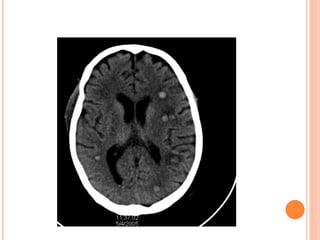
 Aspergillus infection may also disseminate and spread 
haematogenously to other organs, most commonly the brain: 
- seizures, 
- ring-enhancing lesions, 
- cerebral infarctions, 
- intracranial haemorrhage, 
- meningitis, and epidural abscess 
N Engl J Med 1976;295:655-8.
CLINICAL MANIFESTATIONS 
 Other organs such as skin, kidneys, pleura, heart, oesophagus, 
and liver may be involved.
DIAGNOSIS 
 Histopathological diagnosis, by examining lung tissue 
obtained by thoracoscopic or open-lung biopsy, remains the 
'gold standard' in the diagnosis of IPA [1] 
 The significance of isolating Aspergillus sp in sputum samples 
depends on the immune status of the host. 
Isolation of an Aspergillus species from sputum is highly 
predictive of invasive disease in immunocompromised 
patients.[2] 
[1] Ann Hematol2003;82 Suppl. 2:S141-8. 
[2] Am J Med 1996;100:171-8
DIAGNOSIS 
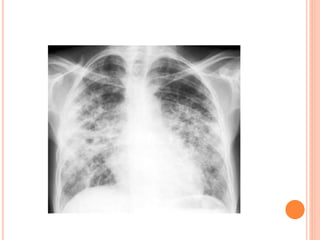
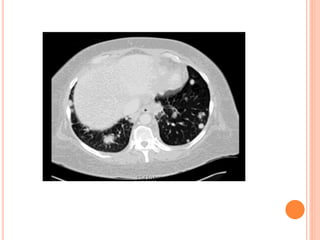
 The routine use of HRCT of the chest early in the course of IPA 
leads to earlier diagnosis and improved outcomes in these 
patients. 
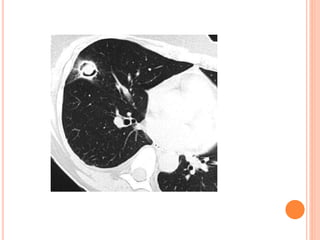
 The typical chest CT scan findings in patients suspected to have 
IPA include 
- multiple nodules 
- halo sign, 
- air crescent sign, 
- ground glass appearance and 
- consolidation 
Clin Microbiol Infect 2001;7 Suppl. 2:54-61.
DIAGNOSIS 
 Bronchoscopy with bronchoalveolar lavage (BAL) is generally 
helpful in the diagnosis of IPA, 
The sensitivity and specificity of a positive result of BAL fluid 
are about 50% and 97%, respectively. [1] 
 Polymerase chain reaction (PCR) is another way to diagnose 
IPA, by the detection of Aspergillus DNA in BAL fluid and 
serum. [2] 
A positiveAspergillus PCR in BAL fluid has an estimated sensitivity of 
67–100% and specificity of 55–95% for IPA. 
PCR sensitivity and specificity have also been reported as 100% and 65– 
92%, respectively, in serum samples. 
[1] Respir Med 1992;86:243-8. 
[2] Br J Haematol 2006;132:478-86
DIAGNOSIS 
 Galactomannan is a polysaccharide cell-wall component that is 
released by Aspergillus during growth. 
 Serum galactomannan can be detected several days before 
the presence of clinical signs, an abnormal chest radiograph, or 
positive culture. 
 This may allow earlier confirmation of the diagnosis, and serial 
determination of serum galactomannan values may be useful in 
assessing the evolution of infection during treatment. 
J Infect Dis2004;190:641-9.
DIAGNOSIS 
 A meta-analysis study was undertaken by Pfeiffer et al. to assess 
the accuracy of a galactomannan assay for diagnosing IPA. 
 Overall, the assay had a sensitivity of 71% and specificity of 89% 
for proven cases of invasive aspergillosis. The negative predictive 
value was 92–98% and the positive predictive value was 25–62% 
Pfeiffer CD et al Diagnosis of invasive aspergillosis using a galactomannan 
assay: a meta-analysis. Clin Infect Dis 2006;42:1417-27
TREATMENT 
 Early initiation of antifungal therapy in patients with strongly 
suspected invasive aspergillosis is warranted while a diagnostic 
evaluation is conducted [1] 
 For primary treatment of invasive pulmonary aspergillosis, IV or 
oral voriconazole is recommended for most patients [2] 
[1] IDSA Guidelines Clin Infect Dis. (2008) 46 (3):327-360. 
[2] Voriconazole versus amphotericin B for primary therapy of 
invasive aspergillosis. N Engl J Med 2002;347:408-15. 
Patients receiving voriconazole had a higher 12-week survival 
(71% vs. 58% for amphotericin).
TREATMENT 
 L-AMB may be considered as alternative primary therapy in some 
patients . [1] 
 For salvage therapy, agents include 
LFABs , 
Posaconazole [2], 
Itraconazole , 
Echinocandins [caspofungin , or micafungin] [3] . 
[1] Amphotericin B lipid complex for invasive fungal infections: analysis of 
safety and efficacy in 556 cases. Clin Infect Dis1998;26:1383-96 
[2] Treatment of invasive aspergillosis with posaconazole in patients who are 
refractory to or intolerant of conventional therapy: an externally controlled 
trial. Clin Infect Dis 2007;44:2-12 
[3] Efficacy and safety of caspofungin for treatment of invasive aspergillosis in 
patients refractory to or intolerant of conventional antifungal therapy. 
Clin Infect Dis 2004;39:1563-71
TREATMENT 
 Combination antifungal drugs from different classes other than 
those in the initial regimen may be used as salvage therapy 
Marr, Kieren A., et al. "A randomised, double-blind study of combination 
antifungal therapy with voriconazole and anidulafungin versus 
voriconazole monotherapy for primary treatment of invasive 
aspergillosis." Mortality 27: 0-0868.
TREATMENT 
 Immunomodulatory therapy, such as using 
- colony-stimulating factors (i.e. G-CSF, GM-CSF )[1] or 
- interferon-γ [2] 
- Granulocyte transfusions [3] 
could be used to decrease the degree of immunosuppression, 
and as an adjunct to antifungal therapy for the treatment of IPA. 
[1] Blood 1995;86:457-62 
[2] Curr Clin Top Infect Dis 2000;20:325-34 
[3] Med Mycol 2006;44(Suppl):383-6
PROPHYLAXIS 
 Antifungal prophylaxis with posaconazole can be recommended 
- HSCT recipients with GVHD who are at high risk for 
invasive aspergillosis and in 
- patients with acute myelogenous leukemia or 
myelodysplastic syndrome who are at high risk for 
invasive aspergillosis 
Posaconazole vs. fluconazole or itraconazole prophylaxis in patients with 
neutropenia. N Engl J Med2007;356:348-59.
TREATMENT 
Surgical therapy may be useful in patients with lesions that are 
contiguous with the great vessels or the pericardium, hemoptysis 
from a single cavitary lesion, or invasion of the chest wall . 
Another relative indication for surgery is the resection of a single 
pulmonary lesion prior to intensive chemotherapy or HSCT. 
Full thoracoscopic approach for surgical management of invasive 
pulmonary aspergillosis. Ann Thorac Surg 2002
CHRONIC NECROTIZING ASPERGILLOSIS 
 It is an indolent, cavitary, and infectious process of the lung 
parenchyma secondary to local invasion by Aspergillus species . 
 In contrast to IPA, CNA runs a slowly progressive course over 
weeks to months,and vascular invasion or dissemination to 
other organs is unusual.
CHRONIC NECROTIZING ASPERGILLOSIS 
 CNA usually affects middle-aged and elderly patients with altered 
local defences, associated with underlying chronic lung diseases 
such as 
-COPD, 
- previous pulmonary tuberculosis, 
- thoracic surgery, 
- radiation therapy, 
- pneumoconiosis, 
- cystic fibrosis, 
- lung infarction, or 
- sarcoidosis. 
Respir Med1994;88:465-8
CHRONIC NECROTIZING ASPERGILLOSIS 
 It may also occur in patients who are mildly immunocompromised 
due to 
-diabetes mellitus, 
- alcoholism, 
- chronic liver disease, 
- low-dose corticosteroid therapy, 
- malnutrition, and 
- connective tissue diseases such as rheumatoid 
arthritis and ankylosing spondylitis. 
Medicine (Baltimore)1982;61:109-24.
CHRONIC NECROTIZING ASPERGILLOSIS 
 It may be difficult to distinguish CNA from aspergilloma, especially 
if a previous chest radiograph is not available. 
 However, in CNA there is local invasion of the lung tissue and 
a pre-existing cavity is not needed, although a cavity with a fungal 
ball may develop in the lung as a secondary phenomenon, due to 
destruction by the fungus.
CLINICAL FEATURES 
 Patients frequently complain of constitutional symptoms such as 
- fever, 
- weight loss of 1–6 months’ duration, 
- malaise, and fatigue, 
- chronic productive cough and haemoptysis, 
Occasionally, patients may be asymptomatic
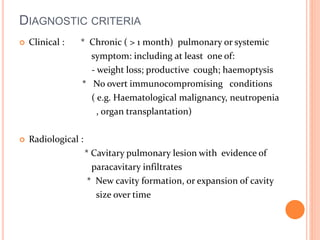
DIAGNOSTIC CRITERIA 
 Clinical : * Chronic ( > 1 month) pulmonary or systemic 
symptom: including at least one of: 
- weight loss; productive cough; haemoptysis 
* No overt immunocompromising conditions 
( e.g. Haematological malignancy, neutropenia 
, organ transplantation) 
 Radiological : 
* Cavitary pulmonary lesion with evidence of 
paracavitary infiltrates 
* New cavity formation, or expansion of cavity 
size over time
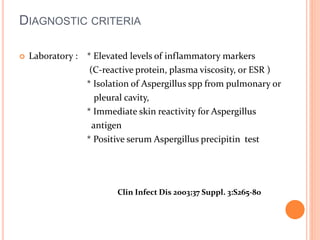
DIAGNOSTIC CRITERIA 
 Laboratory : * Elevated levels of inflammatory markers 
(C-reactive protein, plasma viscosity, or ESR ) 
* Isolation of Aspergillus spp from pulmonary or 
pleural cavity, 
* Immediate skin reactivity for Aspergillus 
antigen 
* Positive serum Aspergillus precipitin test 
Clin Infect Dis 2003;37 Suppl. 3:S265-80
TREATMENT 
Treatment of this infection may prevent progressive destruction 
of lung tissue in patients who are already experiencing impaired 
pulmonary function and who may have little pulmonary reserve 
The greatest body of evidence regarding effective therapy supports the use 
of orally administered itraconazole .[1] 
Although voriconazole [2](and presumably posaconazole) is also likely to 
be effective, there is less published information available for its use in 
CNPA 
[1] Mayo Clin Proc 1996;71:25-30. 
[2] Chest2007;131:1435-41
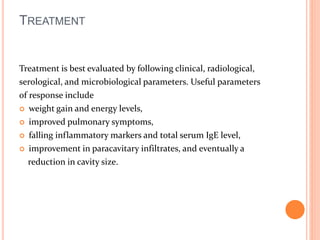
TREATMENT 
Treatment is best evaluated by following clinical, radiological, 
serological, and microbiological parameters. Useful parameters 
of response include 
 weight gain and energy levels, 
 improved pulmonary symptoms, 
 falling inflammatory markers and total serum IgE level, 
 improvement in paracavitary infiltrates, and eventually a 
reduction in cavity size.
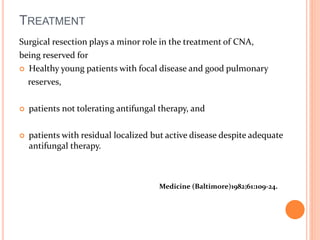
TREATMENT 
Surgical resection plays a minor role in the treatment of CNA, 
being reserved for 
 Healthy young patients with focal disease and good pulmonary 
reserves, 
 patients not tolerating antifungal therapy, and 
 patients with residual localized but active disease despite adequate 
antifungal therapy. 
Medicine (Baltimore)1982;61:109-24.
ASPERGILLOMA 
 Aspergilloma is the most common and best recognized form of 
pulmonary involvement due to Aspergillus. 
 Pulmonary aspergilloma usually develops in a pre-existing cavity in 
the lung. 
 The aspergilloma (fungus ball) is composed of fungal hyphae, 
inflammatory cells, fibrin, mucus, and tissue debris. 
 The most common species of Aspergillus recovered from such 
lesions is A. fumigatus; however, other fungi may cause the 
formation of a fungal ball, such as Zygomycetes and Fusarium.
ASPERGILLOMA 
 Many cavitary lung diseases are complicated by aspergilloma, 
including -tuberculosis, 
-sarcoidosis, 
-bronchiectasis, 
- bronchial cysts and bulla, 
- ankylosing spondylitis, 
-neoplasm, and 
-pulmonary infection, 
 Tuberculosis is the most common associated condition. In a study 
on 544 patients with pulmonary cavities secondary to tuberculosis, 
11% had radiological evidence of aspergilloma. 
Clinical evaluation of 61 patients with pulmonary aspergilloma. 
Intern Med 2000;39:209-12
ASPERGILLOMA 
 Inadequate drainage is thought to facilitate the growth of 
Aspergillus on the walls of these cavities. 
 The fungus ball may move within the cavity, but does not usually 
invade the surrounding lung parenchyma or blood vessels
CLINICAL FEATURES 
 Most patients with aspergilloma are asymptomatic. 
 When symptoms are present, most patients will experience mild 
haemoptysis, but severe and lifethreatening haemoptysis may occur, 
particularly in patients with underlying tuberculosis. 
 Bleeding usually occurs from bronchial blood vessels, and may be due to local 
invasion of blood vessels lining the cavity, endotoxins released from the fungus, 
or mechanical irritation of the exposed vasculature inside the cavity by the 
rolling fungus ball. 
 The mortality rate from haemoptysis related to aspergilloma ranges between 
2% and 14%. 
 Less commonly, patients may develop cough, dyspnoea that is probably 
more related to the underlying lung disease, and fever, which may be 
secondary to the underlying disease or bacterial superinfection of the cavity.
DIAGNOSIS 
 The diagnosis of pulmonary aspergilloma is usually based on the 
clinical and radiographic features, combined with serological or 
microbiologic evidence of Aspergillus spp. 
 Chest radiography is useful in demonstrating the presence of a mass in 
a pre-existing cavity. 
 Aspergilloma appears as an upper-lobe, mobile, intra-cavitary mass 
with an air crescent in the periphery. Localized pleural thickening is 
characteristic 
 A change in the position of the fungus ball after moving the patient on 
his side or from supine to prone position ( Tilt test ) can be seen 
Semin Respir Crit Care Med 2004;25:203-19.
DIAGNOSIS 
 Chest CT scan may be necessary to visualize aspergilloma that is 
not apparent on chest radiograph.These radiological appearances 
may be seen in other different conditions 
- haematoma, 
- neoplasm, 
- abscess, 
- hydatid cyst, and 
- Wegener’s granulomatosis. 
.
TREATMENT 
 Treatment is considered only when patients become symptomatic, 
usually with haemoptysis 
 Surgical resection of the cavity and removal of the fungus ball is 
usually indicated in patients with recurrent haemoptysis, if their 
pulmonary function is sufficient to allow surgery. 
 It is the definitive treatment 
Aspergilloma: a series of 89 surgical cases. Ann Thorac Surg 2000;69:898-903.
TREATMENT 
 Bronchial artery embolization should be considered as a 
temporary measure in patients with life threatening haemoptysis, 
since haemoptysis usually recurs due to the presence of massive 
collateral blood vessels 
Cardiovasc Intervent Radiol 2000;23:351-7.
TREATMENT 
 Administration of amphotericin B percutaneously guided by CT 
scan can be effective for aspergilloma, especially in patients with 
massive haemoptysis, with resolution of haemoptysis within few 
days. [1] 
 The role of medical therapy is uncertain Oral itraconazole 
or voriconazole may be used [2] 
[1] Intern Med 1995;34:85-8 
[2] IDSA Guidelines Clin Infect Dis. (2008) 46 (3):327-360
ALLERGIC BRONCHOPULMONARY ASPERGILLOSIS 
 ABPA is a pulmonary disease that results from hypersensitivity to 
Aspergillus antigens, mostly due to A. fumigatus. 
 The majority of cases of ABPA occur in people with asthma or cystic 
fibrosis. It is estimated that 7–14% of corticosteroid-dependent 
asthmatics and 6% of patients with cystic fibrosis develop ABPA. 
 The pathogenesis of ABPA is not completely understood: 
Aspergillus-specific IgE-mediated type I hypersensitivity reactions, 
specific IgG-mediated type III hypersensitivity reactions, and 
abnormal T-lymphocyte cellular immune responses all appear to 
play important roles in its pathogenesis.
ALLERGIC BRONCHOPULMONARY ASPERGILLOSIS 
 Most significant findings were involvement of the bronchi and 
bronchioles, with 
-bronchocentric granulomas 
- mucoid impaction 
-granulomatous inflammation consisting of palisading 
histiocytes surrounded by lymphocytes, plasma cells, and 
eosinophils. 
- Fungal hyphae were seen,but without evidence of tissue 
invasion.
CLINICAL FEATURES 
 ABPA is usually suspected on clinical grounds, and the diagnosis is 
confirmed by radiological and serological testing. 
 Almost all patients have 
-clinical asthma, and patients usually present 
with episodic wheezing, 
- expectoration of sputum containing brown plugs, 
- pleuritic chest pain, and 
- fever.
DIAGNOSIS 
Diagnostic criteria for ABPA 
 Asthma 
 Immediate skin reactivity to Aspergillus 
 Serum precipitins to A. fumigatus 
 Increased serum IgE and IgG to A. fumigatus 
 Total serum IgE >1000 ng/ml 
 Current or previous pulmonary infiltrates 
 Central bronchiectasis 
 Peripheral eosinophilia (1000 cells/ml) 
Greenberger PA. Allergic bronchopulmonary aspergillosis. 
J Allergy Clin Immunol2002;110:685-92
DIAGNOSIS 
 During acute exacerbations, fleeting pulmonary infiltrates are 
characteristic feature of the disease that tends to be in the upper 
lobe and central in location. 
 There may be transient areas of opacification due to mucoid 
impaction of the airways, which may present as band-like 
opacities emanating from the hilum with rounded distal margin 
(gloved finger appearance). 
 The ’ring sign’ and ’tram lines’ are radiological signs that represent 
the thickened and inflamed bronchi may be seen on chest 
radiographs. 
 Central bronchiectasis and pulmonary fibrosis may develop 
at later stages.
DIAGNOSIS 
 Patterson et al. have also subdivided the clinical course of ABPA into 
five stages that help to guide the management of the disease. These 
stages need not occur in order. 
 The first four are potentially reversible, with no long-term sequelae. 
 Stage I (acute stage) is the initial acute presentation with asthma, 
elevated IgE level, peripheral eosinophilia, pulmonary infiltrates, 
and IgE and IgG antibodies to A. fumigatus. 
 In Stage II (remission stage), the IgE falls but usually remains 
elevated, eosinophilia is absent, and the chest radiograph is clear. 
Serum IgG antibodies to Aspergillus antigen may be slightly 
elevated. 
 Stage III (exacerbation stage) is the recurrence of the same findings as 
in Stage I in patients known to have ABPA. IgE rises to at least double 
the baseline level.
DIAGNOSIS 
 Stage IV (the corticosteroid-dependent stage) occurs in patients 
who have asthma in which control of symptoms is dependent on 
chronic use of high-dose corticosteroid therapy and exacerbations 
are marked by worsening asthma, radiographic changes, and an 
increase in IgE level may occur. Frequently, the chest CT scan will 
show central bronchiectasis. Unfortunately, most patients are 
diagnosed at this stage. 
 In stage V (fibrotic stage), bronchiectasis and fibrosis develop, and 
usually lead to irreversible lung disease. Patients in this stage, may 
present with dyspnoea, cyanosis, rales, and cor pulmonale. 
Clubbing may be present. The serum IgE level and eosinophil count 
might be low or high. 
Ann Intern Med 1982;96:286-91
TREATMENT 
 Treatment of allergic bronchopulmonary aspergillosis (APBA) should 
consist of a combination of corticosteroids and itraconazole. 
 Corticosteroid therapy is the mainstay of therapy for ABPA , with 
improved pulmonary function and fewer episodes of recurrent 
consolidation. [1] 
 Itraconazole has been effective in improving symptoms, facilitating 
weaning from corticosteroids, decreasing Aspergillus titres, and 
improving radiographic abnormalities and pulmonary function. [2] 
[1] Chest 1993;103:1614-7. 
[2] A randomized trial of itraconazole in allergic bronchopulmonary 
aspergillosis. N Engl J Med 2000;342:756-62.
THANKS

Aspergillosis

  • 1.
  • 2.
    BACKGROUND  Aspergillusspecies are ubiquitous molds found in organic matter.  Although more than 100 species have been identified, the majority of human illness is caused byAspergillus fumigatus and Aspergillus niger and, less frequently, by Aspergillus flavus and Aspergillus clavatus  The transmission of fungal spores to the human host is via inhalation.  Aspergillus may cause a broad spectrum of disease in the human host, ranging from hypersensitivity reactions to direct angioinvasion
  • 4.
    INVASIVE PULMONARY ASPERGILLOSIS  IPA was first described in 1953.  The incidence of IPA has increased during the past two decades due to widespread use of chemotherapy and immunosuppressive agents.  Groll et al. documented that the rate of invasive mycoses increased from 0.4 to 3.1% of all autopsies performed between 1978 and 1992  IPA occurs predominantly in immunocompromised patients.
  • 5.
    RISK FACTORS Prolonged neutropenia (<500 cells/mm3 for >10 days) or neutrophil dysfunction  Transplantation (highest risk is with lung and HSCT)  Prolonged (>3 weeks) and high-dose corticosteroid therapy.  Haematological malignancy (risk is higher with leukaemia)  Cytotoxic therapy  Advanced AIDS  Critically ill patients Am J Respir Crit Care Med 2006;173:707-17
  • 6.
     IPA isalso becoming an important infectious disease in ICU patients without the classical risk factors for this condition.  Although many of the critically ill patients with IPA do not have the classic risk factors for IPA (neutropenia, leukaemia, HSCT), they usually have conditions that affect their immune system : -COPD -systemic corticosteroid therapy -Non-haematological malignancy, -liver failure, diabetes mellitus, or -extensive burns Crit Care 2005;9:R191-9.
  • 7.
    CLINICAL MANIFESTATIONS Patients present with symptoms that are usually non-specific ( more than 80% cases involve the lung) and consistent with bronchopneumonia: - fever unresponsive to antibiotics, - cough, sputum production, and dyspnea - pleuritic chest pain - haemoptysis,  Aspergillus infection may also disseminate and spread haematogenously to other organs, most commonly the brain: - seizures, - ring-enhancing lesions, - cerebral infarctions, - intracranial haemorrhage, - meningitis, and epidural abscess N Engl J Med 1976;295:655-8.
  • 8.
    CLINICAL MANIFESTATIONS Other organs such as skin, kidneys, pleura, heart, oesophagus, and liver may be involved.
  • 9.
    DIAGNOSIS  Histopathologicaldiagnosis, by examining lung tissue obtained by thoracoscopic or open-lung biopsy, remains the 'gold standard' in the diagnosis of IPA [1]  The significance of isolating Aspergillus sp in sputum samples depends on the immune status of the host. Isolation of an Aspergillus species from sputum is highly predictive of invasive disease in immunocompromised patients.[2] [1] Ann Hematol2003;82 Suppl. 2:S141-8. [2] Am J Med 1996;100:171-8
  • 11.
    DIAGNOSIS  Theroutine use of HRCT of the chest early in the course of IPA leads to earlier diagnosis and improved outcomes in these patients.  The typical chest CT scan findings in patients suspected to have IPA include - multiple nodules - halo sign, - air crescent sign, - ground glass appearance and - consolidation Clin Microbiol Infect 2001;7 Suppl. 2:54-61.
  • 16.
    DIAGNOSIS  Bronchoscopywith bronchoalveolar lavage (BAL) is generally helpful in the diagnosis of IPA, The sensitivity and specificity of a positive result of BAL fluid are about 50% and 97%, respectively. [1]  Polymerase chain reaction (PCR) is another way to diagnose IPA, by the detection of Aspergillus DNA in BAL fluid and serum. [2] A positiveAspergillus PCR in BAL fluid has an estimated sensitivity of 67–100% and specificity of 55–95% for IPA. PCR sensitivity and specificity have also been reported as 100% and 65– 92%, respectively, in serum samples. [1] Respir Med 1992;86:243-8. [2] Br J Haematol 2006;132:478-86
  • 17.
    DIAGNOSIS  Galactomannanis a polysaccharide cell-wall component that is released by Aspergillus during growth.  Serum galactomannan can be detected several days before the presence of clinical signs, an abnormal chest radiograph, or positive culture.  This may allow earlier confirmation of the diagnosis, and serial determination of serum galactomannan values may be useful in assessing the evolution of infection during treatment. J Infect Dis2004;190:641-9.
  • 18.
    DIAGNOSIS  Ameta-analysis study was undertaken by Pfeiffer et al. to assess the accuracy of a galactomannan assay for diagnosing IPA.  Overall, the assay had a sensitivity of 71% and specificity of 89% for proven cases of invasive aspergillosis. The negative predictive value was 92–98% and the positive predictive value was 25–62% Pfeiffer CD et al Diagnosis of invasive aspergillosis using a galactomannan assay: a meta-analysis. Clin Infect Dis 2006;42:1417-27
  • 19.
    TREATMENT  Earlyinitiation of antifungal therapy in patients with strongly suspected invasive aspergillosis is warranted while a diagnostic evaluation is conducted [1]  For primary treatment of invasive pulmonary aspergillosis, IV or oral voriconazole is recommended for most patients [2] [1] IDSA Guidelines Clin Infect Dis. (2008) 46 (3):327-360. [2] Voriconazole versus amphotericin B for primary therapy of invasive aspergillosis. N Engl J Med 2002;347:408-15. Patients receiving voriconazole had a higher 12-week survival (71% vs. 58% for amphotericin).
  • 20.
    TREATMENT  L-AMBmay be considered as alternative primary therapy in some patients . [1]  For salvage therapy, agents include LFABs , Posaconazole [2], Itraconazole , Echinocandins [caspofungin , or micafungin] [3] . [1] Amphotericin B lipid complex for invasive fungal infections: analysis of safety and efficacy in 556 cases. Clin Infect Dis1998;26:1383-96 [2] Treatment of invasive aspergillosis with posaconazole in patients who are refractory to or intolerant of conventional therapy: an externally controlled trial. Clin Infect Dis 2007;44:2-12 [3] Efficacy and safety of caspofungin for treatment of invasive aspergillosis in patients refractory to or intolerant of conventional antifungal therapy. Clin Infect Dis 2004;39:1563-71
  • 21.
    TREATMENT  Combinationantifungal drugs from different classes other than those in the initial regimen may be used as salvage therapy Marr, Kieren A., et al. "A randomised, double-blind study of combination antifungal therapy with voriconazole and anidulafungin versus voriconazole monotherapy for primary treatment of invasive aspergillosis." Mortality 27: 0-0868.
  • 22.
    TREATMENT  Immunomodulatorytherapy, such as using - colony-stimulating factors (i.e. G-CSF, GM-CSF )[1] or - interferon-γ [2] - Granulocyte transfusions [3] could be used to decrease the degree of immunosuppression, and as an adjunct to antifungal therapy for the treatment of IPA. [1] Blood 1995;86:457-62 [2] Curr Clin Top Infect Dis 2000;20:325-34 [3] Med Mycol 2006;44(Suppl):383-6
  • 23.
    PROPHYLAXIS  Antifungalprophylaxis with posaconazole can be recommended - HSCT recipients with GVHD who are at high risk for invasive aspergillosis and in - patients with acute myelogenous leukemia or myelodysplastic syndrome who are at high risk for invasive aspergillosis Posaconazole vs. fluconazole or itraconazole prophylaxis in patients with neutropenia. N Engl J Med2007;356:348-59.
  • 24.
    TREATMENT Surgical therapymay be useful in patients with lesions that are contiguous with the great vessels or the pericardium, hemoptysis from a single cavitary lesion, or invasion of the chest wall . Another relative indication for surgery is the resection of a single pulmonary lesion prior to intensive chemotherapy or HSCT. Full thoracoscopic approach for surgical management of invasive pulmonary aspergillosis. Ann Thorac Surg 2002
  • 25.
    CHRONIC NECROTIZING ASPERGILLOSIS  It is an indolent, cavitary, and infectious process of the lung parenchyma secondary to local invasion by Aspergillus species .  In contrast to IPA, CNA runs a slowly progressive course over weeks to months,and vascular invasion or dissemination to other organs is unusual.
  • 26.
    CHRONIC NECROTIZING ASPERGILLOSIS  CNA usually affects middle-aged and elderly patients with altered local defences, associated with underlying chronic lung diseases such as -COPD, - previous pulmonary tuberculosis, - thoracic surgery, - radiation therapy, - pneumoconiosis, - cystic fibrosis, - lung infarction, or - sarcoidosis. Respir Med1994;88:465-8
  • 27.
    CHRONIC NECROTIZING ASPERGILLOSIS  It may also occur in patients who are mildly immunocompromised due to -diabetes mellitus, - alcoholism, - chronic liver disease, - low-dose corticosteroid therapy, - malnutrition, and - connective tissue diseases such as rheumatoid arthritis and ankylosing spondylitis. Medicine (Baltimore)1982;61:109-24.
  • 28.
    CHRONIC NECROTIZING ASPERGILLOSIS  It may be difficult to distinguish CNA from aspergilloma, especially if a previous chest radiograph is not available.  However, in CNA there is local invasion of the lung tissue and a pre-existing cavity is not needed, although a cavity with a fungal ball may develop in the lung as a secondary phenomenon, due to destruction by the fungus.
  • 29.
    CLINICAL FEATURES Patients frequently complain of constitutional symptoms such as - fever, - weight loss of 1–6 months’ duration, - malaise, and fatigue, - chronic productive cough and haemoptysis, Occasionally, patients may be asymptomatic
  • 30.
    DIAGNOSTIC CRITERIA Clinical : * Chronic ( > 1 month) pulmonary or systemic symptom: including at least one of: - weight loss; productive cough; haemoptysis * No overt immunocompromising conditions ( e.g. Haematological malignancy, neutropenia , organ transplantation)  Radiological : * Cavitary pulmonary lesion with evidence of paracavitary infiltrates * New cavity formation, or expansion of cavity size over time
  • 31.
    DIAGNOSTIC CRITERIA Laboratory : * Elevated levels of inflammatory markers (C-reactive protein, plasma viscosity, or ESR ) * Isolation of Aspergillus spp from pulmonary or pleural cavity, * Immediate skin reactivity for Aspergillus antigen * Positive serum Aspergillus precipitin test Clin Infect Dis 2003;37 Suppl. 3:S265-80
  • 32.
    TREATMENT Treatment ofthis infection may prevent progressive destruction of lung tissue in patients who are already experiencing impaired pulmonary function and who may have little pulmonary reserve The greatest body of evidence regarding effective therapy supports the use of orally administered itraconazole .[1] Although voriconazole [2](and presumably posaconazole) is also likely to be effective, there is less published information available for its use in CNPA [1] Mayo Clin Proc 1996;71:25-30. [2] Chest2007;131:1435-41
  • 33.
    TREATMENT Treatment isbest evaluated by following clinical, radiological, serological, and microbiological parameters. Useful parameters of response include  weight gain and energy levels,  improved pulmonary symptoms,  falling inflammatory markers and total serum IgE level,  improvement in paracavitary infiltrates, and eventually a reduction in cavity size.
  • 34.
    TREATMENT Surgical resectionplays a minor role in the treatment of CNA, being reserved for  Healthy young patients with focal disease and good pulmonary reserves,  patients not tolerating antifungal therapy, and  patients with residual localized but active disease despite adequate antifungal therapy. Medicine (Baltimore)1982;61:109-24.
  • 35.
    ASPERGILLOMA  Aspergillomais the most common and best recognized form of pulmonary involvement due to Aspergillus.  Pulmonary aspergilloma usually develops in a pre-existing cavity in the lung.  The aspergilloma (fungus ball) is composed of fungal hyphae, inflammatory cells, fibrin, mucus, and tissue debris.  The most common species of Aspergillus recovered from such lesions is A. fumigatus; however, other fungi may cause the formation of a fungal ball, such as Zygomycetes and Fusarium.
  • 36.
    ASPERGILLOMA  Manycavitary lung diseases are complicated by aspergilloma, including -tuberculosis, -sarcoidosis, -bronchiectasis, - bronchial cysts and bulla, - ankylosing spondylitis, -neoplasm, and -pulmonary infection,  Tuberculosis is the most common associated condition. In a study on 544 patients with pulmonary cavities secondary to tuberculosis, 11% had radiological evidence of aspergilloma. Clinical evaluation of 61 patients with pulmonary aspergilloma. Intern Med 2000;39:209-12
  • 37.
    ASPERGILLOMA  Inadequatedrainage is thought to facilitate the growth of Aspergillus on the walls of these cavities.  The fungus ball may move within the cavity, but does not usually invade the surrounding lung parenchyma or blood vessels
  • 38.
    CLINICAL FEATURES Most patients with aspergilloma are asymptomatic.  When symptoms are present, most patients will experience mild haemoptysis, but severe and lifethreatening haemoptysis may occur, particularly in patients with underlying tuberculosis.  Bleeding usually occurs from bronchial blood vessels, and may be due to local invasion of blood vessels lining the cavity, endotoxins released from the fungus, or mechanical irritation of the exposed vasculature inside the cavity by the rolling fungus ball.  The mortality rate from haemoptysis related to aspergilloma ranges between 2% and 14%.  Less commonly, patients may develop cough, dyspnoea that is probably more related to the underlying lung disease, and fever, which may be secondary to the underlying disease or bacterial superinfection of the cavity.
  • 39.
    DIAGNOSIS  Thediagnosis of pulmonary aspergilloma is usually based on the clinical and radiographic features, combined with serological or microbiologic evidence of Aspergillus spp.  Chest radiography is useful in demonstrating the presence of a mass in a pre-existing cavity.  Aspergilloma appears as an upper-lobe, mobile, intra-cavitary mass with an air crescent in the periphery. Localized pleural thickening is characteristic  A change in the position of the fungus ball after moving the patient on his side or from supine to prone position ( Tilt test ) can be seen Semin Respir Crit Care Med 2004;25:203-19.
  • 40.
    DIAGNOSIS  ChestCT scan may be necessary to visualize aspergilloma that is not apparent on chest radiograph.These radiological appearances may be seen in other different conditions - haematoma, - neoplasm, - abscess, - hydatid cyst, and - Wegener’s granulomatosis. .
  • 41.
    TREATMENT  Treatmentis considered only when patients become symptomatic, usually with haemoptysis  Surgical resection of the cavity and removal of the fungus ball is usually indicated in patients with recurrent haemoptysis, if their pulmonary function is sufficient to allow surgery.  It is the definitive treatment Aspergilloma: a series of 89 surgical cases. Ann Thorac Surg 2000;69:898-903.
  • 42.
    TREATMENT  Bronchialartery embolization should be considered as a temporary measure in patients with life threatening haemoptysis, since haemoptysis usually recurs due to the presence of massive collateral blood vessels Cardiovasc Intervent Radiol 2000;23:351-7.
  • 43.
    TREATMENT  Administrationof amphotericin B percutaneously guided by CT scan can be effective for aspergilloma, especially in patients with massive haemoptysis, with resolution of haemoptysis within few days. [1]  The role of medical therapy is uncertain Oral itraconazole or voriconazole may be used [2] [1] Intern Med 1995;34:85-8 [2] IDSA Guidelines Clin Infect Dis. (2008) 46 (3):327-360
  • 44.
    ALLERGIC BRONCHOPULMONARY ASPERGILLOSIS  ABPA is a pulmonary disease that results from hypersensitivity to Aspergillus antigens, mostly due to A. fumigatus.  The majority of cases of ABPA occur in people with asthma or cystic fibrosis. It is estimated that 7–14% of corticosteroid-dependent asthmatics and 6% of patients with cystic fibrosis develop ABPA.  The pathogenesis of ABPA is not completely understood: Aspergillus-specific IgE-mediated type I hypersensitivity reactions, specific IgG-mediated type III hypersensitivity reactions, and abnormal T-lymphocyte cellular immune responses all appear to play important roles in its pathogenesis.
  • 45.
    ALLERGIC BRONCHOPULMONARY ASPERGILLOSIS  Most significant findings were involvement of the bronchi and bronchioles, with -bronchocentric granulomas - mucoid impaction -granulomatous inflammation consisting of palisading histiocytes surrounded by lymphocytes, plasma cells, and eosinophils. - Fungal hyphae were seen,but without evidence of tissue invasion.
  • 46.
    CLINICAL FEATURES ABPA is usually suspected on clinical grounds, and the diagnosis is confirmed by radiological and serological testing.  Almost all patients have -clinical asthma, and patients usually present with episodic wheezing, - expectoration of sputum containing brown plugs, - pleuritic chest pain, and - fever.
  • 47.
    DIAGNOSIS Diagnostic criteriafor ABPA  Asthma  Immediate skin reactivity to Aspergillus  Serum precipitins to A. fumigatus  Increased serum IgE and IgG to A. fumigatus  Total serum IgE >1000 ng/ml  Current or previous pulmonary infiltrates  Central bronchiectasis  Peripheral eosinophilia (1000 cells/ml) Greenberger PA. Allergic bronchopulmonary aspergillosis. J Allergy Clin Immunol2002;110:685-92
  • 48.
    DIAGNOSIS  Duringacute exacerbations, fleeting pulmonary infiltrates are characteristic feature of the disease that tends to be in the upper lobe and central in location.  There may be transient areas of opacification due to mucoid impaction of the airways, which may present as band-like opacities emanating from the hilum with rounded distal margin (gloved finger appearance).  The ’ring sign’ and ’tram lines’ are radiological signs that represent the thickened and inflamed bronchi may be seen on chest radiographs.  Central bronchiectasis and pulmonary fibrosis may develop at later stages.
  • 50.
    DIAGNOSIS  Pattersonet al. have also subdivided the clinical course of ABPA into five stages that help to guide the management of the disease. These stages need not occur in order.  The first four are potentially reversible, with no long-term sequelae.  Stage I (acute stage) is the initial acute presentation with asthma, elevated IgE level, peripheral eosinophilia, pulmonary infiltrates, and IgE and IgG antibodies to A. fumigatus.  In Stage II (remission stage), the IgE falls but usually remains elevated, eosinophilia is absent, and the chest radiograph is clear. Serum IgG antibodies to Aspergillus antigen may be slightly elevated.  Stage III (exacerbation stage) is the recurrence of the same findings as in Stage I in patients known to have ABPA. IgE rises to at least double the baseline level.
  • 51.
    DIAGNOSIS  StageIV (the corticosteroid-dependent stage) occurs in patients who have asthma in which control of symptoms is dependent on chronic use of high-dose corticosteroid therapy and exacerbations are marked by worsening asthma, radiographic changes, and an increase in IgE level may occur. Frequently, the chest CT scan will show central bronchiectasis. Unfortunately, most patients are diagnosed at this stage.  In stage V (fibrotic stage), bronchiectasis and fibrosis develop, and usually lead to irreversible lung disease. Patients in this stage, may present with dyspnoea, cyanosis, rales, and cor pulmonale. Clubbing may be present. The serum IgE level and eosinophil count might be low or high. Ann Intern Med 1982;96:286-91
  • 52.
    TREATMENT  Treatmentof allergic bronchopulmonary aspergillosis (APBA) should consist of a combination of corticosteroids and itraconazole.  Corticosteroid therapy is the mainstay of therapy for ABPA , with improved pulmonary function and fewer episodes of recurrent consolidation. [1]  Itraconazole has been effective in improving symptoms, facilitating weaning from corticosteroids, decreasing Aspergillus titres, and improving radiographic abnormalities and pulmonary function. [2] [1] Chest 1993;103:1614-7. [2] A randomized trial of itraconazole in allergic bronchopulmonary aspergillosis. N Engl J Med 2000;342:756-62.
  • 53.