Chapter 4
Mercantilism
Enforcing the Navigation Acts
The Dominion of New England
An Emerging Colonial System
Salutory Neglect
Royal Control of the Colonies
 Monarchy was the legal authority in the colonies.
 All colonies except Georgia received their charters before the Glorious
  Revolution of 1688 when the crown lost supremacy to parliament.
 Colonies continued as “dependencies of the Crown.”
 Appointed officials served at the “pleasure of the King.”
 During the English Civil War the Dutch became the dominant shipping
  power in the North American Colonies and Caribbean.
 1561 Parliament adopts the Navigation Act
  All goods imported to England or colonies carried on English ships with majority
   English crews.
More Mercantilism
 Assumed that the total of world’s gold and silver remained the same and
  only a nation’s share of that wealth was subject to change.
 The only way to gain was to take another country’s gold and silver.
  Essential: maintain a favorable balance of trade by controlling every aspect of
   exports and imports.
  Colonies were a source of raw materials and markets for goods
 Navigation Act of 1660
  Ships crews had to be ¾ English
  Products to be shipped only to England
     Tobacco
     Rice
     Hemp
     Masts
     Copper Ore
     furs
Navigation Act of 1663
 All colonial imports from Europe had to stop in England, offload and duty
  paid before shipment to colonies.
 England had monopoly to sell Tobacco and Sugar produced in Chesapeake
  colonies and West Indies .
 All colonial commerce channeled through English merchants
 All ships built had to be sold to English buyers
 Increased customs and duties on good shipped through England
  (everything).
Enforcement of Navigation Acts
 During English Civil War, very little enforcement and colonies ignored the
  navigation acts.
 1675 Charles II designates “Lords of Trade” to force colonies to abide by
  Navigation Acts.
 Lords of Trade named Colonial Governors.
 Wrote/reviewed governors instructions and handled all correspondence
  dealing with colonial affairs.
 Edward Randolph
    Arrived in Boston in 1676
    Demanded Massachusetts abide by Navigation Acts
    1678 Massachusetts legislature declares that Navigation Acts had no legal
     standing in the Massachusetts Bay Colony

 1684 Lords of Trade annul the charter of Massachusetts Bay Colony
James II increases enforcement
 1685 James II creates “Dominion of New England” includes all colonies
  from New England south to New Jersey
 Dominion government named by royal authority
  Governor & council but no assembly
  Sir Edmund Andros 1686 in Massachusetts and by 1688 included New York and New
   Jersey under the Dominion
    In Massachusetts, Andros enforced Navigation Acts, punished smugglers and
     suppressed town hall government.
    Adros and his lieutenants took over a Puritan Church for Anglican worship

 Glorious Revolution
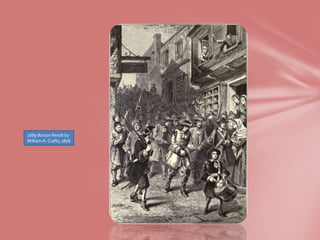
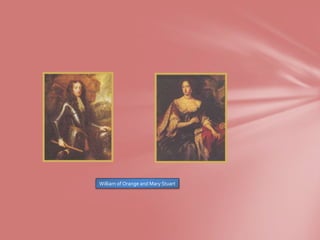
  When news reached Boston that Mary Stuart and William of Orange had assumed
   the throne as joint monarchs and James II had fled to England, the colonists
   arrested Andros
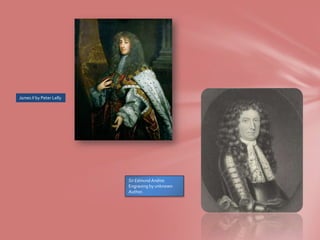
James II by Peter Lelly


                          Sir Edmund Andros
                          Engraving by unknown
                          Author.
1689 Boston Revolt by
William A. Crafts, 1876
William of Orange and Mary Stuart
Act to Prevent Frauds and Abuses and
the Board of Trade
 1696 Act to Prevent Frauds and Abuses
  Writs of Assistance:
    general search warrants that did not have to specify the place to be searched
    Violators (smugglers) tried in Admiralty Courts which did not permit trial by jury

 1696 Board of Trade
  Investigate enforcement of Navigation Acts
Salutary Neglect

 1696-1725 vigorous enforcement
 1714-1760 Hanoverian Kings George I and George II less interested in the
  colonies and allowed their councils to control administration of the
  colonies.
 Robert Walpole, First Minister from 1721-1742 deliberately followed a
  liberal policy of allowing the colonies to pursue their economic interests
The Habit of Self-Government
Evolution of Government within American Colonies
 Evolved without planning
 All colonies except Georgia were founded by trading companies or feudal proprietors
  who held charters from the Crown.
 Over time 8 of these relinquished corporate/ proprietor charters and reverted to the
  Crown
   Royal colonies had governors appointed by Crown
   Proprietary colonies had governors appointed by the proprietor
   Connecticut and Rhode Island retained corporate charters and elected own
    governors
   In corporate and proprietary colonies and in Massachusetts, the Colonial charter
    acted as a Constitution
   English government tradition of enacting Constitutions
    Magna Carta
    English Bill of Rights
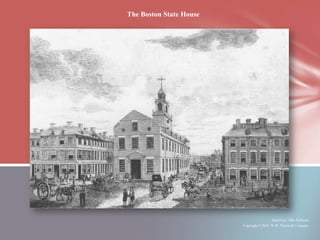
The Boston State House


                                         America, 8th Edition
                         Copyright © 2010 W.W. Norton & Company
The Habit of Self Government
Powers of Colonial Governors
Absolute veto over assemblies and Crown could also veto laws passed by
colonial assemblies.
Colonial Governor
 Appoint and remove officials
 Command the militias
 Grant pardons
 Colonial patronage


Powers of Colonial Assemblies
Elected by Colonists
 Voting Restrictions
   Property ownership (low threshold)
   Excluded women, Indians, Slaves
   A greater population of the colonies could vote than anywhere else in the world.
Powers of Colonial Self -Governing
                    Assemblies
Two important strands of power
 Controlled the budget by right to vote on taxes and expenditures
 Power to initiate legislation
Once established, these powers became fixed in the minds of the
 colonists as a right—not a habit or a privilege
Spanish Colonies in North America
New France
Spanish America in Decline
Spanish Colonies in North America did not become prosperous
 No precious minerals
 Focused mainly on searching for gold and converting Native Americans not on
  sustainable communities
New France
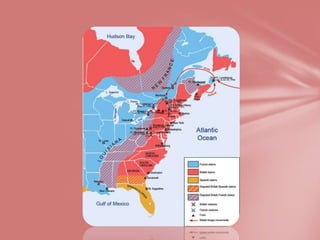
Centered in Canada
 Focused on trading posts
 Focused on converting Native Americans
 French settlers—mostly men, married Native American women and adopted Native
  American customs
 Did not focus on creating sustainable settlements
 French alliances with Native Americans intended in part to counteract British power in
  North America
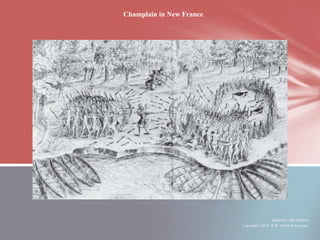
 Samuel de Champlain’s alliance with the Hurons and Algonquin angered Iroquois who
  became allies of the British.
 Champlain’s charter from Louis XIV limited settlers in New France to Roman Catholics.
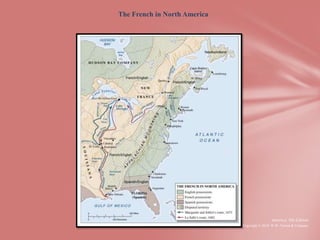
 French exploration of Mississippi River led to founding of New Orleans in 1718.
          By 1732 the population of New Orleans was 2,000 white settlers and 3,800 slaves.
         New Orleans was a financial burden to French government.
Champlain in New France


                                          America, 8th Edition
                          Copyright © 2010 W.W. Norton & Company
The French in North America


                                              America, 8th Edition
                              Copyright © 2010 W.W. Norton & Company
Colonial Wars
James I and Charles I pursued good relations with Louis XIV.
William III a committed Calvinist, did not.
William III & other kingdoms in Europe: Balance of Power policyto check the
rising power of France in Europe and around the world.
Balance of Power foreign policy resulted in several wars in Europe.
          King William’s War (1689–1697)
          Queen Anne’s War (1702–1713)
          King George’s War (1744–1748)
These wars had little effect on England’s North American colonies initially
English government incurred huge debt
Last Colonial War between France and Britain was the 7 Years War/French &
Indian War (1754-1763)
Fought primarily in North America but spread around the world
Nationalism in Britain and the
American Colonies
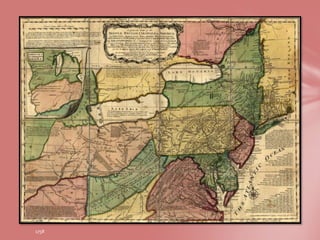
Colonial Incursion
1758
"Were there nothing at stake between the
crown of Great Britain and France but the
Lands of the Ohio, we may reckon it as a great
Prize as has ever been contended for between
two Nations. For this Country is of that vast
Extent Westward as to exceed in good Land all
the European Dominions of Great Britain,
France, and Spain, which are almost destitute
of Inhabitants. It is impossible to conceive that
had his Majesty been made Acquainted with
its value and great importance, the large
strides the French have been making for
several Years past in their encroachments on
his Dominions that his Majesty would sacrifice
one of the best Gems in his Crown to their
Usurpation and Boundless Ambition"
The Ohio Company
The Ohio Company was a land speculation firm organized by
Virginians including Thomas Lee (great uncle of Lighthorse Harry
Lee) and George Washington’s two half brothers, Lawrence
Washington and Augustine Washington, Jr.)
 The King (George II) had given the principals a land Grant of 200,000 acres
  in Ohio Country (generally the same area as present day Ohio)
 Purpose was to encourage settlement (and land purchases) and trade with
  the Indians. Ohio Company had 7 years in which to settle 100 families and
  create a buffer between the French and the British colony of Virginia.
Loyal Land Company (a rival company) also granted land by King
 George in the same area. The principals in this firm included Peter
 Jefferson (father of Thomas Jefferson)
Both the British and the French claimed the Ohio Country but neither
 had created forts or settlements there.
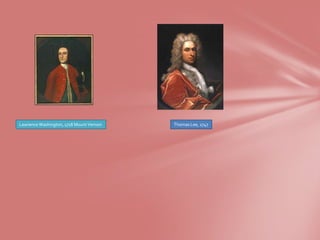
Lawrence Washington, 1718 Mount Vernon   Thomas Lee, 1747
Competing Forts
By 1753, the French had constructed 3 forts and had expelled British traders from the
area.
Iroquois Indians were also angered by the French forts.
Virginia Governor Robert Dinwiddie (an investor in the Ohio Company) ordered Major
George Washington (brother of two principals in the Ohio Company) to warn the French to
leave “Virginia Territory.” Major Washington was 21.
Washington reached Fort le Bouef in December, 1753 and General Jaques La Pierre
refused Washington’s claim to British ownership of the territory.
Dinwiddie sent a company of 40 men with William Trent (another Ohio Company
principal) to construct a fort in January, 1754.
Trent was ousted by the French
Spring 1754: Washington led 150 Colonial militia and Iroquois to build a fort at the
Allegheny, Monongahela and Ohio Rivers (Pittsburgh).
Before Washington’s arrival, he learns that the French have already completed Fort
Duquesne at the same site.
Washington makes camp 40 miles away to await reinforcements.
Battle of Jumonville Glen: May 28, 1754
French send soldiers under command of Joseph Colon de Jumonville to
negotiate with Washington
Washington, informed by Mingo Indians that French were coming,
ambushes the force with help of Iroquois.
 De Jumonville is killed (reportedly by having his head split open by a
  tomahawk)
 Some of the French captives were reportedly scalped.
 One French soldier escaped to report the incident to the Fort.
Washington retreats to Great Meadows and constructs Fort Necessity.
French attacked Fort Necessity on July 3, 1754 and Washington surrendered
 after one day.
 All Colonial horses killed
 1/3 of Washington’s forces killed
French took the weapons and permit Washington to retreat
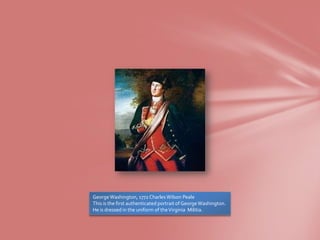
George Washington, 1772 Charles Wilson Peale
This is the first authenticated portrait of George Washington.
He is dressed in the uniform of the Virginia Militia.
Albany Congress
                 (June 19-July 10, 1754)
Meeting of Colonial Commissioners from Maine to Maryland
Representative chiefs from the Iroquois Confederation
Plan of Union
 Drafted by Benjamin Franklin
 Adopted by unanimous vote of the commissioners
  Chief Executive/Supreme Governor called “President-General of the United
    Colonies”
  Supreme Assembly called “Grand Council” with 48 members chosen by colonial
    assemblies
    Oversee defense
    Indian relations
    Trade and settlement in the West
    Levy taxes to support its programs
  British accepted only Supreme Colonial Commander and suggestion to appoint a
  New Yorker as a commissioner for Indian affairs.
Braddock Expedition
General Edward Braddock and two English Divisions along with Colonial
militia and George Washington as a staff officer.
   125 mile wilderness road
   Hauled heavy artillery to surround French fort
   Ambushed 6 miles from Fort Duquesne
     Braddock mortally wounded
     Washington led retreat of 500 militia to Virginia
     900 British and Colonial soldiers died


   Washington letter to his brother
      British army “scandalously beaten by a trifling body of men.” The Redcoats
      “broke and run as sheep before hounds.” The Virginians, “behaved like Men and
      died like Soldiers.”
A World War
1754-1756 War limited to North America
1756 war spread to Europe: 7 Years War
 France, Austria, Russia, Saxony, Sweden, Spain
 Britain, Prussia and Hanover
   William Pitt British Primer Minister (“I know I can save England and no one else
    can!”)
     Confine 7 Years War to North America
     Mobilized 45,000 troops in North America (1/2 British & ½ colonists)
     Treated the colonies as allies & gave subsidies for participation
     Used British Navy to cut off French supply routes to North America
     3-pronged land offensive to defend French invasion routes
       Niagara River, Lake Champlain and St. Lawrence River
       Battle of Quebec
The Peace of Paris
1763
 Britain:
  all French possessions east of the Mississippi River except New Orleans
  All of Spanish Florida

Native American anger
 French gave Native American lands to Britain
 Pontiac’s Rebellion
  Native Americans attacked British (formerly French) forts in the Ohio River Valley
   and Colonial settlements on the frontier.
  Fort Duquesne changed to Fort Pitt—Americans allegedly distribute blankets
   infested with smallpox to Native Americans causing a smallpox epidemic
 Spain
  New Orleans and French territory West of the Mississippi River

His 121 chapter 4 the imperial perspective

  • 1.
  • 2.
    Mercantilism Enforcing the NavigationActs The Dominion of New England An Emerging Colonial System Salutory Neglect
  • 3.
    Royal Control ofthe Colonies  Monarchy was the legal authority in the colonies.  All colonies except Georgia received their charters before the Glorious Revolution of 1688 when the crown lost supremacy to parliament.  Colonies continued as “dependencies of the Crown.”  Appointed officials served at the “pleasure of the King.”  During the English Civil War the Dutch became the dominant shipping power in the North American Colonies and Caribbean.  1561 Parliament adopts the Navigation Act  All goods imported to England or colonies carried on English ships with majority English crews.
  • 4.
    More Mercantilism  Assumedthat the total of world’s gold and silver remained the same and only a nation’s share of that wealth was subject to change.  The only way to gain was to take another country’s gold and silver.  Essential: maintain a favorable balance of trade by controlling every aspect of exports and imports.  Colonies were a source of raw materials and markets for goods  Navigation Act of 1660  Ships crews had to be ¾ English  Products to be shipped only to England  Tobacco  Rice  Hemp  Masts  Copper Ore  furs
  • 5.
    Navigation Act of1663  All colonial imports from Europe had to stop in England, offload and duty paid before shipment to colonies.  England had monopoly to sell Tobacco and Sugar produced in Chesapeake colonies and West Indies .  All colonial commerce channeled through English merchants  All ships built had to be sold to English buyers  Increased customs and duties on good shipped through England (everything).
  • 6.
    Enforcement of NavigationActs  During English Civil War, very little enforcement and colonies ignored the navigation acts.  1675 Charles II designates “Lords of Trade” to force colonies to abide by Navigation Acts.  Lords of Trade named Colonial Governors.  Wrote/reviewed governors instructions and handled all correspondence dealing with colonial affairs.  Edward Randolph  Arrived in Boston in 1676  Demanded Massachusetts abide by Navigation Acts  1678 Massachusetts legislature declares that Navigation Acts had no legal standing in the Massachusetts Bay Colony  1684 Lords of Trade annul the charter of Massachusetts Bay Colony
  • 7.
    James II increasesenforcement  1685 James II creates “Dominion of New England” includes all colonies from New England south to New Jersey  Dominion government named by royal authority  Governor & council but no assembly  Sir Edmund Andros 1686 in Massachusetts and by 1688 included New York and New Jersey under the Dominion  In Massachusetts, Andros enforced Navigation Acts, punished smugglers and suppressed town hall government.  Adros and his lieutenants took over a Puritan Church for Anglican worship  Glorious Revolution  When news reached Boston that Mary Stuart and William of Orange had assumed the throne as joint monarchs and James II had fled to England, the colonists arrested Andros
  • 8.
    James II byPeter Lelly Sir Edmund Andros Engraving by unknown Author.
  • 9.
    1689 Boston Revoltby William A. Crafts, 1876
  • 10.
    William of Orangeand Mary Stuart
  • 11.
    Act to PreventFrauds and Abuses and the Board of Trade  1696 Act to Prevent Frauds and Abuses  Writs of Assistance:  general search warrants that did not have to specify the place to be searched  Violators (smugglers) tried in Admiralty Courts which did not permit trial by jury  1696 Board of Trade  Investigate enforcement of Navigation Acts
  • 12.
    Salutary Neglect  1696-1725vigorous enforcement  1714-1760 Hanoverian Kings George I and George II less interested in the colonies and allowed their councils to control administration of the colonies.  Robert Walpole, First Minister from 1721-1742 deliberately followed a liberal policy of allowing the colonies to pursue their economic interests
  • 13.
    The Habit ofSelf-Government Evolution of Government within American Colonies Evolved without planning All colonies except Georgia were founded by trading companies or feudal proprietors who held charters from the Crown. Over time 8 of these relinquished corporate/ proprietor charters and reverted to the Crown Royal colonies had governors appointed by Crown Proprietary colonies had governors appointed by the proprietor Connecticut and Rhode Island retained corporate charters and elected own governors In corporate and proprietary colonies and in Massachusetts, the Colonial charter acted as a Constitution English government tradition of enacting Constitutions Magna Carta English Bill of Rights
  • 14.
    The Boston StateHouse America, 8th Edition Copyright © 2010 W.W. Norton & Company
  • 15.
    The Habit ofSelf Government Powers of Colonial Governors Absolute veto over assemblies and Crown could also veto laws passed by colonial assemblies. Colonial Governor Appoint and remove officials Command the militias Grant pardons Colonial patronage Powers of Colonial Assemblies Elected by Colonists Voting Restrictions Property ownership (low threshold) Excluded women, Indians, Slaves A greater population of the colonies could vote than anywhere else in the world.
  • 16.
    Powers of ColonialSelf -Governing Assemblies Two important strands of power Controlled the budget by right to vote on taxes and expenditures Power to initiate legislation Once established, these powers became fixed in the minds of the colonists as a right—not a habit or a privilege
  • 17.
    Spanish Colonies inNorth America New France
  • 18.
    Spanish America inDecline Spanish Colonies in North America did not become prosperous No precious minerals Focused mainly on searching for gold and converting Native Americans not on sustainable communities
  • 19.
    New France Centered inCanada Focused on trading posts Focused on converting Native Americans French settlers—mostly men, married Native American women and adopted Native American customs Did not focus on creating sustainable settlements French alliances with Native Americans intended in part to counteract British power in North America Samuel de Champlain’s alliance with the Hurons and Algonquin angered Iroquois who became allies of the British. Champlain’s charter from Louis XIV limited settlers in New France to Roman Catholics. French exploration of Mississippi River led to founding of New Orleans in 1718. By 1732 the population of New Orleans was 2,000 white settlers and 3,800 slaves. New Orleans was a financial burden to French government.
  • 20.
    Champlain in NewFrance America, 8th Edition Copyright © 2010 W.W. Norton & Company
  • 21.
    The French inNorth America America, 8th Edition Copyright © 2010 W.W. Norton & Company
  • 22.
    Colonial Wars James Iand Charles I pursued good relations with Louis XIV. William III a committed Calvinist, did not. William III & other kingdoms in Europe: Balance of Power policyto check the rising power of France in Europe and around the world. Balance of Power foreign policy resulted in several wars in Europe. King William’s War (1689–1697) Queen Anne’s War (1702–1713) King George’s War (1744–1748) These wars had little effect on England’s North American colonies initially English government incurred huge debt Last Colonial War between France and Britain was the 7 Years War/French & Indian War (1754-1763) Fought primarily in North America but spread around the world
  • 23.
    Nationalism in Britainand the American Colonies
  • 24.
  • 25.
  • 26.
    "Were there nothingat stake between the crown of Great Britain and France but the Lands of the Ohio, we may reckon it as a great Prize as has ever been contended for between two Nations. For this Country is of that vast Extent Westward as to exceed in good Land all the European Dominions of Great Britain, France, and Spain, which are almost destitute of Inhabitants. It is impossible to conceive that had his Majesty been made Acquainted with its value and great importance, the large strides the French have been making for several Years past in their encroachments on his Dominions that his Majesty would sacrifice one of the best Gems in his Crown to their Usurpation and Boundless Ambition"
  • 27.
    The Ohio Company TheOhio Company was a land speculation firm organized by Virginians including Thomas Lee (great uncle of Lighthorse Harry Lee) and George Washington’s two half brothers, Lawrence Washington and Augustine Washington, Jr.) The King (George II) had given the principals a land Grant of 200,000 acres in Ohio Country (generally the same area as present day Ohio) Purpose was to encourage settlement (and land purchases) and trade with the Indians. Ohio Company had 7 years in which to settle 100 families and create a buffer between the French and the British colony of Virginia. Loyal Land Company (a rival company) also granted land by King George in the same area. The principals in this firm included Peter Jefferson (father of Thomas Jefferson) Both the British and the French claimed the Ohio Country but neither had created forts or settlements there.
  • 28.
    Lawrence Washington, 1718Mount Vernon Thomas Lee, 1747
  • 29.
    Competing Forts By 1753,the French had constructed 3 forts and had expelled British traders from the area. Iroquois Indians were also angered by the French forts. Virginia Governor Robert Dinwiddie (an investor in the Ohio Company) ordered Major George Washington (brother of two principals in the Ohio Company) to warn the French to leave “Virginia Territory.” Major Washington was 21. Washington reached Fort le Bouef in December, 1753 and General Jaques La Pierre refused Washington’s claim to British ownership of the territory. Dinwiddie sent a company of 40 men with William Trent (another Ohio Company principal) to construct a fort in January, 1754. Trent was ousted by the French Spring 1754: Washington led 150 Colonial militia and Iroquois to build a fort at the Allegheny, Monongahela and Ohio Rivers (Pittsburgh). Before Washington’s arrival, he learns that the French have already completed Fort Duquesne at the same site. Washington makes camp 40 miles away to await reinforcements.
  • 30.
    Battle of JumonvilleGlen: May 28, 1754 French send soldiers under command of Joseph Colon de Jumonville to negotiate with Washington Washington, informed by Mingo Indians that French were coming, ambushes the force with help of Iroquois. De Jumonville is killed (reportedly by having his head split open by a tomahawk) Some of the French captives were reportedly scalped. One French soldier escaped to report the incident to the Fort. Washington retreats to Great Meadows and constructs Fort Necessity. French attacked Fort Necessity on July 3, 1754 and Washington surrendered after one day. All Colonial horses killed 1/3 of Washington’s forces killed French took the weapons and permit Washington to retreat
  • 31.
    George Washington, 1772Charles Wilson Peale This is the first authenticated portrait of George Washington. He is dressed in the uniform of the Virginia Militia.
  • 32.
    Albany Congress (June 19-July 10, 1754) Meeting of Colonial Commissioners from Maine to Maryland Representative chiefs from the Iroquois Confederation Plan of Union Drafted by Benjamin Franklin Adopted by unanimous vote of the commissioners Chief Executive/Supreme Governor called “President-General of the United Colonies” Supreme Assembly called “Grand Council” with 48 members chosen by colonial assemblies Oversee defense Indian relations Trade and settlement in the West Levy taxes to support its programs  British accepted only Supreme Colonial Commander and suggestion to appoint a New Yorker as a commissioner for Indian affairs.
  • 34.
    Braddock Expedition General EdwardBraddock and two English Divisions along with Colonial militia and George Washington as a staff officer. 125 mile wilderness road Hauled heavy artillery to surround French fort Ambushed 6 miles from Fort Duquesne Braddock mortally wounded Washington led retreat of 500 militia to Virginia 900 British and Colonial soldiers died Washington letter to his brother  British army “scandalously beaten by a trifling body of men.” The Redcoats “broke and run as sheep before hounds.” The Virginians, “behaved like Men and died like Soldiers.”
  • 35.
    A World War 1754-1756War limited to North America 1756 war spread to Europe: 7 Years War France, Austria, Russia, Saxony, Sweden, Spain Britain, Prussia and Hanover William Pitt British Primer Minister (“I know I can save England and no one else can!”) Confine 7 Years War to North America Mobilized 45,000 troops in North America (1/2 British & ½ colonists) Treated the colonies as allies & gave subsidies for participation Used British Navy to cut off French supply routes to North America 3-pronged land offensive to defend French invasion routes Niagara River, Lake Champlain and St. Lawrence River Battle of Quebec
  • 36.
    The Peace ofParis 1763 Britain: all French possessions east of the Mississippi River except New Orleans All of Spanish Florida Native American anger French gave Native American lands to Britain Pontiac’s Rebellion Native Americans attacked British (formerly French) forts in the Ohio River Valley and Colonial settlements on the frontier. Fort Duquesne changed to Fort Pitt—Americans allegedly distribute blankets infested with smallpox to Native Americans causing a smallpox epidemic Spain New Orleans and French territory West of the Mississippi River