Chapter 16
Big Business and Organized Labor: 1860-1900
Questions to Consider
1. What were the primary factors that stimulated unprecedented
industrial and agricultural growth in the late 19th century?
Major Catalysts of the 2nd
Industrial Revolution
 Creation of interconnected transportation and communication
networks
 RR and Telephone/Telegraph
 Steamships
 By 1880 widespread application of electrical power
 Industrial machinery
 Trolleys and subways
 Production of steel and chemicals
 Systematic application of scientific research to industrial
processes
 Refining of crude oil into kerosene and gasoline
 Inventions of new products
Advances in Agriculture
 By 1870 US was the world leader in production of
wheat and corn
 Commercial cattle industry
 Slaughter and Meat packing
 Bonanza Farms
 Developed by corporations
 North & South Dakota & Minnesota
 Latest machinery and scientific techniques
 International markets for wheat and corn
What is “Big Business”?
Big Business
 Refers to size
 Before the civil war, most businesses were small, mostly family-owned with few outside
workers by the 1870’s large single businesses with multiple locations, employing
thousands of workers and stockholders.
 Refers to Power & Interconnected relationships
 With each other through social clubs and joint business ventures
 Creating subsidiary businesses
 With politicians from local city councils and mayors to governors, congressmen and
presidents
 Refers to markets
 From local, to state, to region, to intra continental; to international
The Rise of Big Business
 Railroads
 First industries to represent big business
 Building the Transcontinentals
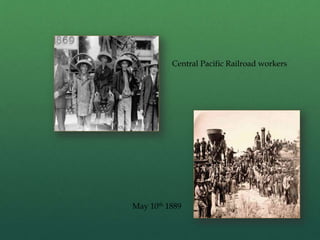
 Central Pacific RR: East from Sacramento
 Hired between 12,00-14,000 Chinese laborers who
came to US in search of gold
 Union Pacific RR: West from Omaha
 1865 Promontory Utah
May 10th 1889
Central Pacific Railroad workers
The Rise of Big Business
 Financing the Railroads
 Railroads constructed by private companies who
raised the funds by selling bonds.
 By 1850’s: Congress approved legislation to provide
federal land to the RR companies
 Inventions Spurred Manufacturing
 Barbed wire, refrigerated box cars
 The telephone
The Rise of Big Business
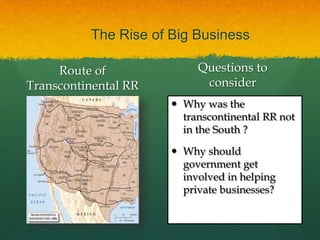
Route of
Transcontinental RR
Questions to
consider
 Why was the
transcontinental RR not
in the South ?
 Why should
government get
involved in helping
private businesses?
The Great Depression of
1873-1879
 Black Thursday: September 18, 1873
 Banking House of Jay Cooke & Company failed over the Northern Pacific Railway
 Northern Pacific acquired 40 million acres of public land in the West
 Cooke sought to raise $100,000,000 in capital through a bond issue ,the bond issue
tanked; Cooke failed and several other banks failed as well.
 Stock Market closed for 10 days due to the panic selling
 US monetary policy: take greenbacks out of circulation until paper money is fully
backed by gold & silver in US Treasury
 Railway bubble: investment in real estate and unsecured loans to railroads
 Thousands of businesses failed defaulting on more than $1,000,000,000 in debt; 1 in
4 workers were unemployed;
The Depression of 1882-
1884
 Business profits declined steeply in 1882
 Manufacturing collapsed (production of durable goods fell by ¼)
 Foreign-owned securities sold because of fear that the US would
abandon the gold standard for its paper currency
 11 New York banks failed as did more than 100 state banks
 Unemployment rose from 2.5% to 7.5% and to 13% in the
northeast
 Kansas farmers burned their own corn because the price was so
low
 Recovery did not begin until 1885
Questions to Consider
2. Who pioneered the growth of Big Business? What were the goals they
aimed to achieve and what were the strategies they used to dominate
their industries?
Capitalism & Free Markets
1. How does the free market lend itself to creation of monopolies?
2. What is a monopoly?
3. How does a monopoly stifle competition?
4. What happens to the free market when there are too many
monopolies?
Corporations and the 2nd
Industrial Revolution
 Businesses grew as a result of rapid expansion of
technology, population, government incentives and
subsidies.
 Business owners sought to integrate all the processes
of production and distribution of goods into single
companies to minimize competition.
 Mergers with competitors: intended to dominate
entire industries and limit competition
What is a Corporation?
 A legal entity that separates the ownership of an enterprise from
the management of its operations.
 Corporations raise money for operations by selling shares of stock
which represent partial ownership but not management authority.
 Stockholders elect a board of directors who appoint and evaluate
the corporation’s executive management and can replace them.
 Stockholders share in the profits of a corporation but they cannot
be held personally liable for the debts of a corporation if it fails.
 Executive management and the board of directors cannot be held
personally liable for negligence or misconduct by the corporation
unless it can be proved that they acted with criminal or gross
negligence.
Who were these people?
 Protestant work ethic
 Hard work is virtuous and will be rewarded either in
this life or the life to come.
 “To secure wealth is an honorable ambition” Russell
Conwell, prominent Baptist Minister in 1870’s.
 In the process of forming huge companies and
eliminating competition, business leaders cut ethical
corners, bribed politicians, exploited workers, broke
laws.
 William Henry Vanderbilt, “The public be dammed!”
Railroad & Business Entrepreneurs
aka “Robber Barons”
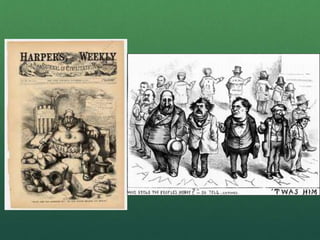
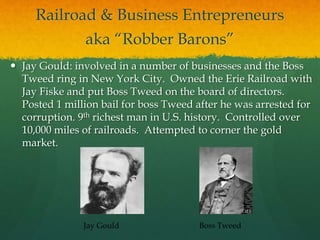
 Jay Gould: involved in a number of businesses and the Boss
Tweed ring in New York City. Owned the Erie Railroad with
Jay Fiske and put Boss Tweed on the board of directors.
Posted 1 million bail for boss Tweed after he was arrested for
corruption. 9th richest man in U.S. history. Controlled over
10,000 miles of railroads. Attempted to corner the gold
market.
Jay Gould Boss Tweed
Entrepreneurs
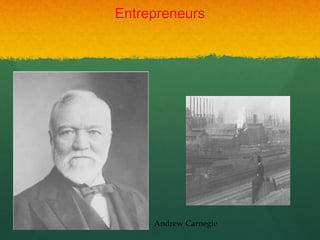
Andrew Carnegie
Entrepreneurs
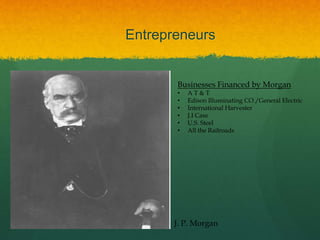
J. P. Morgan
Businesses Financed by Morgan
• A T & T
• Edison Illuminating CO./General Electric
• International Harvester
• J.I Case
• U.S. Steel
• All the Railroads
Entrepreneurs
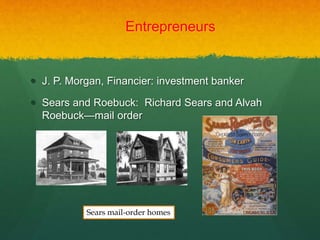
 J. P. Morgan, Financier: investment banker
 Sears and Roebuck: Richard Sears and Alvah
Roebuck—mail order
Sears mail-order homes
Trusts
 A trust is an arrangement that gives a person or
corporation (the trustee) the legal power to manage
another person’s money or another company they own.
 Standard Oil and other big businesses controlled
companies by having their stockholders transfer their
shares “in trust” to trustees who included the big
business barons like John D. Rockefeller.
 The purpose: to avoid anti-monopoly laws that limited
the number of businesses that could be owned by one
company.
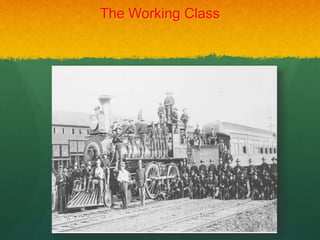
The Working Class
1. What were the efforts of workers to organize unions to promote their
interests during this era?
The Working Class
The Working Class
 Toward Permanent Unions
 1866 National Labor Union
 Contract Labor Act
 Employers to import employees by paying passage
 The Knights of Labor
 Secret
 Protect workers from retaliation
 Hundreds of thousands of workers were members
The Working Class
The Working Class
 The Railroad Strike of 1877
 1st Interstate Strike
 Financial panic of 1873
 Federal troops stopped the strike
 The Sand-Lot Incident
 Meeting to show support for RR strike turned into an attack on
Chinese immigrants
 Anti-Chinese Agitation
 Chinese worked for less and perceived to steal American jobs
 Dennis Kearney and “foreign peril”
 1882: Congress prohibited Chinese immigration for 10 years
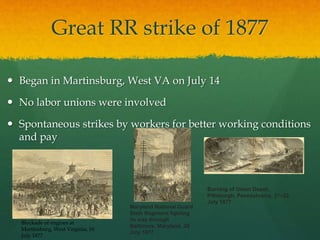
Great RR strike of 1877
 Began in Martinsburg, West VA on July 14
 No labor unions were involved
 Spontaneous strikes by workers for better working conditions
and pay
Blockade of engines at
Martinsburg, West Virginia, 16
July 1877
Maryland National Guard
Sixth Regiment fighting
its way through
Baltimore, Maryland, 20
July 1877
Burning of Union Depot,
Pittsburgh, Pennsylvania, 21–22
July 1877
Who was Blamed?
 German and Bohemian immigrants
 Idle Hands: Illinois Governor Shelby Cullum, “the
vagrant, the willfully idle, was the chief element in
all these disturbances.”
 Communism: "the hands of men dominated by the
devilish spirit of Communism.“
 The 1876 Election Deal: Thomas Scott, of the
Pennsylvania Railroad, delivered disputed
congressional votes to Hayes in exchange for a federal
bailout of failing investments in the Texas and Pacific
railroad
The Working Class
 Anarchism
 Any form of government limits individual freedom and
is abusive
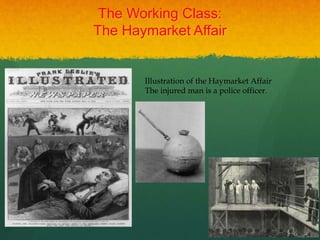
 The Haymarket Affair
 1886 Knights of Labor rally in Chicago
 Bomb thrown into a group of police officers
 Undermined the Knights of Labor though no one found
guilty of incident
 Defendants became martyrs to union cause because
convictions based on questionable evidence.
The Working Class:
The Haymarket Affair
Illustration of the Haymarket Affair
The injured man is a police officer.
The Working Class
 Gompers and the AFL
 1886 25 skilled workers organizations created the
American Federation of Labor
 Samuel Gompers
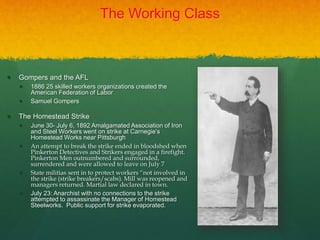
 The Homestead Strike
 June 30- July 6, 1892 Amalgamated Association of Iron
and Steel Workers went on strike at Carnegie’s
Homestead Works near Pittsburgh
 An attempt to break the strike ended in bloodshed when
Pinkerton Detectives and Strikers engaged in a firefight.
Pinkerton Men outnumbered and surrounded,
surrendered and were allowed to leave on July 7
 State militias sent in to protect workers “not involved in
the strike (strike breakers/scabs). Mill was reopened and
managers returned. Martial law declared in town.
 July 23: Anarchist with no connections to the strike
attempted to assassinate the Manager of Homestead
Steelworks. Public support for strike evaporated.
Panic of 1893
 1893 Wheat Prices crashed
 1893 Failure of Argentine bank caused international investors to fear that problems might spread, causing a run on US
treasury gold
 Panic in Europe caused investors to sell American stocks for dollars backed by gold
 Sherman Silver Purchase Act of 1890 required US to purchase silver using notes backed by silver or gold.
 500 Banks and four major RRs failed
 Unemployment: National 17-19%
 25% - Pennsylvania
 35% New York
 43% Michigan
 Populist Movement
 Texas, Alabama, North Carolina: poor white farmers
 Colorado, Idaho, Kansas, Nebraska & North Dakota: wheat farmers
 Hostility to: elites, cities, banks, railroads and gold
 Free silver movement: back paper money with silver not gold
 Racism: Jews control monetary policy & the banks
 US Gold Reserves fell to dangerously low levels. President Cleveland had to borrow 65 million in gold
 JP Morgan and Rothschild family
 Cleveland and Democrats blamed for the panic. Republicans won largest majority ever in elections of 1894
 Recovery began in 1897
The Working Class
 The Pullman Strike
 1893 Panic: Pullman laid off 3,000 of 5,800 employees and cut pay by
30-40% but did not lower rents on homes or prices for food in company
towns
 1894: American RR Worker’s Union refused to handle Pullman cars
 27 states affected
 Entire RR lines brought to halt
 President Grover Cleveland ordered federal troops to protect mail
delivery by protecting strikebreakers from strikers
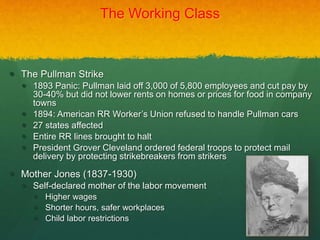
 Mother Jones (1837-1930)
 Self-declared mother of the labor movement
 Higher wages
 Shorter hours, safer workplaces
 Child labor restrictions
The Working Class
Eugene V. Debs &
Socialism
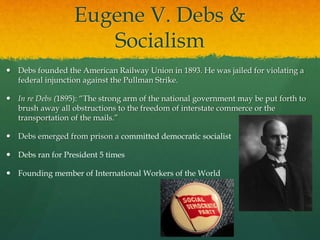
 Debs founded the American Railway Union in 1893. He was jailed for violating a
federal injunction against the Pullman Strike.
 In re Debs (1895): “The strong arm of the national government may be put forth to
brush away all obstructions to the freedom of interstate commerce or the
transportation of the mails.”
 Debs emerged from prison a committed democratic socialist
 Debs ran for President 5 times
 Founding member of International Workers of the World
Soaring Productivity
Few Worker Protections
 US produced 1/3 of the world’s goods by 1900.
 By 1900 the majority of Americans worked in factories and
mines rather than on farms
 Thomas Jefferson’s warning:
 Problems of unregulated Capitalism and reforms
 In 1900 in some U.S. cities, up to 30% of infants died before reaching their first
birthday
 U.S. Mine-worker safety well below other industrialized countries
 Railway worker safety well below other industrialized countries
 Child labor laws still did not exist in 1900

Chapter 16 big business, organized labor, financial panic, populist movement

  • 1.
    Chapter 16 Big Businessand Organized Labor: 1860-1900
  • 2.
    Questions to Consider 1.What were the primary factors that stimulated unprecedented industrial and agricultural growth in the late 19th century?
  • 3.
    Major Catalysts ofthe 2nd Industrial Revolution  Creation of interconnected transportation and communication networks  RR and Telephone/Telegraph  Steamships  By 1880 widespread application of electrical power  Industrial machinery  Trolleys and subways  Production of steel and chemicals  Systematic application of scientific research to industrial processes  Refining of crude oil into kerosene and gasoline  Inventions of new products
  • 4.
    Advances in Agriculture By 1870 US was the world leader in production of wheat and corn  Commercial cattle industry  Slaughter and Meat packing  Bonanza Farms  Developed by corporations  North & South Dakota & Minnesota  Latest machinery and scientific techniques  International markets for wheat and corn
  • 5.
    What is “BigBusiness”?
  • 6.
    Big Business  Refersto size  Before the civil war, most businesses were small, mostly family-owned with few outside workers by the 1870’s large single businesses with multiple locations, employing thousands of workers and stockholders.  Refers to Power & Interconnected relationships  With each other through social clubs and joint business ventures  Creating subsidiary businesses  With politicians from local city councils and mayors to governors, congressmen and presidents  Refers to markets  From local, to state, to region, to intra continental; to international
  • 7.
    The Rise ofBig Business  Railroads  First industries to represent big business  Building the Transcontinentals  Central Pacific RR: East from Sacramento  Hired between 12,00-14,000 Chinese laborers who came to US in search of gold  Union Pacific RR: West from Omaha  1865 Promontory Utah
  • 8.
    May 10th 1889 CentralPacific Railroad workers
  • 9.
    The Rise ofBig Business  Financing the Railroads  Railroads constructed by private companies who raised the funds by selling bonds.  By 1850’s: Congress approved legislation to provide federal land to the RR companies  Inventions Spurred Manufacturing  Barbed wire, refrigerated box cars  The telephone
  • 11.
    The Rise ofBig Business Route of Transcontinental RR Questions to consider  Why was the transcontinental RR not in the South ?  Why should government get involved in helping private businesses?
  • 12.
    The Great Depressionof 1873-1879  Black Thursday: September 18, 1873  Banking House of Jay Cooke & Company failed over the Northern Pacific Railway  Northern Pacific acquired 40 million acres of public land in the West  Cooke sought to raise $100,000,000 in capital through a bond issue ,the bond issue tanked; Cooke failed and several other banks failed as well.  Stock Market closed for 10 days due to the panic selling  US monetary policy: take greenbacks out of circulation until paper money is fully backed by gold & silver in US Treasury  Railway bubble: investment in real estate and unsecured loans to railroads  Thousands of businesses failed defaulting on more than $1,000,000,000 in debt; 1 in 4 workers were unemployed;
  • 13.
    The Depression of1882- 1884  Business profits declined steeply in 1882  Manufacturing collapsed (production of durable goods fell by ¼)  Foreign-owned securities sold because of fear that the US would abandon the gold standard for its paper currency  11 New York banks failed as did more than 100 state banks  Unemployment rose from 2.5% to 7.5% and to 13% in the northeast  Kansas farmers burned their own corn because the price was so low  Recovery did not begin until 1885
  • 14.
    Questions to Consider 2.Who pioneered the growth of Big Business? What were the goals they aimed to achieve and what were the strategies they used to dominate their industries?
  • 15.
    Capitalism & FreeMarkets 1. How does the free market lend itself to creation of monopolies? 2. What is a monopoly? 3. How does a monopoly stifle competition? 4. What happens to the free market when there are too many monopolies?
  • 16.
    Corporations and the2nd Industrial Revolution  Businesses grew as a result of rapid expansion of technology, population, government incentives and subsidies.  Business owners sought to integrate all the processes of production and distribution of goods into single companies to minimize competition.  Mergers with competitors: intended to dominate entire industries and limit competition
  • 17.
    What is aCorporation?  A legal entity that separates the ownership of an enterprise from the management of its operations.  Corporations raise money for operations by selling shares of stock which represent partial ownership but not management authority.  Stockholders elect a board of directors who appoint and evaluate the corporation’s executive management and can replace them.  Stockholders share in the profits of a corporation but they cannot be held personally liable for the debts of a corporation if it fails.  Executive management and the board of directors cannot be held personally liable for negligence or misconduct by the corporation unless it can be proved that they acted with criminal or gross negligence.
  • 18.
    Who were thesepeople?  Protestant work ethic  Hard work is virtuous and will be rewarded either in this life or the life to come.  “To secure wealth is an honorable ambition” Russell Conwell, prominent Baptist Minister in 1870’s.  In the process of forming huge companies and eliminating competition, business leaders cut ethical corners, bribed politicians, exploited workers, broke laws.  William Henry Vanderbilt, “The public be dammed!”
  • 19.
    Railroad & BusinessEntrepreneurs aka “Robber Barons”  Jay Gould: involved in a number of businesses and the Boss Tweed ring in New York City. Owned the Erie Railroad with Jay Fiske and put Boss Tweed on the board of directors. Posted 1 million bail for boss Tweed after he was arrested for corruption. 9th richest man in U.S. history. Controlled over 10,000 miles of railroads. Attempted to corner the gold market. Jay Gould Boss Tweed
  • 20.
  • 21.
    Entrepreneurs J. P. Morgan BusinessesFinanced by Morgan • A T & T • Edison Illuminating CO./General Electric • International Harvester • J.I Case • U.S. Steel • All the Railroads
  • 22.
    Entrepreneurs  J. P.Morgan, Financier: investment banker  Sears and Roebuck: Richard Sears and Alvah Roebuck—mail order Sears mail-order homes
  • 23.
    Trusts  A trustis an arrangement that gives a person or corporation (the trustee) the legal power to manage another person’s money or another company they own.  Standard Oil and other big businesses controlled companies by having their stockholders transfer their shares “in trust” to trustees who included the big business barons like John D. Rockefeller.  The purpose: to avoid anti-monopoly laws that limited the number of businesses that could be owned by one company.
  • 24.
    The Working Class 1.What were the efforts of workers to organize unions to promote their interests during this era?
  • 25.
  • 26.
    The Working Class Toward Permanent Unions  1866 National Labor Union  Contract Labor Act  Employers to import employees by paying passage  The Knights of Labor  Secret  Protect workers from retaliation  Hundreds of thousands of workers were members
  • 27.
  • 28.
    The Working Class The Railroad Strike of 1877  1st Interstate Strike  Financial panic of 1873  Federal troops stopped the strike  The Sand-Lot Incident  Meeting to show support for RR strike turned into an attack on Chinese immigrants  Anti-Chinese Agitation  Chinese worked for less and perceived to steal American jobs  Dennis Kearney and “foreign peril”  1882: Congress prohibited Chinese immigration for 10 years
  • 29.
    Great RR strikeof 1877  Began in Martinsburg, West VA on July 14  No labor unions were involved  Spontaneous strikes by workers for better working conditions and pay Blockade of engines at Martinsburg, West Virginia, 16 July 1877 Maryland National Guard Sixth Regiment fighting its way through Baltimore, Maryland, 20 July 1877 Burning of Union Depot, Pittsburgh, Pennsylvania, 21–22 July 1877
  • 30.
    Who was Blamed? German and Bohemian immigrants  Idle Hands: Illinois Governor Shelby Cullum, “the vagrant, the willfully idle, was the chief element in all these disturbances.”  Communism: "the hands of men dominated by the devilish spirit of Communism.“  The 1876 Election Deal: Thomas Scott, of the Pennsylvania Railroad, delivered disputed congressional votes to Hayes in exchange for a federal bailout of failing investments in the Texas and Pacific railroad
  • 31.
    The Working Class Anarchism  Any form of government limits individual freedom and is abusive  The Haymarket Affair  1886 Knights of Labor rally in Chicago  Bomb thrown into a group of police officers  Undermined the Knights of Labor though no one found guilty of incident  Defendants became martyrs to union cause because convictions based on questionable evidence.
  • 32.
    The Working Class: TheHaymarket Affair Illustration of the Haymarket Affair The injured man is a police officer.
  • 33.
    The Working Class Gompers and the AFL  1886 25 skilled workers organizations created the American Federation of Labor  Samuel Gompers  The Homestead Strike  June 30- July 6, 1892 Amalgamated Association of Iron and Steel Workers went on strike at Carnegie’s Homestead Works near Pittsburgh  An attempt to break the strike ended in bloodshed when Pinkerton Detectives and Strikers engaged in a firefight. Pinkerton Men outnumbered and surrounded, surrendered and were allowed to leave on July 7  State militias sent in to protect workers “not involved in the strike (strike breakers/scabs). Mill was reopened and managers returned. Martial law declared in town.  July 23: Anarchist with no connections to the strike attempted to assassinate the Manager of Homestead Steelworks. Public support for strike evaporated.
  • 34.
    Panic of 1893 1893 Wheat Prices crashed  1893 Failure of Argentine bank caused international investors to fear that problems might spread, causing a run on US treasury gold  Panic in Europe caused investors to sell American stocks for dollars backed by gold  Sherman Silver Purchase Act of 1890 required US to purchase silver using notes backed by silver or gold.  500 Banks and four major RRs failed  Unemployment: National 17-19%  25% - Pennsylvania  35% New York  43% Michigan  Populist Movement  Texas, Alabama, North Carolina: poor white farmers  Colorado, Idaho, Kansas, Nebraska & North Dakota: wheat farmers  Hostility to: elites, cities, banks, railroads and gold  Free silver movement: back paper money with silver not gold  Racism: Jews control monetary policy & the banks  US Gold Reserves fell to dangerously low levels. President Cleveland had to borrow 65 million in gold  JP Morgan and Rothschild family  Cleveland and Democrats blamed for the panic. Republicans won largest majority ever in elections of 1894  Recovery began in 1897
  • 35.
    The Working Class The Pullman Strike  1893 Panic: Pullman laid off 3,000 of 5,800 employees and cut pay by 30-40% but did not lower rents on homes or prices for food in company towns  1894: American RR Worker’s Union refused to handle Pullman cars  27 states affected  Entire RR lines brought to halt  President Grover Cleveland ordered federal troops to protect mail delivery by protecting strikebreakers from strikers  Mother Jones (1837-1930)  Self-declared mother of the labor movement  Higher wages  Shorter hours, safer workplaces  Child labor restrictions
  • 36.
  • 37.
    Eugene V. Debs& Socialism  Debs founded the American Railway Union in 1893. He was jailed for violating a federal injunction against the Pullman Strike.  In re Debs (1895): “The strong arm of the national government may be put forth to brush away all obstructions to the freedom of interstate commerce or the transportation of the mails.”  Debs emerged from prison a committed democratic socialist  Debs ran for President 5 times  Founding member of International Workers of the World
  • 38.
    Soaring Productivity Few WorkerProtections  US produced 1/3 of the world’s goods by 1900.  By 1900 the majority of Americans worked in factories and mines rather than on farms  Thomas Jefferson’s warning:  Problems of unregulated Capitalism and reforms  In 1900 in some U.S. cities, up to 30% of infants died before reaching their first birthday  U.S. Mine-worker safety well below other industrialized countries  Railway worker safety well below other industrialized countries  Child labor laws still did not exist in 1900

Editor's Notes

  • #8  Following the Civil War, a population boom coupled with rebuilding efforts propelled the nation to become the world’s preeminent industrial power. This era was known as the Second Industrial Revolution; the first had occurred in Great Britain in the late eighteenth century. The era was marked by the introduction of the coal steam engine, the textile machine, and the blast furnace for producing iron. The first industries to represent “Big Business” were railroads, linking the western half of the continent to the economic development capabilities of the east. The Central Pacific Railroad, working east from Sacramento, California , and the Union Pacific, working west from Omaha, Nebraska, built the first transcontinental railroad, meeting in 1865 at Promontory, Utah.
  • #10  Railroads were constructed by private companies, which raised the necessary funds by selling bonds. Originally, concerns about the constitutionality of federal involvement in financing railroads precluded the government from becoming involved in their construction, but beginning in the 1850s, schemes that provided federal land to the builders were approved. The growth of manufacturing after the Civil War sparked an innovative streak in Americans, resulting in inventions such as barbed wire, refrigerated box cars, airbrakes for trains, and the telephone.
  • #12  What was the route of the first transcontinental railroad, and why was it not in the South? Who built the railroads? How were they financed?
  • #21  Andrew Carnegie Steel magnate and business icon.
  • #22  J. Pierpont Morgan Morgan is shown here in a famous 1903 portrait by Edward Steichen.
  • #23  Morgan, an investment banker, bought large amounts of stock in corporations, and then in turn sold them for a profit. He also bought rival firms that were in trouble, fixed them, and resold them. In 1890, he controlled one-sixth of the nation’s railroads. Richard Sears and Alvah Roebuck opened a mail-order company in the 1890s. By eliminating the middleman, they could ship goods from a catalog to people throughout the United States.
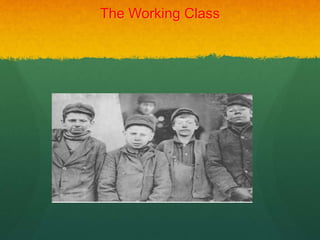
  • #26  Children in industry Four young boys who did the dangerous work of mine helpers in West Virginia in 1900.
  • #27  In 1866, the National Labor Union was founded, comprising labor and reform groups more interested in political and social reforms than in collective bargaining. Before disbanding in 1873, the NLU secured the Contract Labor Act, which encouraged employers to import workers by paying passage. Led by Uriah Smith Stephens, the Knights of Labor was a secret organization designed to protect its members from retaliation from employers. Its members, which numbered in the hundreds of thousands at its peak, allowed skilled and unskilled laborers to join.
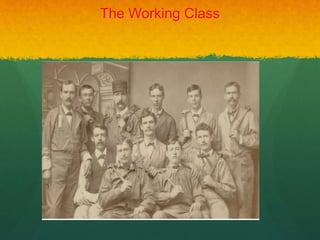
  • #28  Members of the Knights of Labor This national union was more egalitarian than most of its contemporaries.
  • #29  The Railroad Strike of 1877, the first interstate strike in American history, resulted from the financial panic of 1873, during which railroad companies drastically cut wages. The strike eventually erupted in violence, and order was restored when federal troops intervened. At a sandlot in San Francisco, a meeting to show support for the striking railroad workers became an attack on Chinese immigrants. The Chinese were easy scapegoats, as they tended to work for less and were perceived to steal American jobs.
  • #32  Anarchists believe that any form of government is abusive, controlled by the rich to exploit the poor. Many labor unions during the late nineteenth century pushed for the abolition of government to achieve their goals. At an 1886 Knights of Labor rally in Chicago’s Haymarket Square to promote the eight-hour workday, a bomb was thrown into a crowd of police officers. One officer was killed and several others were wounded. Although no one involved with the Knights was found guilty in this affair, they were guilty by association, and soon thereafter its membership dwindled.
  • #33  The Haymarket Affair A priest gives last rites to a policeman after anarchist-labor violence erupts in Haymarket Square, Chicago.
  • #34  In 1886, twenty-five skilled workers organizations joined to create the American Federation of Labor (AFL). Led by Samuel Gompers, the AFL allowed only skilled workers as their members, and very gradually emerged as the preeminent union in the United States. In 1892, the Amalgamated Association of Iron and Steel Workers went on strike at Carnegie’s Homestead Works near Pittsburgh. An attempt to break the strike ended in bloodshed when members of the Pinkerton Detective Agency were brought in to confront the strikers. Eventually, state militias were sent in to protect workers not involved in the strike.
  • #36  The Pullman Strike paralyzed the economies of twenty-seven states in 1894. Members of the American Railway Union (ARU) working at the Pullman Palace Car Company went on strike. No member of the ARU would handle Pullman railcars, sleeper cars that were very popular. By mid July, Midwest railway lines were stuck with cars on tracks that no one would touch. Eventually, President Cleveland ordered federal troops to remove the cars from the tracks, citing federal authority to deliver the mail, which at that time was done by train. Mary Jones (1837-1930), the self-declared mother of the labor movement, promoted higher wages, shorter hours, safer workplaces, and child labor restrictions. Although she lost most of the strikes in which she participated, she lived to see her views become accepted by unions across the country.
  • #37  The Pullman strike Troops guarding the railroads, 1894.