US Second Struggle For Independence
(1789 – 1815)
Bakhtawar Baloch
214195052
Roots of the American
Nation (1492 – 1789)
Historical Background
• King Henry VIII, desired to divorce his wife Catherine (belonging to Spanish
Royal family) due to no legitimate male heir
• Catholic Church domination over all matters and Pope Clément's refusal to
Henry
• King Henry’s excommunication and marriage to Anne Boleyn
• Creation of the Church of England and rise of Protestant values
• Rule of Mary Tudor (Only child of King Henry and Catherine – Strict Catholic)
• Queen Mary’s Marriage to King Philip of Spain
• Killing of hundred of Noble families and stopping Protestant Reformation
Movements
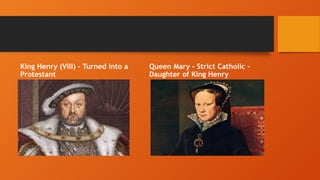
King Henry (VIII) – Turned into a
Protestant
Queen Mary – Strict Catholic –
Daughter of King Henry
1st
Reason
• Discovery voyages - led by Columbus and Vasco De Gama
• Period of religious crusades, scientific discoveries, and finding new routes to Asian lands
• Columbus was in search of the Indian continent but found America
• Discovery voyages – to search for Gold, Glory, and spread Christianity (God)
2nd
Reason
• Persecution of Puritans by the Queen Mary and later by King Charles (I)
• Puritans minded (chosen ones) royal families moved from England to America to be free from
persecution
• Other families including Puritans and Separatists moved to Netherlands
Discovery Voyages – 2 Major Reasons
• New English men settlements in the American continent
• 1610: John Rolfe with 150 men (early settlers) arrived in Jamestown (Virginia of North America)
• Sir Thomas Gates was the first Governor of Jamestown Virginia.
• Tobacco cultivation and trade – hellish, devilish, and damned tobacco
• Puritans and separatists in Netherlands (lived 10 years in Leiden), had poor living conditions and feared
influence of Dutch youth on their children
• 1620 - 102 people including, Pilgrims (separatists) and Puritans (non-separatists or strangers) sailed to
Southampton England to move to Virginia
• 1622 - Edward Winslow with Pilgrims arrived at Cape Cod – and settled at Plymouth
• Edward Winslow was the first Governor of Plymouth Colony.
• Second Wave of Settlers – 1630 – Under John Winthrop (Puritan leader) sailed with 700 puritans (11
fleets of ships)
• Few settled at Plymouth, while many followed John Winthrop and settled at Massachusetts Bay.
• John Winthrop – First Governor of Massachusetts Bay Colony.
• Famous writing of John Winthrop – City Upon a Hill
Early Settlements of English Men to America
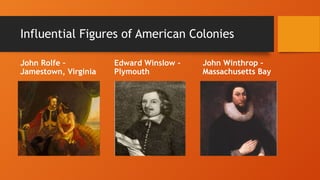
Influential Figures of American Colonies
John Rolfe –
Jamestown, Virginia
John Winthrop –
Massachusetts Bay
Edward Winslow -
Plymouth
First Struggle For
Independence (1750 – 1763)
• The early settlers (English Men) initially developed better understanding with Native Indians
• The Indians provided with skin, food, regional and agricultural knowledge, and supplies
• The new settlers traded beads and shells, also called as Wampum (local currency & jewelry)
• The problems grew with the increasing number of new settlers, cultural & religious differences
• “Multiplication Table” - a household with a single couple, had 8 to 10 children
• The English settlements carried diseases that they had developed immunity against and affected the Native
Indians (smallpox, tuberculosis, measles, cholera, and the bubonic plague).
• Puritan leaders (Increase Mather) declared the spread of illness as an act of God to support the colonists’
right to the land
• Some governments used this to convert the natives to Christianity and make them praying Indians
• The First Indian War (King Philip’s War in 1675) – took place when the government of Plymouth killed 3
Indians from the Wampanoag tribe.
• The divided Indian tribes and American colonies supported Plymouth, leading to signing a treaty
• This clash increased mistrust, anger, and the need to remove any Indian’s regional influence and control
Clashes with The Native Americans
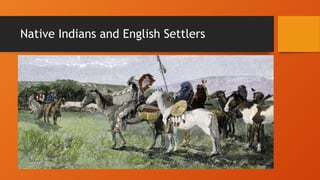
Native Indians and English Settlers
• The Seven Years’ War (called the French and Indian War in the colonies) lasted from 1756 to 1763
• France’s expansion into the Ohio River valley, and increasing conflict with the British claimed American
colonies, especially Virginia
• In 1754, the French built Fort Duquesne at a location where Allegheny and Monongahela Rivers joined,
forming the Ohio River.
• The location was strategically important for France (supported by Indians) and Britain
• Governor William Shirley of Massachusetts, expelled hundreds of French settlers living in Nova Scotia
(Arcadia) to other colonies, fearing they would support France in a military intervention.
• George Washington of Virginia tired to establish talks with the French but failed
• In 1756, British formally declared war but their commander Loudoun gained little success against
French and their Indian allies.
• In 1757, William Pitt saw it as an opportunity to build a huge British Empire, borrowed huge sums of
money, paid Prussia to fight in Europe, and helped to raise troops in North America
• Followed by British victories in Louisburg and capturing of French Forts (1758), Battle of Quebec
(1759), and Fall of Montreal (1760)
French and Indian War (Seven Years War)
• “Interest of The Great Britain Considered” by Benjamin Franklin partly convinced Britain to retain Canada
rather than Guadeloupe.
• Treaty of Paris (February 1763), British took over Canada from France and Florida from Spain
• Treaty allowed France to keep West Indian Sugar Islands and Spain was given Louisiana
• American colonies were strengthened by reduced European dominance (mainly France).
• British King George (II) was under heavy debt
• Permanent British army units were installed in the newly occupied lands in America
• Various taxes were imposed on the American colonies to pay for the spending on war
• Increased resistance and clashes between the colonies and the British rulers
• French internal support of the colonists in the American Revolutionary War
Outcome of the Seven Years War
Key Notes: 1st Struggle For Independence
• Clashes with Native Americans
• Seven Years War
• Reduced influence of Indians, France, and Spain
• Increased interest and influence of Britain
• Multiplication Table – term introduced by Andrew Kennedy, 8 to 10 children
with reduced infant mortality rates
• Benjamin Franklin’s famous writings – A defense of the Americans, The
Albany Plan, Great War for Empire, and The Interest of Great Britain
Considered.
• Mercantilist Theory was implemented as the economical ideology by Britain
Second Struggle For Independence
Events Leading to the Revolutionary War
• After the Seven Years War, British imposed various taxes to raise revenue
• Stamp Act – 1765
• Townshend Acts – 1767
• Tea Act – 1773
• The tax acts were met with resistance by the colonists
• Boston Massacre - A protest by colonists on 1770, when the British soldiers opened fired and killed 5 men
• Boston Tea Party - On 16th
Dec 1773, a group of Bostonian men, dressed as Indians dumped 342 chests of
Tea from British ships into Boston Harbor.
• Intolerable, or Coercive Acts were passed to reassert Britain imperial authority in Massachusetts
• First meeting of the Continental Congress (Sep 1774) – including, George Washington (Virginia), John and
Samuel Adams (Massachusetts), Patrick Henry (Virginia), and John Jay (New York) in Philadelphia
• On April 18 (1775), British troops marched to Massachusetts
• 19th
April - Battle of Lexington and Concord took place between British troops and local militias, starting
the Revolutionary War - “shot heard round the world”
• France internally supported the Revolutionary cause by providing weapons
• Thomas Paine famous writing “Common Sense” promoted the revolutionary cause published on 1776
Major Events During The War
• 2nd
Continental Congress in Philadelphia included other influential people, such as Benjamin Franklin and
Thomas Jefferson – formed a continental army with George Washington (Commander in Chief)
• 17th
June Battle of Bunker Hill – First major battle was fought. Won by British but faced heavy causalities
• 4th
July 1770 – Continental Congress decided to adopt the Declaration of Independence
• Declaration was drafted by a five-man committee including Franklin and John Adams but written by Jefferson
• First (Sep 19th
, 1778) and Second Battle of Saratoga (Oct 7th
, 1778), British John Burgoyne’s faced defeat against
by the American General Horatio Gates.
• June 1778 – France openly declared war against the Britain army
• The rebel troops were trained by the Prussian military officer Baron Friedrich von Steuben (sent by the French),
under the leadership of the French aristocrat Marquis de Lafayette
• During 1779 General Benedict Arnold of the Continental Army secretly allied with the British and in captured
Virginia for the British army
• Battle of Yorktown (1781) where French fleet stationed offshore preventing British from evacuation, British
army faced Washington’s 14000 soldiers, Lord Charles Cornwallis surrendered.
• September 3, 1783 – In Treaty of Paris, Britain recognized the independence of the United States and separate
treaties with France and Spain
Outcome of the Revolutionary War
• July 4th
1776 – America gained its independence
• 1787 – Jacob Shallus wrote the 1st
constitution of the United States signed in
Philadelphia by the Constitutional Convention
• Thomas Jefferson was the first Secretary of State - March 22, 1790, till
December 31, 1793
• George Washington became the first President of America on April 30, 1789
• Alexander Hamilton (Sep 11, 1789) was the first Secretary of the Treasury
• End of Mercantilist economy and introduced trade, agricultural (South) and
industrial (North) economy.
Key Notes
• Implementation of taxes caused resistance
• Battle of Lexington and Concord was the start of the American Revolutionary War
• France secretly supported and then openly declared war against Britain (1778)
• Continental Congress administered the revolutionary war
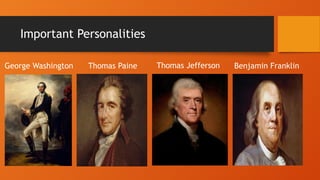
• George Washington, Thomas Jefferson, Benjamin Franklin, and Thomas Paine were
important personalities
• 4th
July 1776 – American Independence
• End of Mercantilist economy
Important Personalities
George Washington Thomas Paine Thomas Jefferson Benjamin Franklin
References
• https://firstamendment.mtsu.edu/article/puritans/
• https://www.historyextra.com/period/tudor/bloody-mary-tudor-brutal-brilliant-what-was-queen
-reign-like/
• https://www.history.com/this-day-in-history/pope-clement-vii-forbids-king-henry-viii-from-rema
rrying
• https://www.britannica.com/biography/John-Winthrop-American-colonial-governor
• https://www.voanews.com/a/6199723.html#:~:text=The%20Pilgrims%20were%20the%20first,Ki
ng%20Henry%20VIII%20of%20England
.
• https://en.wikipedia.org/wiki/John_Winthrop
• https://www.history.com/topics/exploration/john-rolfe
• https://education.nationalgeographic.org/resource/new-england-colonies-and-native-americans/
• https://www.history.com/topics/native-american-history/french-and-indian-war
• https://www.history.com/topics/american-revolution/american-revolution-history
Thankyou
Q & A Session

Presentation on US Historical Background

  • 1.
    US Second StruggleFor Independence (1789 – 1815) Bakhtawar Baloch 214195052
  • 2.
    Roots of theAmerican Nation (1492 – 1789)
  • 3.
    Historical Background • KingHenry VIII, desired to divorce his wife Catherine (belonging to Spanish Royal family) due to no legitimate male heir • Catholic Church domination over all matters and Pope Clément's refusal to Henry • King Henry’s excommunication and marriage to Anne Boleyn • Creation of the Church of England and rise of Protestant values • Rule of Mary Tudor (Only child of King Henry and Catherine – Strict Catholic) • Queen Mary’s Marriage to King Philip of Spain • Killing of hundred of Noble families and stopping Protestant Reformation Movements
  • 4.
    King Henry (VIII)– Turned into a Protestant Queen Mary – Strict Catholic – Daughter of King Henry
  • 5.
    1st Reason • Discovery voyages- led by Columbus and Vasco De Gama • Period of religious crusades, scientific discoveries, and finding new routes to Asian lands • Columbus was in search of the Indian continent but found America • Discovery voyages – to search for Gold, Glory, and spread Christianity (God) 2nd Reason • Persecution of Puritans by the Queen Mary and later by King Charles (I) • Puritans minded (chosen ones) royal families moved from England to America to be free from persecution • Other families including Puritans and Separatists moved to Netherlands Discovery Voyages – 2 Major Reasons
  • 6.
    • New Englishmen settlements in the American continent • 1610: John Rolfe with 150 men (early settlers) arrived in Jamestown (Virginia of North America) • Sir Thomas Gates was the first Governor of Jamestown Virginia. • Tobacco cultivation and trade – hellish, devilish, and damned tobacco • Puritans and separatists in Netherlands (lived 10 years in Leiden), had poor living conditions and feared influence of Dutch youth on their children • 1620 - 102 people including, Pilgrims (separatists) and Puritans (non-separatists or strangers) sailed to Southampton England to move to Virginia • 1622 - Edward Winslow with Pilgrims arrived at Cape Cod – and settled at Plymouth • Edward Winslow was the first Governor of Plymouth Colony. • Second Wave of Settlers – 1630 – Under John Winthrop (Puritan leader) sailed with 700 puritans (11 fleets of ships) • Few settled at Plymouth, while many followed John Winthrop and settled at Massachusetts Bay. • John Winthrop – First Governor of Massachusetts Bay Colony. • Famous writing of John Winthrop – City Upon a Hill Early Settlements of English Men to America
  • 7.
    Influential Figures ofAmerican Colonies John Rolfe – Jamestown, Virginia John Winthrop – Massachusetts Bay Edward Winslow - Plymouth
  • 8.
  • 9.
    • The earlysettlers (English Men) initially developed better understanding with Native Indians • The Indians provided with skin, food, regional and agricultural knowledge, and supplies • The new settlers traded beads and shells, also called as Wampum (local currency & jewelry) • The problems grew with the increasing number of new settlers, cultural & religious differences • “Multiplication Table” - a household with a single couple, had 8 to 10 children • The English settlements carried diseases that they had developed immunity against and affected the Native Indians (smallpox, tuberculosis, measles, cholera, and the bubonic plague). • Puritan leaders (Increase Mather) declared the spread of illness as an act of God to support the colonists’ right to the land • Some governments used this to convert the natives to Christianity and make them praying Indians • The First Indian War (King Philip’s War in 1675) – took place when the government of Plymouth killed 3 Indians from the Wampanoag tribe. • The divided Indian tribes and American colonies supported Plymouth, leading to signing a treaty • This clash increased mistrust, anger, and the need to remove any Indian’s regional influence and control Clashes with The Native Americans
  • 10.
    Native Indians andEnglish Settlers
  • 11.
    • The SevenYears’ War (called the French and Indian War in the colonies) lasted from 1756 to 1763 • France’s expansion into the Ohio River valley, and increasing conflict with the British claimed American colonies, especially Virginia • In 1754, the French built Fort Duquesne at a location where Allegheny and Monongahela Rivers joined, forming the Ohio River. • The location was strategically important for France (supported by Indians) and Britain • Governor William Shirley of Massachusetts, expelled hundreds of French settlers living in Nova Scotia (Arcadia) to other colonies, fearing they would support France in a military intervention. • George Washington of Virginia tired to establish talks with the French but failed • In 1756, British formally declared war but their commander Loudoun gained little success against French and their Indian allies. • In 1757, William Pitt saw it as an opportunity to build a huge British Empire, borrowed huge sums of money, paid Prussia to fight in Europe, and helped to raise troops in North America • Followed by British victories in Louisburg and capturing of French Forts (1758), Battle of Quebec (1759), and Fall of Montreal (1760) French and Indian War (Seven Years War)
  • 12.
    • “Interest ofThe Great Britain Considered” by Benjamin Franklin partly convinced Britain to retain Canada rather than Guadeloupe. • Treaty of Paris (February 1763), British took over Canada from France and Florida from Spain • Treaty allowed France to keep West Indian Sugar Islands and Spain was given Louisiana • American colonies were strengthened by reduced European dominance (mainly France). • British King George (II) was under heavy debt • Permanent British army units were installed in the newly occupied lands in America • Various taxes were imposed on the American colonies to pay for the spending on war • Increased resistance and clashes between the colonies and the British rulers • French internal support of the colonists in the American Revolutionary War Outcome of the Seven Years War
  • 13.
    Key Notes: 1stStruggle For Independence • Clashes with Native Americans • Seven Years War • Reduced influence of Indians, France, and Spain • Increased interest and influence of Britain • Multiplication Table – term introduced by Andrew Kennedy, 8 to 10 children with reduced infant mortality rates • Benjamin Franklin’s famous writings – A defense of the Americans, The Albany Plan, Great War for Empire, and The Interest of Great Britain Considered. • Mercantilist Theory was implemented as the economical ideology by Britain
  • 14.
    Second Struggle ForIndependence
  • 15.
    Events Leading tothe Revolutionary War • After the Seven Years War, British imposed various taxes to raise revenue • Stamp Act – 1765 • Townshend Acts – 1767 • Tea Act – 1773 • The tax acts were met with resistance by the colonists • Boston Massacre - A protest by colonists on 1770, when the British soldiers opened fired and killed 5 men • Boston Tea Party - On 16th Dec 1773, a group of Bostonian men, dressed as Indians dumped 342 chests of Tea from British ships into Boston Harbor. • Intolerable, or Coercive Acts were passed to reassert Britain imperial authority in Massachusetts • First meeting of the Continental Congress (Sep 1774) – including, George Washington (Virginia), John and Samuel Adams (Massachusetts), Patrick Henry (Virginia), and John Jay (New York) in Philadelphia • On April 18 (1775), British troops marched to Massachusetts • 19th April - Battle of Lexington and Concord took place between British troops and local militias, starting the Revolutionary War - “shot heard round the world” • France internally supported the Revolutionary cause by providing weapons • Thomas Paine famous writing “Common Sense” promoted the revolutionary cause published on 1776
  • 16.
    Major Events DuringThe War • 2nd Continental Congress in Philadelphia included other influential people, such as Benjamin Franklin and Thomas Jefferson – formed a continental army with George Washington (Commander in Chief) • 17th June Battle of Bunker Hill – First major battle was fought. Won by British but faced heavy causalities • 4th July 1770 – Continental Congress decided to adopt the Declaration of Independence • Declaration was drafted by a five-man committee including Franklin and John Adams but written by Jefferson • First (Sep 19th , 1778) and Second Battle of Saratoga (Oct 7th , 1778), British John Burgoyne’s faced defeat against by the American General Horatio Gates. • June 1778 – France openly declared war against the Britain army • The rebel troops were trained by the Prussian military officer Baron Friedrich von Steuben (sent by the French), under the leadership of the French aristocrat Marquis de Lafayette • During 1779 General Benedict Arnold of the Continental Army secretly allied with the British and in captured Virginia for the British army • Battle of Yorktown (1781) where French fleet stationed offshore preventing British from evacuation, British army faced Washington’s 14000 soldiers, Lord Charles Cornwallis surrendered. • September 3, 1783 – In Treaty of Paris, Britain recognized the independence of the United States and separate treaties with France and Spain
  • 17.
    Outcome of theRevolutionary War • July 4th 1776 – America gained its independence • 1787 – Jacob Shallus wrote the 1st constitution of the United States signed in Philadelphia by the Constitutional Convention • Thomas Jefferson was the first Secretary of State - March 22, 1790, till December 31, 1793 • George Washington became the first President of America on April 30, 1789 • Alexander Hamilton (Sep 11, 1789) was the first Secretary of the Treasury • End of Mercantilist economy and introduced trade, agricultural (South) and industrial (North) economy.
  • 18.
    Key Notes • Implementationof taxes caused resistance • Battle of Lexington and Concord was the start of the American Revolutionary War • France secretly supported and then openly declared war against Britain (1778) • Continental Congress administered the revolutionary war • George Washington, Thomas Jefferson, Benjamin Franklin, and Thomas Paine were important personalities • 4th July 1776 – American Independence • End of Mercantilist economy
  • 19.
    Important Personalities George WashingtonThomas Paine Thomas Jefferson Benjamin Franklin
  • 20.
    References • https://firstamendment.mtsu.edu/article/puritans/ • https://www.historyextra.com/period/tudor/bloody-mary-tudor-brutal-brilliant-what-was-queen -reign-like/ •https://www.history.com/this-day-in-history/pope-clement-vii-forbids-king-henry-viii-from-rema rrying • https://www.britannica.com/biography/John-Winthrop-American-colonial-governor • https://www.voanews.com/a/6199723.html#:~:text=The%20Pilgrims%20were%20the%20first,Ki ng%20Henry%20VIII%20of%20England . • https://en.wikipedia.org/wiki/John_Winthrop • https://www.history.com/topics/exploration/john-rolfe • https://education.nationalgeographic.org/resource/new-england-colonies-and-native-americans/ • https://www.history.com/topics/native-american-history/french-and-indian-war • https://www.history.com/topics/american-revolution/american-revolution-history
  • 21.