From Colony to State

 CREATED BY MELISSA SUTTON
       THIRD GRADE
         2010 – 2011
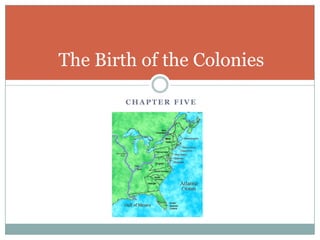
The Birth of the Colonies

        CHAPTER FIVE
Lesson 1: Colonial South Carolina

 Southern Colonies:
       Maryland, Virginia, North Carolina, South Carolina, Georgia
 Carolina became two separate colonies in 1729. Why?
 In 1732 the southern part of South Carolina became
    Georgia. Why?
   The colonists wanted South Carolina to become a royal
    colony. Why?
   Rice became an important EXPORT, or good that is
    produced in one country and shipped to another.
   Many people settled near swamps to grow rice.
   Many IMMIGRANTS, people who come to live in a new
    country, settled in the Up Country and trade became an
    important industry.
Lesson 2: Early South Carolina Government

 Regulators – settlers that wanted to control the Up Country
 Colonial Government:
   South Carolina was ruled by a royal governor chosen by the King
   Royal council advised royal governor
   Local – Commons House of Assembly
         Protected freedoms and property of the citizens
         Ran the courts and decided matter about road construction
     The King of England gave final approval of any new laws
 Great Britain made colonists pay a TAX, or money collected by a
  government from its citizens to pay for expenses, on certain
  goods.
 Stamp Act – a law that said colonists must buy special stamps to
  put on all newspapers, books, and documents.
     Why did this make the colonists angry?
Lesson 2: Early South Carolina Government

 After the Stamp Act, Great Britain place a tax on tea.
  Colonists boycotted tea. A BOYCOTT is a protest in
  which people refuse to use certain goods.
 Boston Tea Party and Charles Town reaction
 First Continental Congress met in Philadelphia, PA
  in 1774. A temporary state CONSTITUTION, or a
  series of laws that govern a nation, state, or group,
  was created.
 The General Assembly was created so the colonists
  would have a voice in making their own laws.
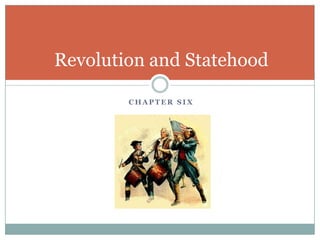
Revolution and Statehood

        CHAPTER SIX
Lesson 1: The American Revolution

 Passing of Intolerable Acts:
   Laws that punished Massachusetts colony for protesting the
    tea tax
   South Carolina helped Boston by sending them supplies

   South Carolina boycotted British goods

 In 1775 fighting began between colonists and British
  and the Revolutionary War began.
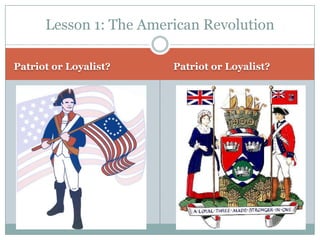
 PATRIOTS, colonists against British rule, fought
  LOYALISTS, colonists supporting British rule, in the
  Battle of Ninety-Six; the Patriots won.
Lesson 1: The American Revolution

Patriot or Loyalist?    Patriot or Loyalist?
Lesson 1: The American Revolution

 A battle took place on Sullivan’s Island where
  American troops, led by William Moultrie, defeated
  the British.
 Declaration of Independence:
     This DECLARATION, or statement, stated that the colonies
      wanted their independence from Great Britain. They wanted
      to form a new and separate nation called the United States of
      America.
 Francis Marion: “Swamp Fox”
   Led a group of volunteer soldiers to attack the British and
    disappear into the swamps
Lesson 2: From Colony to State

 Parts of South Carolina were destroyed during the
  Revolutionary War.
 People still settled in South Carolina after the war.
 Charles Town became Charleston in 1783.
 Up Country vs. Low Country
    Up Country wanted the capital to move to a more central
     location; Low Country wanted it to stay
 Columbia was born in 1786 when the government
 moved the capital to the Midlands along the
 Congaree River.
Lesson 2: From Colony to State

 United States Constitution
    Written at the Constitutional Convention in Philadelphia, PA in 1787
    Some South Carolinians did not want to RATIFY, or approve, the
     U.S. Constitution because they wanted each state to have more
     power.
    Stated that enslaved Africans could not be brought to the U.S. after
     1808
    South Carolina ratified the U.S. Constitution in 1788
 South Carolina wrote a new constitution
    Served not just the Low Country like the old constitution but also the
     Up Country
    Gave all men the right to vote, not just land owners

From colony to state

  • 1.
    From Colony toState CREATED BY MELISSA SUTTON THIRD GRADE 2010 – 2011
  • 2.
    The Birth ofthe Colonies CHAPTER FIVE
  • 3.
    Lesson 1: ColonialSouth Carolina  Southern Colonies:  Maryland, Virginia, North Carolina, South Carolina, Georgia  Carolina became two separate colonies in 1729. Why?  In 1732 the southern part of South Carolina became Georgia. Why?  The colonists wanted South Carolina to become a royal colony. Why?  Rice became an important EXPORT, or good that is produced in one country and shipped to another.  Many people settled near swamps to grow rice.  Many IMMIGRANTS, people who come to live in a new country, settled in the Up Country and trade became an important industry.
  • 4.
    Lesson 2: EarlySouth Carolina Government  Regulators – settlers that wanted to control the Up Country  Colonial Government:  South Carolina was ruled by a royal governor chosen by the King  Royal council advised royal governor  Local – Commons House of Assembly  Protected freedoms and property of the citizens  Ran the courts and decided matter about road construction  The King of England gave final approval of any new laws  Great Britain made colonists pay a TAX, or money collected by a government from its citizens to pay for expenses, on certain goods.  Stamp Act – a law that said colonists must buy special stamps to put on all newspapers, books, and documents.  Why did this make the colonists angry?
  • 5.
    Lesson 2: EarlySouth Carolina Government  After the Stamp Act, Great Britain place a tax on tea. Colonists boycotted tea. A BOYCOTT is a protest in which people refuse to use certain goods.  Boston Tea Party and Charles Town reaction  First Continental Congress met in Philadelphia, PA in 1774. A temporary state CONSTITUTION, or a series of laws that govern a nation, state, or group, was created.  The General Assembly was created so the colonists would have a voice in making their own laws.
  • 6.
  • 7.
    Lesson 1: TheAmerican Revolution  Passing of Intolerable Acts:  Laws that punished Massachusetts colony for protesting the tea tax  South Carolina helped Boston by sending them supplies  South Carolina boycotted British goods  In 1775 fighting began between colonists and British and the Revolutionary War began.  PATRIOTS, colonists against British rule, fought LOYALISTS, colonists supporting British rule, in the Battle of Ninety-Six; the Patriots won.
  • 8.
    Lesson 1: TheAmerican Revolution Patriot or Loyalist? Patriot or Loyalist?
  • 9.
    Lesson 1: TheAmerican Revolution  A battle took place on Sullivan’s Island where American troops, led by William Moultrie, defeated the British.  Declaration of Independence:  This DECLARATION, or statement, stated that the colonies wanted their independence from Great Britain. They wanted to form a new and separate nation called the United States of America.  Francis Marion: “Swamp Fox”  Led a group of volunteer soldiers to attack the British and disappear into the swamps
  • 10.
    Lesson 2: FromColony to State  Parts of South Carolina were destroyed during the Revolutionary War.  People still settled in South Carolina after the war.  Charles Town became Charleston in 1783.  Up Country vs. Low Country  Up Country wanted the capital to move to a more central location; Low Country wanted it to stay  Columbia was born in 1786 when the government moved the capital to the Midlands along the Congaree River.
  • 11.
    Lesson 2: FromColony to State  United States Constitution  Written at the Constitutional Convention in Philadelphia, PA in 1787  Some South Carolinians did not want to RATIFY, or approve, the U.S. Constitution because they wanted each state to have more power.  Stated that enslaved Africans could not be brought to the U.S. after 1808  South Carolina ratified the U.S. Constitution in 1788  South Carolina wrote a new constitution  Served not just the Low Country like the old constitution but also the Up Country  Gave all men the right to vote, not just land owners