Do Zombies Care About
the Past?
Some fine points about studying history and why it’s a good idea.
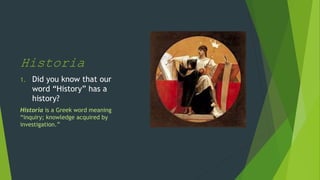
Historia
1. Did you know that our
word “History” has a
history?
Historia is a Greek word meaning
“inquiry; knowledge acquired by
investigation.”
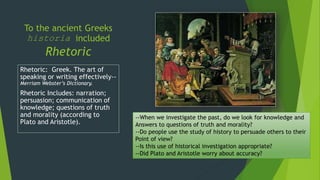
To the ancient Greeks
historia included
Rhetoric
Rhetoric: Greek. The art of
speaking or writing effectively--
Merriam Webster’s Dictionary.
Rhetoric Includes: narration;
persuasion; communication of
knowledge; questions of truth
and morality (according to
Plato and Aristotle).
--When we investigate the past, do we look for knowledge and
Answers to questions of truth and morality?
--Do people use the study of history to persuade others to their
Point of view?
--Is this use of historical investigation appropriate?
--Did Plato and Aristotle worry about accuracy?
Huh?
 If history is an investigation into the past to acquire knowledge and
communicate that knowledge through speaking and writing, using narrative,
argument, persuasion, and asking questions about truth, ethics and morality;
shouldn’t we be able to agree about history?
 What about your liberal cousin and your Tea Party uncle on Thanksgiving? Do they
agree about history? What informs their views? Debate over the National Anthem
(click on this link)
 Truth vs. Accuracy. What is the difference?
 How does human complexity enter into a discussion of history?
 Thomas Jefferson wrote in the Declaration of Independence that “all men are created
equal…” Yet Thomas Jefferson owned other men as slaves. Which is a more accurate
perspective of Jefferson? His rhetoric or his actions? Which had more impact on history? Can
we discuss Thomas Jefferson or George Washington without discussing this complexity?
Everybody Has an Opinion
About What History is…
 History is… An investigation and discussion of the past
 “The past is never dead. It’s not even past.” William Faulkner,
Requiem for a Nun. (1950)
 “The past is a foreign country. They do things differently there.” L.P.
Hartley, The Go-Between. (1953)
And More Opinions…
 History Is … asking questions about the meaning of the past:
 How did we come to be who we are?
 “History is the essence of innumerable biographies.” --Thomas Carlyle, On
History, (1848).
 “History is little else than a picture of human crimes and misfortunes.” --
Francois Marie Arouet de Voltaire, L’Ingénue (1757).
 “History is a guide to navigation in perilous times. History is who we are
and why we are the way we are.” –David McCullough
 “The arc of the moral universe is long, but it bends towards justice.” –Dr.
Martin Luther King, Jr.
And Even More Opinions…
 History is… An Awareness of perspectives that are different from
our own
 “The most effective way to destroy people is to deny and
obliterate their own understanding of their history.” –George
Orwell
Can We Ever Really Know the past?
 “It frustrates and fascinates me that we'll never know for sure, that
despite the best efforts of historians and scientists and poets, there
are some things we'll just never know. What the first song sounded
like. How it felt to see the first photograph. Who kissed the first kiss,
and if it was any good.” –Isaac Merion, Warm Bodies.
What do these questions have to do with
Our Class?
 Glad you asked…
 We will be doing history
 We will investigate the past asking “Who, what, when, where, why and how” questions.
 We will use various sources for our investigation. There is no single, definitive source for
knowledge about the past.
 We will examine different perspectives about the past
 Rich and powerful
 Poor and working class
 Women
 Slaves
 Immigrants
 We will write about the past—sometimes in narrative form, sometimes in persuasive form
 We will analyze what other historians have concluded about the past. What conclusions are more
persuasive than others and why?
The 6 C’s of Historical thinking
 When we do history, we need to remember the 6 C’s of historical analysis:
1. Change over time: Historians view history as a progression from point A to point B with point B always
being closer to the present.
2. Chronology: Because some things happened before other things, we need to keep in mind the chronology
of events.
3. Context: In what context did an event occur? In what context was a source we are analyzing created?
Who was the intended audience? What was going on in the larger world?
4. Complexity: Not everyone experiences history the same way and different people have different
perspectives about the same event. Everybody is complex as a result, history is complex.
5. Causation: There is usually more than one cause of an event. Not everyone agrees on causation.
6. Contingency: The effect of choices that some people in the past made have an effect on choices that
other people in the past made and the effects of these choices may impact the present.
So… Why study the past and what can a
zombie tell us about why we should?
 Watch the clip. Identify questions asked by R about his history?
 Do those who are not infected view history differently than R does?
 Which view of history is correct?
 How do R’s questions about himself and his society relate to the study of history?
 Analyze this clip in light of the 6 “C’s” of historical thinking?

Do zombies care about the past 2016

  • 1.
    Do Zombies CareAbout the Past? Some fine points about studying history and why it’s a good idea.
  • 2.
    Historia 1. Did youknow that our word “History” has a history? Historia is a Greek word meaning “inquiry; knowledge acquired by investigation.”
  • 3.
    To the ancientGreeks historia included Rhetoric Rhetoric: Greek. The art of speaking or writing effectively-- Merriam Webster’s Dictionary. Rhetoric Includes: narration; persuasion; communication of knowledge; questions of truth and morality (according to Plato and Aristotle). --When we investigate the past, do we look for knowledge and Answers to questions of truth and morality? --Do people use the study of history to persuade others to their Point of view? --Is this use of historical investigation appropriate? --Did Plato and Aristotle worry about accuracy?
  • 4.
    Huh?  If historyis an investigation into the past to acquire knowledge and communicate that knowledge through speaking and writing, using narrative, argument, persuasion, and asking questions about truth, ethics and morality; shouldn’t we be able to agree about history?  What about your liberal cousin and your Tea Party uncle on Thanksgiving? Do they agree about history? What informs their views? Debate over the National Anthem (click on this link)  Truth vs. Accuracy. What is the difference?  How does human complexity enter into a discussion of history?  Thomas Jefferson wrote in the Declaration of Independence that “all men are created equal…” Yet Thomas Jefferson owned other men as slaves. Which is a more accurate perspective of Jefferson? His rhetoric or his actions? Which had more impact on history? Can we discuss Thomas Jefferson or George Washington without discussing this complexity?
  • 5.
    Everybody Has anOpinion About What History is…  History is… An investigation and discussion of the past  “The past is never dead. It’s not even past.” William Faulkner, Requiem for a Nun. (1950)  “The past is a foreign country. They do things differently there.” L.P. Hartley, The Go-Between. (1953)
  • 6.
    And More Opinions… History Is … asking questions about the meaning of the past:  How did we come to be who we are?  “History is the essence of innumerable biographies.” --Thomas Carlyle, On History, (1848).  “History is little else than a picture of human crimes and misfortunes.” -- Francois Marie Arouet de Voltaire, L’Ingénue (1757).  “History is a guide to navigation in perilous times. History is who we are and why we are the way we are.” –David McCullough  “The arc of the moral universe is long, but it bends towards justice.” –Dr. Martin Luther King, Jr.
  • 7.
    And Even MoreOpinions…  History is… An Awareness of perspectives that are different from our own  “The most effective way to destroy people is to deny and obliterate their own understanding of their history.” –George Orwell
  • 8.
    Can We EverReally Know the past?  “It frustrates and fascinates me that we'll never know for sure, that despite the best efforts of historians and scientists and poets, there are some things we'll just never know. What the first song sounded like. How it felt to see the first photograph. Who kissed the first kiss, and if it was any good.” –Isaac Merion, Warm Bodies.
  • 9.
    What do thesequestions have to do with Our Class?  Glad you asked…  We will be doing history  We will investigate the past asking “Who, what, when, where, why and how” questions.  We will use various sources for our investigation. There is no single, definitive source for knowledge about the past.  We will examine different perspectives about the past  Rich and powerful  Poor and working class  Women  Slaves  Immigrants  We will write about the past—sometimes in narrative form, sometimes in persuasive form  We will analyze what other historians have concluded about the past. What conclusions are more persuasive than others and why?
  • 10.
    The 6 C’sof Historical thinking  When we do history, we need to remember the 6 C’s of historical analysis: 1. Change over time: Historians view history as a progression from point A to point B with point B always being closer to the present. 2. Chronology: Because some things happened before other things, we need to keep in mind the chronology of events. 3. Context: In what context did an event occur? In what context was a source we are analyzing created? Who was the intended audience? What was going on in the larger world? 4. Complexity: Not everyone experiences history the same way and different people have different perspectives about the same event. Everybody is complex as a result, history is complex. 5. Causation: There is usually more than one cause of an event. Not everyone agrees on causation. 6. Contingency: The effect of choices that some people in the past made have an effect on choices that other people in the past made and the effects of these choices may impact the present.
  • 11.
    So… Why studythe past and what can a zombie tell us about why we should?  Watch the clip. Identify questions asked by R about his history?  Do those who are not infected view history differently than R does?  Which view of history is correct?  How do R’s questions about himself and his society relate to the study of history?  Analyze this clip in light of the 6 “C’s” of historical thinking?