C
HIGH PRESSURE
PROCESSING
BY : AHMAD FARIS BIN AHMAD AZLI (2016250396)
FATEN NAJAMUNISA BINTI AB.AZIZ (2016250428)
FATIN NABILA BINTI MOHD ARIPIN (2016250476)
NUR ILHAM BINTI ZAINUDDIN (2016250248)
NUR SHAHIDAH BINTI MUSA (2016250202)
INTRODUCTION
• As a result, in recent years, the food industry has shown increased interest in innovative
approaches, which can provide products of proven quality and with a reduced environmental
cost, increasing the products 'added value.
• For example, physical technology (high pressure processing), electromagnetic technologies,
acoustic technologies and others.
• Thermal processing is a primary method for food pasteurization and sterilization. However, the
application of heat impairs food quality. As an alternative to thermal processing, high-pressure
processing (HPP) uses elevated pressures,
• High pressure processing also known as high hydrostatic pressure or ultra high pressure
processing.
• Basically, this method can be used for solid or liquid food with or without packaging with the
range value of pressure of 100 to 800 MPa.
• HPP can work efficiently throughout the mass of the food and also independent to size, shape
or composition of food.
MECHANISM
• Pressure is increased at a certain rate until the target pressure is reached, the target pressure is
held for a specific amount of time, and then pressure is released at a specific rate.
• Typical pressures applied to foods range from 300 – 800 MPa (43,500 – 116,000 psi).
• Heat may also be applied, however, the majority of high pressure processes are conducted at
refrigerated temperatures, relying mainly on pressure to process the food.
• While the temperature increase of water is approximately 3°C per 100 MPa, this can be
significantly higher for more compressible food ingredients like fats, resulting in a greater
temperature increase during pressurization for foods with higher fat content.
CONT’D
• Pressure is transmitted instantaneously & uniformly throughout the food product
independent of size and shape
• Food will not be crushed
• No gradient of effectiveness from outside to inside
• Product compressed, returns to original shape; water relatively incompressible
• Due to adiabatic heating, temperature of the product increases (water : 3 °C increase for
every 100 MPa; temperature increase depends on the food components)
• Batch or semi-continuous process
• Can alter some food products
• Lethal effects on microorganisms
• affects cell morphology, membranes, spore coats
• denatures proteins & enzymes
• permeability of membranes leakage
• Sensitivity to HHP
• Gram Negatives > Yeast/Mold > Gram Positives >Spores
• Product specific; inactivation dependent on pH, RH, medium/food, exposure time, pressure
level, etc.
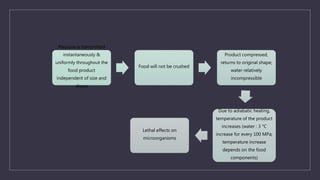
Pressure is transmitted
instantaneously &
uniformly throughout the
food product
independent of size and
shape
Food will not be crushed
Product compressed,
returns to original shape;
water relatively
incompressible
Due to adiabatic heating,
temperature of the product
increases (water : 3 °C
increase for every 100 MPa;
temperature increase
depends on the food
components)
Lethal effects on
microorganisms
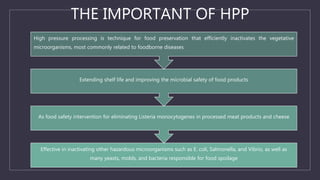
THE IMPORTANT OF HPP
Effective in inactivating other hazardous microorganisms such as E. coli, Salmonella, and Vibrio, as well as
many yeasts, molds, and bacteria responsible for food spoilage
As food safety intervention for eliminating Listeria monocytogenes in processed meat products and cheese
Extending shelf life and improving the microbial safety of food products
High pressure processing is technique for food preservation that efficiently inactivates the vegetative
microorganisms, most commonly related to foodborne diseases
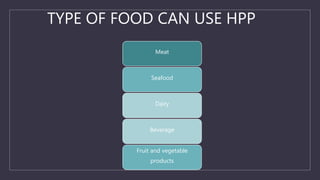
TYPE OF FOOD CAN USE HPP
Meat
Seafood
Dairy
Beverage
Fruit and vegetable
products
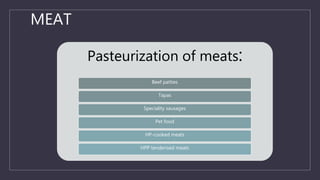
MEAT
Pasteurization of meats:
Beef patties
Tapas
Speciality sausages
Pet food
HP-cooked meats
HPP tenderised meats
SEAFOOD
Separate raw shellfish meat
from its shells, and also for
oysters and clams
Shucking oysters and also as
intervention to inactivate Vibrio
Vulnificus bacteria in oysters.
DAIRY PRODUCTS
Milk
Cheddar
cheese
Sandwich
Probiotics
Functional
dairy
BEVERAGE
Cold pasteurization
method for fruit juices:
Fruit juices
& beverages
Wellness
Drinks
FRUIT AND VEGETABLE PRODUCTS
Pasteurization and sterilization of
fruits, sauces, and salad dressings
Dips, spreads, sauces
Bases (tomato, pumpkin, sweet
potato)
Soups
Salads (beans, potato, pasta,
vegetables)
ADVANTAGES OF HPP
Inactivation of vegetative bacteria and spores at higher temperature
No evident of toxicity
Preservation of nutrients, colors and flavors
Reduced processing times
Uniformity of treatment throughout food
Potential for reduction or elimination of chemical preservatives
Positive consumer appeal.
LIMITING ASPECTS
Expensive equipment
Ineffective against bacterial spores
Limited to refrigerated foods and for use by high throughput
commercial operations.
EFFECT ON CHEMICAL COMPOSITION OF FOOD
Temperature of water increase 3 ⁰C per 100 MPa
but can be higher for more compressible food eg:
fats
HPP does not effect much on low molecular
weight.
Vitamin, flavors and pigments undamaged during
HPP process
Nutriont value and quality is preserved
•Gelatinization of carbohydrates form through pressure increase
but proteins can be denatured at high temperature.
Figure 1: A. Schematic representation of the elliptic phase diagram of proteins
illustrating pressure, heat and cold denaturation. B: picture of denatured eggs.
(Muntean, et al., 2016)
EFFECT OF HPP ON MICROORGANISM
Denaturation protein has major
impact on the microorganism
survival.
The bacteria cell impossible to
recover.
Not effective against all
microbial forms:
Spore-forming microorganism
highly resistant to HPP when in
spore form.
Need combination pressure,
heat or other antibacterial
treatment
Endospores resist to HPP
need combination of high
pressure treatment, pressure
>1000 MPa and heat treatment
temperatures >80⁰C
Yeast and molds sensitive to
HPP.
inactive within a few minutes by
pressure 300-400 Mpa at room
temperature.
PREVIOUS STUDY
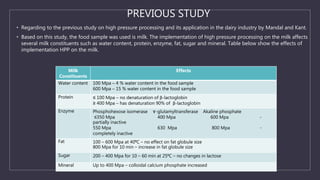
• Regarding to the previous study on high pressure processing and its application in the dairy industry by Mandal and Kant.
• Based on this study, the food sample was used is milk. The implementation of high pressure processing on the milk affects
several milk constituents such as water content, protein, enzyme, fat, sugar and mineral. Table below show the effects of
implementation HPP on the milk.
Milk
Constituents
Effects
Water content 100 Mpa – 4 % water content in the food sample
600 Mpa – 15 % water content in the food sample
Protein ≤ 100 Mpa – no denaturation of β-lactoglobin
≥ 400 Mpa – has denaturation 90% of β-lactoglobin
Enzyme Phosphohexose isomerase ɤ-glutamyltransferase Akaline phosphate
≤350 Mpa 400 Mpa 600 Mpa -
partially inactive
550 Mpa 630 Mpa 800 Mpa -
completely inactive
Fat 100 – 600 Mpa at 40⁰C – no effect on fat globule size
800 Mpa for 10 min – increase in fat globule size
Sugar 200 – 400 Mpa for 10 – 60 min at 25⁰C – no changes in lactose
Mineral Up to 400 Mpa – colloidal calcium phosphate increased
• According to the study on preservation of foods by HPP (Pechalaraju & Shireesha, 2013), an extensive research was carried out
in order to improve the safety and quality of current food product. This study was conducted due to there are limitation in HPP.
• Table of advantage, limitations and commercial application of HPP (Fellows, 2009)
Advantages Limitations Examples of commercial applications
products
Kills vegetative bacteria and spore
at higher temperatures
Little effect on food
enzyme activity
Pasteurisation and sterilisation of fruit products,
sauces, pickles, yoghurts and salad dressings
No evidence of toxicity Some microbial survival Pasteurisation of meats and vegetables
Colours, flavours and nutrients are
preserved
Expensive equipment Decontamination of high risk or high value heat
sensitive ingredients including shellfish,
flavourings and vitamins.
Reduced processing times Food should have
approx. 40% free water
for anti-microbial effect
Uniformity of treatment
throughout food
Batch processing
Desirable texture changes possible Limited packaging
options
Study on high pressure processing by
Balasubramaniam & Farkas (2008)
 Both liquid and solid food can apply HPP
Usually:
Solid food in batch equipment
Liquid food in semi continuous equipment
Commercial scale of HPP system can cost between USD 500,000 to USD 2.5 million
Depends on the equipment capacity and extent of automation.
REFERENCES
1) (PDF) "High-Pressure Processing and Its Applications in ... (n.d.). Retrieved from
https://www.researchgate.net/publication/321724626_High-
Pressure_Processing_and_Its_Applications_in_the_Dairy_Industry
2) Pechalaraju, M., & Shireesha, B. (2013). Preservation of foods by high pressure processing
3) Balasubramaniam, V., & Farkas, D. (2008). High-pressure Food Processing. Food Science and
Technology International,14(5), 413-418. doi:10.1177/1082013208098812
4) Muntean, M., Marian, O., Barbieru, V., Cătunescu, G. M., Ranta, O., Drocas, I., & Terhes, S. (2016).
High Pressure Processing in Food Industry – Characteristics and Applications. Agriculture and
Agricultural Science Procedia, 10, 377-383. doi:10.1016/j.aaspro.2016.09.077
5) High Pressure Processing of Foods. (n.d.). Retrieved from https://tinyurl.com/yabl9c4u

High pressure processing

  • 1.
    C HIGH PRESSURE PROCESSING BY :AHMAD FARIS BIN AHMAD AZLI (2016250396) FATEN NAJAMUNISA BINTI AB.AZIZ (2016250428) FATIN NABILA BINTI MOHD ARIPIN (2016250476) NUR ILHAM BINTI ZAINUDDIN (2016250248) NUR SHAHIDAH BINTI MUSA (2016250202)
  • 2.
    INTRODUCTION • As aresult, in recent years, the food industry has shown increased interest in innovative approaches, which can provide products of proven quality and with a reduced environmental cost, increasing the products 'added value. • For example, physical technology (high pressure processing), electromagnetic technologies, acoustic technologies and others. • Thermal processing is a primary method for food pasteurization and sterilization. However, the application of heat impairs food quality. As an alternative to thermal processing, high-pressure processing (HPP) uses elevated pressures, • High pressure processing also known as high hydrostatic pressure or ultra high pressure processing. • Basically, this method can be used for solid or liquid food with or without packaging with the range value of pressure of 100 to 800 MPa. • HPP can work efficiently throughout the mass of the food and also independent to size, shape or composition of food.
  • 3.
    MECHANISM • Pressure isincreased at a certain rate until the target pressure is reached, the target pressure is held for a specific amount of time, and then pressure is released at a specific rate. • Typical pressures applied to foods range from 300 – 800 MPa (43,500 – 116,000 psi). • Heat may also be applied, however, the majority of high pressure processes are conducted at refrigerated temperatures, relying mainly on pressure to process the food. • While the temperature increase of water is approximately 3°C per 100 MPa, this can be significantly higher for more compressible food ingredients like fats, resulting in a greater temperature increase during pressurization for foods with higher fat content.
  • 4.
    CONT’D • Pressure istransmitted instantaneously & uniformly throughout the food product independent of size and shape • Food will not be crushed • No gradient of effectiveness from outside to inside • Product compressed, returns to original shape; water relatively incompressible • Due to adiabatic heating, temperature of the product increases (water : 3 °C increase for every 100 MPa; temperature increase depends on the food components) • Batch or semi-continuous process • Can alter some food products • Lethal effects on microorganisms • affects cell morphology, membranes, spore coats • denatures proteins & enzymes • permeability of membranes leakage • Sensitivity to HHP • Gram Negatives > Yeast/Mold > Gram Positives >Spores • Product specific; inactivation dependent on pH, RH, medium/food, exposure time, pressure level, etc.
  • 5.
    Pressure is transmitted instantaneously& uniformly throughout the food product independent of size and shape Food will not be crushed Product compressed, returns to original shape; water relatively incompressible Due to adiabatic heating, temperature of the product increases (water : 3 °C increase for every 100 MPa; temperature increase depends on the food components) Lethal effects on microorganisms
  • 6.
    THE IMPORTANT OFHPP Effective in inactivating other hazardous microorganisms such as E. coli, Salmonella, and Vibrio, as well as many yeasts, molds, and bacteria responsible for food spoilage As food safety intervention for eliminating Listeria monocytogenes in processed meat products and cheese Extending shelf life and improving the microbial safety of food products High pressure processing is technique for food preservation that efficiently inactivates the vegetative microorganisms, most commonly related to foodborne diseases
  • 7.
    TYPE OF FOODCAN USE HPP Meat Seafood Dairy Beverage Fruit and vegetable products
  • 8.
    MEAT Pasteurization of meats: Beefpatties Tapas Speciality sausages Pet food HP-cooked meats HPP tenderised meats
  • 9.
    SEAFOOD Separate raw shellfishmeat from its shells, and also for oysters and clams Shucking oysters and also as intervention to inactivate Vibrio Vulnificus bacteria in oysters.
  • 10.
  • 11.
    BEVERAGE Cold pasteurization method forfruit juices: Fruit juices & beverages Wellness Drinks
  • 12.
    FRUIT AND VEGETABLEPRODUCTS Pasteurization and sterilization of fruits, sauces, and salad dressings Dips, spreads, sauces Bases (tomato, pumpkin, sweet potato) Soups Salads (beans, potato, pasta, vegetables)
  • 13.
    ADVANTAGES OF HPP Inactivationof vegetative bacteria and spores at higher temperature No evident of toxicity Preservation of nutrients, colors and flavors Reduced processing times Uniformity of treatment throughout food Potential for reduction or elimination of chemical preservatives Positive consumer appeal.
  • 14.
    LIMITING ASPECTS Expensive equipment Ineffectiveagainst bacterial spores Limited to refrigerated foods and for use by high throughput commercial operations.
  • 15.
    EFFECT ON CHEMICALCOMPOSITION OF FOOD Temperature of water increase 3 ⁰C per 100 MPa but can be higher for more compressible food eg: fats HPP does not effect much on low molecular weight. Vitamin, flavors and pigments undamaged during HPP process Nutriont value and quality is preserved •Gelatinization of carbohydrates form through pressure increase but proteins can be denatured at high temperature.
  • 16.
    Figure 1: A.Schematic representation of the elliptic phase diagram of proteins illustrating pressure, heat and cold denaturation. B: picture of denatured eggs. (Muntean, et al., 2016)
  • 17.
    EFFECT OF HPPON MICROORGANISM Denaturation protein has major impact on the microorganism survival. The bacteria cell impossible to recover. Not effective against all microbial forms: Spore-forming microorganism highly resistant to HPP when in spore form. Need combination pressure, heat or other antibacterial treatment Endospores resist to HPP need combination of high pressure treatment, pressure >1000 MPa and heat treatment temperatures >80⁰C Yeast and molds sensitive to HPP. inactive within a few minutes by pressure 300-400 Mpa at room temperature.
  • 18.
    PREVIOUS STUDY • Regardingto the previous study on high pressure processing and its application in the dairy industry by Mandal and Kant. • Based on this study, the food sample was used is milk. The implementation of high pressure processing on the milk affects several milk constituents such as water content, protein, enzyme, fat, sugar and mineral. Table below show the effects of implementation HPP on the milk. Milk Constituents Effects Water content 100 Mpa – 4 % water content in the food sample 600 Mpa – 15 % water content in the food sample Protein ≤ 100 Mpa – no denaturation of β-lactoglobin ≥ 400 Mpa – has denaturation 90% of β-lactoglobin Enzyme Phosphohexose isomerase ɤ-glutamyltransferase Akaline phosphate ≤350 Mpa 400 Mpa 600 Mpa - partially inactive 550 Mpa 630 Mpa 800 Mpa - completely inactive Fat 100 – 600 Mpa at 40⁰C – no effect on fat globule size 800 Mpa for 10 min – increase in fat globule size Sugar 200 – 400 Mpa for 10 – 60 min at 25⁰C – no changes in lactose Mineral Up to 400 Mpa – colloidal calcium phosphate increased
  • 19.
    • According tothe study on preservation of foods by HPP (Pechalaraju & Shireesha, 2013), an extensive research was carried out in order to improve the safety and quality of current food product. This study was conducted due to there are limitation in HPP. • Table of advantage, limitations and commercial application of HPP (Fellows, 2009) Advantages Limitations Examples of commercial applications products Kills vegetative bacteria and spore at higher temperatures Little effect on food enzyme activity Pasteurisation and sterilisation of fruit products, sauces, pickles, yoghurts and salad dressings No evidence of toxicity Some microbial survival Pasteurisation of meats and vegetables Colours, flavours and nutrients are preserved Expensive equipment Decontamination of high risk or high value heat sensitive ingredients including shellfish, flavourings and vitamins. Reduced processing times Food should have approx. 40% free water for anti-microbial effect Uniformity of treatment throughout food Batch processing Desirable texture changes possible Limited packaging options
  • 20.
    Study on highpressure processing by Balasubramaniam & Farkas (2008)  Both liquid and solid food can apply HPP Usually: Solid food in batch equipment Liquid food in semi continuous equipment Commercial scale of HPP system can cost between USD 500,000 to USD 2.5 million Depends on the equipment capacity and extent of automation.
  • 21.
    REFERENCES 1) (PDF) "High-PressureProcessing and Its Applications in ... (n.d.). Retrieved from https://www.researchgate.net/publication/321724626_High- Pressure_Processing_and_Its_Applications_in_the_Dairy_Industry 2) Pechalaraju, M., & Shireesha, B. (2013). Preservation of foods by high pressure processing 3) Balasubramaniam, V., & Farkas, D. (2008). High-pressure Food Processing. Food Science and Technology International,14(5), 413-418. doi:10.1177/1082013208098812 4) Muntean, M., Marian, O., Barbieru, V., Cătunescu, G. M., Ranta, O., Drocas, I., & Terhes, S. (2016). High Pressure Processing in Food Industry – Characteristics and Applications. Agriculture and Agricultural Science Procedia, 10, 377-383. doi:10.1016/j.aaspro.2016.09.077 5) High Pressure Processing of Foods. (n.d.). Retrieved from https://tinyurl.com/yabl9c4u