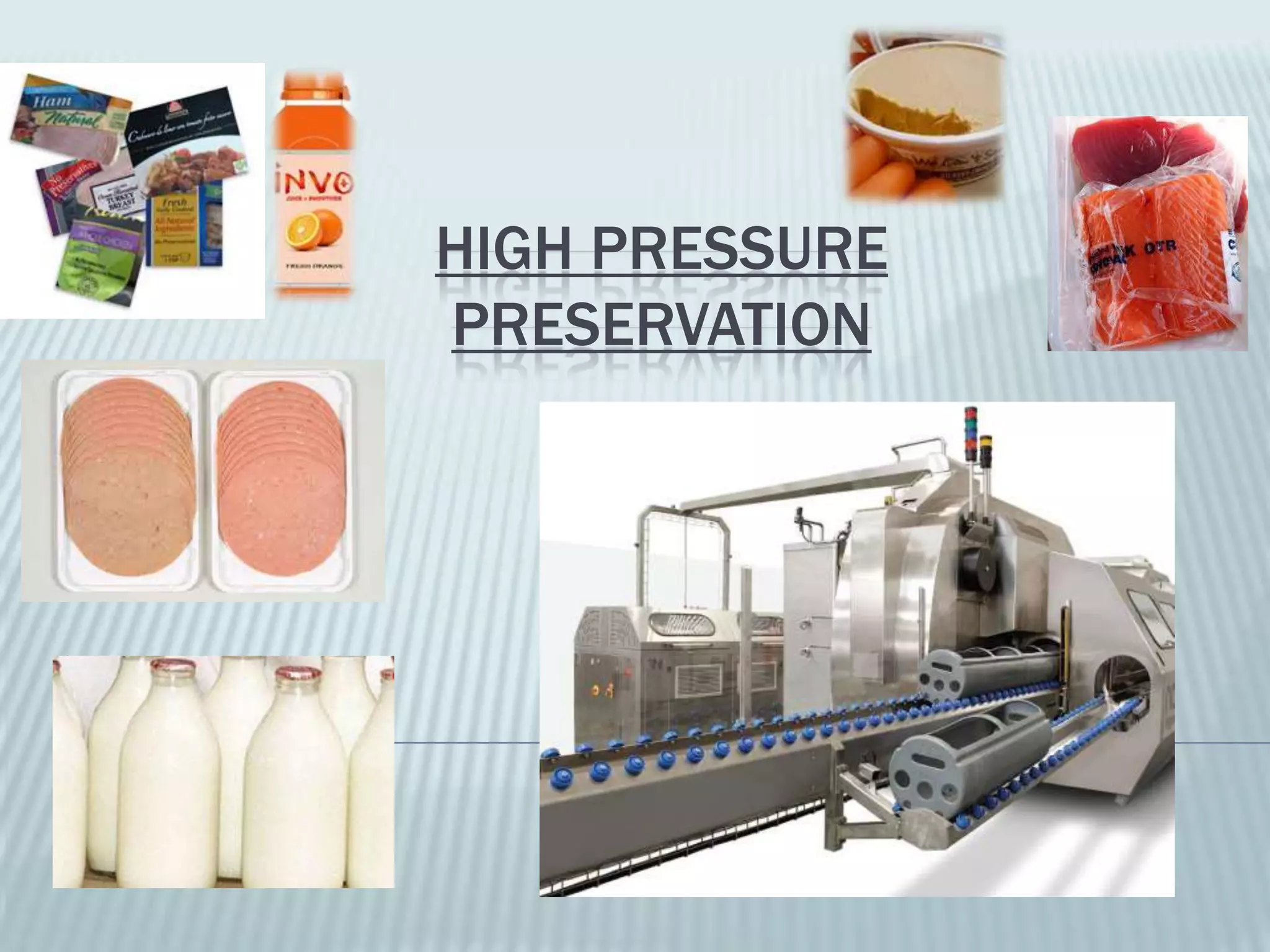
HIGH PRESSURE
    PRESERVATION


.
INTRODUCTION
   High-pressure processing (HPP) is a “nonthermal” food preservation technique
    that inactivates harmful pathogens and vegetative spoilage microorganisms by
    using pressure rather than heat to effect pasteurization.
   Allowing most foods to be preserved with minimal effects on taste, texture,
    appearance, or nutritional value.
   Pressure treatment can be used to process both liquid and high-moisture-
    content solid foods.( Aw=0.95)
   For example, a grape can be easily crushed if pressure is applied to it by placing it
    between two fingers and squeezing along one axis. In contrast, if the grape is
    exposed to a uniform pressure by submerging it in water inside a sealed flexible
    bottle and squeezing, the grape retains its shape no matter how hard the
   bottle is squeezed. In this case, the pressure transmitted from the bottle wall
    through the water is applied uniformly around the fruit.
   Porous system will collapse ( eg strawberries are crushed by HPP)
   U.S., Canada, and Mexico, Spain, Italy, Portugal, France, UK, and Germany,
    Australia, and Asia (Japan, China, and S. Korea) lead the commercialization of
    high pressure technology.
   Cost is 0.5-2.5 Million $ ( equipment) and HPP treatment costs are quoted as
    ranging from 4–10 cents/lb ( equal to that of thermal processing)
PRINCIPLE.
• Le Chatelier’s principle. Any phenomenon (phase transition,
change in molecular Configuration, chemical reaction) accompanied
by a decrease in volume is enhanced by pressure. Accordingly,
pressure shifts the system to that of lowest volume.
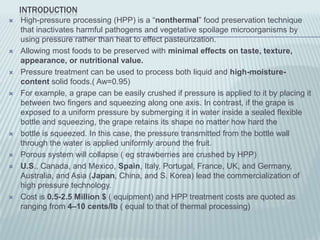
Isostatic principle: The principle of isostatic processing
is presented in . The food products are compressed by
uniform pressure from every direction and then returned to
their original shape when the pressure is released. The
products are compressed independently of the product size and
geometry because transmission of pressure to the core is not
mass/time dependant thus the process is minimized
If a food product contains sufficient moisture, pressure will
not damage the product at the macroscopic levels as long as the
pressure is applied uniformly in all directions
HIGH PRESSURE EQUIPMENT
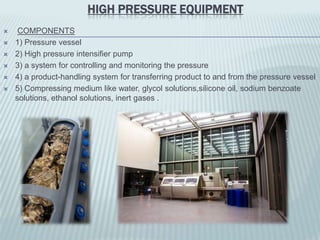
    COMPONENTS
   1) Pressure vessel
   2) High pressure intensifier pump
   3) a system for controlling and monitoring the pressure
   4) a product-handling system for transferring product to and from the pressure vessel
   5) Compressing medium like water, glycol solutions,silicone oil, sodium benzoate
    solutions, ethanol solutions, inert gases .
A typical HPP process uses food products packaged in a high-barrier, flexible
 pouch or a plastic container. The packages are loaded into the high-pressure
                                    chamber

  The vessel is sealed and the vessel is filled with a pressure transmitting fluid
                                (normally water).


Pressurized by the use of a high-pressure pump, which injects additional quantities of
    fluid. The packages of food, surrounded by the pressure-transmitting fluid,
          are subjected to the same pressure as exists in the vessel itself.

  After holding the product for the desired time at the target pressure, the vessel is
             decompressed by releasing the pressure-transmitting fluid.


Approximately 5–6 cycles/hr are possible, allowing time for compression, holding,
                   decompression, loading, and unloading.


  After pressure treatment, the processed product is removed from the vessel and
                    stored/distributed in a conventional manner.
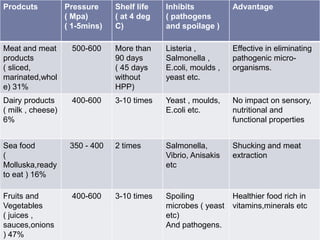
Prodcuts           Pressure     Shelf life   Inhibits           Advantage
                   ( Mpa)       ( at 4 deg   ( pathogens
                   ( 1-5mins)   C)           and spoilage )

Meat and meat       500-600     More than    Listeria ,         Effective in eliminating
products                        90 days      Salmonella ,       pathogenic micro-
( sliced,                       ( 45 days    E.coli, moulds ,   organisms.
marinated,whol                  without      yeast etc.
e) 31%                          HPP)
Dairy products      400-600     3-10 times   Yeast , moulds,    No impact on sensory,
( milk , cheese)                             E.coli etc.        nutritional and
6%                                                              functional properties


Sea food            350 - 400   2 times      Salmonella,        Shucking and meat
(                                            Vibrio, Anisakis   extraction
Molluska,ready                               etc
to eat ) 16%

Fruits and          400-600     3-10 times   Spoiling           Healthier food rich in
Vegetables                                   microbes ( yeast   vitamins,minerals etc
( juices ,                                   etc)
sauces,onions                                And pathogens.
) 47%
MICROBIAL EFFICACY
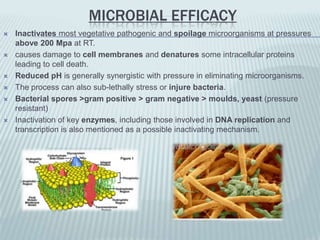
   Inactivates most vegetative pathogenic and spoilage microorganisms at pressures
    above 200 Mpa at RT.
   causes damage to cell membranes and denatures some intracellular proteins
    leading to cell death.
   Reduced pH is generally synergistic with pressure in eliminating microorganisms.
   The process can also sub-lethally stress or injure bacteria.
   Bacterial spores >gram positive > gram negative > moulds, yeast (pressure
    resistant)
   Inactivation of key enzymes, including those involved in DNA replication and
    transcription is also mentioned as a possible inactivating mechanism.
USES
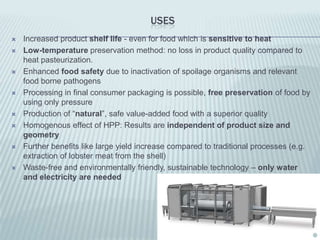
   Increased product shelf life - even for food which is sensitive to heat
   Low-temperature preservation method: no loss in product quality compared to
    heat pasteurization.
   Enhanced food safety due to inactivation of spoilage organisms and relevant
    food borne pathogens
   Processing in final consumer packaging is possible, free preservation of food by
    using only pressure
   Production of “natural”, safe value-added food with a superior quality
   Homogenous effect of HPP: Results are independent of product size and
    geometry
   Further benefits like large yield increase compared to traditional processes (e.g.
    extraction of lobster meat from the shell)
   Waste-free and environmentally friendly, sustainable technology – only water
    and electricity are needed

High pressure preservation

  • 1.
    HIGH PRESSURE PRESERVATION .
  • 2.
    INTRODUCTION  High-pressure processing (HPP) is a “nonthermal” food preservation technique that inactivates harmful pathogens and vegetative spoilage microorganisms by using pressure rather than heat to effect pasteurization.  Allowing most foods to be preserved with minimal effects on taste, texture, appearance, or nutritional value.  Pressure treatment can be used to process both liquid and high-moisture- content solid foods.( Aw=0.95)  For example, a grape can be easily crushed if pressure is applied to it by placing it between two fingers and squeezing along one axis. In contrast, if the grape is exposed to a uniform pressure by submerging it in water inside a sealed flexible bottle and squeezing, the grape retains its shape no matter how hard the  bottle is squeezed. In this case, the pressure transmitted from the bottle wall through the water is applied uniformly around the fruit.  Porous system will collapse ( eg strawberries are crushed by HPP)  U.S., Canada, and Mexico, Spain, Italy, Portugal, France, UK, and Germany, Australia, and Asia (Japan, China, and S. Korea) lead the commercialization of high pressure technology.  Cost is 0.5-2.5 Million $ ( equipment) and HPP treatment costs are quoted as ranging from 4–10 cents/lb ( equal to that of thermal processing)
  • 3.
    PRINCIPLE. • Le Chatelier’sprinciple. Any phenomenon (phase transition, change in molecular Configuration, chemical reaction) accompanied by a decrease in volume is enhanced by pressure. Accordingly, pressure shifts the system to that of lowest volume. Isostatic principle: The principle of isostatic processing is presented in . The food products are compressed by uniform pressure from every direction and then returned to their original shape when the pressure is released. The products are compressed independently of the product size and geometry because transmission of pressure to the core is not mass/time dependant thus the process is minimized If a food product contains sufficient moisture, pressure will not damage the product at the macroscopic levels as long as the pressure is applied uniformly in all directions
  • 4.
    HIGH PRESSURE EQUIPMENT  COMPONENTS  1) Pressure vessel  2) High pressure intensifier pump  3) a system for controlling and monitoring the pressure  4) a product-handling system for transferring product to and from the pressure vessel  5) Compressing medium like water, glycol solutions,silicone oil, sodium benzoate solutions, ethanol solutions, inert gases .
  • 5.
    A typical HPPprocess uses food products packaged in a high-barrier, flexible pouch or a plastic container. The packages are loaded into the high-pressure chamber The vessel is sealed and the vessel is filled with a pressure transmitting fluid (normally water). Pressurized by the use of a high-pressure pump, which injects additional quantities of fluid. The packages of food, surrounded by the pressure-transmitting fluid, are subjected to the same pressure as exists in the vessel itself. After holding the product for the desired time at the target pressure, the vessel is decompressed by releasing the pressure-transmitting fluid. Approximately 5–6 cycles/hr are possible, allowing time for compression, holding, decompression, loading, and unloading. After pressure treatment, the processed product is removed from the vessel and stored/distributed in a conventional manner.
  • 6.
    Prodcuts Pressure Shelf life Inhibits Advantage ( Mpa) ( at 4 deg ( pathogens ( 1-5mins) C) and spoilage ) Meat and meat 500-600 More than Listeria , Effective in eliminating products 90 days Salmonella , pathogenic micro- ( sliced, ( 45 days E.coli, moulds , organisms. marinated,whol without yeast etc. e) 31% HPP) Dairy products 400-600 3-10 times Yeast , moulds, No impact on sensory, ( milk , cheese) E.coli etc. nutritional and 6% functional properties Sea food 350 - 400 2 times Salmonella, Shucking and meat ( Vibrio, Anisakis extraction Molluska,ready etc to eat ) 16% Fruits and 400-600 3-10 times Spoiling Healthier food rich in Vegetables microbes ( yeast vitamins,minerals etc ( juices , etc) sauces,onions And pathogens. ) 47%
  • 7.
    MICROBIAL EFFICACY  Inactivates most vegetative pathogenic and spoilage microorganisms at pressures above 200 Mpa at RT.  causes damage to cell membranes and denatures some intracellular proteins leading to cell death.  Reduced pH is generally synergistic with pressure in eliminating microorganisms.  The process can also sub-lethally stress or injure bacteria.  Bacterial spores >gram positive > gram negative > moulds, yeast (pressure resistant)  Inactivation of key enzymes, including those involved in DNA replication and transcription is also mentioned as a possible inactivating mechanism.
  • 8.
    USES  Increased product shelf life - even for food which is sensitive to heat  Low-temperature preservation method: no loss in product quality compared to heat pasteurization.  Enhanced food safety due to inactivation of spoilage organisms and relevant food borne pathogens  Processing in final consumer packaging is possible, free preservation of food by using only pressure  Production of “natural”, safe value-added food with a superior quality  Homogenous effect of HPP: Results are independent of product size and geometry  Further benefits like large yield increase compared to traditional processes (e.g. extraction of lobster meat from the shell)  Waste-free and environmentally friendly, sustainable technology – only water and electricity are needed