HIGH PRESSURE
PROCESSING
SAHLA PARVIN M K
M.TECH FOOD TECHNOLOGY
23412MFT016
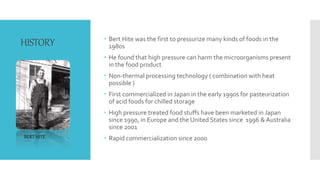
HISTORY  Bert Hite was the first to pressurize many kinds of foods in the
1980s
 He found that high pressure can harm the microorganisms present
in the food product
 Non-thermal processing technology ( combination with heat
possible )
 First commercialized in Japan in the early 1990s for pasteurization
of acid foods for chilled storage
 High pressure treated food stuffs have been marketed in Japan
since 1990, in Europe and the United States since 1996 & Australia
since 2001
 Rapid commercialization since 2000
BERT HITE
INTRODUCTION
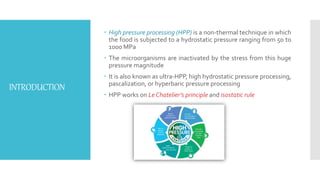
 High pressure processing (HPP) is a non-thermal technique in which
the food is subjected to a hydrostatic pressure ranging from 50 to
1000 MPa
 The microorganisms are inactivated by the stress from this huge
pressure magnitude
 It is also known as ultra-HPP, high hydrostatic pressure processing,
pascalization, or hyperbaric pressure processing
 HPP works on LeChatelier’s principle and isostatic rule
LECHATELIER’S
PRINCIPLE
ISOSTATICRULE
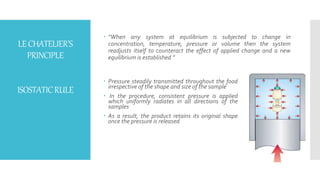
 “When any system at equilibrium is subjected to change in
concentration, temperature, pressure or volume then the system
readjusts itself to counteract the effect of applied change and a new
equilibrium is established ”
 Pressure steadily transmitted throughout the food
irrespective of the shape and size of the sample
 In the procedure, consistent pressure is applied
which uniformly radiates in all directions of the
samples
 As a result, the product retains its original shape
once the pressure is released
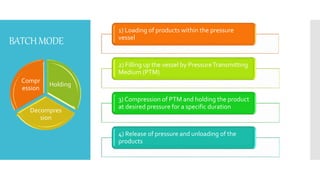
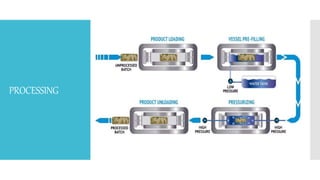
BATCHMODE
1) Loading of products within the pressure
vessel
2) Filling up the vessel by PressureTransmitting
Medium (PTM)
3) Compression of PTM and holding the product
at desired pressure for a specific duration
4) Release of pressure and unloading of the
products
Holding
Decompres
sion
Compr
ession
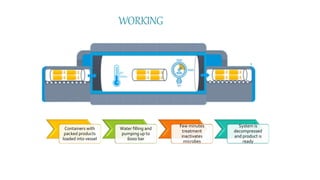
WORKING
Containers with
packed products
loaded into vessel
Water filling and
pumping up to
6000 bar
Few minutes
treatment
inactivates
microbes
System is
decompressed
and product is
ready
PROCESSING
TYPEOFFOOD
PRODUCTS
SUITABLEFORHPP
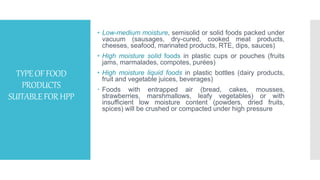
• Low-medium moisture, semisolid or solid foods packed under
vacuum (sausages, dry-cured, cooked meat products,
cheeses, seafood, marinated products, RTE, dips, sauces)
• High moisture solid foods in plastic cups or pouches (fruits
jams, marmalades, compotes, purées)
• High moisture liquid foods in plastic bottles (dairy products,
fruit and vegetable juices, beverages)
 Foods with entrapped air (bread, cakes, mousses,
strawberries, marshmallows, leafy vegetables) or with
insufficient low moisture content (powders, dried fruits,
spices) will be crushed or compacted under high pressure
MECHANISMOF
MICROBIAL
INACTIVATION
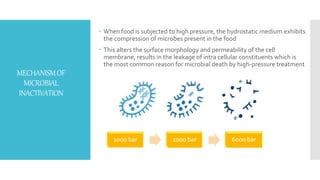
 When food is subjected to high pressure, the hydrostatic medium exhibits
the compression of microbes present in the food
 This alters the surface morphology and permeability of the cell
membrane, results in the leakage of intra cellular constituents which is
the most common reason for microbial death by high-pressure treatment
1000 bar 2000 bar 6000 bar
MECHANISMOF
INACTIVATING
SPOILAGEENZYMES
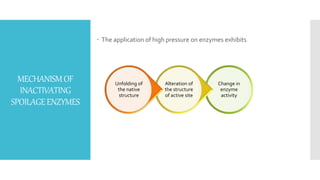
 The application of high pressure on enzymes exhibits
Change in
enzyme
activity
Alteration of
the structure
of active site
Unfolding of
the native
structure
EFFECTOFHPP
ONSHELF-LIFE
 HPP effect on shelf life extension depends on process and
product parameters
 High pressure and longer holding time generally favor
microbial inactivation and decrease of enzyme activity
 Storage temperature after HPP is also the factor that can
influence shelf life of the product
 HPP can increase shelf life to 10 times in comparison to non-
treated fresh products
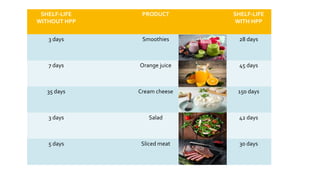
SHELF-LIFE
WITHOUT HPP
PRODUCT SHELF-LIFE
WITH HPP
3 days Smoothies 28 days
7 days Orange juice 45 days
35 days Cream cheese 150 days
3 days Salad 42 days
5 days Sliced meat 30 days
APPLICATIONSOFHPPIN
FOODINDUSTRY
FRUITSAND
VEGETABLES
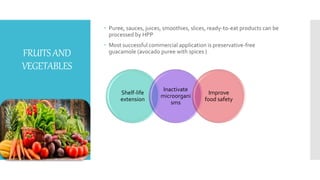
 Puree, sauces, juices, smoothies, slices, ready-to-eat products can be
processed by HPP
 Most successful commercial application is preservative-free
guacamole (avocado puree with spices )
Shelf-life
extension
Inactivate
microorgani
sms
Improve
food safety
MEATANDFISH
INDUSTRY
.
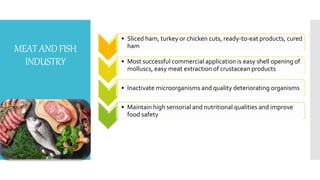
• Sliced ham, turkey or chicken cuts, ready-to-eat products, cured
ham
.
• Most successful commercial application is easy shell opening of
molluscs, easy meat extraction of crustacean products
• Inactivate microorganisms and quality deteriorating organisms
• Maintain high sensorial and nutritional qualities and improve
food safety
DAIRYINDUSTRY
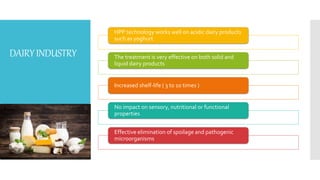
HPP technology works well on acidic dairy products
such as yoghurt
The treatment is very effective on both solid and
liquid dairy products
Increased shelf-life ( 3 to 10 times )
No impact on sensory, nutritional or functional
properties
Effective elimination of spoilage and pathogenic
microorganisms
PACKAGING
REQUIREMENTSFOR
HPP
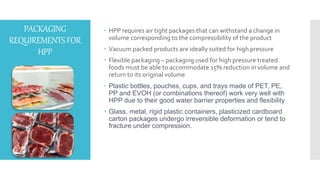
 HPP requires air tight packages that can withstand a change in
volume corresponding to the compressibility of the product
 Vacuum packed products are ideally suited for high pressure
 Flexible packaging – packaging used for high pressure treated
foods must be able to accommodate 15% reduction in volume and
return to its original volume
 Plastic bottles, pouches, cups, and trays made of PET, PE,
PP and EVOH (or combinations thereof) work very well with
HPP due to their good water barrier properties and flexibility
 Glass, metal, rigid plastic containers, plasticized cardboard
carton packages undergo irreversible deformation or tend to
fracture under compression.
HIGH PRESSURE  PROCESSING ( HPP )  .pptx

HIGH PRESSURE PROCESSING ( HPP ) .pptx

  • 1.
    HIGH PRESSURE PROCESSING SAHLA PARVINM K M.TECH FOOD TECHNOLOGY 23412MFT016
  • 2.
    HISTORY  BertHite was the first to pressurize many kinds of foods in the 1980s  He found that high pressure can harm the microorganisms present in the food product  Non-thermal processing technology ( combination with heat possible )  First commercialized in Japan in the early 1990s for pasteurization of acid foods for chilled storage  High pressure treated food stuffs have been marketed in Japan since 1990, in Europe and the United States since 1996 & Australia since 2001  Rapid commercialization since 2000 BERT HITE
  • 3.
    INTRODUCTION  High pressureprocessing (HPP) is a non-thermal technique in which the food is subjected to a hydrostatic pressure ranging from 50 to 1000 MPa  The microorganisms are inactivated by the stress from this huge pressure magnitude  It is also known as ultra-HPP, high hydrostatic pressure processing, pascalization, or hyperbaric pressure processing  HPP works on LeChatelier’s principle and isostatic rule
  • 4.
    LECHATELIER’S PRINCIPLE ISOSTATICRULE  “When anysystem at equilibrium is subjected to change in concentration, temperature, pressure or volume then the system readjusts itself to counteract the effect of applied change and a new equilibrium is established ”  Pressure steadily transmitted throughout the food irrespective of the shape and size of the sample  In the procedure, consistent pressure is applied which uniformly radiates in all directions of the samples  As a result, the product retains its original shape once the pressure is released
  • 5.
    BATCHMODE 1) Loading ofproducts within the pressure vessel 2) Filling up the vessel by PressureTransmitting Medium (PTM) 3) Compression of PTM and holding the product at desired pressure for a specific duration 4) Release of pressure and unloading of the products Holding Decompres sion Compr ession
  • 6.
    WORKING Containers with packed products loadedinto vessel Water filling and pumping up to 6000 bar Few minutes treatment inactivates microbes System is decompressed and product is ready
  • 7.
  • 8.
    TYPEOFFOOD PRODUCTS SUITABLEFORHPP • Low-medium moisture,semisolid or solid foods packed under vacuum (sausages, dry-cured, cooked meat products, cheeses, seafood, marinated products, RTE, dips, sauces) • High moisture solid foods in plastic cups or pouches (fruits jams, marmalades, compotes, purées) • High moisture liquid foods in plastic bottles (dairy products, fruit and vegetable juices, beverages)  Foods with entrapped air (bread, cakes, mousses, strawberries, marshmallows, leafy vegetables) or with insufficient low moisture content (powders, dried fruits, spices) will be crushed or compacted under high pressure
  • 10.
    MECHANISMOF MICROBIAL INACTIVATION  When foodis subjected to high pressure, the hydrostatic medium exhibits the compression of microbes present in the food  This alters the surface morphology and permeability of the cell membrane, results in the leakage of intra cellular constituents which is the most common reason for microbial death by high-pressure treatment 1000 bar 2000 bar 6000 bar
  • 12.
    MECHANISMOF INACTIVATING SPOILAGEENZYMES  The applicationof high pressure on enzymes exhibits Change in enzyme activity Alteration of the structure of active site Unfolding of the native structure
  • 13.
    EFFECTOFHPP ONSHELF-LIFE  HPP effecton shelf life extension depends on process and product parameters  High pressure and longer holding time generally favor microbial inactivation and decrease of enzyme activity  Storage temperature after HPP is also the factor that can influence shelf life of the product  HPP can increase shelf life to 10 times in comparison to non- treated fresh products
  • 14.
    SHELF-LIFE WITHOUT HPP PRODUCT SHELF-LIFE WITHHPP 3 days Smoothies 28 days 7 days Orange juice 45 days 35 days Cream cheese 150 days 3 days Salad 42 days 5 days Sliced meat 30 days
  • 15.
  • 16.
    FRUITSAND VEGETABLES  Puree, sauces,juices, smoothies, slices, ready-to-eat products can be processed by HPP  Most successful commercial application is preservative-free guacamole (avocado puree with spices ) Shelf-life extension Inactivate microorgani sms Improve food safety
  • 17.
    MEATANDFISH INDUSTRY . • Sliced ham,turkey or chicken cuts, ready-to-eat products, cured ham . • Most successful commercial application is easy shell opening of molluscs, easy meat extraction of crustacean products • Inactivate microorganisms and quality deteriorating organisms • Maintain high sensorial and nutritional qualities and improve food safety
  • 18.
    DAIRYINDUSTRY HPP technology workswell on acidic dairy products such as yoghurt The treatment is very effective on both solid and liquid dairy products Increased shelf-life ( 3 to 10 times ) No impact on sensory, nutritional or functional properties Effective elimination of spoilage and pathogenic microorganisms
  • 19.
    PACKAGING REQUIREMENTSFOR HPP  HPP requiresair tight packages that can withstand a change in volume corresponding to the compressibility of the product  Vacuum packed products are ideally suited for high pressure  Flexible packaging – packaging used for high pressure treated foods must be able to accommodate 15% reduction in volume and return to its original volume  Plastic bottles, pouches, cups, and trays made of PET, PE, PP and EVOH (or combinations thereof) work very well with HPP due to their good water barrier properties and flexibility  Glass, metal, rigid plastic containers, plasticized cardboard carton packages undergo irreversible deformation or tend to fracture under compression.