High-Performance
Liquid Chromatography
Prepared by- ALOK RANJAN
(M.V.Sc. II YEAR)
Deptt. Of Animal Nutrition
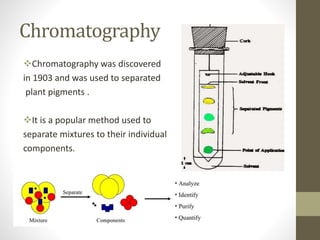
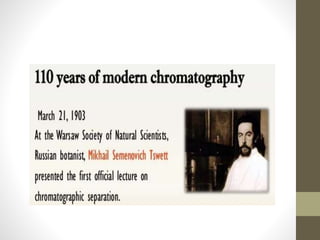
Chromatography
Chromatography was discovered
in 1903 and was used to separated
plant pigments .
It is a popular method used to
separate mixtures to their individual
components.
Scope
• The history of HPLC began in the 60’s and was known as high
pressure liquid chromatography.
• The instrumentation and columns improved over the time and it is
now known as high performance liquid chromatography.
• HPLC separation technique provides high speed, efficiency and high
sensitivity as compared to liquid chromatography.
• A very small volume of sample is injected into a tube packed with a
stationary phase (3-5 microns particles).
• The sample is pushed down the column with a mobile phase by
applying high pressure and the components are detected and
quantified as they exit the column.
Introduction
• A popular analytical technique used for the separation,
identification and quantification
• solvent usually flows through column but here,solvents
are forced.
• solvent will be forced under high pressures upto 400
atmospheres so that sample can be separated
• Chromatography can be depicted as a mass exchange
process including adsorption
• the adsorbent, is regularly a granular material made of
solid particles (e.g. silica, polymers, etc.) 2 μm to 50 μm
in size
• pressurized fluid is commonly a blend of solvents (e.g.
water, acetonitrile and/or methanol) and is known as
‘mobile phase’
• (HPLC depends on pumps to pass a pressurized fluid and
an example blend through a section loaded with
adsorbent, prompting the partition of the specimen
segments.)
• -The pressurized fluid is commonly a blend of solvents
(e.g. water, acetonitrile and/or methanol) and is known
as ‘mobile phase’.
• Its organization and temperature plays an important part
in the partition procedure by affecting the connections
occurring between sample segments and adsorbent
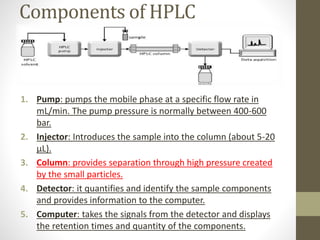
Components of HPLC
1. Pump: pumps the mobile phase at a specific flow rate in
mL/min. The pump pressure is normally between 400-600
bar.
2. Injector: Introduces the sample into the column (about 5-20
μL).
3. Column: provides separation through high pressure created
by the small particles.
4. Detector: it quantifies and identify the sample components
and provides information to the computer.
5. Computer: takes the signals from the detector and displays
the retention times and quantity of the components.
Principle of HPLC
• The process involves interaction of compounds in the analyte
(which travels along the mobile phase ) across an immobile
surface(stationary phase).
• The compounds bind at the specific regions of stationary
phase based on certain physical and chemical properties.
• This bound molecules are then eluted with a suitable buffer
and are the same collected with time.
• The more polar compounds adsorbed with silica i.e. stationary
phase, Hence move slowly while compounds with
hydrophobic nature doesn’t bind with stationary phase, Hence
moves faster & comes out first and displays its graph.
HPLC

HPLC

  • 1.
    High-Performance Liquid Chromatography Prepared by-ALOK RANJAN (M.V.Sc. II YEAR) Deptt. Of Animal Nutrition
  • 2.
    Chromatography Chromatography was discovered in1903 and was used to separated plant pigments . It is a popular method used to separate mixtures to their individual components.
  • 4.
    Scope • The historyof HPLC began in the 60’s and was known as high pressure liquid chromatography. • The instrumentation and columns improved over the time and it is now known as high performance liquid chromatography. • HPLC separation technique provides high speed, efficiency and high sensitivity as compared to liquid chromatography. • A very small volume of sample is injected into a tube packed with a stationary phase (3-5 microns particles). • The sample is pushed down the column with a mobile phase by applying high pressure and the components are detected and quantified as they exit the column.
  • 5.
    Introduction • A popularanalytical technique used for the separation, identification and quantification • solvent usually flows through column but here,solvents are forced. • solvent will be forced under high pressures upto 400 atmospheres so that sample can be separated • Chromatography can be depicted as a mass exchange process including adsorption • the adsorbent, is regularly a granular material made of solid particles (e.g. silica, polymers, etc.) 2 μm to 50 μm in size • pressurized fluid is commonly a blend of solvents (e.g. water, acetonitrile and/or methanol) and is known as ‘mobile phase’
  • 6.
    • (HPLC dependson pumps to pass a pressurized fluid and an example blend through a section loaded with adsorbent, prompting the partition of the specimen segments.) • -The pressurized fluid is commonly a blend of solvents (e.g. water, acetonitrile and/or methanol) and is known as ‘mobile phase’. • Its organization and temperature plays an important part in the partition procedure by affecting the connections occurring between sample segments and adsorbent
  • 7.
    Components of HPLC 1.Pump: pumps the mobile phase at a specific flow rate in mL/min. The pump pressure is normally between 400-600 bar. 2. Injector: Introduces the sample into the column (about 5-20 μL). 3. Column: provides separation through high pressure created by the small particles. 4. Detector: it quantifies and identify the sample components and provides information to the computer. 5. Computer: takes the signals from the detector and displays the retention times and quantity of the components.
  • 8.
    Principle of HPLC •The process involves interaction of compounds in the analyte (which travels along the mobile phase ) across an immobile surface(stationary phase). • The compounds bind at the specific regions of stationary phase based on certain physical and chemical properties. • This bound molecules are then eluted with a suitable buffer and are the same collected with time. • The more polar compounds adsorbed with silica i.e. stationary phase, Hence move slowly while compounds with hydrophobic nature doesn’t bind with stationary phase, Hence moves faster & comes out first and displays its graph.