Basic Terms and Concepts of
Mechanical Ventilation
Dr.sivaraj karri
Senior resident
Dept of pulmonary medicine,GSL.
Normal Mechanics Of Spontaneous
Ventilation
 Ventilation- is simply the movement of air into and out of the lungs.
 Respiration - involves the exchange of oxygen and carbondioxide between an
organism and its environment.
 external respiration
 internal respiration.
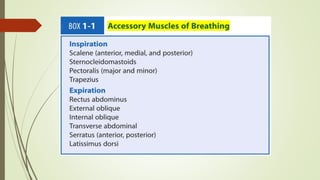
 Accessory Muscles of Breathing
Gas Flow and Pressure Gradients During
Ventilation
 For air to flow through a tube or airway, a pressure gradient must exist.
 when the pressure at the airway opening and the pressure in the alveoli are the
same, as occurs at the end of expiration, no gas flow occurs because the pressures
across the conductive airways are equal (i.e., there is no pressure gradient).
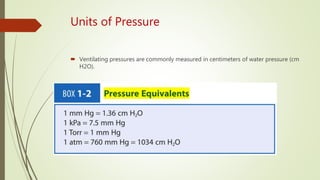
Units of Pressure
 Ventilating pressures are commonly measured in centimeters of water pressure (cm
H2O).
Definition of Pressures and Gradients in
the Lungs
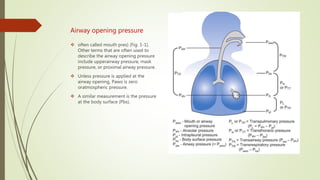
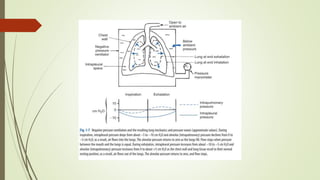
Airway opening pressure
 often called mouth pres) (Fig. 1-1).
Other terms that are often used to
describe the airway opening pressure
include upperairway pressure, mask
pressure, or proximal airway pressure.
 Unless pressure is applied at the
airway opening, Pawo is zero
oratmospheric pressure.
 A similar measurement is the pressure
at the body surface (Pbs).
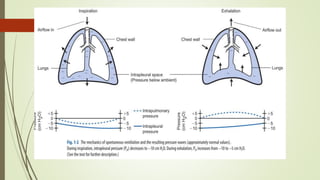
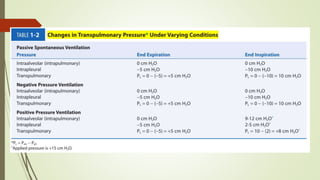
Intrapleural pressure (Ppl)
 is normally about −5 cm H2O at the
end of expiration during spontaneous
breathing. It is about −10 cm
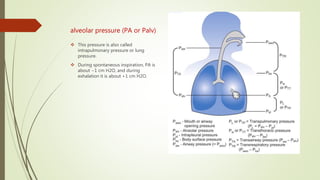
alveolar pressure (PA or Palv)
 This pressure is also called
intrapulmonary pressure or lung
pressure.
 During spontaneous inspiration, PA is
about −1 cm H2O, and during
exhalation it is about +1 cm H2O.
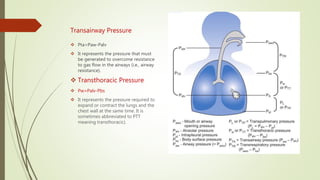
Transairway Pressure
 Pta=Paw-Palv
 It represents the pressure that must
be generated to overcome resistance
to gas flow in the airways (i.e., airway
resistance).
 Transthoracic Pressure
 Pw=Palv-Pbs
 It represents the pressure required to
expand or contract the lungs and the
chest wall at the same time. It is
sometimes abbreviated to PTT
meaning transthoracic).
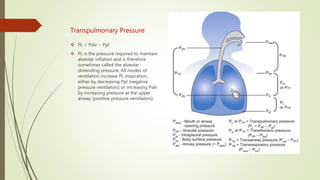
Transpulmonary Pressure
 PL = Palv − Ppl
 PL is the pressure required to maintain
alveolar inflation and is therefore
sometimes called the alveolar
distending pressure. All modes of
ventilation increase PL inspiration,
either by decreasing Ppl (negative
pressure ventilators) or increasing Palv
by increasing pressure at the upper
airway (positive pressure ventilators).
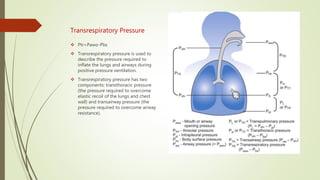
Transrespiratory Pressure
 Ptr=Pawo-Pbs
 Transrespiratory pressure is used to
describe the pressure required to
inflate the lungs and airways during
positive pressure ventilation.
 Transrespiratory pressure has two
components: transthoracic pressure
(the pressure required to overcome
elastic recoil of the lungs and chest
wall) and transairway pressure (the
pressure required to overcome airway
resistance).
LUNG CHARACTERISTICS
 Normally, two types of forces oppose inflation of the lungs: elastic forces and
frictional forces.
 compliance and resistance
Which one is more elastic ?
Tennis ball Golf ball
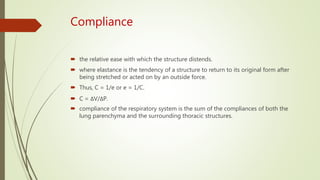
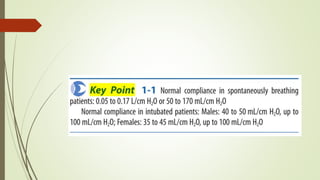
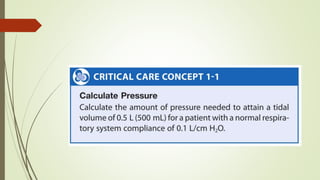
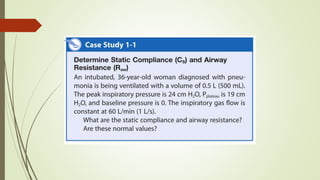
Compliance
 the relative ease with which the structure distends.
 where elastance is the tendency of a structure to return to its original form after
being stretched or acted on by an outside force.
 Thus, C = 1/e or e = 1/C.
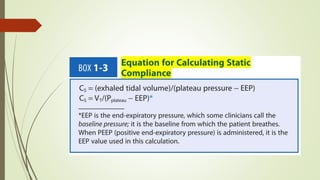
 C = ΔV/ΔP.
 compliance of the respiratory system is the sum of the compliances of both the
lung parenchyma and the surrounding thoracic structures.
Resistance
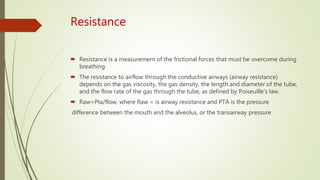
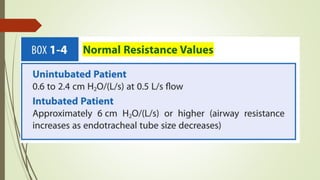
 Resistance is a measurement of the frictional forces that must be overcome during
breathing
 The resistance to airflow through the conductive airways (airway resistance)
depends on the gas viscosity, the gas density, the length and diameter of the tube,
and the flow rate of the gas through the tube, as defined by Poiseuille’s law.
 Raw=Pta/flow, where Raw = is airway resistance and PTA is the pressure
difference between the mouth and the alveolus, or the transairway pressure
TIME CONSTANTS
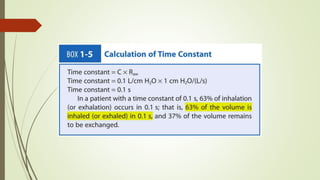
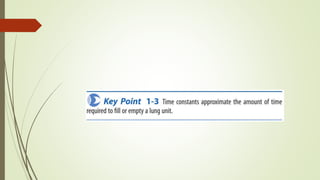
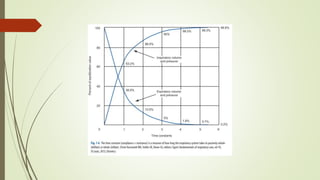
 The product of compliance (C) and resistance (Raw called a time constant.
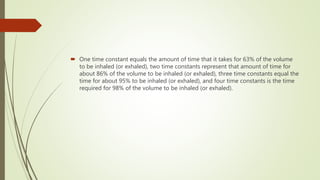
 One time constant equals the amount of time that it takes for 63% of the volume
to be inhaled (or exhaled), two time constants represent that amount of time for
about 86% of the volume to be inhaled (or exhaled), three time constants equal the
time for about 95% to be inhaled (or exhaled), and four time constants is the time
required for 98% of the volume to be inhaled (or exhaled).
TYPES OF MECHANICAL VENTILATION
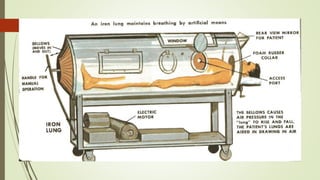
 Negative Pressure Ventilation
 Negative pressure ventilators do provide several advantages. The upper airway can
be maintained without the use of an endotracheal tube or tracheostomy. Patients
receiving negative pressure ventilation can talk and eat while being ventilated.
Negative pressure ventilation has fewer physiological disadvantages in patients
with normal cardiovascular function than positive pressure ventilation.
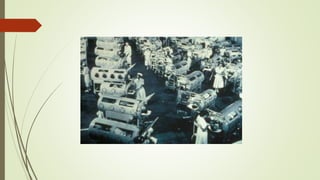
 chest cuirass, Poncho wrap, and Porta-Lung) have been used in home care to treat
patients with chronic respiratory failure associated with neuromuscular diseases
(e.g., polio and amyotrophic lateral sclerosis).9-12 More recently, these devices
have been replaced with noninvasive positive pressure ventilators (NIV)
Positive Pressure Ventilation
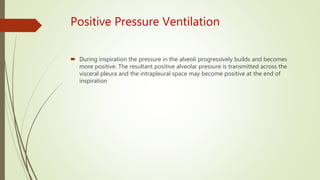
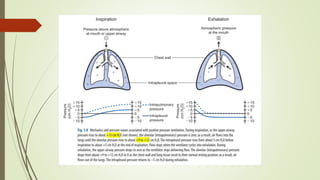
 During inspiration the pressure in the alveoli progressively builds and becomes
more positive. The resultant positive alveolar pressure is transmitted across the
visceral pleura and the intrapleural space may become positive at the end of
inspiration
High-Frequency Ventilation
 High-frequency ventilation uses above-normal ventilating rates with below-normal
ventilating volumes.
 high-frequency positive pressure ventilation (HFPPV), which uses respiratory rates
of about 60 to 100 breaths/min;
 high-frequency jet ventilation (HFJV), which uses rates between about 100 and 400
to 600 breaths/min;
 high-frequency oscillatory ventilation (HFOV), which uses rates into the thousands,
up to about 4000 breaths/min.
 Ventilation with high-frequency oscillation has been used primarily in infants with
respiratory distress and in adults or infants with open air leaks, such as
bronchopleural fistulas.
DEFINITION OF PRESSURES IN POSITIVE
PRESSURE VENTILATION
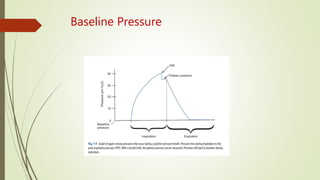
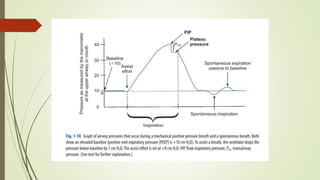
Baseline Pressure
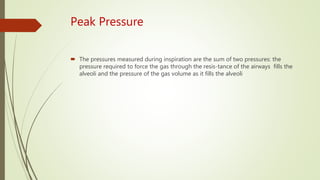
Peak Pressure
 The pressures measured during inspiration are the sum of two pressures: the
pressure required to force the gas through the resis-tance of the airways fills the
alveoli and the pressure of the gas volume as it fills the alveoli
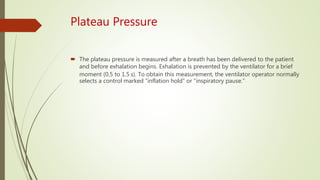
Plateau Pressure
 The plateau pressure is measured after a breath has been delivered to the patient
and before exhalation begins. Exhalation is prevented by the ventilator for a brief
moment (0.5 to 1.5 s). To obtain this measurement, the ventilator operator normally
selects a control marked “inflation hold” or “inspiratory pause.”
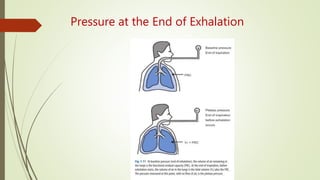
Pressure at the End of Exhalation
THANK U

Basic terms and concepts of mechanical ventilation

  • 1.
    Basic Terms andConcepts of Mechanical Ventilation Dr.sivaraj karri Senior resident Dept of pulmonary medicine,GSL.
  • 2.
    Normal Mechanics OfSpontaneous Ventilation  Ventilation- is simply the movement of air into and out of the lungs.  Respiration - involves the exchange of oxygen and carbondioxide between an organism and its environment.  external respiration  internal respiration.  Accessory Muscles of Breathing
  • 4.
    Gas Flow andPressure Gradients During Ventilation  For air to flow through a tube or airway, a pressure gradient must exist.  when the pressure at the airway opening and the pressure in the alveoli are the same, as occurs at the end of expiration, no gas flow occurs because the pressures across the conductive airways are equal (i.e., there is no pressure gradient).
  • 5.
    Units of Pressure Ventilating pressures are commonly measured in centimeters of water pressure (cm H2O).
  • 6.
    Definition of Pressuresand Gradients in the Lungs
  • 7.
    Airway opening pressure often called mouth pres) (Fig. 1-1). Other terms that are often used to describe the airway opening pressure include upperairway pressure, mask pressure, or proximal airway pressure.  Unless pressure is applied at the airway opening, Pawo is zero oratmospheric pressure.  A similar measurement is the pressure at the body surface (Pbs).
  • 8.
    Intrapleural pressure (Ppl) is normally about −5 cm H2O at the end of expiration during spontaneous breathing. It is about −10 cm
  • 9.
    alveolar pressure (PAor Palv)  This pressure is also called intrapulmonary pressure or lung pressure.  During spontaneous inspiration, PA is about −1 cm H2O, and during exhalation it is about +1 cm H2O.
  • 10.
    Transairway Pressure  Pta=Paw-Palv It represents the pressure that must be generated to overcome resistance to gas flow in the airways (i.e., airway resistance).  Transthoracic Pressure  Pw=Palv-Pbs  It represents the pressure required to expand or contract the lungs and the chest wall at the same time. It is sometimes abbreviated to PTT meaning transthoracic).
  • 11.
    Transpulmonary Pressure  PL= Palv − Ppl  PL is the pressure required to maintain alveolar inflation and is therefore sometimes called the alveolar distending pressure. All modes of ventilation increase PL inspiration, either by decreasing Ppl (negative pressure ventilators) or increasing Palv by increasing pressure at the upper airway (positive pressure ventilators).
  • 12.
    Transrespiratory Pressure  Ptr=Pawo-Pbs Transrespiratory pressure is used to describe the pressure required to inflate the lungs and airways during positive pressure ventilation.  Transrespiratory pressure has two components: transthoracic pressure (the pressure required to overcome elastic recoil of the lungs and chest wall) and transairway pressure (the pressure required to overcome airway resistance).
  • 15.
    LUNG CHARACTERISTICS  Normally,two types of forces oppose inflation of the lungs: elastic forces and frictional forces.  compliance and resistance
  • 16.
    Which one ismore elastic ? Tennis ball Golf ball
  • 17.
    Compliance  the relativeease with which the structure distends.  where elastance is the tendency of a structure to return to its original form after being stretched or acted on by an outside force.  Thus, C = 1/e or e = 1/C.  C = ΔV/ΔP.  compliance of the respiratory system is the sum of the compliances of both the lung parenchyma and the surrounding thoracic structures.
  • 21.
    Resistance  Resistance isa measurement of the frictional forces that must be overcome during breathing  The resistance to airflow through the conductive airways (airway resistance) depends on the gas viscosity, the gas density, the length and diameter of the tube, and the flow rate of the gas through the tube, as defined by Poiseuille’s law.  Raw=Pta/flow, where Raw = is airway resistance and PTA is the pressure difference between the mouth and the alveolus, or the transairway pressure
  • 24.
    TIME CONSTANTS  Theproduct of compliance (C) and resistance (Raw called a time constant.
  • 26.
     One timeconstant equals the amount of time that it takes for 63% of the volume to be inhaled (or exhaled), two time constants represent that amount of time for about 86% of the volume to be inhaled (or exhaled), three time constants equal the time for about 95% to be inhaled (or exhaled), and four time constants is the time required for 98% of the volume to be inhaled (or exhaled).
  • 29.
    TYPES OF MECHANICALVENTILATION  Negative Pressure Ventilation  Negative pressure ventilators do provide several advantages. The upper airway can be maintained without the use of an endotracheal tube or tracheostomy. Patients receiving negative pressure ventilation can talk and eat while being ventilated. Negative pressure ventilation has fewer physiological disadvantages in patients with normal cardiovascular function than positive pressure ventilation.
  • 33.
     chest cuirass,Poncho wrap, and Porta-Lung) have been used in home care to treat patients with chronic respiratory failure associated with neuromuscular diseases (e.g., polio and amyotrophic lateral sclerosis).9-12 More recently, these devices have been replaced with noninvasive positive pressure ventilators (NIV)
  • 35.
    Positive Pressure Ventilation During inspiration the pressure in the alveoli progressively builds and becomes more positive. The resultant positive alveolar pressure is transmitted across the visceral pleura and the intrapleural space may become positive at the end of inspiration
  • 37.
    High-Frequency Ventilation  High-frequencyventilation uses above-normal ventilating rates with below-normal ventilating volumes.  high-frequency positive pressure ventilation (HFPPV), which uses respiratory rates of about 60 to 100 breaths/min;  high-frequency jet ventilation (HFJV), which uses rates between about 100 and 400 to 600 breaths/min;  high-frequency oscillatory ventilation (HFOV), which uses rates into the thousands, up to about 4000 breaths/min.  Ventilation with high-frequency oscillation has been used primarily in infants with respiratory distress and in adults or infants with open air leaks, such as bronchopleural fistulas.
  • 38.
    DEFINITION OF PRESSURESIN POSITIVE PRESSURE VENTILATION
  • 39.
  • 40.
    Peak Pressure  Thepressures measured during inspiration are the sum of two pressures: the pressure required to force the gas through the resis-tance of the airways fills the alveoli and the pressure of the gas volume as it fills the alveoli
  • 41.
    Plateau Pressure  Theplateau pressure is measured after a breath has been delivered to the patient and before exhalation begins. Exhalation is prevented by the ventilator for a brief moment (0.5 to 1.5 s). To obtain this measurement, the ventilator operator normally selects a control marked “inflation hold” or “inspiratory pause.”
  • 43.
    Pressure at theEnd of Exhalation
  • 44.