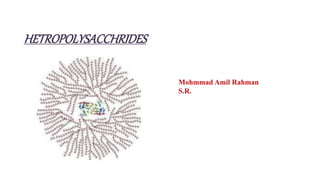
HETROPOLYSACCHRIDES
Mohmmad Amil Rahman
S.R.
Carbohydrates
• Carbohydrates can be defined as polyhydroxyaldehydes and
polyhydroxyketones or compounds that give
polyhydroxyaldehydes and/or polyhydroxyketones on
hydrolysis
Or
• the carbohydrates can be defined as the aldehyde or ketone
derivatives of polyhydric alcohols
Hetropolysacchrides
The heteropolysaccharides are made up of more than one kind of
monosaccharides and monosaccharide derivatives.
Or
They are also repeating units of disaccharides which is made of
modified monosaccharide units.
a) The most important heteropolysaccharides in human beings are the
mucopolysaccharides (glycosaminoglycans).
b) These are present in connective tissues and mucous secretions.
c) Hexosamines and uronic acids are the prominent constituents of
mucopolysaccharides.
Mucopolysacchrides (Glycosaminoglycans)
Glycosaminoglycans (GAGs) are a family of highly sulphated,
complex & polydisperse linear polysaccharides that have a variety
of important biological roles.
Composed of Amino Sugars ( Hexosamine ) & Uronic Acid
units.
 Some of the GAGs do not contain Uronic Acids.
 Hexosamines are generally acetylated.
 GAGs are essential components of tissues either in free form or
as a complex of proteins
a. Mucoproteins : > 10% carbohydrate content
b. Glycoproteins : < 10% carbohydrate content
Glycosaminoglycans(GAG)
Components of Glycosaminoglycan :
1. Hexosamine or Amino Sugars :
 Glucosamine
 Galactosamine
 Manosamine
 or their Acetylated Derivatives
2. Uronic Acid
 Glucuronic Acid (GlcUA)
 Iduronic Acid (IDUA)
 Constituent of certain Mucopolysaccharides
 Chitin/ Chitosamine
Present in Chondritin Sulphates that are
present in cartilage, bones, tendons and
heart valves… Chondrosamine
Derivatives of Amino Sugars
Uronic Acid
Oxidation Of Aldose
At Primary Alcohol
(Terminal Carbon)
H-C=O

H-C-OH

OH-C-H

H-C-OH

H-C-OH

CH2OH
COOH
Glycosaminoglycans
Glucuronic Acid :
A sugar acid derived from glucose, with its sixth carbon
atom oxidized to a carboxylic acid.
1. Glucose  Glucuronic acid, Iduronic
acid
2. Mannose  Mannuronic acid
3. Galactose  Galacturonic acid
1
Glycosaminoglycans : Classification
Nitrogenous Heteropolysaccharides (GAG) are divided in to
1. Neutral Mucopolysaccharides – Blood gp. Substances &
ovalbumin
2. Acidic Mucopolysaccharides
a. Sulphate Free – 1. Hyaluronic Acid
2. Chondroitin
b. Sulphated - 1. Keratan Sulphate I & II
2. Chondroitin Sulphate A ,B , C & D
3. Heparin
4. Heparan Sulphate
D
Acidic Mucopolysaccharides: Sulphate free
1. Hyaluronic Acid:
Isolated from Vitreous humour of Eye
present in synovial fluid , umbilical cord,
skin, Haemolytic streptococci &
rheumatic nodule
Occurs both as free & salt-like complex
with proteins
 Forms ground substance of
Mesenchyme – gel like substance
Serves as lubricant and shock absorber.
Promotes wound healing
Linkage: β (1-3) and β (1-4)
 Intrarticular inj. of Hyaluronic acid in knee joint is used to
alleviate pain in Osteoarthritis of knee joints
• This basic structure is repeated a number of times to form a very big
molecule (MW 150,000-1,500,000).
• Hyluronic acid acts as a cementing substance.
• It helps in retaining water in the interstitial spaces.
• It is a very efficient lubricant e.g. in the synovial fluid.
Hyaluronidase: Spreading Factor
 an enzyme that breaks (β 1-4linkages) of hyaluronic acid and other GAG.
Enzyme present in high amount in testes, seminal fluid snake venom.
Hyaluronidase of semen has a role in fertilization as it clears the gel
(hyaluronic acid) around the ovum for better penetration of sperm into ovum.
Hyaluronidase catalyzes the depolymerization of hyaluronic acid
 Thus reducing the viscosity, facilitates the diffusion of materials into tissue
spaces.
Hyaluronidase of bacteria help in their invasion into the animal tissue.
Acidic Mucopolysaccharides: Sulphate free
2. Chondroitin:
Present in cornea & cranial
cartilages.
 Contains N-Acetyl-Galactosamine
Tissue Distribution: Cartilage,
bone, skin, blood vessel wall
Function: Helps to maintain the
structure and shape of tissues
Linkage: β (1-3) and β (1-4)
Acidic Mucopolysaccharides: Sulphated
3. Keratan Sulphate
Only GAG with no Uronic acid
Present in costal cartilages , cornea ,
Nucleus pulposus & Aorta
Ester Sulphate is present at C-6
1. Keratan Sulphate I : Cornea
Linkage between N-Ac-Glu & Protein is
N-glycosidic type with aspartate residue
Maintains the corneal transparency.
2. Keratan Sulphate II: Skeletal Tissue
 Linkage between N-Ac-Glu & Protein is
O-glycosidic type with Serine or Threonine
residue
4. Chondroitin Sulphates
Chondroitin Sulphate A :
Present in ground substance of
tissues & cartilages as a part of
Chondroproteins
 mainly in adult bone, cartilages &
cornea
Chondroitin Sulphates
Chondroitin Sulphate B : Dermatan SO4
It has L-Iduronic Acid
Present in skin , cardiac valves, tendons.
 also found in aortic walls & Lungs
 Has weak anticoagulant properties.
 some times referred as β-Heparin
L-Iduronic Acid is synthesized from
Glucose in Liver
Chondroitin Sulphates
Chondroitin Sulphate C
C-6 of Galactosamine is Sulphated
 Present in Cartilages & tendons
Glucosamine and chondroitin -6-
sulphate are used as therapeutic
agents for knee and hip
osteoarthritis
Chondroitin Sulphate D : cartilages of
Shark
 C-2 or C-3 of Glucuronic acid is also
sulphated
5. Heparin or α- Heparin
Anticoagulant found in Liver & produced by mast cells of liver
 present in Lungs, thymus , spleen ,skin , walls of large arteries & in
small quantities in blood
 Polymer of repeating disaccharide units of D-Glucosamine & either
of the two Uronic acids.
 D-Glucuronic acid concentration is higher at beginning but 5-
epimerase converts it to L-Iduronic acid ( up to 90%) in fully formed
Heparin
 NH2 gp at C-2 & -OH gp at C-6 on Glucosamine are sulphated.
 -OH gp of C-2 of Uronic acid are also Sulphated
it is the only intracellular GAG
Heparin
Molecular wt varies from 17-20 KD
 Strongly Acidic due to presence of sulphate groups
 Protein moiety attached to heparin is generally rich in Serine &
Glycine residues.
 approximately ⅔ of Serine Residues are attached to GAG chains
 O-Glycosidic linkage is formed between N-acetyl-glucosamine &
Serine residues
 Linkage through Threonine is also observed .
 Heparin binds to Factor IX & XI & anti thrombin III
Heparin helps in the release of the enzyme lipoprotein lipase thus
acting as clearing Factor.
 2mg/10ml low Heparin is used as an anticoagulant in vitro
Heparan Sulphate
Isolated from Amyloid Liver
Normal tissues like Aorta also contain it
 present in Liver, urine & spleen of patients with Hurler’s
Syndrome
 Molecular wt. is much lower than Heparin
Extent of sulphation is very less
 D-Glucuronic acid (GlcUA) concentration is High
Lesser L-Iduronic Acid ( IDUA )
 Very weak or Low anticoagulant activity
 Extracellular GAG
Present on cell surface as Proteoglycans.
Neutral Mucopolysaccharides
Blood Group Substances :
The RBC membrane contains several antigenic substances, based on
which persons are classified into different blood groups.
More than 160 different antigens are known.
 ABO system and Lewis system are known to involve Glycoproteins.
ABO system is associated with 3 blood group substances on RBCs
designated as A, B, & H antigens.
The H antigen is the basic structure.
 RBCs having H antigen are denoted as blood group O.
A & B antigens differ from H in having additional sugar residues.
Blood Group Substances - Antigens
The H locus codes for fucosyl transferase.
N acetyl galactosaminyl transferase is present in blood group
A person
Galactosyl transferase is present in group B person,.
None of the enzymes present in blood group O
 Both of the enzymes present in blood group AB.
Dextran (Homopolysachrides)
• These are highly branched
homopolymers of glucose units
1-6, 1-4, and 1-3linkage.
• Basically it is polymer of D-
Glucose.
• Molecular weights ranging
between 1,000–40,000,000
daltons (Da).
• The basic reaction catalyzed by dextransucrase is
[n sucrose → (α-d-glucopyranosyl unit)n + n d-fructose]
• Dextrans have an inhibitory effect on thrombolytic
aggregation and coagulation factors and are used as volume
expanders.
• After fractionation there are several clinical products
available: Dextran 40 (average molecular mass 40,000
Da), Dextran 60 (average molecular mass 60,000 Da)
and Dextran 70 (average molecular mass 70,000 Da).
• Dextran solution, have been used as Plasma
Expander. When given IV, in cases of blood loss
(haemorrhage), it increases the blood volume.
Because of their high viscosity, low osmotic
pressure, slow disintegration and utilisation, and
slow elimination from the body they remain in
blood for many hours to exert its effect.
• Disadvantage:
• Only disadvantage is that it can interfere with grouping
and cross-matching, as it forms false agglutination
(Roleux formfation). Hence blood sample for grouping
and cross-matching should be collected before
administration of dextran in a case of haemorrhage and
blood loss, where blood transfusion may be required.
Dietary fiber
• Dietary fiber is a ubiquitous component of plant foods and
includes materials of diverse chemical and morphological
structure, resistant to the action of human alimentary enzymes
but that may be digested by microflora in the gut.
• Dietary fiber is a polymer matrix with variable physicochemical
properties including susceptibility to bacterial fermentation,
water-holding capacity, cation-exchange, and adsorptive
functions.
• Fiber undergoes compositional changes as a consequence of
bacterial enzymatic action in the colon. Dietary fiber is of
clinical significance in certain disorders of colonic function and
in glucose and lipid metabolism.
• Chemically fiber was defined as "non starch polysaccharides
(NSP)" . The NSP include cellulose and non-cellulosic
polysaccharides (NCP).
• The latter includes: Pectin and Hemicelluloses (structural
polysaccharides); fructans, glucofructans, mannans and
galactomannan (storage polysaccharides); gums and mucilages
(isolated polysaccharides), containing a mixture of pentoses,
hexoses and uronic acids.
Beneficial effects of fiber
• low energy valve ( 1.5 – 2.5 kcal/g)
• increase in stool volume
• Promote laxation , blood cholesterol and blood glucose
attenuation (SCFA – effective inhibitor of fatty acid and
cholesterol synthesis and release glucose slowly) thereby
reducing the risk of non communicable diseases
• Increases the colonic blood flow
• Lower luminal pH and modulation of the colonic flora by
stimulation of beneficial bacteria and inhibition of undesirable
bacteria
• Viscous fibers reduce the risk of duodenal ulcer by delaying the
gastric emptying
Adverse effect of fiber
• Intake of dietary fiber in excess of 50 grams per day may cause an
intestinal obstruction in susceptible individuals. In most individuals,
however, this amount of fiber will improve (rather than
compromise) bowel health.
• Excessive intake of fiber can also cause a fluid imbalance, leading
to dehydration. Individuals who decide to suddenly double or
triple their fiber intake are often advised to double or triple their
water intake for this reason.
• In addition, excessive intake of non fermentable fiber, typically in
supplemental form, may lead to mineral deficiencies by reducing
the absorption or increasing the excretion of minerals, especially
when mineral intake is too low or when mineral needs are
increased such as during pregnancy, lactation, or adolescence.

Hetropolysaccharides

  • 1.
  • 2.
    Carbohydrates • Carbohydrates canbe defined as polyhydroxyaldehydes and polyhydroxyketones or compounds that give polyhydroxyaldehydes and/or polyhydroxyketones on hydrolysis Or • the carbohydrates can be defined as the aldehyde or ketone derivatives of polyhydric alcohols
  • 5.
    Hetropolysacchrides The heteropolysaccharides aremade up of more than one kind of monosaccharides and monosaccharide derivatives. Or They are also repeating units of disaccharides which is made of modified monosaccharide units. a) The most important heteropolysaccharides in human beings are the mucopolysaccharides (glycosaminoglycans). b) These are present in connective tissues and mucous secretions. c) Hexosamines and uronic acids are the prominent constituents of mucopolysaccharides.
  • 6.
    Mucopolysacchrides (Glycosaminoglycans) Glycosaminoglycans (GAGs)are a family of highly sulphated, complex & polydisperse linear polysaccharides that have a variety of important biological roles. Composed of Amino Sugars ( Hexosamine ) & Uronic Acid units.  Some of the GAGs do not contain Uronic Acids.  Hexosamines are generally acetylated.  GAGs are essential components of tissues either in free form or as a complex of proteins a. Mucoproteins : > 10% carbohydrate content b. Glycoproteins : < 10% carbohydrate content
  • 7.
    Glycosaminoglycans(GAG) Components of Glycosaminoglycan: 1. Hexosamine or Amino Sugars :  Glucosamine  Galactosamine  Manosamine  or their Acetylated Derivatives 2. Uronic Acid  Glucuronic Acid (GlcUA)  Iduronic Acid (IDUA)
  • 8.
     Constituent ofcertain Mucopolysaccharides  Chitin/ Chitosamine Present in Chondritin Sulphates that are present in cartilage, bones, tendons and heart valves… Chondrosamine Derivatives of Amino Sugars
  • 9.
    Uronic Acid Oxidation OfAldose At Primary Alcohol (Terminal Carbon) H-C=O  H-C-OH  OH-C-H  H-C-OH  H-C-OH  CH2OH COOH
  • 10.
    Glycosaminoglycans Glucuronic Acid : Asugar acid derived from glucose, with its sixth carbon atom oxidized to a carboxylic acid. 1. Glucose  Glucuronic acid, Iduronic acid 2. Mannose  Mannuronic acid 3. Galactose  Galacturonic acid 1
  • 12.
    Glycosaminoglycans : Classification NitrogenousHeteropolysaccharides (GAG) are divided in to 1. Neutral Mucopolysaccharides – Blood gp. Substances & ovalbumin 2. Acidic Mucopolysaccharides a. Sulphate Free – 1. Hyaluronic Acid 2. Chondroitin b. Sulphated - 1. Keratan Sulphate I & II 2. Chondroitin Sulphate A ,B , C & D 3. Heparin 4. Heparan Sulphate D
  • 13.
    Acidic Mucopolysaccharides: Sulphatefree 1. Hyaluronic Acid: Isolated from Vitreous humour of Eye present in synovial fluid , umbilical cord, skin, Haemolytic streptococci & rheumatic nodule Occurs both as free & salt-like complex with proteins  Forms ground substance of Mesenchyme – gel like substance Serves as lubricant and shock absorber. Promotes wound healing Linkage: β (1-3) and β (1-4)  Intrarticular inj. of Hyaluronic acid in knee joint is used to alleviate pain in Osteoarthritis of knee joints
  • 14.
    • This basicstructure is repeated a number of times to form a very big molecule (MW 150,000-1,500,000). • Hyluronic acid acts as a cementing substance. • It helps in retaining water in the interstitial spaces. • It is a very efficient lubricant e.g. in the synovial fluid.
  • 15.
    Hyaluronidase: Spreading Factor an enzyme that breaks (β 1-4linkages) of hyaluronic acid and other GAG. Enzyme present in high amount in testes, seminal fluid snake venom. Hyaluronidase of semen has a role in fertilization as it clears the gel (hyaluronic acid) around the ovum for better penetration of sperm into ovum. Hyaluronidase catalyzes the depolymerization of hyaluronic acid  Thus reducing the viscosity, facilitates the diffusion of materials into tissue spaces. Hyaluronidase of bacteria help in their invasion into the animal tissue.
  • 17.
    Acidic Mucopolysaccharides: Sulphatefree 2. Chondroitin: Present in cornea & cranial cartilages.  Contains N-Acetyl-Galactosamine Tissue Distribution: Cartilage, bone, skin, blood vessel wall Function: Helps to maintain the structure and shape of tissues Linkage: β (1-3) and β (1-4)
  • 19.
    Acidic Mucopolysaccharides: Sulphated 3.Keratan Sulphate Only GAG with no Uronic acid Present in costal cartilages , cornea , Nucleus pulposus & Aorta Ester Sulphate is present at C-6 1. Keratan Sulphate I : Cornea Linkage between N-Ac-Glu & Protein is N-glycosidic type with aspartate residue Maintains the corneal transparency. 2. Keratan Sulphate II: Skeletal Tissue  Linkage between N-Ac-Glu & Protein is O-glycosidic type with Serine or Threonine residue
  • 20.
    4. Chondroitin Sulphates ChondroitinSulphate A : Present in ground substance of tissues & cartilages as a part of Chondroproteins  mainly in adult bone, cartilages & cornea
  • 21.
    Chondroitin Sulphates Chondroitin SulphateB : Dermatan SO4 It has L-Iduronic Acid Present in skin , cardiac valves, tendons.  also found in aortic walls & Lungs  Has weak anticoagulant properties.  some times referred as β-Heparin L-Iduronic Acid is synthesized from Glucose in Liver
  • 22.
    Chondroitin Sulphates Chondroitin SulphateC C-6 of Galactosamine is Sulphated  Present in Cartilages & tendons Glucosamine and chondroitin -6- sulphate are used as therapeutic agents for knee and hip osteoarthritis Chondroitin Sulphate D : cartilages of Shark  C-2 or C-3 of Glucuronic acid is also sulphated
  • 23.
    5. Heparin orα- Heparin Anticoagulant found in Liver & produced by mast cells of liver  present in Lungs, thymus , spleen ,skin , walls of large arteries & in small quantities in blood  Polymer of repeating disaccharide units of D-Glucosamine & either of the two Uronic acids.  D-Glucuronic acid concentration is higher at beginning but 5- epimerase converts it to L-Iduronic acid ( up to 90%) in fully formed Heparin  NH2 gp at C-2 & -OH gp at C-6 on Glucosamine are sulphated.  -OH gp of C-2 of Uronic acid are also Sulphated it is the only intracellular GAG
  • 24.
    Heparin Molecular wt variesfrom 17-20 KD  Strongly Acidic due to presence of sulphate groups  Protein moiety attached to heparin is generally rich in Serine & Glycine residues.  approximately ⅔ of Serine Residues are attached to GAG chains  O-Glycosidic linkage is formed between N-acetyl-glucosamine & Serine residues  Linkage through Threonine is also observed .  Heparin binds to Factor IX & XI & anti thrombin III Heparin helps in the release of the enzyme lipoprotein lipase thus acting as clearing Factor.  2mg/10ml low Heparin is used as an anticoagulant in vitro
  • 25.
    Heparan Sulphate Isolated fromAmyloid Liver Normal tissues like Aorta also contain it  present in Liver, urine & spleen of patients with Hurler’s Syndrome  Molecular wt. is much lower than Heparin Extent of sulphation is very less  D-Glucuronic acid (GlcUA) concentration is High Lesser L-Iduronic Acid ( IDUA )  Very weak or Low anticoagulant activity  Extracellular GAG Present on cell surface as Proteoglycans.
  • 26.
    Neutral Mucopolysaccharides Blood GroupSubstances : The RBC membrane contains several antigenic substances, based on which persons are classified into different blood groups. More than 160 different antigens are known.  ABO system and Lewis system are known to involve Glycoproteins. ABO system is associated with 3 blood group substances on RBCs designated as A, B, & H antigens. The H antigen is the basic structure.  RBCs having H antigen are denoted as blood group O. A & B antigens differ from H in having additional sugar residues.
  • 27.
    Blood Group Substances- Antigens The H locus codes for fucosyl transferase. N acetyl galactosaminyl transferase is present in blood group A person Galactosyl transferase is present in group B person,. None of the enzymes present in blood group O  Both of the enzymes present in blood group AB.
  • 28.
    Dextran (Homopolysachrides) • Theseare highly branched homopolymers of glucose units 1-6, 1-4, and 1-3linkage. • Basically it is polymer of D- Glucose. • Molecular weights ranging between 1,000–40,000,000 daltons (Da).
  • 29.
    • The basicreaction catalyzed by dextransucrase is [n sucrose → (α-d-glucopyranosyl unit)n + n d-fructose] • Dextrans have an inhibitory effect on thrombolytic aggregation and coagulation factors and are used as volume expanders. • After fractionation there are several clinical products available: Dextran 40 (average molecular mass 40,000 Da), Dextran 60 (average molecular mass 60,000 Da) and Dextran 70 (average molecular mass 70,000 Da).
  • 30.
    • Dextran solution,have been used as Plasma Expander. When given IV, in cases of blood loss (haemorrhage), it increases the blood volume. Because of their high viscosity, low osmotic pressure, slow disintegration and utilisation, and slow elimination from the body they remain in blood for many hours to exert its effect. • Disadvantage: • Only disadvantage is that it can interfere with grouping and cross-matching, as it forms false agglutination (Roleux formfation). Hence blood sample for grouping and cross-matching should be collected before administration of dextran in a case of haemorrhage and blood loss, where blood transfusion may be required.
  • 31.
    Dietary fiber • Dietaryfiber is a ubiquitous component of plant foods and includes materials of diverse chemical and morphological structure, resistant to the action of human alimentary enzymes but that may be digested by microflora in the gut. • Dietary fiber is a polymer matrix with variable physicochemical properties including susceptibility to bacterial fermentation, water-holding capacity, cation-exchange, and adsorptive functions.
  • 32.
    • Fiber undergoescompositional changes as a consequence of bacterial enzymatic action in the colon. Dietary fiber is of clinical significance in certain disorders of colonic function and in glucose and lipid metabolism. • Chemically fiber was defined as "non starch polysaccharides (NSP)" . The NSP include cellulose and non-cellulosic polysaccharides (NCP). • The latter includes: Pectin and Hemicelluloses (structural polysaccharides); fructans, glucofructans, mannans and galactomannan (storage polysaccharides); gums and mucilages (isolated polysaccharides), containing a mixture of pentoses, hexoses and uronic acids.
  • 34.
    Beneficial effects offiber • low energy valve ( 1.5 – 2.5 kcal/g) • increase in stool volume • Promote laxation , blood cholesterol and blood glucose attenuation (SCFA – effective inhibitor of fatty acid and cholesterol synthesis and release glucose slowly) thereby reducing the risk of non communicable diseases • Increases the colonic blood flow • Lower luminal pH and modulation of the colonic flora by stimulation of beneficial bacteria and inhibition of undesirable bacteria • Viscous fibers reduce the risk of duodenal ulcer by delaying the gastric emptying
  • 36.
    Adverse effect offiber • Intake of dietary fiber in excess of 50 grams per day may cause an intestinal obstruction in susceptible individuals. In most individuals, however, this amount of fiber will improve (rather than compromise) bowel health. • Excessive intake of fiber can also cause a fluid imbalance, leading to dehydration. Individuals who decide to suddenly double or triple their fiber intake are often advised to double or triple their water intake for this reason. • In addition, excessive intake of non fermentable fiber, typically in supplemental form, may lead to mineral deficiencies by reducing the absorption or increasing the excretion of minerals, especially when mineral intake is too low or when mineral needs are increased such as during pregnancy, lactation, or adolescence.