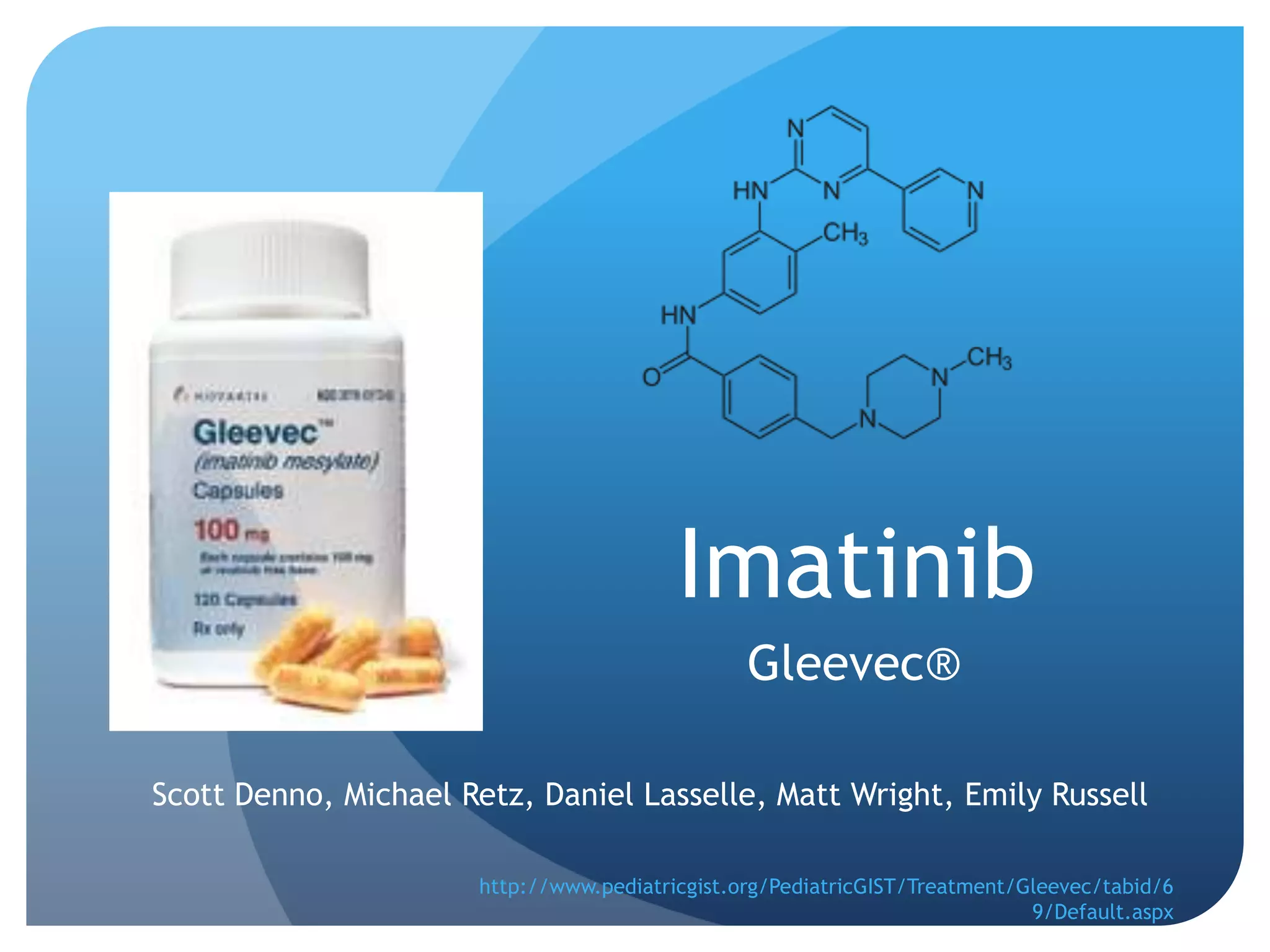
Imatinib
                                                Gleevec®

Scott Denno, Michael Retz, Daniel Lasselle, Matt Wright, Emily Russell

                      http://www.pediatricgist.org/PediatricGIST/Treatment/Gleevec/tabid/6
                                                                            9/Default.aspx
Gleevec® (Imatinib)
 A tyrosine Kinase Inhibitor developed in the
  late 1990's to treat Chronic Mylogenous
  Leukemia which is a cancer of the lymphatic
  system and bone. 1
 CML is caused by a translocation of the 9th and
  22nd chromosomes.1
   Causes the Bcr-Abl oncogene to be created.1
   Responsible for the activation of many signal
    transduction pathways that cause the
    characteristics of CML.
Mechanism of Action
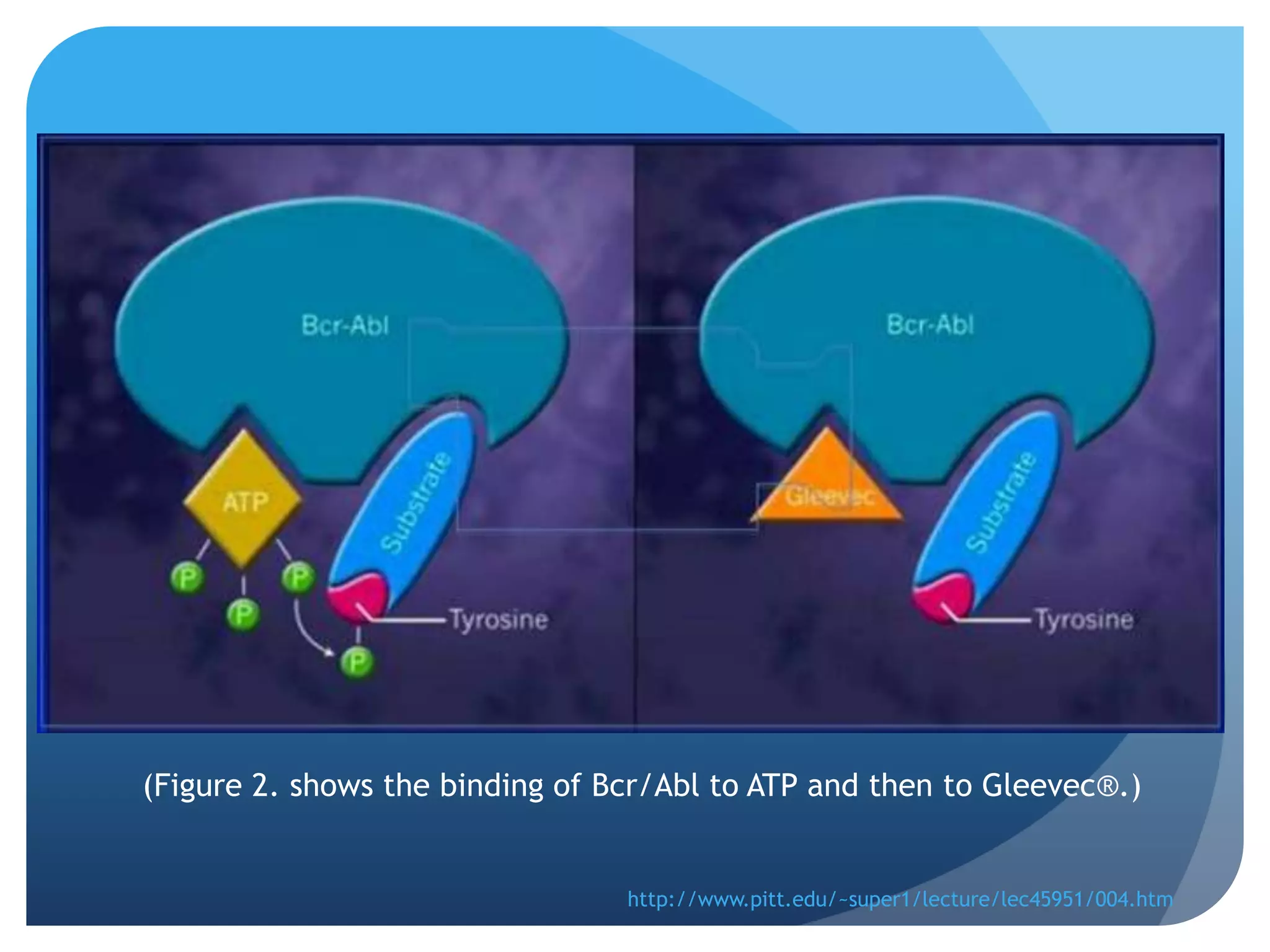
 Imatinib binds to Bcr/Abl protein very close
  to the binding site of ATP, blocking ATP from
  binding.2
   Without the binding of ATP, Bcr/Abl
    cannot phosphorylate substrate proteins.2
 Imatinib is very specific to this sub-family of
  receptor tyrosine kinases.2
(Figure 2. shows the binding of Bcr/Abl to ATP and then to Gleevec®.)


                                 http://www.pitt.edu/~super1/lecture/lec45951/004.htm
Mechanism of Action
 Blocking the ability of Bcr/Abl stops several
  transduction pathways that cause the
  excessive proliferation of partially
  differentiated cells that lead to CML.4
 The main oncogenes that are inhibited are
  Ras, Myc, and STAT.4
  Each of these oncogenes cause a signal cascade
   that cause cell proliferation.4
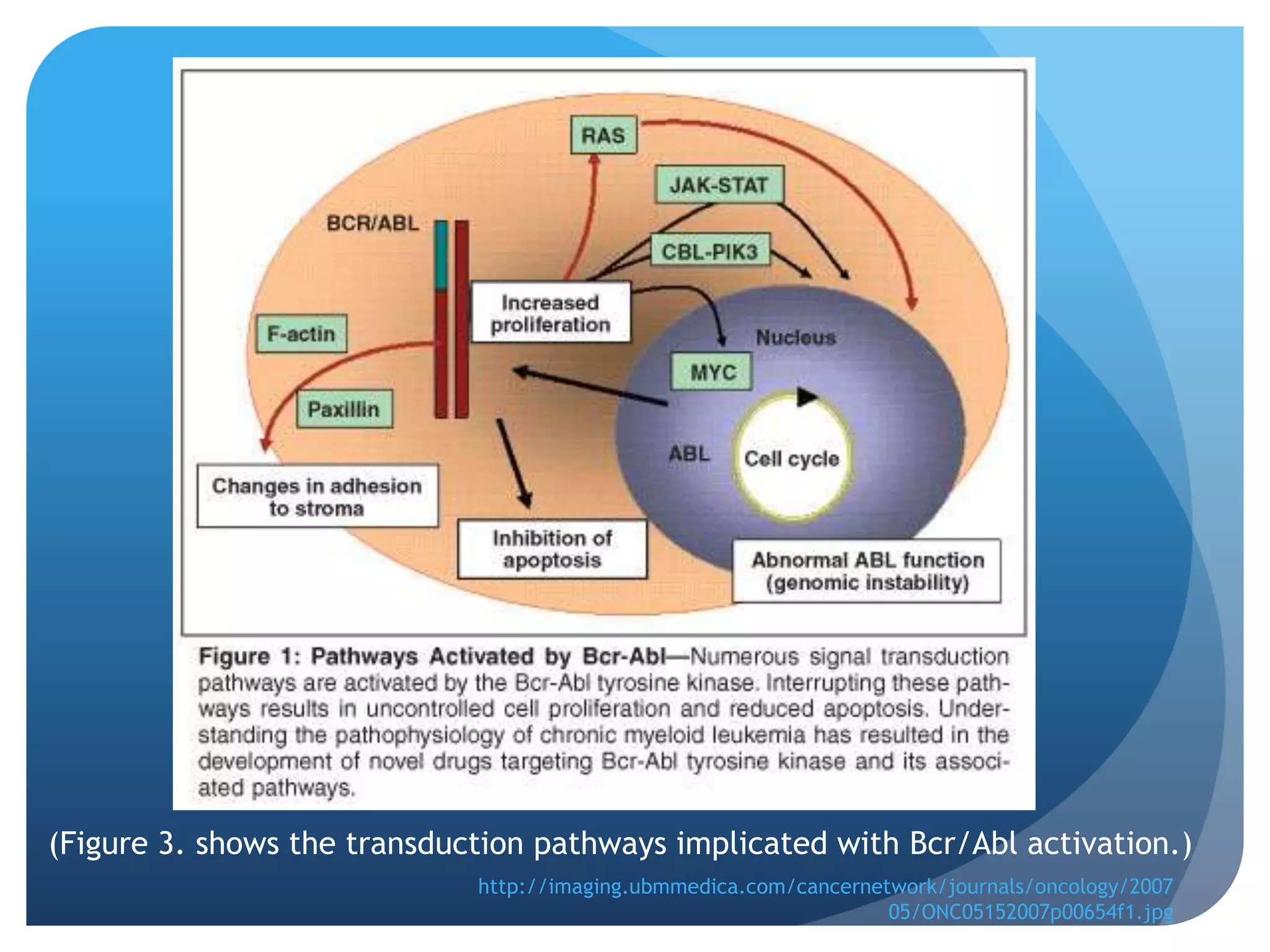
(Figure 3. shows the transduction pathways implicated with Bcr/Abl activation.)
                             http://imaging.ubmmedica.com/cancernetwork/journals/oncology/2007
                                                                   05/ONC05152007p00654f1.jpg
Distribution5

1. Protein Binding = 95%
2. VD = 6.2 ± 2.2 L/Kg or 434 L for a 70 Kg
   Patient
Protein Binding5


 Primarily with Albumin and α1 – acid
  Glycoprotein
   Albumin binds with weak acids
   α1 – acid Glycoprotein binds with
    weak bases
Volume of Distribution5


 Vd(Imatinib) > 40 L
 Protein binding usually lowers Vd
Absorption6


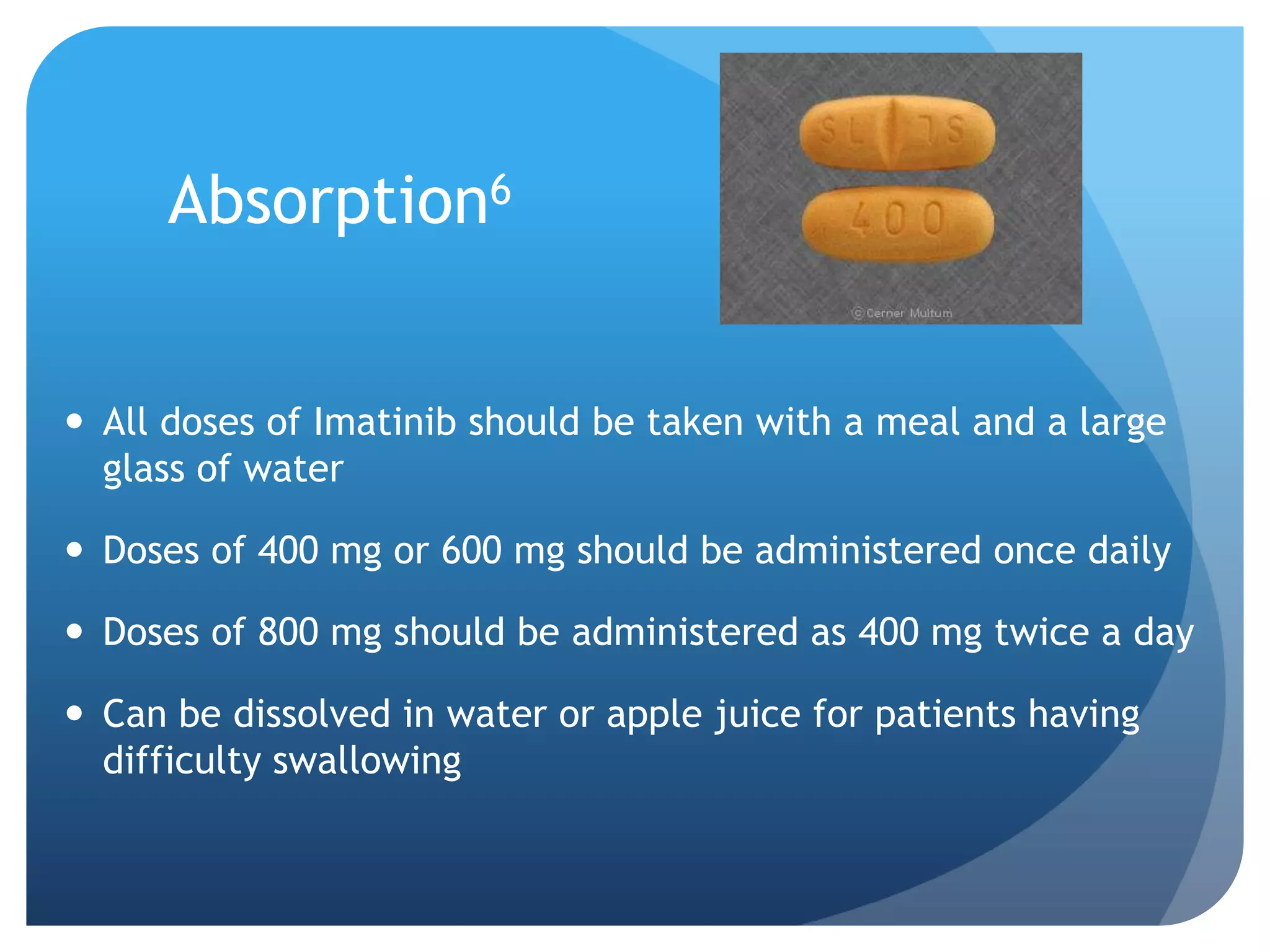
 All doses of Imatinib should be taken with a meal and a large
  glass of water

 Doses of 400 mg or 600 mg should be administered once daily

 Doses of 800 mg should be administered as 400 mg twice a day

 Can be dissolved in water or apple juice for patients having
  difficulty swallowing
Absorption6
 Imatinib is well absorbed after oral
  administration
 Maximal drug concentration (Cmax) achieved
  within 2 to 4 hours post dose.
 Mean absolute bioavailability is 98%
 Mean imatinib AUC increases proportionally with
  increasing doses ranging from 25 to 1,000 mg
Absorption6
 There is no significant change in the
  pharmacokinetics of Imatinib upon repeated
  dosing
 Accumulation is 1.5-2.5-fold at steady state
  when Imatinib is dosed once daily
 At clinically relevant concentrations
  Imatinib, binding to plasma proteins in in
  vitro experiments is approximately
  95%, mostly albumin and alpha-1 acid
  glycoprotein
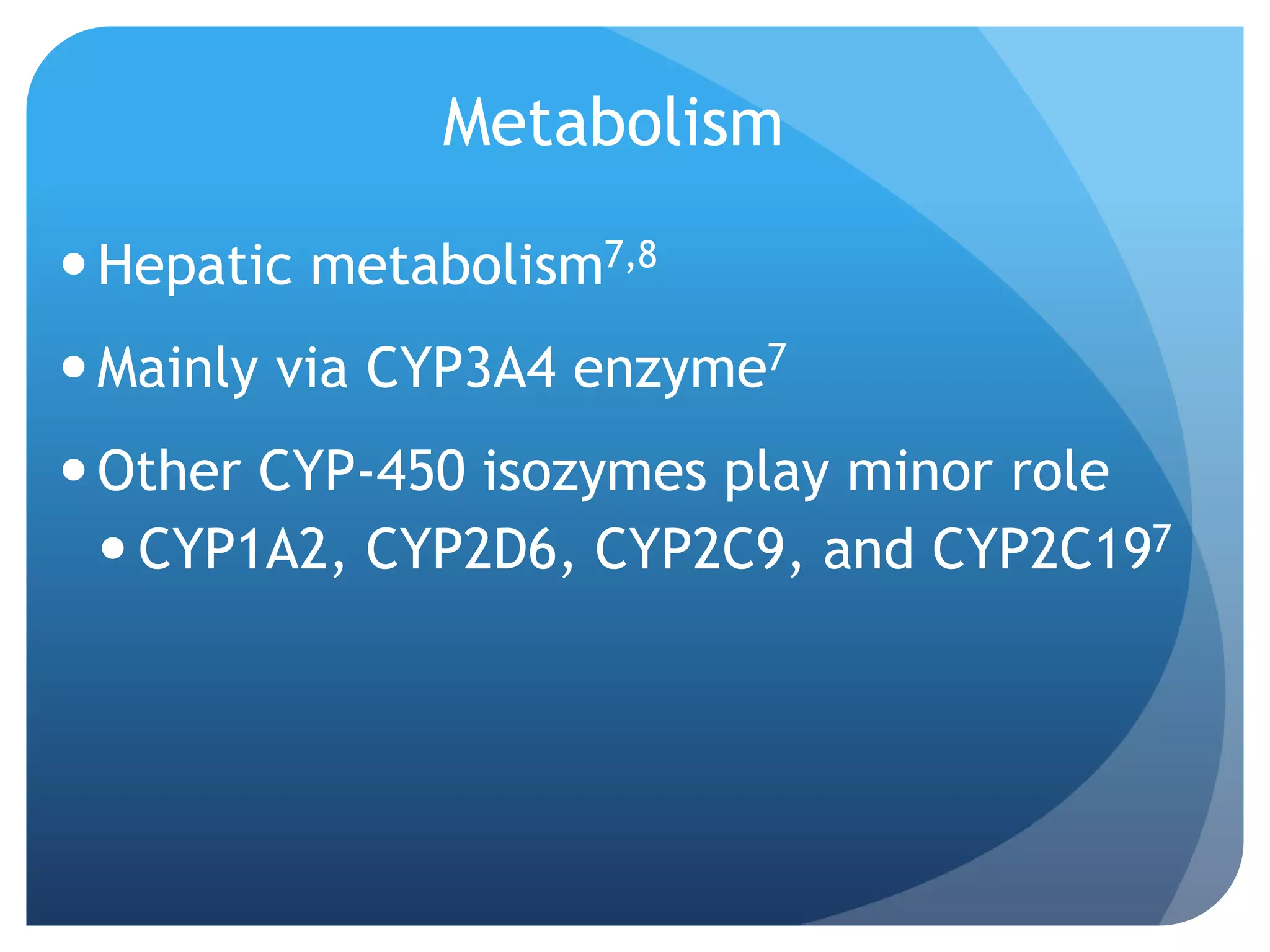
Metabolism

 Hepatic metabolism7,8
 Mainly via CYP3A4 enzyme7
 Other CYP-450 isozymes play minor role
   CYP1A2, CYP2D6, CYP2C9, and CYP2C197
Figure 4. Imatinib
location of
metabolism.


                                                            Picture: "Pathway: Imatinib
                      Pathway, Pharmacokinetics/Pharmacodynamics  [UNDER REVIEW]."
                     Imatinib Pathway, Pharmacokinetics/Pharmacodynamics [PharmGKB].
                                                          N.p., n.d. Web. 11 Nov. 2012.
Metabolism
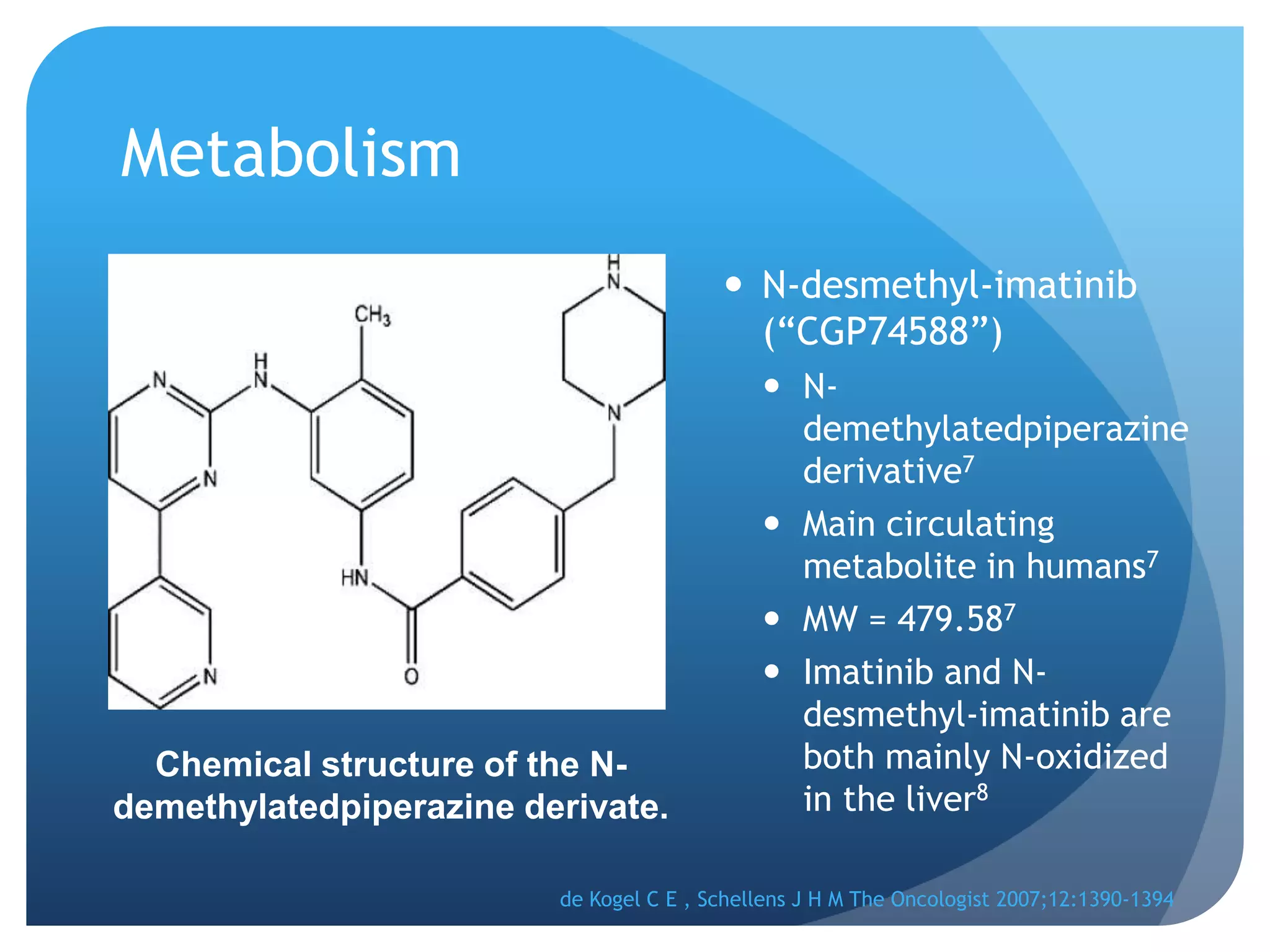
                                          N-desmethyl-imatinib
                                           (“CGP74588”)
                                              N-
                                               demethylatedpiperazine
                                               derivative7
                                              Main circulating
                                               metabolite in humans7
                                              MW = 479.587
                                              Imatinib and N-
                                               desmethyl-imatinib are
  Chemical structure of the N-                 both mainly N-oxidized
demethylatedpiperazine derivate.               in the liver8

                         de Kogel C E , Schellens J H M The Oncologist 2007;12:1390-1394
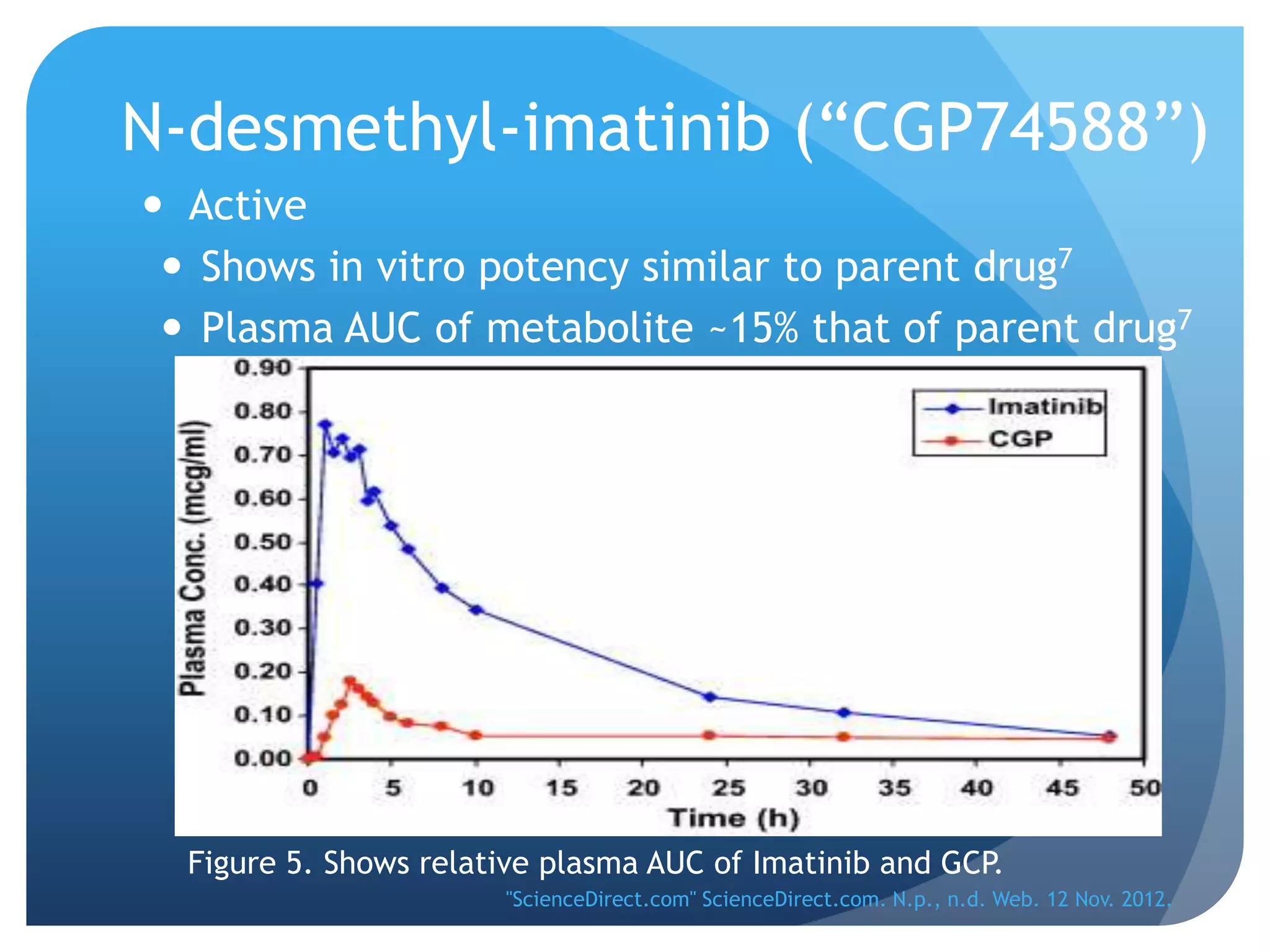
N-desmethyl-imatinib (“CGP74588”)
 Active
  Shows in vitro potency similar to parent drug7
  Plasma AUC of metabolite ~15% that of parent drug7


  Figure 5. Shows relative plasma AUC of Imatinib and GCP.
                       "ScienceDirect.com" ScienceDirect.com. N.p., n.d. Web. 12 Nov. 2012.
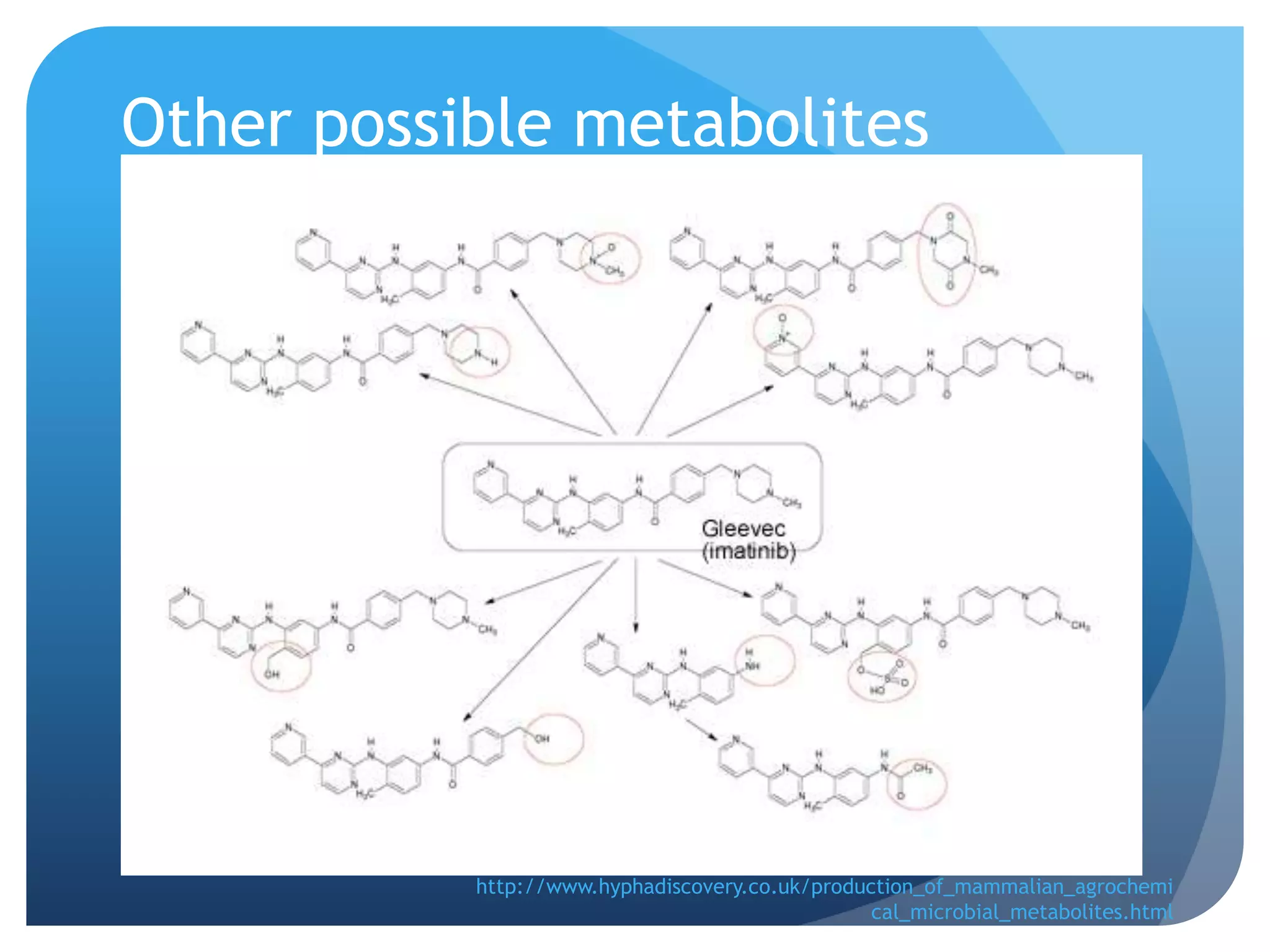
Other possible metabolites


           http://www.hyphadiscovery.co.uk/production_of_mammalian_agrochemi
                                                 cal_microbial_metabolites.html
Excretion9
 Urinary to Fecal Ratio is 1:5
 Renal Excretion = 13% of dose
   5% unchanged in urine
 Fecal Excretion = 70% of the dose
   20% unchanged in feces
 Elimination Half-life about 18 hrs
 Excretion generally the same in adults and
  children
Excretion
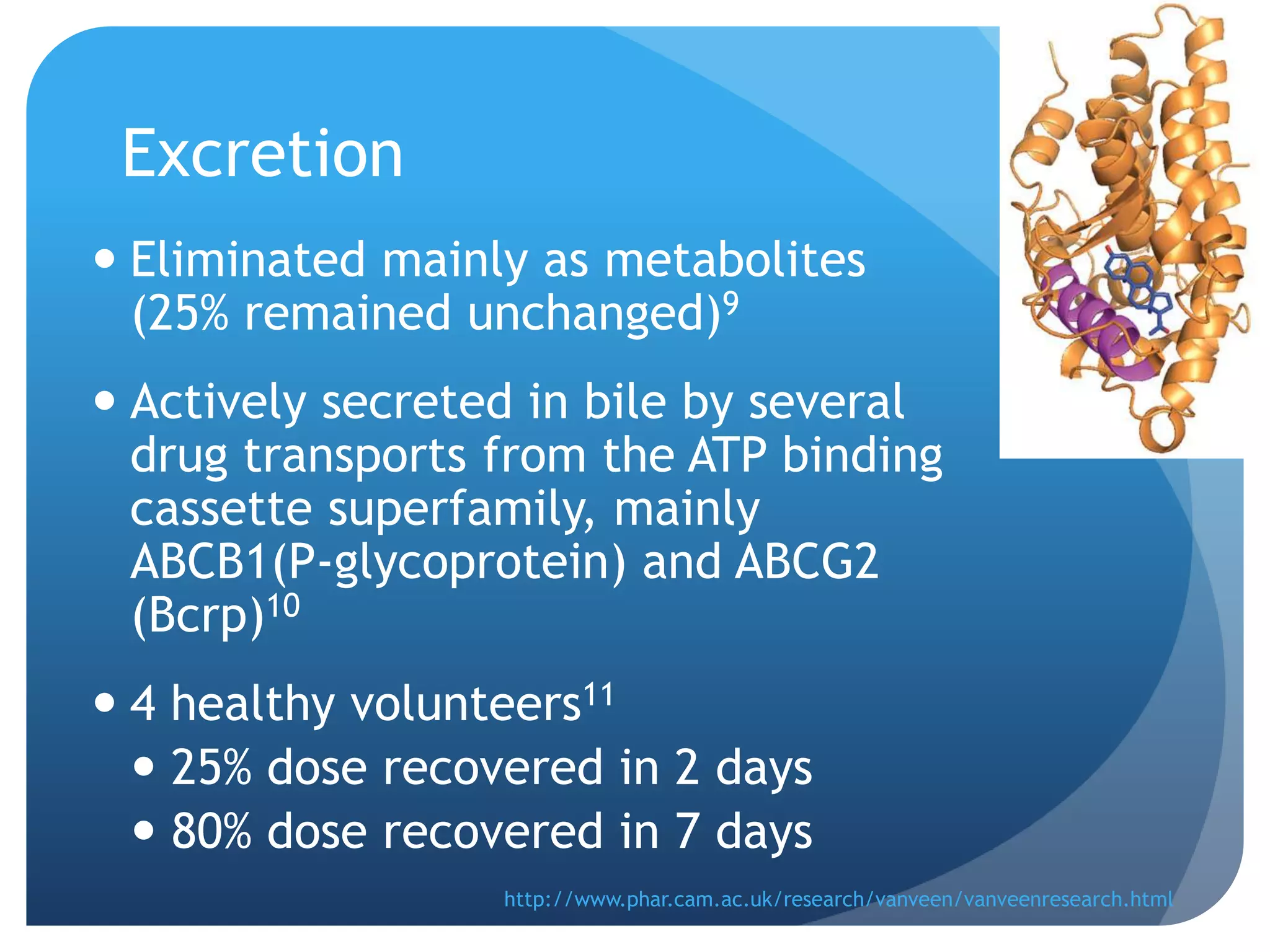
 Eliminated mainly as metabolites
  (25% remained unchanged)9
 Actively secreted in bile by several
  drug transports from the ATP binding
  cassette superfamily, mainly
  ABCB1(P-glycoprotein) and ABCG2
  (Bcrp)10
 4 healthy volunteers11
   25% dose recovered in 2 days
   80% dose recovered in 7 days
                  http://www.phar.cam.ac.uk/research/vanveen/vanveenresearch.html
Excretion9
 Though clearance
  is variable based
  on patient weight
  and age, the
  manufacturer does
  not recommend
  dose adjustment
 Monitoring is
  important to avoid
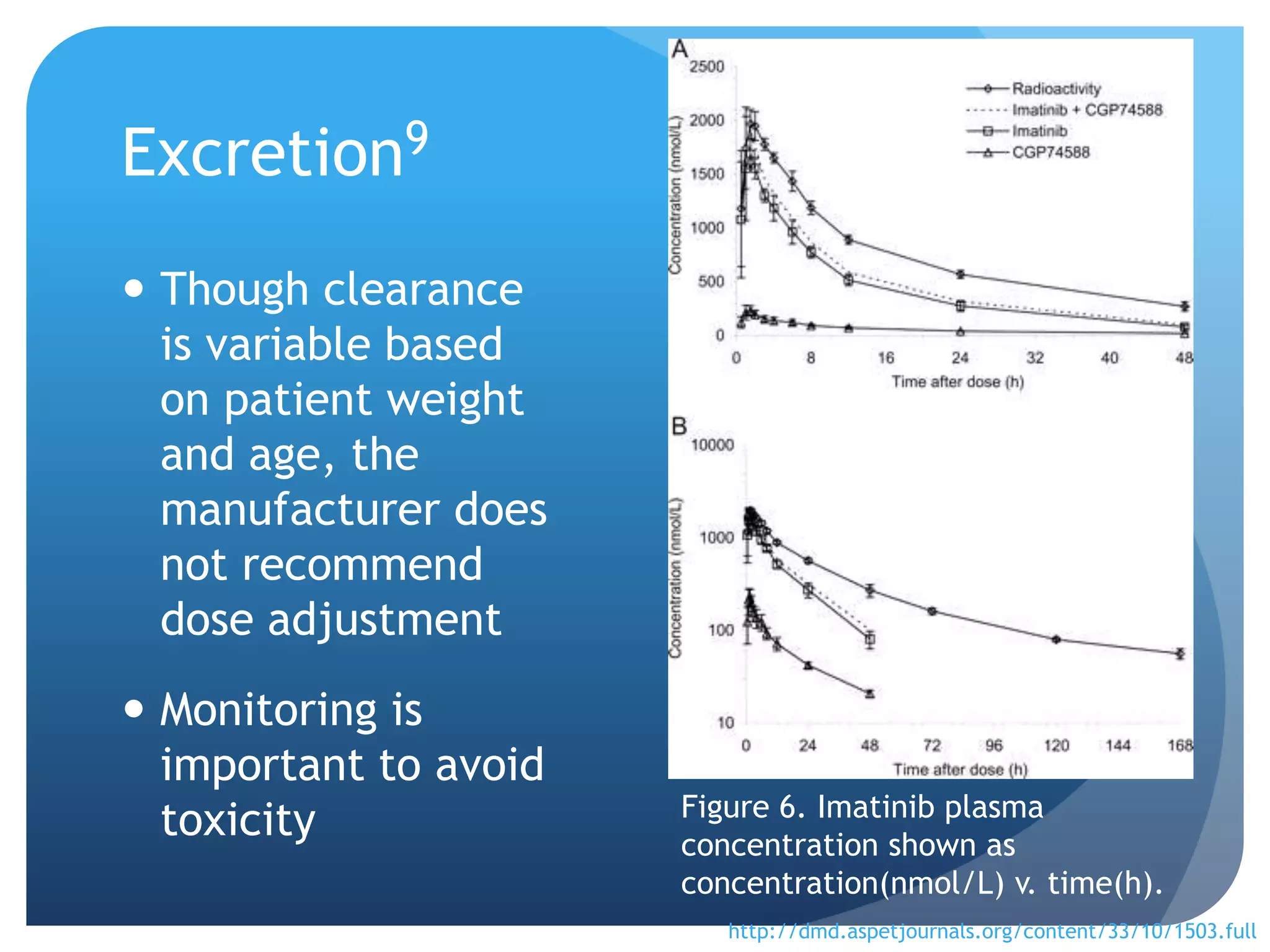
                       Figure 6. Imatinib plasma
  toxicity             concentration shown as
                       concentration(nmol/L) v. time(h).
                          http://dmd.aspetjournals.org/content/33/10/1503.full
References
1.    Faderl S, Talpaz M, Estrov Z, O'Brian S, Kurzrock R, KantarjianH. The Biology of Chronic
            Myeloid Leukemia. New England Journal of Medicine. 1999; 341: 164-172
2.    DeVita V, Lawrence T, Rosenberg S, eds. DeVita, Hellman, and Rosenberg's Cancer: Principles
            and Practice of Oncology. 9th ed. North American edition: Lippincott Williams &
            Wilkins; 2011: 1962-1964
3.    Druker BJ, Tamura S, Buchdunger E, et al. Effects of a selective inhibitor of the Abl tyrosine
            kinase on the growth of Bcr-Abl positive cells. Nat Med. 1996;2:561-566.
4.    Jabbour E, Cortes J, Kantarjian H. Optimal First-Line Treatment of Chronic Myeloid
            Leukemia: How to Use Imatinib and What Role for Newer Drugs. Oncology. 2007; 21: 6
5.    Brunton LL, Chabner BA, Knollman BC, eds. Pharmacological Basis of Therapeutics. 12th ed.
            New York, NY: McGraw-Hill; 2011.
6.    Peng B, Dutreix C, et al. AbosluteBioavailavbility of Imatinib(Gleevec®) Orally versus
            Intravenous Infusion. Clinical Journal of Pharmacology. 2004; 44: 158-162
7.    Product Information: GLEEVEC(R) oral tablet , imatinibmesylate oral tablet . Novartis Pharmaceutical
            Corporation, East Hanover, NJ, 2005.
8.    Truven Health Products. N.p., n.d. Web. 12 Nov. 2012.
9.    Peng B, Lloyd P, Schran H. Clinical pharmacokinetics of imatinib. PubMed.gov.
      2005;44(9):879-94.
10.   Kogel CE, Schellens JHM, Imatinib. The Oncologist. 2007.
11.   Gschwind, HP. Metabolism and disposition of imatinibmesylate in healthy volunteers. Drug
            Metabolism and Disposition. 2005. July 6, 2005. doi:10.1124

Gleevec group presentation#1

  • 1.
    Imatinib Gleevec® Scott Denno, Michael Retz, Daniel Lasselle, Matt Wright, Emily Russell http://www.pediatricgist.org/PediatricGIST/Treatment/Gleevec/tabid/6 9/Default.aspx
  • 2.
    Gleevec® (Imatinib)  Atyrosine Kinase Inhibitor developed in the late 1990's to treat Chronic Mylogenous Leukemia which is a cancer of the lymphatic system and bone. 1  CML is caused by a translocation of the 9th and 22nd chromosomes.1  Causes the Bcr-Abl oncogene to be created.1  Responsible for the activation of many signal transduction pathways that cause the characteristics of CML.
  • 3.
    Mechanism of Action Imatinib binds to Bcr/Abl protein very close to the binding site of ATP, blocking ATP from binding.2  Without the binding of ATP, Bcr/Abl cannot phosphorylate substrate proteins.2  Imatinib is very specific to this sub-family of receptor tyrosine kinases.2
  • 4.
    (Figure 2. showsthe binding of Bcr/Abl to ATP and then to Gleevec®.) http://www.pitt.edu/~super1/lecture/lec45951/004.htm
  • 5.
    Mechanism of Action Blocking the ability of Bcr/Abl stops several transduction pathways that cause the excessive proliferation of partially differentiated cells that lead to CML.4  The main oncogenes that are inhibited are Ras, Myc, and STAT.4  Each of these oncogenes cause a signal cascade that cause cell proliferation.4
  • 6.
    (Figure 3. showsthe transduction pathways implicated with Bcr/Abl activation.) http://imaging.ubmmedica.com/cancernetwork/journals/oncology/2007 05/ONC05152007p00654f1.jpg
  • 7.
    Distribution5 1. Protein Binding= 95% 2. VD = 6.2 ± 2.2 L/Kg or 434 L for a 70 Kg Patient
  • 8.
    Protein Binding5  Primarilywith Albumin and α1 – acid Glycoprotein  Albumin binds with weak acids  α1 – acid Glycoprotein binds with weak bases
  • 9.
    Volume of Distribution5 Vd(Imatinib) > 40 L  Protein binding usually lowers Vd
  • 10.
    Absorption6  All dosesof Imatinib should be taken with a meal and a large glass of water  Doses of 400 mg or 600 mg should be administered once daily  Doses of 800 mg should be administered as 400 mg twice a day  Can be dissolved in water or apple juice for patients having difficulty swallowing
  • 11.
    Absorption6  Imatinib iswell absorbed after oral administration  Maximal drug concentration (Cmax) achieved within 2 to 4 hours post dose.  Mean absolute bioavailability is 98%  Mean imatinib AUC increases proportionally with increasing doses ranging from 25 to 1,000 mg
  • 12.
    Absorption6  There isno significant change in the pharmacokinetics of Imatinib upon repeated dosing  Accumulation is 1.5-2.5-fold at steady state when Imatinib is dosed once daily  At clinically relevant concentrations Imatinib, binding to plasma proteins in in vitro experiments is approximately 95%, mostly albumin and alpha-1 acid glycoprotein
  • 13.
    Metabolism  Hepatic metabolism7,8 Mainly via CYP3A4 enzyme7  Other CYP-450 isozymes play minor role  CYP1A2, CYP2D6, CYP2C9, and CYP2C197
  • 14.
    Figure 4. Imatinib locationof metabolism. Picture: "Pathway: Imatinib Pathway, Pharmacokinetics/Pharmacodynamics  [UNDER REVIEW]." Imatinib Pathway, Pharmacokinetics/Pharmacodynamics [PharmGKB]. N.p., n.d. Web. 11 Nov. 2012.
  • 15.
    Metabolism  N-desmethyl-imatinib (“CGP74588”)  N- demethylatedpiperazine derivative7  Main circulating metabolite in humans7  MW = 479.587  Imatinib and N- desmethyl-imatinib are Chemical structure of the N- both mainly N-oxidized demethylatedpiperazine derivate. in the liver8 de Kogel C E , Schellens J H M The Oncologist 2007;12:1390-1394
  • 16.
    N-desmethyl-imatinib (“CGP74588”)  Active  Shows in vitro potency similar to parent drug7  Plasma AUC of metabolite ~15% that of parent drug7 Figure 5. Shows relative plasma AUC of Imatinib and GCP. "ScienceDirect.com" ScienceDirect.com. N.p., n.d. Web. 12 Nov. 2012.
  • 17.
    Other possible metabolites http://www.hyphadiscovery.co.uk/production_of_mammalian_agrochemi cal_microbial_metabolites.html
  • 18.
    Excretion9  Urinary toFecal Ratio is 1:5  Renal Excretion = 13% of dose  5% unchanged in urine  Fecal Excretion = 70% of the dose  20% unchanged in feces  Elimination Half-life about 18 hrs  Excretion generally the same in adults and children
  • 19.
    Excretion  Eliminated mainlyas metabolites (25% remained unchanged)9  Actively secreted in bile by several drug transports from the ATP binding cassette superfamily, mainly ABCB1(P-glycoprotein) and ABCG2 (Bcrp)10  4 healthy volunteers11  25% dose recovered in 2 days  80% dose recovered in 7 days http://www.phar.cam.ac.uk/research/vanveen/vanveenresearch.html
  • 20.
    Excretion9  Though clearance is variable based on patient weight and age, the manufacturer does not recommend dose adjustment  Monitoring is important to avoid Figure 6. Imatinib plasma toxicity concentration shown as concentration(nmol/L) v. time(h). http://dmd.aspetjournals.org/content/33/10/1503.full
  • 21.
    References 1. Faderl S, Talpaz M, Estrov Z, O'Brian S, Kurzrock R, KantarjianH. The Biology of Chronic Myeloid Leukemia. New England Journal of Medicine. 1999; 341: 164-172 2. DeVita V, Lawrence T, Rosenberg S, eds. DeVita, Hellman, and Rosenberg's Cancer: Principles and Practice of Oncology. 9th ed. North American edition: Lippincott Williams & Wilkins; 2011: 1962-1964 3. Druker BJ, Tamura S, Buchdunger E, et al. Effects of a selective inhibitor of the Abl tyrosine kinase on the growth of Bcr-Abl positive cells. Nat Med. 1996;2:561-566. 4. Jabbour E, Cortes J, Kantarjian H. Optimal First-Line Treatment of Chronic Myeloid Leukemia: How to Use Imatinib and What Role for Newer Drugs. Oncology. 2007; 21: 6 5. Brunton LL, Chabner BA, Knollman BC, eds. Pharmacological Basis of Therapeutics. 12th ed. New York, NY: McGraw-Hill; 2011. 6. Peng B, Dutreix C, et al. AbosluteBioavailavbility of Imatinib(Gleevec®) Orally versus Intravenous Infusion. Clinical Journal of Pharmacology. 2004; 44: 158-162 7. Product Information: GLEEVEC(R) oral tablet , imatinibmesylate oral tablet . Novartis Pharmaceutical Corporation, East Hanover, NJ, 2005. 8. Truven Health Products. N.p., n.d. Web. 12 Nov. 2012. 9. Peng B, Lloyd P, Schran H. Clinical pharmacokinetics of imatinib. PubMed.gov. 2005;44(9):879-94. 10. Kogel CE, Schellens JHM, Imatinib. The Oncologist. 2007. 11. Gschwind, HP. Metabolism and disposition of imatinibmesylate in healthy volunteers. Drug Metabolism and Disposition. 2005. July 6, 2005. doi:10.1124

Editor's Notes

  • #2 Picture: http://www.pediatricgist.org/PediatricGIST/Treatment/Gleevec/tabid/69/Default.aspx
  • #3 Faderl S, Talpaz M, Estrov Z, O'Brian S, Kurzrock R, Kantarjian H. The Biology of Chronic Myeloid Leukemia. New England Journal of Medicine. 1999; 341: 164-17
  • #4 DeVita V, Lawrence T, Rosenberg S, eds. DeVita, Hellman, and Rosenberg's Cancer: Principles and Practice of Oncology. 9th ed. North American edition: Lippincott Williams & Wilkins; 2011: 1962-1964Druker BJ, Tamura S, Buchdunger E, et al. Effects of a selective inhibitor of the Abl tyrosine kinase on the growth of Bcr-Abl positive cells. Nat Med. 1996;2:561-566.
  • #5 First picture - Druker BJ, Tamura S, Buchdunger E, et al. Effects of a selective inhibitor of the Abl tyrosine kinase on the growth of Bcr-Abl positive cells. Nat Med. 1996;2:561-566.
  • #6 Jabbour E, Cortes J, Kantarjian H. Optimal First-Line Treatment of Chronic Myeloid Leukemia: How to Use Imatinib and What Role for Newer Drugs. Oncology. 2007; 21: 6
  • #7 Jabbour E, Cortes J, Kantarjian H. Optimal First-Line Treatment of Chronic Myeloid Leukemia: How to Use Imatinib and What Role for Newer Drugs. Oncology. 2007; 21: 6http://imaging.ubmmedica.com/cancernetwork/journals/oncology/200705/ONC05152007p00654f1.jpg
  • #8 Brunton LL, Chabner BA, Knollman BC, eds. Pharmacological Basis of Therapeutics. 12th ed. New York, NY: McGraw-Hill; 2011.
  • #11 Picture: 400 SLSL.Drugs.com. http://www.drugs.com/imprints/400-sl-sl-12647.html
  • #14 Context: 1)Product Information: GLEEVEC(R) oral tablet , imatinibmesylate oral tablet . Novartis Pharmaceutical Corporation, East Hanover, NJ, 2005. 2)Truven Health Products. N.p., n.d. Web. 12 Nov. 2012. <http://www.thomsonhc.com/micromedex2/librarian/ND_T/evidencexpert>.Picture: "Pathway: Imatinib Pathway, Pharmacokinetics/Pharmacodynamics   [UNDER REVIEW]." Imatinib Pathway, Pharmacokinetics/Pharmacodynamics [PharmGKB]. N.p., n.d. Web. 11 Nov. 2012. <http://www.pharmgkb.org/pathway/PA164713427>.
  • #15 Picture: "Pathway: Imatinib Pathway, Pharmacokinetics/Pharmacodynamics   [UNDER REVIEW]." Imatinib Pathway, Pharmacokinetics/Pharmacodynamics [PharmGKB]. N.p., n.d. Web. 11 Nov. 2012.
  • #16 Picture: de Kogel C E , Schellens J H M The Oncologist 2007;12:1390-1394Context: 1) Product Information: GLEEVEC(R) oral tablet , imatinibmesylate oral tablet . Novartis Pharmaceutical Corporation, East Hanover, NJ, 2005.2)"The Oncologist." Imatinib. N.p., n.d. Web. 11 Nov. 2012. <http://theoncologist.alphamedpress.org/content/12/12/1390.full>.
  • #17 Context: 1)Truven Health Products. N.p., n.d. Web. 12 Nov. 2012. <http://www.thomsonhc.com/micromedex2/librarian/ND_T/evidencexpert>.Picture: "ScienceDirect.com" ScienceDirect.com. N.p., n.d. Web. 12 Nov. 2012. <http://www.sciencedirect.com/science/article/pii/S0039914011006862>.
  • #18 Picture: DMPK and Degradation Metabolites Using Microbial Biotransformation. N.p., n.d. Web. 11 Nov. 2012. <http://www.hyphadiscovery.co.uk/production_of_mammalian_agrochemical_microbial_metabolites.html>
  • #19 Source:ImatinibMesylate. Micromedex 2.0. http://www.thomsonhc.com/micromedex2/librarian/PFDefaultActionId/evidencexpert.DoIntegratedSearch
  • #20 Peng B, Lloyd P, Schran H. Clinical pharmacokinetics of imatinib. PubMed.gov. 2005;44(9):879-94. http://www.ncbi.nlm.nih.gov/pubmed/16122278. Accessed November 11, 2012.Kogel CE, Schellens JHM, Imatinib. The Oncologist. 2007. http://theoncologist.alphamedpress.org/content/12/12/1390.full Accessed November 18, 2012.Gschwind, HP. Metabolism and disposition of imatinibmesylate in healthy volunteers. Drug Metabolism and Disposition. 2005. July 6, 2005. doi:10.1124 http://dmd.aspetjournals.org/content/33/10/1503.full. Accessed November 10, 2012. Picture: Van Veen, H. Human Breast Cancer Resistance Protein. University of Cambridge http://www.phar.cam.ac.uk/research/vanveen/vanveenresearch.html.
  • #21 Gschwind, HP. Metabolism and disposition of imatinibmesylate in healthy volunteers. Drug Metabolism and Disposition. 2005. July 6, 2005. doi:10.1124 http://dmd.aspetjournals.org/content/33/10/1503.full. Accessed November 10, 2012.