)بِسْمِ اللهِ الرَّحْ منِ الرَّحِيمِ ( 
سَنُرِيهِمْ آيَاتِنَا فِي الآفَاقِ وَفِي أَنف سِهِمْ حَتَّى يَتَبَيَّنَ لَهُمْ أَنَّهُ الحَقُّ 
) أَوَ لَمْ يَكْفِ بِرَب كَ أَنَّهُ عَلَى كُ ل يََْ هََِيد ) فصلت الآية 53 
"صدق الله العظيم"
 The development of the tooth involves 
many complex biological processes. 
 The fundamental developmental 
processes is similar for all teeth. 
Dr Hesham Dameer
STAGES OF TOOTH DEVELOPMENT MAY BE 
DESCRIBED ACCORDING TO : 
1- Changes in the morphology of the developing tooth 
(MORPHOLOGICAL STAGES) . 
2- Its physiological changes (HISTOPHYSIOLOGICAL 
STAGES). 
Note: both the morphological and the histophysiological 
changes are shearing in the different tooth development 
stages.
Stages of teeth development 
MORPHOLOGICAL STAGES 
1. Dental lamina 
2. Bud stage 
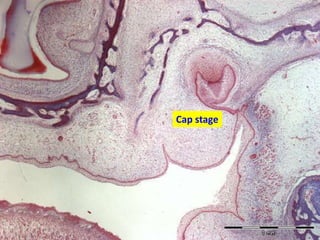
3. Cap stage 
4. Bell stage ( early & advanced ) 
5. Root Stage 
By hesham Dameer
HISTOPHYSIOLOGICAL STAGES 
1- INITIATION. 
2- PROLIFERATION. 
3- HISTO-DIFFERENTIATION. 
4- MORPHO-DIFFERENTIATION. 
5- APPOSITION. 
Dr Hesham Dameer
Initiation of Tooth Development 
The initiation of tooth development begins at 37 days of development 
with formation of a continuous horseshoe-band of thickened epithelium 
in the location of upper and lower jaws – Primary Epithelial Band 
Each band of epithelium will give 
rise to 2 sub divisions: 
1. Dental lamina and 
2. Vestibular lamina 
Dr Hesham Dameer
Early Dental Lamina 
Tongue Dental lamina Vestibular lamina
Primary epithelial 
band 
Ectomesenchyme
Vestibular lamina:- 
It is a wedge of epithelial cells facial to dental lamina. 
It proliferates into ectomesenchyme. Then degenerates at 
the center to form cleft which becomes the oral vestibules. 
Dr Hesham Dameer
Dr Hesham Dameer
The dental lamina 
ECTODERM 
MESODERM 
(Connective 
tissue) 
Flat cells 
Columnar cells 
Basement 
membrane
Also 
No teeth without dental lamina 
No fruits without a tree 
Dr Hesham Dameer
 
Dental lamina appears as a thickening of the oral 
epithelium adjacent to condensation of ectomesenchyme 
• 20 areas of enlargement or knobs appear, which will form 
tooth buds for the 20 primary teeth 
•Not all will appear at the same time . The first to develop are 
those of the anterior mandible region
•At this early stage the tooth buds have already determined 
their crown morphology . 
 Successional lamina : lamina from which permanent 
teeth develop which replace the primary teeth except for 
the permanent molars. 
Dr Hesham Dameer
 Dental lamina formation and development of tooth buds
mesenchymal proliferation 
Dental lamina
• M 
Max. bone development 
Mand. bone dev. 
Tongue 
Dental lamina &Tooth bud 
Meckel's cartilage
B 
• F. Developing 
mandibular bone 
• G. Meckel's cartilage 
• A. Dental lamina 
• B. Tooth bud 
• C. Mesenchymal 
cells condensation 
A 
B 
C 
F 
Dr Hesham Dameer
Function of the dental lamina 
1. Initiation of deciduous dentition ( 2 MIU ) . 
2. Initiation of successors of deciduous dentition . This is preceded 
by the growth of the terminal end of the dental lamina lingual to 
the deciduous enamel organ . ( 5 MIU. For central incisors, 10 M. 
of age for second premolars ) . 
3. Initiation of permanent molars . 
This is preceded by the extension of dental lamina distal to the 
enamel organ of the second deciduous molar to form the 
permanent molar tooth buds 
( first molar 4MIU. , second molar 1 year , third molar 4-5 years ) 
 It is thus evident that the activity of the dental lamina extends 
over a period of about five years and disintegrates completely or 
remains as epithelial rests of Serres.
Fate of the dental lamina 
1) The broad connection of the dental lamina with the 
dental organ seen in the cap stage is broken in the bell 
stage by mesenchymal invasion . 
2) The mesenchymal invasion at first divides the general 
dental lamina into lateral dental lamina and dental 
lamina proper. The dental lamina proper, growths at its 
terminal end ( successional lamina ) which form the 
primordium of the permanent tooth germ . The lateral 
dental lamina which connected to the deciduous tooth 
germ degenerates . 
Sometimes , the remnants of the dental lamina persists as 
epithelial rests and known epithelial rests of serres .
GENERAL DENTAL 
LAMINA 
SUCCESSIONAL 
LAMINA ( DENTAL 
LAMIA PROPER ) 
LATERAL 
DENTAL 
LAMINA
Epithelial rests of serres 
mesenchymal 
invasion 
Epithelial rests
Epithelial rests of Serres
Dr Hesham Dameer
Tooth bud stage : 
• At certain regions along the 
dental lamina , 10 rounded or 
ovoid localized growth of 
epithelium ( Tooth bud ) in each 
arch correspond to the 
primordia of the enamel organs 
of the decidous teeth . These 
buds were surrounded by 
proliferating mesenchymal cells, 
which are packed closely 
beneath and around the 
epithelial buds 
Dr Hesham Dameer
The mesoderm exerts 
a pressure at the base 
of tooth bud . The 
pressure of the 
mesoderm leads to 
invagination of the 
undersurface of the 
tooth bud , while the 
lower margin of the 
concavity proliferates 
downward to 
surround the actively 
growing mesoderm . 
Pressure of the mesoderm 
Dr Hesham Dameer
• As a result of this topographic alteration , the round shaped 
tooth bud is transformed to a cap shaped structure . 
Later on , the cap shape structure can be distinguished into different 
cell layers , as follows : 
Dr Hesham Dameer
Dr Hesham 
Dameer
Early cap stage:- 
The inner cell become low columnar called inner epithelium 
or inner dental epithelium. 
The outer cells become flat and called outer dental epithelium 
or outer enamel epithelium. 
The ectomesenchymal tissue becomes condensed in the 
concave surface and called dental papilla (much cells, low 
fibers). 
Some ectomesenchymal fibers surround the cap called dental 
follicle (sac) (low cells, much fibers). 
Enamel knot may be formed due to localized thickening at 
the inner dental epithelium at center. 
Strands of epithelial cells also may be formed and called 
enamel cord . 
Dr Hesham Dameer
Inner Enamel Epithelium 
Cell Free Zone 
Enamel cord 
Cap stage 
DENTAL 
(follicle ) 
Dr Hesham Dameer
Cap stage
Late cap stage:- 
A fourth layer of epithelial cells is formed between the inner 
dental epithelium and stellate reticulum called stratum 
intermedium. It is formed of two layers of rounded cells which 
have high activity of alkaline phosphatase enzyme that 
responsible for enamel formation. 
Cervical loop:- 
It is the most peripheral areas in both sides of cap (the 
proliferation zone) the outer and inner enamel epithelial cells 
come together with minimal inclusion of the stratum 
intermedium and stellate reticulum. 
After crown formation cervical loop cells proliferate to form 
bilayer of cells (outer and inner enamel epithelium) called root 
sheath of Hertwig's 
Dr Hesham Dameer
1- Cap-shaped stage 
2- Tooth bell stage 
Dr Hesham Dameer
A. Early bell stage 
B. Advanced bell stage
bell stage 
A . Early bell stage : 
This stage is reached when the invagination of the dental organ is deepened and also 
the margin of the dental organ ( cervical loop )grows deeper into the underlying 
mesenchyme . 
1. Enamel organ tissues begin to differentiate. 
2. Enamel organ begins to fold into shape of finished 
crown. 
3. Dental papilla tissues begin to differentiate. 
Associated with these changes , other changes occur in the dental 
organ as : 
1. Outer enamel epithelium become cells transformed into folded 
layer instead of the previous smooth layer . The adjacent 
ectomesenchyme invade these folds. 
The ectomesenchyme contain a rich capillary buds to provide 
nutrition for the highly and metabolically active dental organ . 
By hesham Dameer
2. Inner enamel epithelium become tall columnar and measure 
4 to 5 micrometer in diameter and about 40 micrometer in 
length . These cells exert an inductive effect on the 
underlying ectomesenchymal cells found in the dental 
papilla resulting in there differentiation into odontoblasts . 
3. Stellate reticulum The mucoid fluids in the intercellular 
spaces increases , thus the cells of the stellate reticulum 
appear star shaped . As amelogenesis starts , the reticulum 
will collapse and reduce in size . Thus the capillaries of the 
invading ectomesenchyme found in the folds of the outer 
enamel epithelium will come in close relation to the inner 
enamel epithelium . 
Dr Hesham Dameer
3. Stratum intermedium Several squamous cells develop between 
the stellate reticulum and the inner enamel epithelium . These 
cells have a high degree of metabolic activity and appear to be 
essential for enamel formation . 
3. Dental papilla Before amelogenesis, the inductive effect exerted 
by the organized inner enamel epithelium ( tall columnar cells ), 
causes transformation of the peripheral ectomesenchymal cells of 
the dental papilla into odontoblasts and become potentially 
capable to form dentin . 
4. Dental sac The fibrillar components of the dental sac arrange 
themselves in a circular pattern . As the root start to develop and 
cementum is being is being deposited on dentin surface, the fibers of 
the dental sac differentiate into periodontal fibers and become 
embedded into the developing cementum and alveolar bone . 
Dr Hesham Dameer
Functions of the enamel organ 
1- Outer enamel epithelium : 
Active transport of nutrient materials specially, after hard tissues 
formation . 
2- Stellate reticulum : 
a. Act as a buffer against physical forces that may distort the 
configurations of the developing tooth . 
b. It permit a limited flow of nutritional elements from the 
capillaries of the invading ectomesenchyme found in the folds to 
the formative cells . 
c. It keep a room for the developing enamel . 
Dr Hesham Dameer
3. Stratum intermedium: 
The function of this layer is not understood : 
a. It is believed to control fluid diffusion into and out of the 
ameloblasts . 
b. It provides the enamel organ with alkaline phosphate 
enzyme needed for mineralization . 
c. These cells plus the inner dental epithelium are considered 
as a single unite responsible for enamel formation . 
4. Inner enamel epithelium : 
a. It exerts an inductive effect on the undifferentiated cells 
of the dental papilla to differentiate into odontoblasts. 
b. Transport of the nutritive materials from the dental papilla 
to the enamel organ before dental hard tissues formation.
c. It arranged in a pattern to determine the morphology 
of the crown . 
d. It lays down enamel matrix and helps in its mineralization . 
e. It shares in the root formation. 
g. It secretes primary enamel cuticle and share in the 
formation of the reduced enamel epithelium which help in 
protection of the newly formed enamel against resorption 
and preventing precipitation of cementum . 
5- Dental papilla : 
Gives rise to dentin and dental pulp . 
6- Dental sac : 
Give rise to cementum, periodontal ligament and alveolar 
bone.
Early bell stage
• A= cervical loop 
• B= stellate 
reticulum 
• C= enamel cord 
• D= inner enamel 
epithelium 
• E= stratum 
intermedium 
• F= dental lamina 
• G= outer enamel 
epithelium 
• H= dental papilla
• A= dental papilla (a 
very condensed 
group of cells) 
• B= ameloblast cell 
layer of the inner 
enamel epithelium 
cells are columnar 
• C= outer enamel 
epithelium cells 
• D= stellate 
reticulum 
• E= stratum 
intermedium 
• F= outer cells of 
dental papilla or 
differentiating 
odontoblasts
Future crown patterning occurs in the bell stage, by folding of the 
inner dental epithelium.
Bell Stage 
Diagram of early bell stage
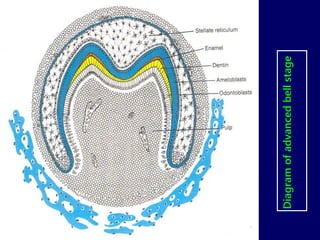
B. Advanced bell stage 
Formation of hard 
tissue structure 
• A= odontoblasts 
• B= dental papilla 
• C= dentin 
• D= organizing 
ameloblast layer of 
inner dental epithelium 
• E= outer enamel 
epithelium 
• F= stellate reticulum 
• G = stratum intermedium 
Dr Hesham Dameer
Histological structure of the tooth germ during advanced 
bell stage 
STRATUM 
INTER. 
STELLATE 
RETICULUM 
INNER 
DENT. 
EPITH. 
PREDENTIN 
ODONTOBLASTS
Ameloblast & odontoblast 
• Ameloblast and 
Odontoblast layers 
move apart, leaving 
enamel and dentine 
between them 
Dr Hesham Dameer
Advanced bell stage
Advanced bell stage 
• 1 - ameloblasts 
2 - enamel 
3 - dentine 
(predentine) 
4 - odontoblasts 
5 - dental pulp 
Dr Hesham Dameer
Dentin 
Predentin 
Odontoblasts 
Enamel 
Ameloblas
Advanced bell stage 
Histological structure of the tooth germ 
OUTER DENTAL 
EPITHELIUM 
CAPILLARY LOOP 
ENAMEL 
DENTIN 
PREDENTIN
Diagram of advanced bell stage
Dr Hesham Dameer
Root Stage 
 After complete formation of the crown , both the inner 
and outer enamel epithelium at the cervical end of the 
crown is known cervical loop . The vertical cervical loop 
grows in horizontal direction to form the epithelial 
diaphragm . 
The epithelial cells, at the cervical area or cervical to the 
epithelial diaphragm proliferate leading to the formation 
of the first portion of the root sheath . Both the root sheath 
and the epithelial diaphragm only consists of outer and 
inner enamel epithelium . 
 The inner enamel epithelium cells of the root sheath will 
induce the adjacent ectomesenchymal cells to 
differentiate into odontoblasts .
 The odontoblasts deposit dentin on the inner side of the root 
sheath . As a result of dentin deposition , the root sheath will 
degenerate , thus exposing newly for dentin surface into the 
adjacent ectomesenchyme . 
 The surrounding ectomesenchymal cells begin to differentiate 
to cementoblasts . 
 Cementoblasts start cementum formation , to which the fibers 
of the dental sac will be embedded . 
 Occasionally , an incomplete degeneration of root sheath may 
occur, resulting in the presence of some epithelial cells in the 
form of nests which known epithelial rests of Malassez . 
 In case of multiroot formation, tongue like processes arise from 
the margin of epithelial diaphragm, thus dividing the primitive 
apical foramen into more one, corresponding to the number of 
the growing processes . At first these processes grow in horizontal 
direction, but later their free ends grow vertically .
 The inner enamel epithelial cells of the processes induce the 
the adjacent mesenchymal cells to differentiate into 
odontoblasts that in turn deposit dentin . The margins of the 
process will grow downwards with downgrowth of the root 
sheath, resulting in the formation of multiroot . 
Dr Hesham Dameer
FORMATION OF SUPPORTING TISSUES 
• Supporting tissues develops during root formation from 
dental follicle. 
• As the root sheath fragments ectomesenchymal cells of the 
dental follicle penetrate between the epithelial fenestrations 
and become opposed to the newly formed dentine of root. 
• These cells differentiate into cementoblasts. 
• Cementoblasts elaborate an organic matrix that become 
mineralize. 
• Collagen fiber bundles of periodontal ligament become 
anchored . 
• Cells of PDL and fiber bundles differentiate from dental 
follicle. 
• Cells forming the bone in which PDL fibers anchored also 
differentiate from dental follicle. 
Dr Hesham Dameer
A= Epithelial root sheath 
B= Ectomesenchymal cells 
C=Dental follicle 
D= Odontoblast 
Dr Hesham Dameer
• A= cervix of 
tooth 
• B= epithelial 
diaphragm (part 
of root sheath) – 
these cells don’t 
become tall 
(columnar) 
because they are 
not going to be 
secreting 
anything like in 
the crown. 
• C= odontoblast 
layer 
• D= dentin 
• E= pulp 
• F = alveolar bone 
Dr Hesham Dameer
• Developmental process: eruptive 
stage of tooth development 
• Region or location: Root shealth 
• A= crown 
• B = root 
• C= DEJ (artifact space) 
• D= ameloblasts 
• E= dentin 
• F = odontoblast layer 
• G = Hertwig’s epithelial root sheath 
• Specific components or positional 
parts of HERS: 
• 1= epithelial diaphragm (curve 
between root sheath and diaphram) 
• 2= root sheath 
• 3= cervix of tooth 
Dr Hesham Dameer
Cell rest (of Malassez) 
Differentiation of dental follicle cells 
Dr Hesham Dameer
Root Formation (Cervical loop forms the epithelialroot sheath 
of Hertwig) 
Cervical loop 
Dental papilla
Cervical loop 
Hertwig’s epithelial root sheath
Tongue-like extentions 
Dr Hesham Dameer
 Tongue like processes arise from the margin of epithelial diaphragm, thus 
dividing the primitive root trunk into more one, corresponding to the 
number of the growing processes .
Root Formation 
Dr Hesham Dameer
Root Formation 
Dr Hesham Dameer
• Developmental 
process: Late crown 
or early eruptive 
stage of tooth 
development. This 
tooth is erupted, 
however apical 
foramen are still 
open. 
• Region or location: 
Multirooted tooth 
• A= what’s left of root 
sheath 
• B= apical foramen 
• C= dentin 
• D= interradicular 
septum (furcation 
area) 
• E= pulp 
• Interradicular 
septum is in the 
middle (D)
Tooth development .. hesham dameer

Tooth development .. hesham dameer

  • 2.
    )بِسْمِ اللهِ الرَّحْمنِ الرَّحِيمِ ( سَنُرِيهِمْ آيَاتِنَا فِي الآفَاقِ وَفِي أَنف سِهِمْ حَتَّى يَتَبَيَّنَ لَهُمْ أَنَّهُ الحَقُّ ) أَوَ لَمْ يَكْفِ بِرَب كَ أَنَّهُ عَلَى كُ ل يََْ هََِيد ) فصلت الآية 53 "صدق الله العظيم"
  • 3.
     The developmentof the tooth involves many complex biological processes.  The fundamental developmental processes is similar for all teeth. Dr Hesham Dameer
  • 4.
    STAGES OF TOOTHDEVELOPMENT MAY BE DESCRIBED ACCORDING TO : 1- Changes in the morphology of the developing tooth (MORPHOLOGICAL STAGES) . 2- Its physiological changes (HISTOPHYSIOLOGICAL STAGES). Note: both the morphological and the histophysiological changes are shearing in the different tooth development stages.
  • 5.
    Stages of teethdevelopment MORPHOLOGICAL STAGES 1. Dental lamina 2. Bud stage 3. Cap stage 4. Bell stage ( early & advanced ) 5. Root Stage By hesham Dameer
  • 6.
    HISTOPHYSIOLOGICAL STAGES 1-INITIATION. 2- PROLIFERATION. 3- HISTO-DIFFERENTIATION. 4- MORPHO-DIFFERENTIATION. 5- APPOSITION. Dr Hesham Dameer
  • 7.
    Initiation of ToothDevelopment The initiation of tooth development begins at 37 days of development with formation of a continuous horseshoe-band of thickened epithelium in the location of upper and lower jaws – Primary Epithelial Band Each band of epithelium will give rise to 2 sub divisions: 1. Dental lamina and 2. Vestibular lamina Dr Hesham Dameer
  • 8.
    Early Dental Lamina Tongue Dental lamina Vestibular lamina
  • 9.
    Primary epithelial band Ectomesenchyme
  • 10.
    Vestibular lamina:- Itis a wedge of epithelial cells facial to dental lamina. It proliferates into ectomesenchyme. Then degenerates at the center to form cleft which becomes the oral vestibules. Dr Hesham Dameer
  • 11.
  • 12.
    The dental lamina ECTODERM MESODERM (Connective tissue) Flat cells Columnar cells Basement membrane
  • 13.
    Also No teethwithout dental lamina No fruits without a tree Dr Hesham Dameer
  • 14.
     Dental laminaappears as a thickening of the oral epithelium adjacent to condensation of ectomesenchyme • 20 areas of enlargement or knobs appear, which will form tooth buds for the 20 primary teeth •Not all will appear at the same time . The first to develop are those of the anterior mandible region
  • 15.
    •At this earlystage the tooth buds have already determined their crown morphology .  Successional lamina : lamina from which permanent teeth develop which replace the primary teeth except for the permanent molars. Dr Hesham Dameer
  • 16.
     Dental laminaformation and development of tooth buds
  • 18.
  • 19.
    • M Max.bone development Mand. bone dev. Tongue Dental lamina &Tooth bud Meckel's cartilage
  • 20.
    B • F.Developing mandibular bone • G. Meckel's cartilage • A. Dental lamina • B. Tooth bud • C. Mesenchymal cells condensation A B C F Dr Hesham Dameer
  • 21.
    Function of thedental lamina 1. Initiation of deciduous dentition ( 2 MIU ) . 2. Initiation of successors of deciduous dentition . This is preceded by the growth of the terminal end of the dental lamina lingual to the deciduous enamel organ . ( 5 MIU. For central incisors, 10 M. of age for second premolars ) . 3. Initiation of permanent molars . This is preceded by the extension of dental lamina distal to the enamel organ of the second deciduous molar to form the permanent molar tooth buds ( first molar 4MIU. , second molar 1 year , third molar 4-5 years )  It is thus evident that the activity of the dental lamina extends over a period of about five years and disintegrates completely or remains as epithelial rests of Serres.
  • 22.
    Fate of thedental lamina 1) The broad connection of the dental lamina with the dental organ seen in the cap stage is broken in the bell stage by mesenchymal invasion . 2) The mesenchymal invasion at first divides the general dental lamina into lateral dental lamina and dental lamina proper. The dental lamina proper, growths at its terminal end ( successional lamina ) which form the primordium of the permanent tooth germ . The lateral dental lamina which connected to the deciduous tooth germ degenerates . Sometimes , the remnants of the dental lamina persists as epithelial rests and known epithelial rests of serres .
  • 23.
    GENERAL DENTAL LAMINA SUCCESSIONAL LAMINA ( DENTAL LAMIA PROPER ) LATERAL DENTAL LAMINA
  • 24.
    Epithelial rests ofserres mesenchymal invasion Epithelial rests
  • 25.
  • 26.
  • 27.
    Tooth bud stage: • At certain regions along the dental lamina , 10 rounded or ovoid localized growth of epithelium ( Tooth bud ) in each arch correspond to the primordia of the enamel organs of the decidous teeth . These buds were surrounded by proliferating mesenchymal cells, which are packed closely beneath and around the epithelial buds Dr Hesham Dameer
  • 28.
    The mesoderm exerts a pressure at the base of tooth bud . The pressure of the mesoderm leads to invagination of the undersurface of the tooth bud , while the lower margin of the concavity proliferates downward to surround the actively growing mesoderm . Pressure of the mesoderm Dr Hesham Dameer
  • 29.
    • As aresult of this topographic alteration , the round shaped tooth bud is transformed to a cap shaped structure . Later on , the cap shape structure can be distinguished into different cell layers , as follows : Dr Hesham Dameer
  • 30.
  • 31.
    Early cap stage:- The inner cell become low columnar called inner epithelium or inner dental epithelium. The outer cells become flat and called outer dental epithelium or outer enamel epithelium. The ectomesenchymal tissue becomes condensed in the concave surface and called dental papilla (much cells, low fibers). Some ectomesenchymal fibers surround the cap called dental follicle (sac) (low cells, much fibers). Enamel knot may be formed due to localized thickening at the inner dental epithelium at center. Strands of epithelial cells also may be formed and called enamel cord . Dr Hesham Dameer
  • 32.
    Inner Enamel Epithelium Cell Free Zone Enamel cord Cap stage DENTAL (follicle ) Dr Hesham Dameer
  • 33.
  • 34.
    Late cap stage:- A fourth layer of epithelial cells is formed between the inner dental epithelium and stellate reticulum called stratum intermedium. It is formed of two layers of rounded cells which have high activity of alkaline phosphatase enzyme that responsible for enamel formation. Cervical loop:- It is the most peripheral areas in both sides of cap (the proliferation zone) the outer and inner enamel epithelial cells come together with minimal inclusion of the stratum intermedium and stellate reticulum. After crown formation cervical loop cells proliferate to form bilayer of cells (outer and inner enamel epithelium) called root sheath of Hertwig's Dr Hesham Dameer
  • 35.
    1- Cap-shaped stage 2- Tooth bell stage Dr Hesham Dameer
  • 36.
    A. Early bellstage B. Advanced bell stage
  • 37.
    bell stage A. Early bell stage : This stage is reached when the invagination of the dental organ is deepened and also the margin of the dental organ ( cervical loop )grows deeper into the underlying mesenchyme . 1. Enamel organ tissues begin to differentiate. 2. Enamel organ begins to fold into shape of finished crown. 3. Dental papilla tissues begin to differentiate. Associated with these changes , other changes occur in the dental organ as : 1. Outer enamel epithelium become cells transformed into folded layer instead of the previous smooth layer . The adjacent ectomesenchyme invade these folds. The ectomesenchyme contain a rich capillary buds to provide nutrition for the highly and metabolically active dental organ . By hesham Dameer
  • 38.
    2. Inner enamelepithelium become tall columnar and measure 4 to 5 micrometer in diameter and about 40 micrometer in length . These cells exert an inductive effect on the underlying ectomesenchymal cells found in the dental papilla resulting in there differentiation into odontoblasts . 3. Stellate reticulum The mucoid fluids in the intercellular spaces increases , thus the cells of the stellate reticulum appear star shaped . As amelogenesis starts , the reticulum will collapse and reduce in size . Thus the capillaries of the invading ectomesenchyme found in the folds of the outer enamel epithelium will come in close relation to the inner enamel epithelium . Dr Hesham Dameer
  • 39.
    3. Stratum intermediumSeveral squamous cells develop between the stellate reticulum and the inner enamel epithelium . These cells have a high degree of metabolic activity and appear to be essential for enamel formation . 3. Dental papilla Before amelogenesis, the inductive effect exerted by the organized inner enamel epithelium ( tall columnar cells ), causes transformation of the peripheral ectomesenchymal cells of the dental papilla into odontoblasts and become potentially capable to form dentin . 4. Dental sac The fibrillar components of the dental sac arrange themselves in a circular pattern . As the root start to develop and cementum is being is being deposited on dentin surface, the fibers of the dental sac differentiate into periodontal fibers and become embedded into the developing cementum and alveolar bone . Dr Hesham Dameer
  • 40.
    Functions of theenamel organ 1- Outer enamel epithelium : Active transport of nutrient materials specially, after hard tissues formation . 2- Stellate reticulum : a. Act as a buffer against physical forces that may distort the configurations of the developing tooth . b. It permit a limited flow of nutritional elements from the capillaries of the invading ectomesenchyme found in the folds to the formative cells . c. It keep a room for the developing enamel . Dr Hesham Dameer
  • 41.
    3. Stratum intermedium: The function of this layer is not understood : a. It is believed to control fluid diffusion into and out of the ameloblasts . b. It provides the enamel organ with alkaline phosphate enzyme needed for mineralization . c. These cells plus the inner dental epithelium are considered as a single unite responsible for enamel formation . 4. Inner enamel epithelium : a. It exerts an inductive effect on the undifferentiated cells of the dental papilla to differentiate into odontoblasts. b. Transport of the nutritive materials from the dental papilla to the enamel organ before dental hard tissues formation.
  • 42.
    c. It arrangedin a pattern to determine the morphology of the crown . d. It lays down enamel matrix and helps in its mineralization . e. It shares in the root formation. g. It secretes primary enamel cuticle and share in the formation of the reduced enamel epithelium which help in protection of the newly formed enamel against resorption and preventing precipitation of cementum . 5- Dental papilla : Gives rise to dentin and dental pulp . 6- Dental sac : Give rise to cementum, periodontal ligament and alveolar bone.
  • 43.
  • 44.
    • A= cervicalloop • B= stellate reticulum • C= enamel cord • D= inner enamel epithelium • E= stratum intermedium • F= dental lamina • G= outer enamel epithelium • H= dental papilla
  • 45.
    • A= dentalpapilla (a very condensed group of cells) • B= ameloblast cell layer of the inner enamel epithelium cells are columnar • C= outer enamel epithelium cells • D= stellate reticulum • E= stratum intermedium • F= outer cells of dental papilla or differentiating odontoblasts
  • 46.
    Future crown patterningoccurs in the bell stage, by folding of the inner dental epithelium.
  • 47.
    Bell Stage Diagramof early bell stage
  • 48.
    B. Advanced bellstage Formation of hard tissue structure • A= odontoblasts • B= dental papilla • C= dentin • D= organizing ameloblast layer of inner dental epithelium • E= outer enamel epithelium • F= stellate reticulum • G = stratum intermedium Dr Hesham Dameer
  • 49.
    Histological structure ofthe tooth germ during advanced bell stage STRATUM INTER. STELLATE RETICULUM INNER DENT. EPITH. PREDENTIN ODONTOBLASTS
  • 50.
    Ameloblast & odontoblast • Ameloblast and Odontoblast layers move apart, leaving enamel and dentine between them Dr Hesham Dameer
  • 51.
  • 52.
    Advanced bell stage • 1 - ameloblasts 2 - enamel 3 - dentine (predentine) 4 - odontoblasts 5 - dental pulp Dr Hesham Dameer
  • 54.
  • 55.
    Advanced bell stage Histological structure of the tooth germ OUTER DENTAL EPITHELIUM CAPILLARY LOOP ENAMEL DENTIN PREDENTIN
  • 57.
  • 58.
  • 59.
    Root Stage After complete formation of the crown , both the inner and outer enamel epithelium at the cervical end of the crown is known cervical loop . The vertical cervical loop grows in horizontal direction to form the epithelial diaphragm . The epithelial cells, at the cervical area or cervical to the epithelial diaphragm proliferate leading to the formation of the first portion of the root sheath . Both the root sheath and the epithelial diaphragm only consists of outer and inner enamel epithelium .  The inner enamel epithelium cells of the root sheath will induce the adjacent ectomesenchymal cells to differentiate into odontoblasts .
  • 60.
     The odontoblastsdeposit dentin on the inner side of the root sheath . As a result of dentin deposition , the root sheath will degenerate , thus exposing newly for dentin surface into the adjacent ectomesenchyme .  The surrounding ectomesenchymal cells begin to differentiate to cementoblasts .  Cementoblasts start cementum formation , to which the fibers of the dental sac will be embedded .  Occasionally , an incomplete degeneration of root sheath may occur, resulting in the presence of some epithelial cells in the form of nests which known epithelial rests of Malassez .  In case of multiroot formation, tongue like processes arise from the margin of epithelial diaphragm, thus dividing the primitive apical foramen into more one, corresponding to the number of the growing processes . At first these processes grow in horizontal direction, but later their free ends grow vertically .
  • 61.
     The innerenamel epithelial cells of the processes induce the the adjacent mesenchymal cells to differentiate into odontoblasts that in turn deposit dentin . The margins of the process will grow downwards with downgrowth of the root sheath, resulting in the formation of multiroot . Dr Hesham Dameer
  • 62.
    FORMATION OF SUPPORTINGTISSUES • Supporting tissues develops during root formation from dental follicle. • As the root sheath fragments ectomesenchymal cells of the dental follicle penetrate between the epithelial fenestrations and become opposed to the newly formed dentine of root. • These cells differentiate into cementoblasts. • Cementoblasts elaborate an organic matrix that become mineralize. • Collagen fiber bundles of periodontal ligament become anchored . • Cells of PDL and fiber bundles differentiate from dental follicle. • Cells forming the bone in which PDL fibers anchored also differentiate from dental follicle. Dr Hesham Dameer
  • 63.
    A= Epithelial rootsheath B= Ectomesenchymal cells C=Dental follicle D= Odontoblast Dr Hesham Dameer
  • 64.
    • A= cervixof tooth • B= epithelial diaphragm (part of root sheath) – these cells don’t become tall (columnar) because they are not going to be secreting anything like in the crown. • C= odontoblast layer • D= dentin • E= pulp • F = alveolar bone Dr Hesham Dameer
  • 65.
    • Developmental process:eruptive stage of tooth development • Region or location: Root shealth • A= crown • B = root • C= DEJ (artifact space) • D= ameloblasts • E= dentin • F = odontoblast layer • G = Hertwig’s epithelial root sheath • Specific components or positional parts of HERS: • 1= epithelial diaphragm (curve between root sheath and diaphram) • 2= root sheath • 3= cervix of tooth Dr Hesham Dameer
  • 66.
    Cell rest (ofMalassez) Differentiation of dental follicle cells Dr Hesham Dameer
  • 67.
    Root Formation (Cervicalloop forms the epithelialroot sheath of Hertwig) Cervical loop Dental papilla
  • 68.
    Cervical loop Hertwig’sepithelial root sheath
  • 70.
  • 71.
     Tongue likeprocesses arise from the margin of epithelial diaphragm, thus dividing the primitive root trunk into more one, corresponding to the number of the growing processes .
  • 72.
    Root Formation DrHesham Dameer
  • 73.
    Root Formation DrHesham Dameer
  • 74.
    • Developmental process:Late crown or early eruptive stage of tooth development. This tooth is erupted, however apical foramen are still open. • Region or location: Multirooted tooth • A= what’s left of root sheath • B= apical foramen • C= dentin • D= interradicular septum (furcation area) • E= pulp • Interradicular septum is in the middle (D)