APPENDICITIS
Ms.Beena Vaza
INTRODUCTION
• The appendix sits at the junction of the small intestine
and large intestine.
• It’s a thin tube about four inches long. Normally, the
appendix sits in the lower right abdomen.
Presentation title 2
DEFINITION
•Appendicitis is an inflammation of the
vermiform appendix that develops most
commonly in adolescents and young
adults.
Presentation title 3
ETIOLOGY
OBSTRUCTIVE CAUSES :
• Fecal calculus or stone that occlude lumen of the appendix.
• Twisting or curling of the appendix.
• Swelling of the bowel wall
NON ONSTRUCTIVE CAUSES :
• Spread of infection
• Vascular occlusion
• Trauma
• Diet lacking fibres
Presentation title 4
PATHOPHYSIOLOGY
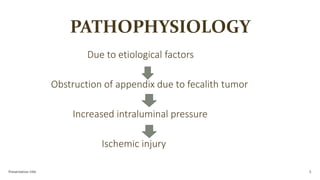
Due to etiological factors
Obstruction of appendix due to fecalith tumor
Increased intraluminal pressure
Ischemic injury
Presentation title 5
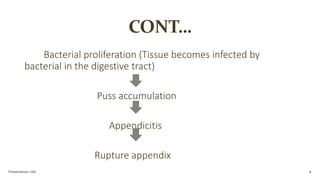
CONT…
Bacterial proliferation (Tissue becomes infected by
bacterial in the digestive tract)
Puss accumulation
Appendicitis
Rupture appendix
Presentation title 6
SIGN & SYMPTOMS
• Lower abdominal pain
• Vomiting
• Anorexia
• Fever
• Haematuria (Uncommon)
• Constipation
• Abdominal rigidity
Presentation title 7
DIAGNOSTIC EVALUATION
• History collection
• Physical examination
• Blood tests
- Elevated WBC count
- Elevated C reactive protein
• Urinanalysis
• X- ray
• Abdominal USG
• CT scan
• MRI
Presentation title 8
MEDICAL MANAGEMENT
• To treat infection
• Give antibiotics for bacterial infection
• Give analgesics for pain
• Give antipyretics for fever
• Give antiemetics for vomiting
• Give fluid therapy for electrolyte balance
• Give supportive drugs for nutritional support
Presentation title 9
SURGICAL MANAGEMENT
• The surgical procedure for the removal of the appendix is
called an appendectomy.
• Appendectomy can be performed through open or
laparoscopic surgery.
• Laparoscopic appendectomy has several advantages over
open appendectomy as an intervention for appendicitis.
Presentation title 10
PRE – OPERATIVE
PREPARATION
• Once diagnosis is suspected , the patient is admitted to
hospital
• Give IV fluid ( NS or RL)
• Ryle’s tube is not necessary in simple appendicitis.
• Second generation cephalosporin along with metronidazole is
given.
• Informed consent is taken.
Presentation title 11
APPENDECTOMY
• It is a surgical procedure to remove the appendix from the
abdomen.
• It can be performed either with a small incision on the
abdomen or laparoscopically ( key hole surgery).
INDICATIONS FOR OPEN APPENDECTOMY :
• Severe inflammation or prior surgical procedures.
• Perforated or gangrenous appendicitis.
• peritonitis.
Presentation title 12
LAPAROSCOPIC APPENDECTOMY
• Become popular nowdays.
• Less post operative pain.
• Speedy recovery.
• If intraoperative complication that cannot be handled with
laparoscopy arise during laparoscopic appendectomy,
conversion to an open appendectomy.
Presentation title 13
NURSING MANAGEMENT
NURSES RESPONSIBILITY
Presentation title 14

APPENDICITIS...ppt...MSN -I...SlideShare....

  • 1.
  • 2.
    INTRODUCTION • The appendixsits at the junction of the small intestine and large intestine. • It’s a thin tube about four inches long. Normally, the appendix sits in the lower right abdomen. Presentation title 2
  • 3.
    DEFINITION •Appendicitis is aninflammation of the vermiform appendix that develops most commonly in adolescents and young adults. Presentation title 3
  • 4.
    ETIOLOGY OBSTRUCTIVE CAUSES : •Fecal calculus or stone that occlude lumen of the appendix. • Twisting or curling of the appendix. • Swelling of the bowel wall NON ONSTRUCTIVE CAUSES : • Spread of infection • Vascular occlusion • Trauma • Diet lacking fibres Presentation title 4
  • 5.
    PATHOPHYSIOLOGY Due to etiologicalfactors Obstruction of appendix due to fecalith tumor Increased intraluminal pressure Ischemic injury Presentation title 5
  • 6.
    CONT… Bacterial proliferation (Tissuebecomes infected by bacterial in the digestive tract) Puss accumulation Appendicitis Rupture appendix Presentation title 6
  • 7.
    SIGN & SYMPTOMS •Lower abdominal pain • Vomiting • Anorexia • Fever • Haematuria (Uncommon) • Constipation • Abdominal rigidity Presentation title 7
  • 8.
    DIAGNOSTIC EVALUATION • Historycollection • Physical examination • Blood tests - Elevated WBC count - Elevated C reactive protein • Urinanalysis • X- ray • Abdominal USG • CT scan • MRI Presentation title 8
  • 9.
    MEDICAL MANAGEMENT • Totreat infection • Give antibiotics for bacterial infection • Give analgesics for pain • Give antipyretics for fever • Give antiemetics for vomiting • Give fluid therapy for electrolyte balance • Give supportive drugs for nutritional support Presentation title 9
  • 10.
    SURGICAL MANAGEMENT • Thesurgical procedure for the removal of the appendix is called an appendectomy. • Appendectomy can be performed through open or laparoscopic surgery. • Laparoscopic appendectomy has several advantages over open appendectomy as an intervention for appendicitis. Presentation title 10
  • 11.
    PRE – OPERATIVE PREPARATION •Once diagnosis is suspected , the patient is admitted to hospital • Give IV fluid ( NS or RL) • Ryle’s tube is not necessary in simple appendicitis. • Second generation cephalosporin along with metronidazole is given. • Informed consent is taken. Presentation title 11
  • 12.
    APPENDECTOMY • It isa surgical procedure to remove the appendix from the abdomen. • It can be performed either with a small incision on the abdomen or laparoscopically ( key hole surgery). INDICATIONS FOR OPEN APPENDECTOMY : • Severe inflammation or prior surgical procedures. • Perforated or gangrenous appendicitis. • peritonitis. Presentation title 12
  • 13.
    LAPAROSCOPIC APPENDECTOMY • Becomepopular nowdays. • Less post operative pain. • Speedy recovery. • If intraoperative complication that cannot be handled with laparoscopy arise during laparoscopic appendectomy, conversion to an open appendectomy. Presentation title 13
  • 14.