APPENDICITIS
JOHNY WILBERT, M.SC[N]
LECTURER,
APOLLO INSTITUTE OF HOSPITAL
MANAGEMENT AND ALLIED SCIENCE
Introduction
• The appendix is a small, finger-like appendage
attached to the cecum just below the ileo-cecal
valve.
• Because it empties into the colon inefficiently
and its lumen is small, it is prone to becoming
obstructed and is vulnerable to infection.
• The obstructed appendix becomes inflamed
and edematous and eventually fills with pus,
this is called appendicitis.
Definition
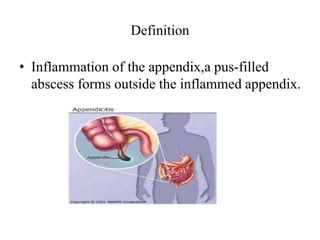
• Inflammation of the appendix,a pus-filled
abscess forms outside the inflammed appendix.
Incidence
• Males are affected more than females.
• Teenagers more frequently than adults.
• The highest incidence is in those between the
ages of 10 and 30years.
Causes
• Appendix becomes blocked, often by
stool, a foreign body, kinking, or
cancer.
• Blockage may also occur from
infection, since the appendix swells in
response to any response in the body.
Types of appendicitis
• There are 2 basic types of appendicitis
Chronic appendicitis
Acute appendicitis
Signs and symptoms
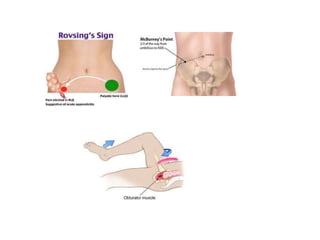
• Lower right quadrant pain(at Mcburneys point)
• Low-grade fever.
• Nausea.
• Vomitting
• Constipation or diarrhea.
• Rebound tenderness.
• Loss of appetite
• Rovsing’s sign (pain in right lower quadrant
with palpation of left lower quadrant).
• Ruptured appendix causes abdominal
distention develops from paralytic ileus.
• Inability to pass fatus
• Painful urination
• Severe cramps
• Dunphy’s sign (increased pain with
coughing).
• Obturator sign( pain on internal
rotation of right thigh)
• Psoas sign (pain on extension of right
thigh).
Diagnostic evaluation
• Complete physical examination.
• Abdominal x-ray.
• Ultrasound
• Complete blood count
• CT scan
• Rectal exam
• Urine test
Treatment
• Antibiotics
• NPO
• Iv fluid
• Analgesics
• Antiemetics
• Surgery(appendicectomy) either open or
laprascopic
Complication
• Perforation leads to peritonitis or an abscess.
• High grade fever
• Thank you

Appendicitis

  • 1.
    APPENDICITIS JOHNY WILBERT, M.SC[N] LECTURER, APOLLOINSTITUTE OF HOSPITAL MANAGEMENT AND ALLIED SCIENCE
  • 2.
    Introduction • The appendixis a small, finger-like appendage attached to the cecum just below the ileo-cecal valve. • Because it empties into the colon inefficiently and its lumen is small, it is prone to becoming obstructed and is vulnerable to infection.
  • 3.
    • The obstructedappendix becomes inflamed and edematous and eventually fills with pus, this is called appendicitis.
  • 4.
    Definition • Inflammation ofthe appendix,a pus-filled abscess forms outside the inflammed appendix.
  • 5.
    Incidence • Males areaffected more than females. • Teenagers more frequently than adults. • The highest incidence is in those between the ages of 10 and 30years.
  • 6.
    Causes • Appendix becomesblocked, often by stool, a foreign body, kinking, or cancer. • Blockage may also occur from infection, since the appendix swells in response to any response in the body.
  • 7.
    Types of appendicitis •There are 2 basic types of appendicitis Chronic appendicitis Acute appendicitis
  • 8.
    Signs and symptoms •Lower right quadrant pain(at Mcburneys point) • Low-grade fever. • Nausea. • Vomitting • Constipation or diarrhea.
  • 10.
    • Rebound tenderness. •Loss of appetite • Rovsing’s sign (pain in right lower quadrant with palpation of left lower quadrant). • Ruptured appendix causes abdominal distention develops from paralytic ileus. • Inability to pass fatus
  • 11.
    • Painful urination •Severe cramps • Dunphy’s sign (increased pain with coughing). • Obturator sign( pain on internal rotation of right thigh) • Psoas sign (pain on extension of right thigh).
  • 12.
    Diagnostic evaluation • Completephysical examination. • Abdominal x-ray. • Ultrasound • Complete blood count • CT scan • Rectal exam • Urine test
  • 13.
    Treatment • Antibiotics • NPO •Iv fluid • Analgesics • Antiemetics • Surgery(appendicectomy) either open or laprascopic
  • 14.
    Complication • Perforation leadsto peritonitis or an abscess. • High grade fever
  • 15.