HERBARIUM TECHNIQUES
Dr. M. Priyadharshana
Assistant Professor in Botany
V. O. Chidambaram College,Thoothukudi
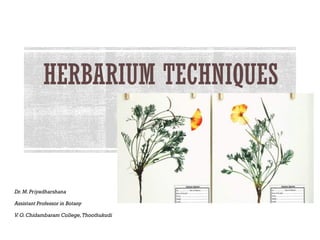
▪ A herbarium is a collection of dried
plant specimens mounted on
herbarium sheets.
▪ The first herbarium was created by
Cesalpini and his friends in 1550.
Foldable Knife Forceps
Trowel
Plastic Bags Tags
Vasculum
Pocket lens
Drying sheets
Plant Press Notebook and Pencil
The important observations to note
before plant collection
▪ Plant type:Tree/shrub/herb/climber
▪ Flower characters : Colour, Smell, Size
▪ Fruit Characters: Colour, Taste of ripe
and unripe fruits.
▪ Local name of the plants
▪ How local people utilize the plant?
(medicinal/edible)
▪ Habitat details: Place, soil, altitude,
climate and environmental conditions
▪ Plant Secretions: Fluid produced when
plant parts are detached.
▪ Plants must be collected from their original
habitat after thorough observation.
▪ Frequent field trips are necessary to observe
different growth stages. The best time for plant
collection is when plants bears flowers and
fruits.
▪ Collect 2-3 plant specimens to avoid data loss.
▪ Plants less than 1ft height should be collected
with roots.
▪ The fruits and seeds should be collected
separately and stored in labelled bags.
▪ Each plant species is assigned a unique
number recorded in the field note book. The
same number should be labelled on all
specimens of that species.
▪ The specimens are placed inside the
vasculum. The delicate plant parts should be
stored in polythene bags separately.
▪ Remove the unwanted plant parts
before pressing.
▪ Spread the plant on drying sheets,
ensuring leaves, flowers and fruits
are well exposed.
▪ Another two drying sheets are
placed over it and another specimen
is spread over the sheet in a similar
way.
▪ Stack multiple specimens in the
wooden plant press.
▪ A gentle pressure is applied over the
board and the bundle is tied with the
rope.
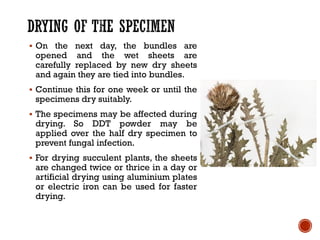
▪ On the next day, the bundles are
opened and the wet sheets are
carefully replaced by new dry sheets
and again they are tied into bundles.
▪ Continue this for one week or until the
specimens dry suitably.
▪ The specimens may be affected during
drying. So DDT powder may be
applied over the half dry specimen to
prevent fungal infection.
▪ For drying succulent plants, the sheets
are changed twice or thrice in a day or
artificial drying using aluminium plates
or electric iron can be used for faster
drying.
▪ The dried plant specimens may be
damaged by insects. In order to protect
the specimens they are poisoned before
mounting.
▪ Mercuric chloride solution is used for
poisoning.
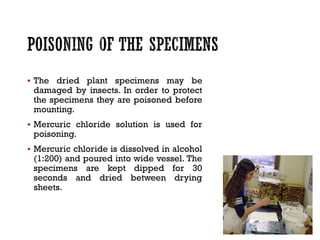
▪ Mercuric chloride is dissolved in alcohol
(1:200) and poured into wide vessel. The
specimens are kept dipped for 30
seconds and dried between drying
sheets.
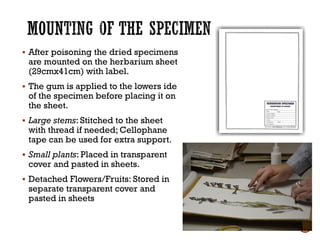
▪ After poisoning the dried specimens
are mounted on the herbarium sheet
(29cmx41cm) with label.
▪ The gum is applied to the lowers ide
of the specimen before placing it on
the sheet.
▪ Large stems: Stitched to the sheet
with thread if needed; Cellophane
tape can be used for extra support.
▪ Small plants: Placed in transparent
cover and pasted in sheets.
▪ Detached Flowers/Fruits: Stored in
separate transparent cover and
pasted in sheets
▪ A printed label is placed on the
lower right corner of the sheet.
The label includes
▪ Collectors name; Collection no.
▪ Botanical name; local name
▪ Family
▪ Date and place of collection
▪ Habitat details (Place/soil
type/altitude)
▪ Habit details (Tree/shrub/herb)
▪ Uses and special remarks
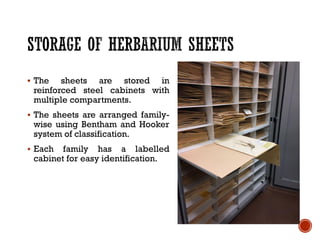
▪ The sheets are stored in
reinforced steel cabinets with
multiple compartments.
▪ The sheets are arranged family-
wise using Bentham and Hooker
system of classification.
▪ Each family has a labelled
cabinet for easy identification.
▪ Herbarium specimens are
spoiled by Herbarium
beetle, Drugstore beetles
and book lice.
Protection Method:
▪ Fumigation with cyanide
gas, carbon disulfide and
ethylene dichloride.
▪ DDT can be dusted for long
term preservation.
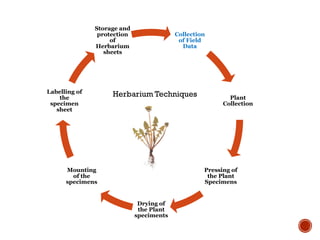
Collection
of Field
Data
Plant
Collection
Pressing of
the Plant
Specimens
Drying of
the Plant
speciments
Mounting
of the
specimens
Labelling of
the
specimen
sheet
Storage and
protection
of
Herbarium
sheets
Herbarium Techniques
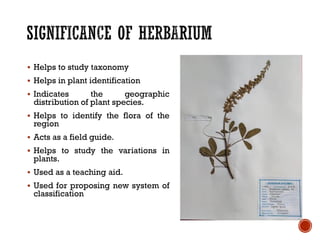
▪ Helps to study taxonomy
▪ Helps in plant identification
▪ Indicates the geographic
distribution of plant species.
▪ Helps to identify the flora of the
region
▪ Acts as a field guide.
▪ Helps to study the variations in
plants.
▪ Used as a teaching aid.
▪ Used for proposing new system of
classification
Herbarium Techniques - Methods & Importance

Herbarium Techniques - Methods & Importance

  • 1.
    HERBARIUM TECHNIQUES Dr. M.Priyadharshana Assistant Professor in Botany V. O. Chidambaram College,Thoothukudi
  • 2.
    ▪ A herbariumis a collection of dried plant specimens mounted on herbarium sheets. ▪ The first herbarium was created by Cesalpini and his friends in 1550.
  • 3.
  • 4.
  • 5.
    The important observationsto note before plant collection ▪ Plant type:Tree/shrub/herb/climber ▪ Flower characters : Colour, Smell, Size ▪ Fruit Characters: Colour, Taste of ripe and unripe fruits. ▪ Local name of the plants ▪ How local people utilize the plant? (medicinal/edible) ▪ Habitat details: Place, soil, altitude, climate and environmental conditions ▪ Plant Secretions: Fluid produced when plant parts are detached.
  • 6.
    ▪ Plants mustbe collected from their original habitat after thorough observation. ▪ Frequent field trips are necessary to observe different growth stages. The best time for plant collection is when plants bears flowers and fruits. ▪ Collect 2-3 plant specimens to avoid data loss. ▪ Plants less than 1ft height should be collected with roots. ▪ The fruits and seeds should be collected separately and stored in labelled bags. ▪ Each plant species is assigned a unique number recorded in the field note book. The same number should be labelled on all specimens of that species. ▪ The specimens are placed inside the vasculum. The delicate plant parts should be stored in polythene bags separately.
  • 7.
    ▪ Remove theunwanted plant parts before pressing. ▪ Spread the plant on drying sheets, ensuring leaves, flowers and fruits are well exposed. ▪ Another two drying sheets are placed over it and another specimen is spread over the sheet in a similar way. ▪ Stack multiple specimens in the wooden plant press. ▪ A gentle pressure is applied over the board and the bundle is tied with the rope.
  • 8.
    ▪ On thenext day, the bundles are opened and the wet sheets are carefully replaced by new dry sheets and again they are tied into bundles. ▪ Continue this for one week or until the specimens dry suitably. ▪ The specimens may be affected during drying. So DDT powder may be applied over the half dry specimen to prevent fungal infection. ▪ For drying succulent plants, the sheets are changed twice or thrice in a day or artificial drying using aluminium plates or electric iron can be used for faster drying.
  • 9.
    ▪ The driedplant specimens may be damaged by insects. In order to protect the specimens they are poisoned before mounting. ▪ Mercuric chloride solution is used for poisoning. ▪ Mercuric chloride is dissolved in alcohol (1:200) and poured into wide vessel. The specimens are kept dipped for 30 seconds and dried between drying sheets.
  • 10.
    ▪ After poisoningthe dried specimens are mounted on the herbarium sheet (29cmx41cm) with label. ▪ The gum is applied to the lowers ide of the specimen before placing it on the sheet. ▪ Large stems: Stitched to the sheet with thread if needed; Cellophane tape can be used for extra support. ▪ Small plants: Placed in transparent cover and pasted in sheets. ▪ Detached Flowers/Fruits: Stored in separate transparent cover and pasted in sheets
  • 11.
    ▪ A printedlabel is placed on the lower right corner of the sheet. The label includes ▪ Collectors name; Collection no. ▪ Botanical name; local name ▪ Family ▪ Date and place of collection ▪ Habitat details (Place/soil type/altitude) ▪ Habit details (Tree/shrub/herb) ▪ Uses and special remarks
  • 13.
    ▪ The sheetsare stored in reinforced steel cabinets with multiple compartments. ▪ The sheets are arranged family- wise using Bentham and Hooker system of classification. ▪ Each family has a labelled cabinet for easy identification.
  • 14.
    ▪ Herbarium specimensare spoiled by Herbarium beetle, Drugstore beetles and book lice. Protection Method: ▪ Fumigation with cyanide gas, carbon disulfide and ethylene dichloride. ▪ DDT can be dusted for long term preservation.
  • 15.
    Collection of Field Data Plant Collection Pressing of thePlant Specimens Drying of the Plant speciments Mounting of the specimens Labelling of the specimen sheet Storage and protection of Herbarium sheets Herbarium Techniques
  • 16.
    ▪ Helps tostudy taxonomy ▪ Helps in plant identification ▪ Indicates the geographic distribution of plant species. ▪ Helps to identify the flora of the region ▪ Acts as a field guide. ▪ Helps to study the variations in plants. ▪ Used as a teaching aid. ▪ Used for proposing new system of classification