Department of botany
Submitted to:- Submitted by -:
vaishnavi Sharma
Content
⚫What is Herbarium ?
⚫Aimof Herbarium
⚫Types of Herbarium
⚫Technique of Herbarium
⚫Roleof Herbarium
⚫Some important herbarium in India
.
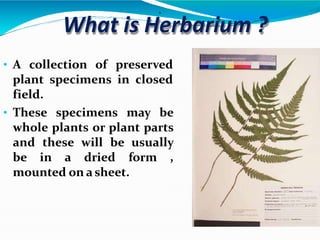
What is Herbarium ?
• A collection of preserved
plant specimens in closed
field.
• These specimens may be
whole plants or plant parts
and these will be usually
be in a dried form ,
mounted on a sheet.
⚫It is based on a scientific collection, in
continuous of plant specimens
which are
expansion
carefully dried, labelled and
treated for its permanent
conveniently
preservation.
⚫Its research work focuses on the collection of
plant specimens which are catalogued and
systematic botanical classification
Aim of Herbarium
Tostudyon various plants
Tocontribute to scientific studies
dried
To preserve the catalogues of seeds and
herbarium plants
To maintain plants on theedge of extinctions
To inform the students and public about these
effect of global warming on
plants
To inform them the
ecological system
Types of Herbarium
 Davisand Heywood haveclassified the
herbaria into threecategory:
A] National or MajorHerbaria
B] Regional Herbaria
C] Local Herbaria
Techniques of Herbarium
It involves following step and guideline
which help in creating conventional useful
and long lasting herbarium specimens:
1 Collection
2 Pressing
3 Drying
4 poisoning
5 Mounting
6 Stitching
7 labelling
8 storage
1] Collection :
⚫Plant specimen should bear flowers and fruits , if
present.
⚫Herbaceous small plant specimen should be
collected with roots orother underground parts.
⚫A twig of about 25 cm with leaves & flowers , will
form an ideal material.
⚫Note sheet’s no. & data recorded in the field
notebook.
⚫Soon after the specimens are collected, they should
be pressed in the field itself.
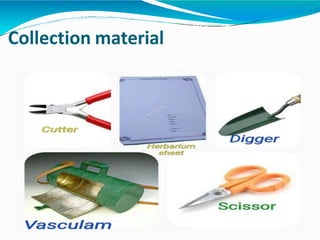
Collection material
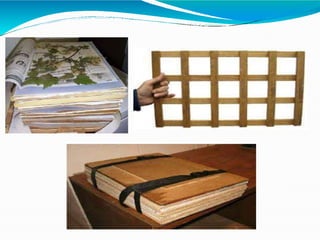
2] Pressing
⚫Specimens should be carefully placed in the center
on the pressing sheets.
⚫If specimens are large enough , they should be bend
giving them shapeof V, N orW .
⚫ the bundles should be uniform in thickness in the
middle and on the sides.
⚫Specimens should be kept oneabove theother.
3] Drying:
⚫After two or three changes the specimens are finally
kept in fresh blotting sheets and dried either by
natural orartificial heating.
4] Poisoning:
 useof mercuric chloride
 Lauryl pentachorophenate (LPCP) as substitute of
mercuric chloride
5] Mounting and Stitching
⚫ The standard size of a herbarium sheet is 29 x 42
cm.
⚫Usually made of durablecard sheets
⚫It is advisable to mount one specimen on each
herbarium sheet.
⚫Dissected and loose parts such as flowers , fruits
&seeds are kept in paper packets & pasted to the
mounted sheet.
6] Labelling :
The labels are put on the right hand side, at the bottom
of the herbarium sheets they are of 3” x 5” size and
should have the following information :
a) Name of organization with which specimen plant
originated
b) Nameof the family
c) Botanical nameof the plant
d) Local name
e) Localityof collection
f) Dateof collection
g) Habitatof the plant
h) Field notes & collection no.
i) Nameof collector
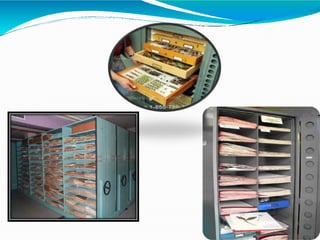
7] Storage :
⚫Plant specimens, which have been properly mounted &
identified , are filled systematically in special wooden/
steel cabinets.
⚫The herbarium sheets loaded with specimens are filed
inside folders which are of various color schemes
indicating species, genus, family , geographical area, etc
⚫Plants are arranged & stored following bentham &
Hooker’s/ Engler & prantl’ system of classification.
8] Fumigation:
⚫This is done for killing insects which often damage
plant.
⚫The most common method is to keep Naphthalene balls
within muslin bags in each pigeon hole.
⚫Some time paradichlorobenzene is used.
⚫Small cloth bags with PDB are placed in the pigeon
holes.
⚫Thechemical also besprinkled on sheets or bundles.
Role of Herbarium
⚫Toactasa repositoryof dried plantspecimens,
safeguard them against loss & destruction by fungi,
insects, etc. & make them available forstudy.
⚫Several herbariaof repute, keepType Specimens – the
principal proof of the existence of a species, in safe
custody, often in rooms with restricted access.
⚫As original documents upon which knowledge of
taxonomiccharacters rests, herbarium specimens
greatly help in developing floras, manuals and
monograph.
⚫Those engaged in taxonomic studies, can personally
identify theirengaged collection bycomparisonwith
already identified herbariumspecimens.
⚫Voucher specimens preserved in various herbaria
provide an index of specimens on which studies on
chromosomes, phytochemistry, ultrastructure micro
morphology, etc. have been undertaken.
⚫Most herbaria havespecimenscollected from different
parts of the world & thus their scrutiny can provide
informationon thegeographical distributionof taxa.
Cont…
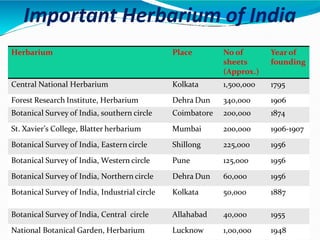
Important Herbarium of India
Herbarium Place No of
sheets
(Approx.)
Year of
founding
Central National Herbarium Kolkata 1,500,000 1795
Forest Research Institute, Herbarium Dehra Dun 340,000 1906
Botanical Survey of India, southern circle Coimbatore 200,000 1874
St. Xavier’s College, Blatter herbarium Mumbai 200,000 1906-1907
Botanical Survey of India, Eastern circle Shillong 225,000 1956
Botanical Survey of India, Western circle Pune 125,000 1956
Botanical Survey of India, Northern circle Dehra Dun 60,000 1956
Botanical Survey of India, Industrial circle Kolkata 50,000 1887
Botanical Survey of India, Central circle Allahabad 40,000 1955
National Botanical Garden, Herbarium Lucknow 1,00,000 1948
 References
A Text Book of Botany : Angiosperms
By B. P
. Pandey
www.slideshare.com
www.herbarium imeges.com
herbariumpptfullcoveroftopicharbarium.pptx

herbariumpptfullcoveroftopicharbarium.pptx

  • 1.
    Department of botany Submittedto:- Submitted by -: vaishnavi Sharma
  • 2.
    Content ⚫What is Herbarium? ⚫Aimof Herbarium ⚫Types of Herbarium ⚫Technique of Herbarium ⚫Roleof Herbarium ⚫Some important herbarium in India
  • 3.
    . What is Herbarium? • A collection of preserved plant specimens in closed field. • These specimens may be whole plants or plant parts and these will be usually be in a dried form , mounted on a sheet.
  • 4.
    ⚫It is basedon a scientific collection, in continuous of plant specimens which are expansion carefully dried, labelled and treated for its permanent conveniently preservation. ⚫Its research work focuses on the collection of plant specimens which are catalogued and systematic botanical classification
  • 5.
    Aim of Herbarium Tostudyonvarious plants Tocontribute to scientific studies dried To preserve the catalogues of seeds and herbarium plants To maintain plants on theedge of extinctions To inform the students and public about these effect of global warming on plants To inform them the ecological system
  • 6.
    Types of Herbarium Davisand Heywood haveclassified the herbaria into threecategory: A] National or MajorHerbaria B] Regional Herbaria C] Local Herbaria
  • 7.
    Techniques of Herbarium Itinvolves following step and guideline which help in creating conventional useful and long lasting herbarium specimens: 1 Collection 2 Pressing 3 Drying 4 poisoning 5 Mounting 6 Stitching 7 labelling 8 storage
  • 8.
    1] Collection : ⚫Plantspecimen should bear flowers and fruits , if present. ⚫Herbaceous small plant specimen should be collected with roots orother underground parts. ⚫A twig of about 25 cm with leaves & flowers , will form an ideal material. ⚫Note sheet’s no. & data recorded in the field notebook. ⚫Soon after the specimens are collected, they should be pressed in the field itself.
  • 9.
  • 10.
    2] Pressing ⚫Specimens shouldbe carefully placed in the center on the pressing sheets. ⚫If specimens are large enough , they should be bend giving them shapeof V, N orW . ⚫ the bundles should be uniform in thickness in the middle and on the sides. ⚫Specimens should be kept oneabove theother.
  • 12.
    3] Drying: ⚫After twoor three changes the specimens are finally kept in fresh blotting sheets and dried either by natural orartificial heating. 4] Poisoning:  useof mercuric chloride  Lauryl pentachorophenate (LPCP) as substitute of mercuric chloride
  • 13.
    5] Mounting andStitching ⚫ The standard size of a herbarium sheet is 29 x 42 cm. ⚫Usually made of durablecard sheets ⚫It is advisable to mount one specimen on each herbarium sheet. ⚫Dissected and loose parts such as flowers , fruits &seeds are kept in paper packets & pasted to the mounted sheet.
  • 14.
    6] Labelling : Thelabels are put on the right hand side, at the bottom of the herbarium sheets they are of 3” x 5” size and should have the following information : a) Name of organization with which specimen plant originated b) Nameof the family c) Botanical nameof the plant d) Local name e) Localityof collection f) Dateof collection g) Habitatof the plant h) Field notes & collection no. i) Nameof collector
  • 15.
    7] Storage : ⚫Plantspecimens, which have been properly mounted & identified , are filled systematically in special wooden/ steel cabinets. ⚫The herbarium sheets loaded with specimens are filed inside folders which are of various color schemes indicating species, genus, family , geographical area, etc ⚫Plants are arranged & stored following bentham & Hooker’s/ Engler & prantl’ system of classification.
  • 17.
    8] Fumigation: ⚫This isdone for killing insects which often damage plant. ⚫The most common method is to keep Naphthalene balls within muslin bags in each pigeon hole. ⚫Some time paradichlorobenzene is used. ⚫Small cloth bags with PDB are placed in the pigeon holes. ⚫Thechemical also besprinkled on sheets or bundles.
  • 18.
    Role of Herbarium ⚫Toactasarepositoryof dried plantspecimens, safeguard them against loss & destruction by fungi, insects, etc. & make them available forstudy. ⚫Several herbariaof repute, keepType Specimens – the principal proof of the existence of a species, in safe custody, often in rooms with restricted access. ⚫As original documents upon which knowledge of taxonomiccharacters rests, herbarium specimens greatly help in developing floras, manuals and monograph.
  • 19.
    ⚫Those engaged intaxonomic studies, can personally identify theirengaged collection bycomparisonwith already identified herbariumspecimens. ⚫Voucher specimens preserved in various herbaria provide an index of specimens on which studies on chromosomes, phytochemistry, ultrastructure micro morphology, etc. have been undertaken. ⚫Most herbaria havespecimenscollected from different parts of the world & thus their scrutiny can provide informationon thegeographical distributionof taxa. Cont…
  • 20.
    Important Herbarium ofIndia Herbarium Place No of sheets (Approx.) Year of founding Central National Herbarium Kolkata 1,500,000 1795 Forest Research Institute, Herbarium Dehra Dun 340,000 1906 Botanical Survey of India, southern circle Coimbatore 200,000 1874 St. Xavier’s College, Blatter herbarium Mumbai 200,000 1906-1907 Botanical Survey of India, Eastern circle Shillong 225,000 1956 Botanical Survey of India, Western circle Pune 125,000 1956 Botanical Survey of India, Northern circle Dehra Dun 60,000 1956 Botanical Survey of India, Industrial circle Kolkata 50,000 1887 Botanical Survey of India, Central circle Allahabad 40,000 1955 National Botanical Garden, Herbarium Lucknow 1,00,000 1948
  • 21.
     References A TextBook of Botany : Angiosperms By B. P . Pandey www.slideshare.com www.herbarium imeges.com