EVOLUTION OF MANAGEMENT THEORY
INDIVIDUAL ASSIGNMENT ONE
“EVOLUTION OF MANAGEMENT THEORY”
INTRODUCTION TO MANAGEMENT (TL 1053)
TRANSPORT AND LOGISTICS MANAGEMENT
UNIVERSITY of MORATUWA
14th
BATCH
HASHAN RAHUBADDHA
141456 X
INDEX
TOPIC PAGE
# Management Theory Introduction 1
# Why studying Management theory is important 1
# Management History Brief Introduction 1
# Historical events that are significant to the study of management
(a) Adam Smith’s Publication of Wealth of the Nations
(b) Industrial Revolution
2
2
# Evolution of the management theory (1890-2000) 3
# Scientific Management Theory
* Scientific Management theorists
* Fredirck Winslow Taylor
* The Gilbreths
4
4
5
# Administrative Management Theory
* Scientific Management theorists 5
# Comparison between scientific and administrative management theory
* Similaraties
* Differences
6
6
# Behavioral Management Theory 7
# Management Science Theory 8
# Organizational Environmental Theory
(a) Systems Approach
(b) Contingency Approach
(c) Multivariate Approach
9
10
10
MANAGEMENT THEORY INTRODUCTION
Management in businesses and organizations is the function that coordinates the efforts of
people to accomplish goals and objectives by using available resources efficiently and
effectively.
Management includes planning, organizing, staffing, leading or directing,
and controlling an organization to accomplish the goal or target. Resourcing encompasses the
deployment and manipulation of human resources,
financial resources, technological resources, and natural resources. Management is also
an academic discipline, asocial science whose objective is to study social organization.
WHY STUDYING MANAGEMENT THEORY IS IMPORTANT
Studying Management History is Important because it helps to understand today's
management theory and practice. It is important to know the history of management that it
could help us to develop good organizations. History of management tells us that how different
theories of management developed. Many great constructions of history like Egyptian pyramids
and great china's wall led us to know the management of these constructions. . Moreover, it
helps us see what did and did not work in the past thus helping us to make better decisions to
achieve higher productivity and efficiency levels.
MANAGEMENT HISTORY BRIEF INTRODUCTION
People have been shaping and reshaping organizations for many centuries in order to be more
efficient and productive. Looking back through world history, we can trace the stories of people
working together in formal organizations such as the Greek and Roman armies, the Roman
Catholic Church and the East India Company. People have also long been writing about how to
make organizations efficient and effective, since long before terms such as "management"
came into common usage. Management and organizations are products of their historical and
social times and places. Thus, we can understand the evolution of management theory in terms
of how people have wrestled with matters of relationships at particular times in history. Two
prominent and important historical events that were significant to the evolution omanagement
theory is the Adams Smith’s publication of Wealth of Nations and Industrial Revolution
1
HISTORICAL EVENTS THAT ARE SIGNIFCANT TO THE STUDY OF
MANAGEMENT
ADAM SMITH’S PUBLICATION OF WEALTH OF NATIONS
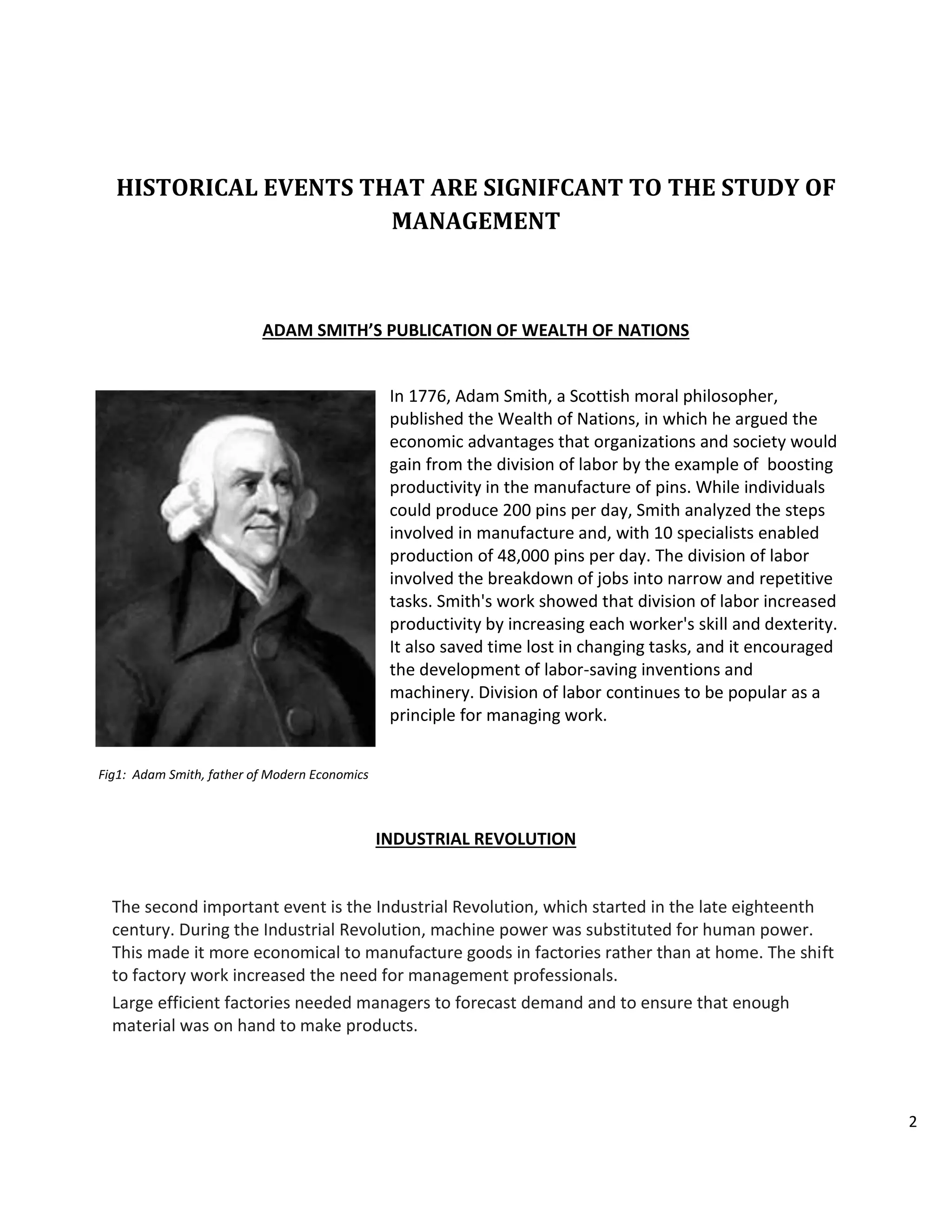
In 1776, Adam Smith, a Scottish moral philosopher,
published the Wealth of Nations, in which he argued the
economic advantages that organizations and society would
gain from the division of labor by the example of boosting
productivity in the manufacture of pins. While individuals
could produce 200 pins per day, Smith analyzed the steps
involved in manufacture and, with 10 specialists enabled
production of 48,000 pins per day. The division of labor
involved the breakdown of jobs into narrow and repetitive
tasks. Smith's work showed that division of labor increased
productivity by increasing each worker's skill and dexterity.
It also saved time lost in changing tasks, and it encouraged
the development of labor-saving inventions and
machinery. Division of labor continues to be popular as a
principle for managing work.
INDUSTRIAL REVOLUTION
The second important event is the Industrial Revolution, which started in the late eighteenth
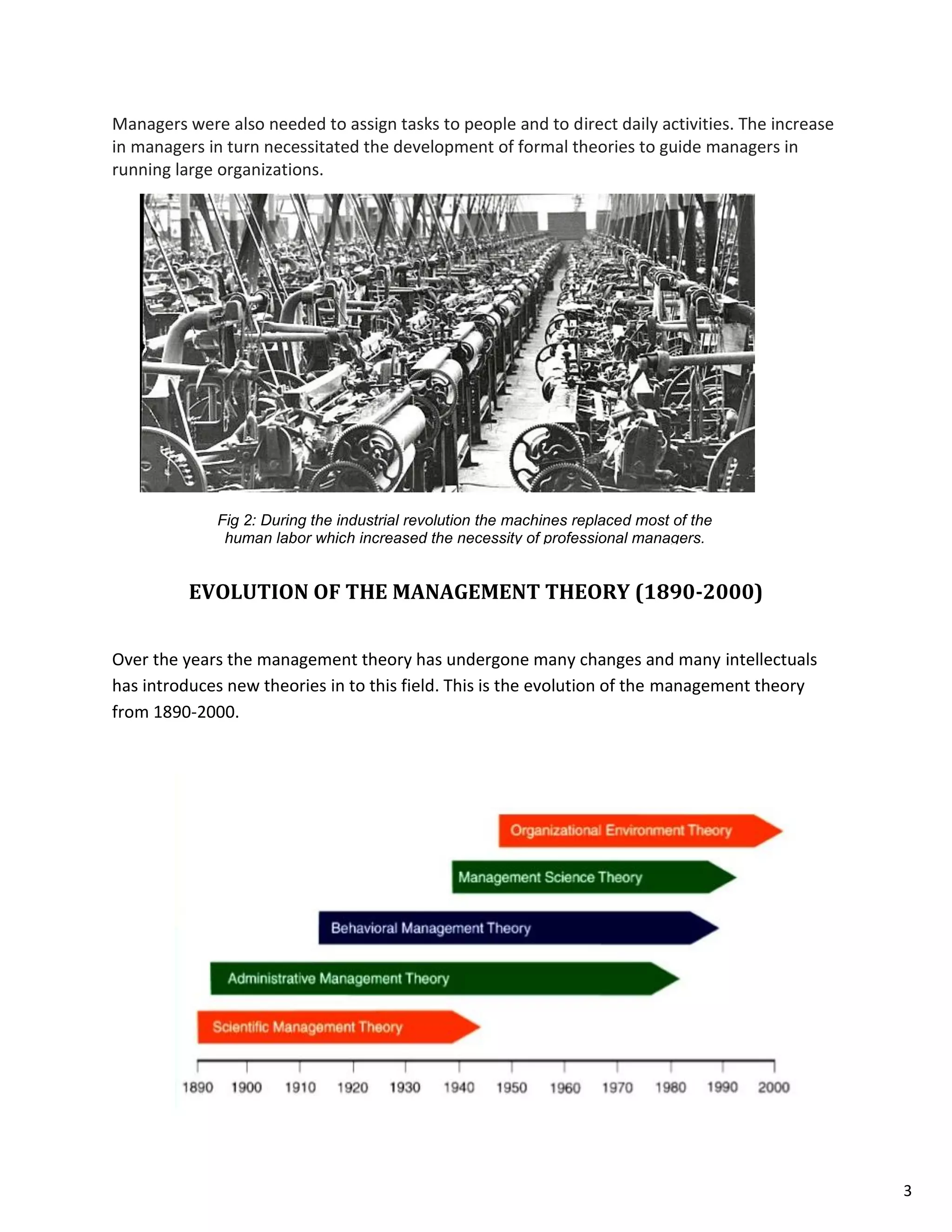
century. During the Industrial Revolution, machine power was substituted for human power.
This made it more economical to manufacture goods in factories rather than at home. The shift
to factory work increased the need for management professionals.
Large efficient factories needed managers to forecast demand and to ensure that enough
material was on hand to make products.
Fig1: Adam Smith, father of Modern Economics
2
Managers were also needed to assign tasks to people and to direct daily activities. The increase
in managers in turn necessitated the development of formal theories to guide managers in
running large organizations.
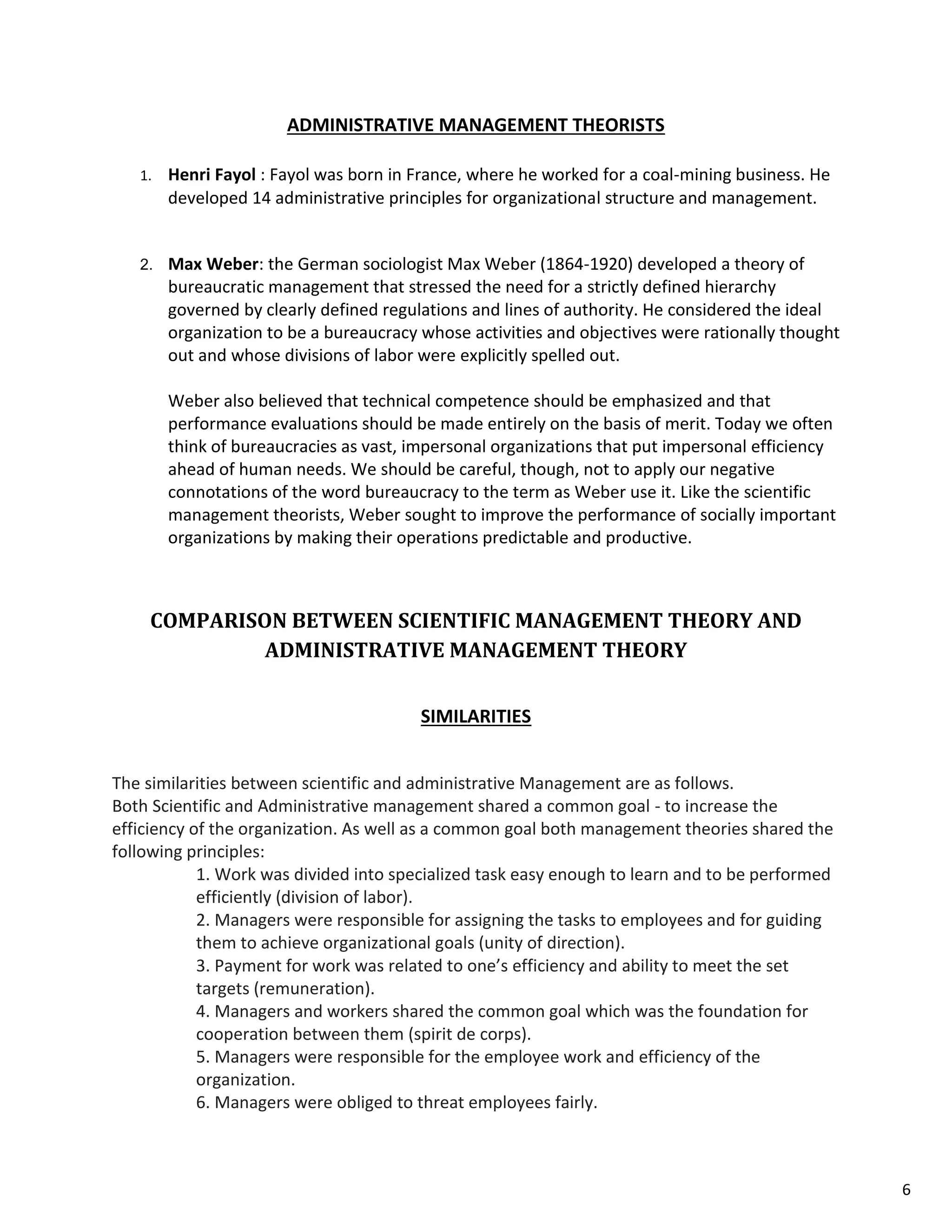
EVOLUTION OF THE MANAGEMENT THEORY (1890-2000)
Over the years the management theory has undergone many changes and many intellectuals
has introduces new theories in to this field. This is the evolution of the management theory
from 1890-2000.
Fig 2: During the industrial revolution the machines replaced most of the
human labor which increased the necessity of professional managers.
3
1. SCIENTIFIC MANAGEMENT THEORY
Scientific Management, or Taylorism is a management theory that analyzes work flows to
improve economic efficiency, specially labor productivity. This management theory, developed
by F.W. Taylor, was dominant in manufacturing industries in the 1880s and 1890s. Important
components of scientific management include analysis, synthesis, logic, rationality, empiricism,
work ethic, efficiency, elimination of waste and standardized best practices.
Taylor and Gilbreths introduced methods of measuring worker productivity, including time
studies and motion studies, which are still used today in operations and management.
SCIENTIFIC MANAGEMENT THEORISTS
1. Fredrick Winslow Taylor
2. Frank Gilbreth Snr.
3. Lillian Gilbreth
FREDERICK WINSLOW TAYLOR
During the industrial revolution there came many management theories
to increase the efficiency and productivity of factories. One such who
sought to improve industrial efficiency is Frederick Winslow Taylor who
was an American mechanical engineer was one of the intellectual
leaders of the Efficiency movement and his ideas broadly convenient,
were highly influential in the Progressive Era. Taylor summed up his
efficiency techniques in his book, “The Principles of scientific
Management”. Taylor’s pioneering work in applying engineering
principles to the work done on the factory floor was instrumental in the
creation and development of the branch of engineering that is now
known as industrial engineering.
His book was based on four basic theories which were,
1. The development of a true science
2. The scientific selection of the workman
3. The scientific education and development of the workman
4. Intimate and friendly cooperation between the management and the men.
fig 3: Frederick Winslow Taylor
Author of Scientific Management
His innovations in industrial engineering, particularly in time and motion studies, paid off in dramatic
improvements in productivity. At the same time, he has been criticized and credited with destroying the
soul of work, of dehumanizing factories, making men into automatons.
4
THE GILBRETHS
Frank and Lillian Gilbreth who were the engineers in the early 20th
Century have been regarded
as important contributors to Scientific Management theory. They made their contribution to
the scientific management movement as a husband‐and‐wife team. Frank Glibreth became
interested in motion study and reduced the number of movements in bricklaying from eighteen
to five. This increased the productivity of bricking the “one best way of doing a given task”,
whereas Lillian who held a P.H.D for psychology, concerned herself with the human aspects of
management. The Gilbreths held that the most important cause of workers’ dissatisfaction was
the lack of management’s interest in them. They emphasized that management should
understand their needs and personality.
The management theory of Frank and Lillian Gilbreth can be summed up by the following.
1. Reduce the number of motions in a task to increase the efficiency
2. Focus on the incremental study of motions and time to understand an entire task.
3. The goal of increased efficiency is both increased profit and greater worker satisfaction.
2. ADMINISTRATIVE MANAGEMENT THEORY
Administrative management theory attempts to find a rational way to design an organization as
a whole. The theory generally calls for a formalized administrative structure, a clear division of
labor, and delegation of power and authority to administrators relevant to their areas of
responsibilities.
Figure 4: Frank and Lillian Gilberth who
collaborated on fatigue and motion studies and
focused on ways of promoting the individual
worker's welfare.
5
ADMINISTRATIVE MANAGEMENT THEORISTS
1. Henri Fayol : Fayol was born in France, where he worked for a coal-mining business. He
developed 14 administrative principles for organizational structure and management.
2. Max Weber: the German sociologist Max Weber (1864‐1920) developed a theory of
bureaucratic management that stressed the need for a strictly defined hierarchy
governed by clearly defined regulations and lines of authority. He considered the ideal
organization to be a bureaucracy whose activities and objectives were rationally thought
out and whose divisions of labor were explicitly spelled out.
Weber also believed that technical competence should be emphasized and that
performance evaluations should be made entirely on the basis of merit. Today we often
think of bureaucracies as vast, impersonal organizations that put impersonal efficiency
ahead of human needs. We should be careful, though, not to apply our negative
connotations of the word bureaucracy to the term as Weber use it. Like the scientific
management theorists, Weber sought to improve the performance of socially important
organizations by making their operations predictable and productive.
COMPARISON BETWEEN SCIENTIFIC MANAGEMENT THEORY AND
ADMINISTRATIVE MANAGEMENT THEORY
SIMILARITIES
The similarities between scientific and administrative Management are as follows.
Both Scientific and Administrative management shared a common goal - to increase the
efficiency of the organization. As well as a common goal both management theories shared the
following principles:
1. Work was divided into specialized task easy enough to learn and to be performed
efficiently (division of labor).
2. Managers were responsible for assigning the tasks to employees and for guiding
them to achieve organizational goals (unity of direction).
3. Payment for work was related to one’s efficiency and ability to meet the set
targets (remuneration).
4. Managers and workers shared the common goal which was the foundation for
cooperation between them (spirit de corps).
5. Managers were responsible for the employee work and efficiency of the
organization.
6. Managers were obliged to threat employees fairly.
6
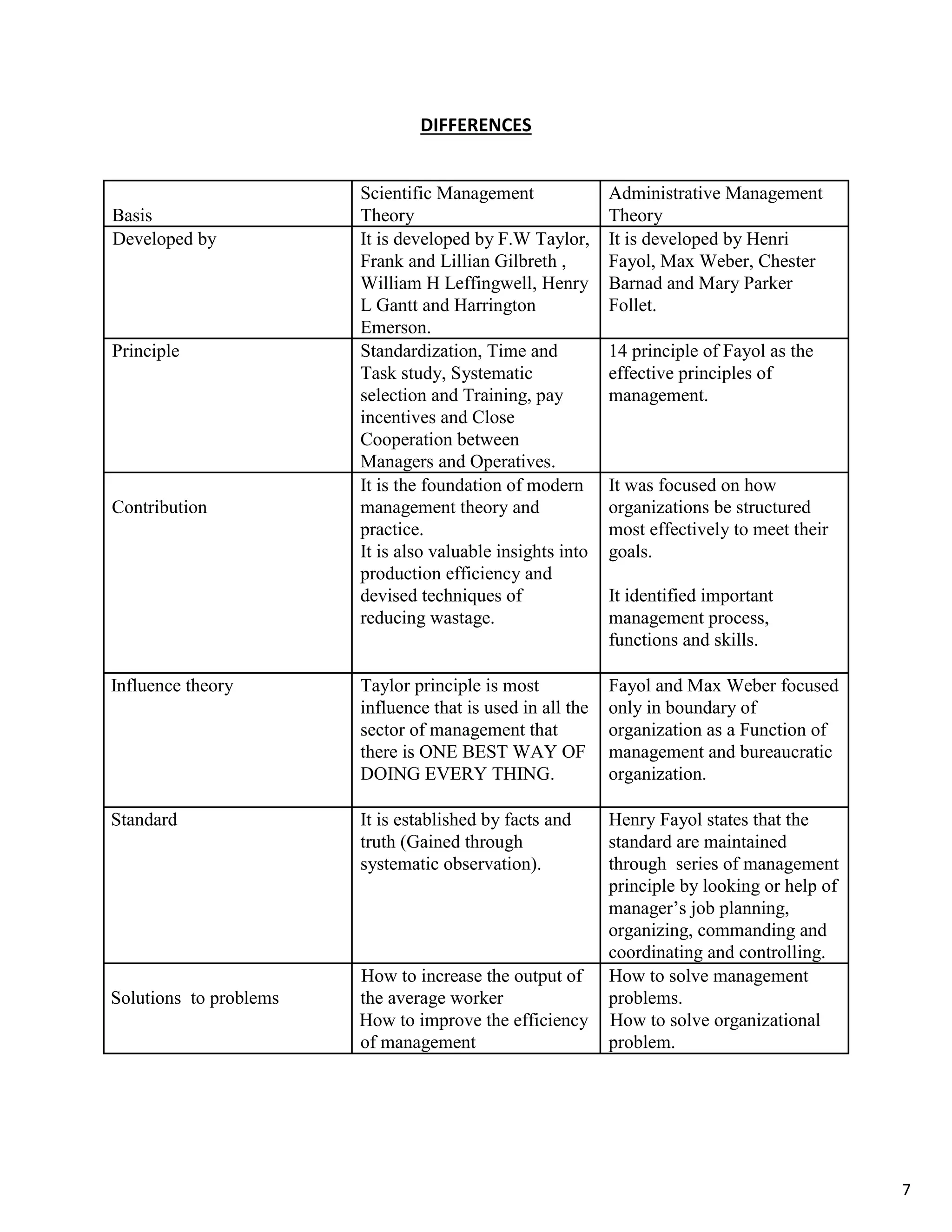
DIFFERENCES
Basis
Scientific Management
Theory
Administrative Management
Theory
i. Developed by It is developed by F.W Taylor,
Frank and Lillian Gilbreth ,
William H Leffingwell, Henry
L Gantt and Harrington
Emerson.
It is developed by Henri
Fayol, Max Weber, Chester
Barnad and Mary Parker
Follet.
ii. Principle Standardization, Time and
Task study, Systematic
selection and Training, pay
incentives and Close
Cooperation between
Managers and Operatives.
14 principle of Fayol as the
effective principles of
management.
iii. Contribution
It is the foundation of modern
management theory and
practice.
It is also valuable insights into
production efficiency and
devised techniques of
reducing wastage.
It was focused on how
organizations be structured
most effectively to meet their
goals.
It identified important
management process,
functions and skills.
iv. Influence theory Taylor principle is most
influence that is used in all the
sector of management that
there is ONE BEST WAY OF
DOING EVERY THING.
Fayol and Max Weber focused
only in boundary of
organization as a Function of
management and bureaucratic
organization.
v. Standard It is established by facts and
truth (Gained through
systematic observation).
Henry Fayol states that the
standard are maintained
through series of management
principle by looking or help of
manager’s job planning,
organizing, commanding and
coordinating and controlling.
vi. Solutions to problems
a. How to increase the output of
the average worker
b. How to improve the efficiency
of management
a) How to solve management
problems.
b) How to solve organizational
problem.
7
3. .BEHAVIORAL MANAGEMENT THEORY
(Understanding Employee Behavior & Motivation)
Behavioral management theory was developed in response to the need to account for
employee behavior and motivation. The shift moved management from a production-
orientation (classical leadership theory) to a leadership style focused on the workers' human
need for work-related satisfaction and good working conditions.
Behavioral management theory relies on the notion that managers will better understand the
human aspect to workers and treat employees as important assets to achieve goals.
Management taking a special interest in workers makes them feel like part of a special group.
As time went on, thinking shifted, and management started looking at employee satisfaction
and working conditions as a way to increase productivity. Theorists like Elton Mayo and others
studied employee productivity under different conditions to determine a connection.
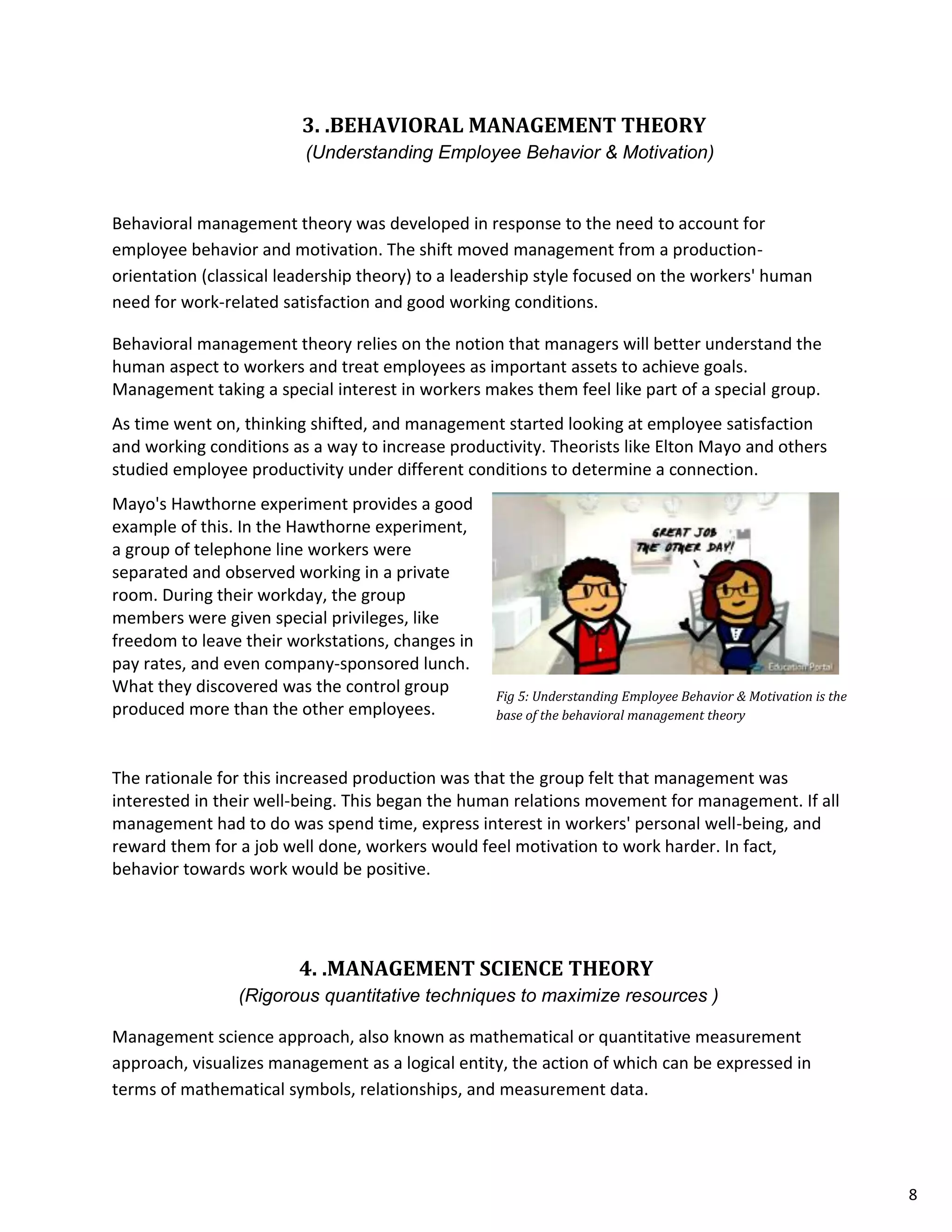
Mayo's Hawthorne experiment provides a good
example of this. In the Hawthorne experiment,
a group of telephone line workers were
separated and observed working in a private
room. During their workday, the group
members were given special privileges, like
freedom to leave their workstations, changes in
pay rates, and even company-sponsored lunch.
What they discovered was the control group
produced more than the other employees.
The rationale for this increased production was that the group felt that management was
interested in their well-being. This began the human relations movement for management. If all
management had to do was spend time, express interest in workers' personal well-being, and
reward them for a job well done, workers would feel motivation to work harder. In fact,
behavior towards work would be positive.
4. .MANAGEMENT SCIENCE THEORY
(Rigorous quantitative techniques to maximize resources )
Management science approach, also known as mathematical or quantitative measurement
approach, visualizes management as a logical entity, the action of which can be expressed in
terms of mathematical symbols, relationships, and measurement data.
Fig 5: Understanding Employee Behavior & Motivation is the
base of the behavioral management theory
8
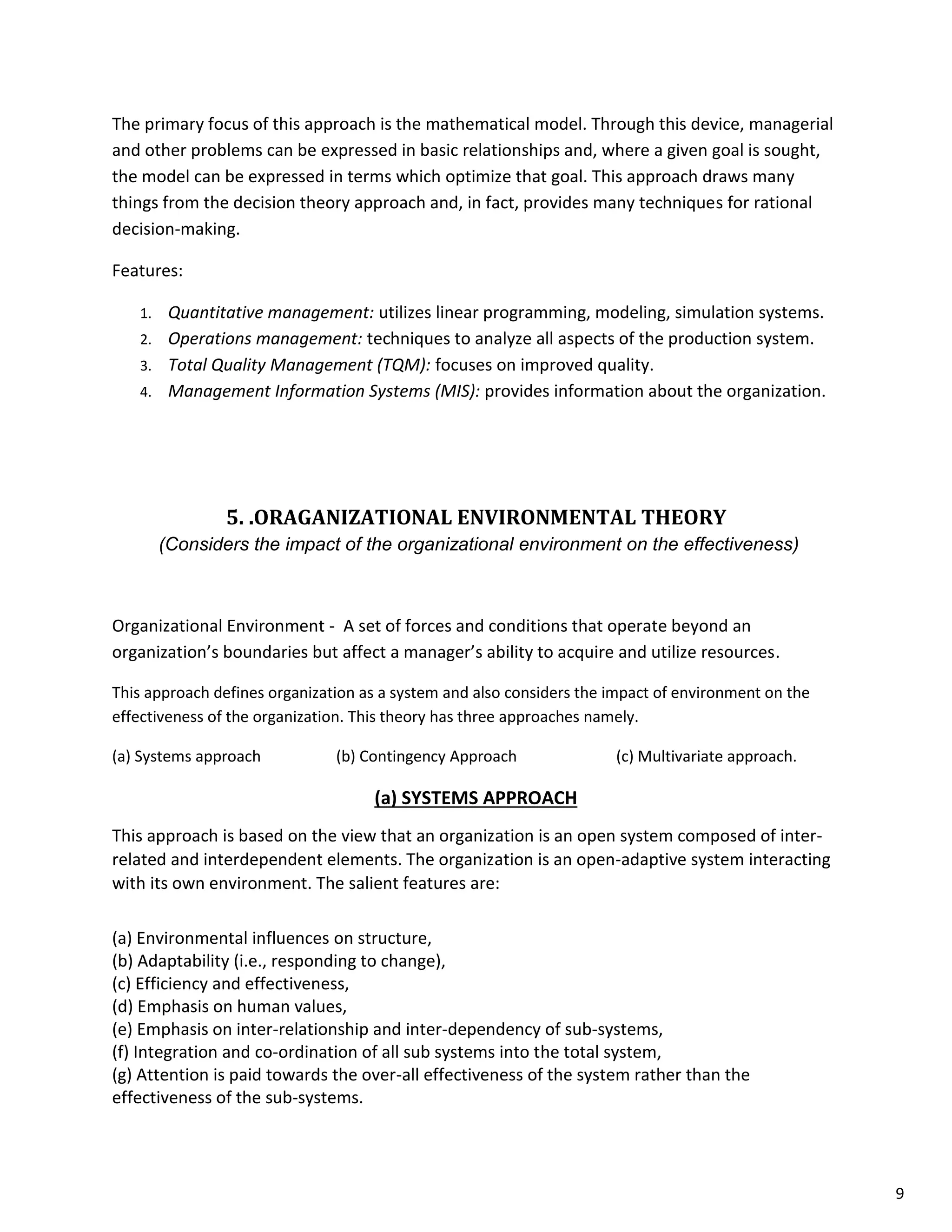
The primary focus of this approach is the mathematical model. Through this device, managerial
and other problems can be expressed in basic relationships and, where a given goal is sought,
the model can be expressed in terms which optimize that goal. This approach draws many
things from the decision theory approach and, in fact, provides many techniques for rational
decision-making.
Features:
1. Quantitative management: utilizes linear programming, modeling, simulation systems.
2. Operations management: techniques to analyze all aspects of the production system.
3. Total Quality Management (TQM): focuses on improved quality.
4. Management Information Systems (MIS): provides information about the organization.
5. .ORAGANIZATIONAL ENVIRONMENTAL THEORY
(Considers the impact of the organizational environment on the effectiveness)
Organizational Environment - A set of forces and conditions that operate beyond an
organization’s boundaries but affect a manager’s ability to acquire and utilize resources.
This approach defines organization as a system and also considers the impact of environment on the
effectiveness of the organization. This theory has three approaches namely.
(a) Systems approach (b) Contingency Approach (c) Multivariate approach.
(a) SYSTEMS APPROACH
This approach is based on the view that an organization is an open system composed of inter-
related and interdependent elements. The organization is an open-adaptive system interacting
with its own environment. The salient features are:
(a) Environmental influences on structure,
(b) Adaptability (i.e., responding to change),
(c) Efficiency and effectiveness,
(d) Emphasis on human values,
(e) Emphasis on inter-relationship and inter-dependency of sub-systems,
(f) Integration and co-ordination of all sub systems into the total system,
(g) Attention is paid towards the over-all effectiveness of the system rather than the
effectiveness of the sub-systems.
9
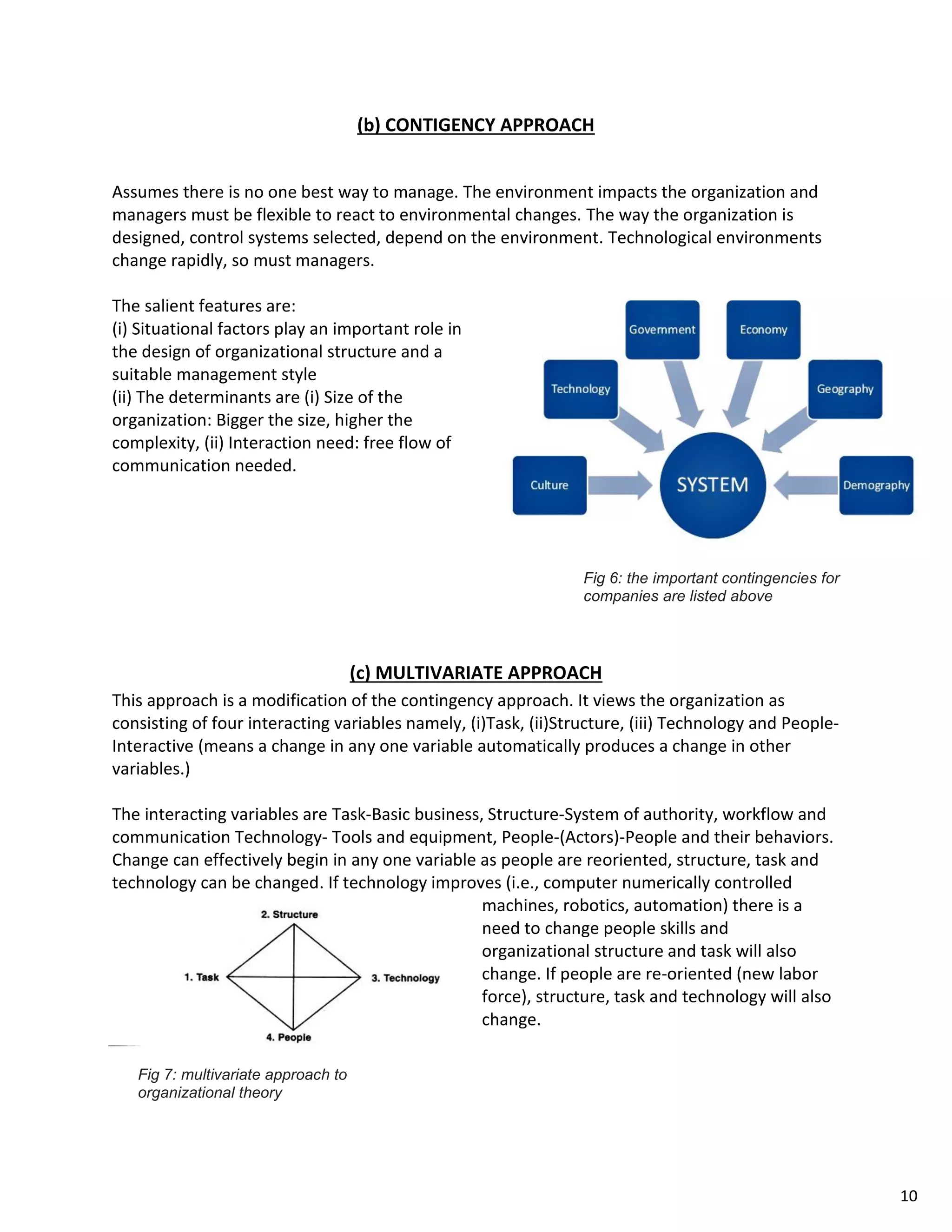
(b) CONTIGENCY APPROACH
Assumes there is no one best way to manage. The environment impacts the organization and
managers must be flexible to react to environmental changes. The way the organization is
designed, control systems selected, depend on the environment. Technological environments
change rapidly, so must managers.
The salient features are:
(i) Situational factors play an important role in
the design of organizational structure and a
suitable management style
(ii) The determinants are (i) Size of the
organization: Bigger the size, higher the
complexity, (ii) Interaction need: free flow of
communication needed.
(c) MULTIVARIATE APPROACH
This approach is a modification of the contingency approach. It views the organization as
consisting of four interacting variables namely, (i)Task, (ii)Structure, (iii) Technology and People-
Interactive (means a change in any one variable automatically produces a change in other
variables.)
The interacting variables are Task-Basic business, Structure-System of authority, workflow and
communication Technology- Tools and equipment, People-(Actors)-People and their behaviors.
Change can effectively begin in any one variable as people are reoriented, structure, task and
technology can be changed. If technology improves (i.e., computer numerically controlled
machines, robotics, automation) there is a
need to change people skills and
organizational structure and task will also
change. If people are re-oriented (new labor
force), structure, task and technology will also
change.
Fig 6: the important contingencies for
companies are listed above
Fig 7: multivariate approach to
organizational theory
10
SOURCES
o ORGANIZATION AND MANAGEMENT By R.D. Agarwal
o MANAGEMENT (10TH
EDITION) By Stephen P. Robbins Mary Coulter
o EVOLUTIION OF MANAGEMENT THEORY BY PROFESSOR HANUS COHEREN
o www.yourarticlelibrary.com
o www.polaris.umuc.edu
o www. study.com
o www.boundless.com
o www.skymark.com
o https://en.wikipedia.org
o http://www.business.com/management/management-theory-of-frank-and-lillian-gilbreth/
o http://likeeasy.blogspot.com/2014/05/comparison-between-scientific-and.html
o THE EVOLUTION OF MANAGEMENT THEORY Irwin/McGraw-Hill ©The McGraw-Hill
Companies, Inc., 2000

Evolution of Management Theory

  • 1.
  • 2.
    INDIVIDUAL ASSIGNMENT ONE “EVOLUTIONOF MANAGEMENT THEORY” INTRODUCTION TO MANAGEMENT (TL 1053) TRANSPORT AND LOGISTICS MANAGEMENT UNIVERSITY of MORATUWA 14th BATCH HASHAN RAHUBADDHA 141456 X
  • 3.
    INDEX TOPIC PAGE # ManagementTheory Introduction 1 # Why studying Management theory is important 1 # Management History Brief Introduction 1 # Historical events that are significant to the study of management (a) Adam Smith’s Publication of Wealth of the Nations (b) Industrial Revolution 2 2 # Evolution of the management theory (1890-2000) 3 # Scientific Management Theory * Scientific Management theorists * Fredirck Winslow Taylor * The Gilbreths 4 4 5 # Administrative Management Theory * Scientific Management theorists 5 # Comparison between scientific and administrative management theory * Similaraties * Differences 6 6 # Behavioral Management Theory 7 # Management Science Theory 8 # Organizational Environmental Theory (a) Systems Approach (b) Contingency Approach (c) Multivariate Approach 9 10 10
  • 4.
    MANAGEMENT THEORY INTRODUCTION Managementin businesses and organizations is the function that coordinates the efforts of people to accomplish goals and objectives by using available resources efficiently and effectively. Management includes planning, organizing, staffing, leading or directing, and controlling an organization to accomplish the goal or target. Resourcing encompasses the deployment and manipulation of human resources, financial resources, technological resources, and natural resources. Management is also an academic discipline, asocial science whose objective is to study social organization. WHY STUDYING MANAGEMENT THEORY IS IMPORTANT Studying Management History is Important because it helps to understand today's management theory and practice. It is important to know the history of management that it could help us to develop good organizations. History of management tells us that how different theories of management developed. Many great constructions of history like Egyptian pyramids and great china's wall led us to know the management of these constructions. . Moreover, it helps us see what did and did not work in the past thus helping us to make better decisions to achieve higher productivity and efficiency levels. MANAGEMENT HISTORY BRIEF INTRODUCTION People have been shaping and reshaping organizations for many centuries in order to be more efficient and productive. Looking back through world history, we can trace the stories of people working together in formal organizations such as the Greek and Roman armies, the Roman Catholic Church and the East India Company. People have also long been writing about how to make organizations efficient and effective, since long before terms such as "management" came into common usage. Management and organizations are products of their historical and social times and places. Thus, we can understand the evolution of management theory in terms of how people have wrestled with matters of relationships at particular times in history. Two prominent and important historical events that were significant to the evolution omanagement theory is the Adams Smith’s publication of Wealth of Nations and Industrial Revolution 1
  • 5.
    HISTORICAL EVENTS THATARE SIGNIFCANT TO THE STUDY OF MANAGEMENT ADAM SMITH’S PUBLICATION OF WEALTH OF NATIONS In 1776, Adam Smith, a Scottish moral philosopher, published the Wealth of Nations, in which he argued the economic advantages that organizations and society would gain from the division of labor by the example of boosting productivity in the manufacture of pins. While individuals could produce 200 pins per day, Smith analyzed the steps involved in manufacture and, with 10 specialists enabled production of 48,000 pins per day. The division of labor involved the breakdown of jobs into narrow and repetitive tasks. Smith's work showed that division of labor increased productivity by increasing each worker's skill and dexterity. It also saved time lost in changing tasks, and it encouraged the development of labor-saving inventions and machinery. Division of labor continues to be popular as a principle for managing work. INDUSTRIAL REVOLUTION The second important event is the Industrial Revolution, which started in the late eighteenth century. During the Industrial Revolution, machine power was substituted for human power. This made it more economical to manufacture goods in factories rather than at home. The shift to factory work increased the need for management professionals. Large efficient factories needed managers to forecast demand and to ensure that enough material was on hand to make products. Fig1: Adam Smith, father of Modern Economics 2
  • 6.
    Managers were alsoneeded to assign tasks to people and to direct daily activities. The increase in managers in turn necessitated the development of formal theories to guide managers in running large organizations. EVOLUTION OF THE MANAGEMENT THEORY (1890-2000) Over the years the management theory has undergone many changes and many intellectuals has introduces new theories in to this field. This is the evolution of the management theory from 1890-2000. Fig 2: During the industrial revolution the machines replaced most of the human labor which increased the necessity of professional managers. 3
  • 7.
    1. SCIENTIFIC MANAGEMENTTHEORY Scientific Management, or Taylorism is a management theory that analyzes work flows to improve economic efficiency, specially labor productivity. This management theory, developed by F.W. Taylor, was dominant in manufacturing industries in the 1880s and 1890s. Important components of scientific management include analysis, synthesis, logic, rationality, empiricism, work ethic, efficiency, elimination of waste and standardized best practices. Taylor and Gilbreths introduced methods of measuring worker productivity, including time studies and motion studies, which are still used today in operations and management. SCIENTIFIC MANAGEMENT THEORISTS 1. Fredrick Winslow Taylor 2. Frank Gilbreth Snr. 3. Lillian Gilbreth FREDERICK WINSLOW TAYLOR During the industrial revolution there came many management theories to increase the efficiency and productivity of factories. One such who sought to improve industrial efficiency is Frederick Winslow Taylor who was an American mechanical engineer was one of the intellectual leaders of the Efficiency movement and his ideas broadly convenient, were highly influential in the Progressive Era. Taylor summed up his efficiency techniques in his book, “The Principles of scientific Management”. Taylor’s pioneering work in applying engineering principles to the work done on the factory floor was instrumental in the creation and development of the branch of engineering that is now known as industrial engineering. His book was based on four basic theories which were, 1. The development of a true science 2. The scientific selection of the workman 3. The scientific education and development of the workman 4. Intimate and friendly cooperation between the management and the men. fig 3: Frederick Winslow Taylor Author of Scientific Management His innovations in industrial engineering, particularly in time and motion studies, paid off in dramatic improvements in productivity. At the same time, he has been criticized and credited with destroying the soul of work, of dehumanizing factories, making men into automatons. 4
  • 8.
    THE GILBRETHS Frank andLillian Gilbreth who were the engineers in the early 20th Century have been regarded as important contributors to Scientific Management theory. They made their contribution to the scientific management movement as a husband‐and‐wife team. Frank Glibreth became interested in motion study and reduced the number of movements in bricklaying from eighteen to five. This increased the productivity of bricking the “one best way of doing a given task”, whereas Lillian who held a P.H.D for psychology, concerned herself with the human aspects of management. The Gilbreths held that the most important cause of workers’ dissatisfaction was the lack of management’s interest in them. They emphasized that management should understand their needs and personality. The management theory of Frank and Lillian Gilbreth can be summed up by the following. 1. Reduce the number of motions in a task to increase the efficiency 2. Focus on the incremental study of motions and time to understand an entire task. 3. The goal of increased efficiency is both increased profit and greater worker satisfaction. 2. ADMINISTRATIVE MANAGEMENT THEORY Administrative management theory attempts to find a rational way to design an organization as a whole. The theory generally calls for a formalized administrative structure, a clear division of labor, and delegation of power and authority to administrators relevant to their areas of responsibilities. Figure 4: Frank and Lillian Gilberth who collaborated on fatigue and motion studies and focused on ways of promoting the individual worker's welfare. 5
  • 9.
    ADMINISTRATIVE MANAGEMENT THEORISTS 1.Henri Fayol : Fayol was born in France, where he worked for a coal-mining business. He developed 14 administrative principles for organizational structure and management. 2. Max Weber: the German sociologist Max Weber (1864‐1920) developed a theory of bureaucratic management that stressed the need for a strictly defined hierarchy governed by clearly defined regulations and lines of authority. He considered the ideal organization to be a bureaucracy whose activities and objectives were rationally thought out and whose divisions of labor were explicitly spelled out. Weber also believed that technical competence should be emphasized and that performance evaluations should be made entirely on the basis of merit. Today we often think of bureaucracies as vast, impersonal organizations that put impersonal efficiency ahead of human needs. We should be careful, though, not to apply our negative connotations of the word bureaucracy to the term as Weber use it. Like the scientific management theorists, Weber sought to improve the performance of socially important organizations by making their operations predictable and productive. COMPARISON BETWEEN SCIENTIFIC MANAGEMENT THEORY AND ADMINISTRATIVE MANAGEMENT THEORY SIMILARITIES The similarities between scientific and administrative Management are as follows. Both Scientific and Administrative management shared a common goal - to increase the efficiency of the organization. As well as a common goal both management theories shared the following principles: 1. Work was divided into specialized task easy enough to learn and to be performed efficiently (division of labor). 2. Managers were responsible for assigning the tasks to employees and for guiding them to achieve organizational goals (unity of direction). 3. Payment for work was related to one’s efficiency and ability to meet the set targets (remuneration). 4. Managers and workers shared the common goal which was the foundation for cooperation between them (spirit de corps). 5. Managers were responsible for the employee work and efficiency of the organization. 6. Managers were obliged to threat employees fairly. 6
  • 10.
    DIFFERENCES Basis Scientific Management Theory Administrative Management Theory i.Developed by It is developed by F.W Taylor, Frank and Lillian Gilbreth , William H Leffingwell, Henry L Gantt and Harrington Emerson. It is developed by Henri Fayol, Max Weber, Chester Barnad and Mary Parker Follet. ii. Principle Standardization, Time and Task study, Systematic selection and Training, pay incentives and Close Cooperation between Managers and Operatives. 14 principle of Fayol as the effective principles of management. iii. Contribution It is the foundation of modern management theory and practice. It is also valuable insights into production efficiency and devised techniques of reducing wastage. It was focused on how organizations be structured most effectively to meet their goals. It identified important management process, functions and skills. iv. Influence theory Taylor principle is most influence that is used in all the sector of management that there is ONE BEST WAY OF DOING EVERY THING. Fayol and Max Weber focused only in boundary of organization as a Function of management and bureaucratic organization. v. Standard It is established by facts and truth (Gained through systematic observation). Henry Fayol states that the standard are maintained through series of management principle by looking or help of manager’s job planning, organizing, commanding and coordinating and controlling. vi. Solutions to problems a. How to increase the output of the average worker b. How to improve the efficiency of management a) How to solve management problems. b) How to solve organizational problem. 7
  • 11.
    3. .BEHAVIORAL MANAGEMENTTHEORY (Understanding Employee Behavior & Motivation) Behavioral management theory was developed in response to the need to account for employee behavior and motivation. The shift moved management from a production- orientation (classical leadership theory) to a leadership style focused on the workers' human need for work-related satisfaction and good working conditions. Behavioral management theory relies on the notion that managers will better understand the human aspect to workers and treat employees as important assets to achieve goals. Management taking a special interest in workers makes them feel like part of a special group. As time went on, thinking shifted, and management started looking at employee satisfaction and working conditions as a way to increase productivity. Theorists like Elton Mayo and others studied employee productivity under different conditions to determine a connection. Mayo's Hawthorne experiment provides a good example of this. In the Hawthorne experiment, a group of telephone line workers were separated and observed working in a private room. During their workday, the group members were given special privileges, like freedom to leave their workstations, changes in pay rates, and even company-sponsored lunch. What they discovered was the control group produced more than the other employees. The rationale for this increased production was that the group felt that management was interested in their well-being. This began the human relations movement for management. If all management had to do was spend time, express interest in workers' personal well-being, and reward them for a job well done, workers would feel motivation to work harder. In fact, behavior towards work would be positive. 4. .MANAGEMENT SCIENCE THEORY (Rigorous quantitative techniques to maximize resources ) Management science approach, also known as mathematical or quantitative measurement approach, visualizes management as a logical entity, the action of which can be expressed in terms of mathematical symbols, relationships, and measurement data. Fig 5: Understanding Employee Behavior & Motivation is the base of the behavioral management theory 8
  • 12.
    The primary focusof this approach is the mathematical model. Through this device, managerial and other problems can be expressed in basic relationships and, where a given goal is sought, the model can be expressed in terms which optimize that goal. This approach draws many things from the decision theory approach and, in fact, provides many techniques for rational decision-making. Features: 1. Quantitative management: utilizes linear programming, modeling, simulation systems. 2. Operations management: techniques to analyze all aspects of the production system. 3. Total Quality Management (TQM): focuses on improved quality. 4. Management Information Systems (MIS): provides information about the organization. 5. .ORAGANIZATIONAL ENVIRONMENTAL THEORY (Considers the impact of the organizational environment on the effectiveness) Organizational Environment - A set of forces and conditions that operate beyond an organization’s boundaries but affect a manager’s ability to acquire and utilize resources. This approach defines organization as a system and also considers the impact of environment on the effectiveness of the organization. This theory has three approaches namely. (a) Systems approach (b) Contingency Approach (c) Multivariate approach. (a) SYSTEMS APPROACH This approach is based on the view that an organization is an open system composed of inter- related and interdependent elements. The organization is an open-adaptive system interacting with its own environment. The salient features are: (a) Environmental influences on structure, (b) Adaptability (i.e., responding to change), (c) Efficiency and effectiveness, (d) Emphasis on human values, (e) Emphasis on inter-relationship and inter-dependency of sub-systems, (f) Integration and co-ordination of all sub systems into the total system, (g) Attention is paid towards the over-all effectiveness of the system rather than the effectiveness of the sub-systems. 9
  • 13.
    (b) CONTIGENCY APPROACH Assumesthere is no one best way to manage. The environment impacts the organization and managers must be flexible to react to environmental changes. The way the organization is designed, control systems selected, depend on the environment. Technological environments change rapidly, so must managers. The salient features are: (i) Situational factors play an important role in the design of organizational structure and a suitable management style (ii) The determinants are (i) Size of the organization: Bigger the size, higher the complexity, (ii) Interaction need: free flow of communication needed. (c) MULTIVARIATE APPROACH This approach is a modification of the contingency approach. It views the organization as consisting of four interacting variables namely, (i)Task, (ii)Structure, (iii) Technology and People- Interactive (means a change in any one variable automatically produces a change in other variables.) The interacting variables are Task-Basic business, Structure-System of authority, workflow and communication Technology- Tools and equipment, People-(Actors)-People and their behaviors. Change can effectively begin in any one variable as people are reoriented, structure, task and technology can be changed. If technology improves (i.e., computer numerically controlled machines, robotics, automation) there is a need to change people skills and organizational structure and task will also change. If people are re-oriented (new labor force), structure, task and technology will also change. Fig 6: the important contingencies for companies are listed above Fig 7: multivariate approach to organizational theory 10
  • 14.
    SOURCES o ORGANIZATION ANDMANAGEMENT By R.D. Agarwal o MANAGEMENT (10TH EDITION) By Stephen P. Robbins Mary Coulter o EVOLUTIION OF MANAGEMENT THEORY BY PROFESSOR HANUS COHEREN o www.yourarticlelibrary.com o www.polaris.umuc.edu o www. study.com o www.boundless.com o www.skymark.com o https://en.wikipedia.org o http://www.business.com/management/management-theory-of-frank-and-lillian-gilbreth/ o http://likeeasy.blogspot.com/2014/05/comparison-between-scientific-and.html o THE EVOLUTION OF MANAGEMENT THEORY Irwin/McGraw-Hill ©The McGraw-Hill Companies, Inc., 2000