HENRI FAYOL 
Prepared By: 
DIVYANSHU ROY 
DHIREN RANAWAT 
BHAVNESH MATHUR 
VAGEESH SHARMA
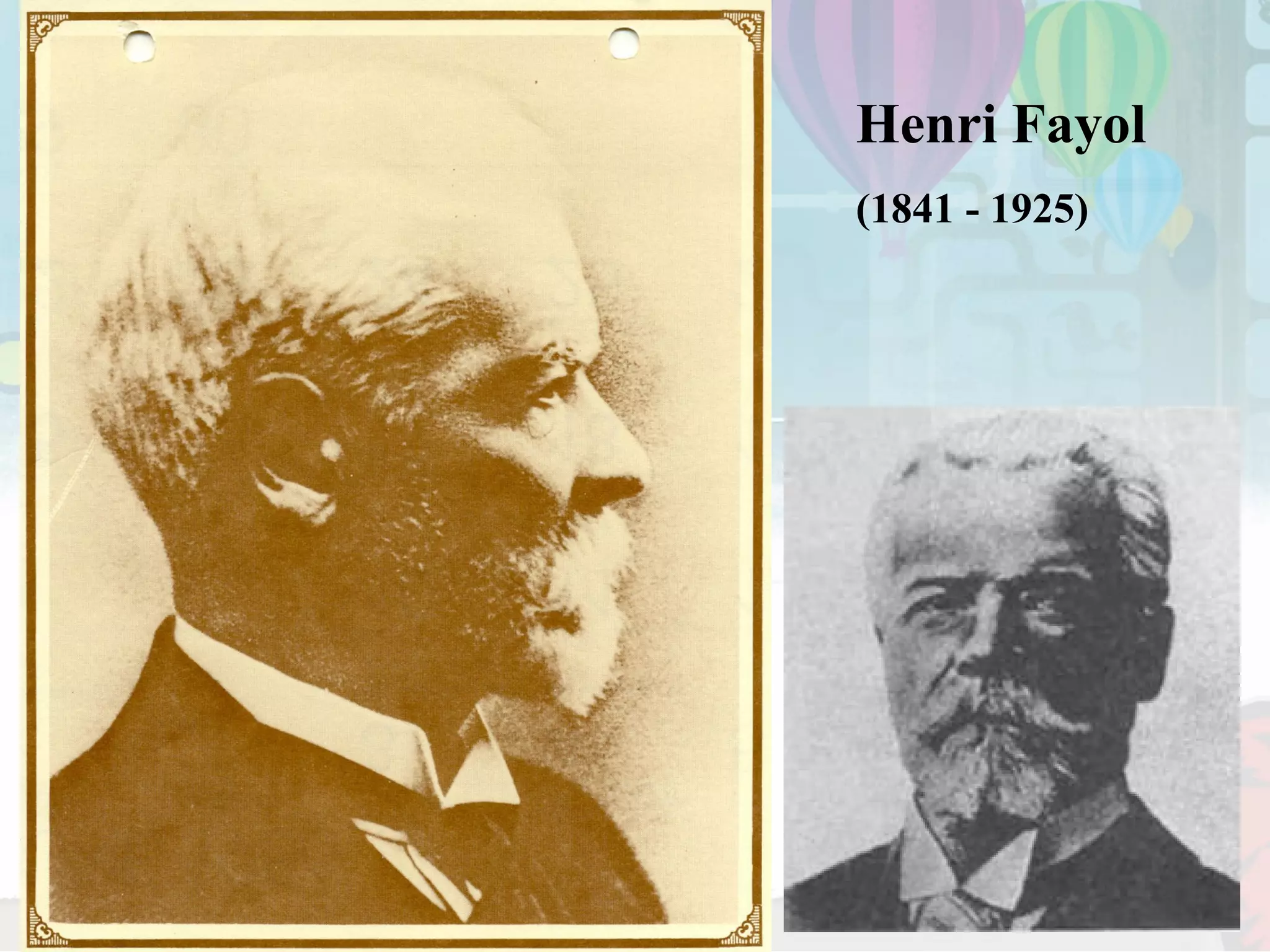
Henri Fayol 
(1841 - 1925)
Henri Fayol’s Background 
• Born in July,1841 in Istanbul, Turkey 
• His father, an engineer, was appointed superintendent of 
works to build the Galata Bridge, which bridged the Golden 
Horn. 
• His family then returned to France in 1847. 
• Graduated from the National School of Mines in Saint 
Etrenne in 1860
Cont… 
•After graduation he went to work and spent his entire career at the 
mining company, “CommentryFourchamboult-Decazeville”. 
•By 1890, the company was one of the largest producers of iron 
and steel in France and regarded as a vital industry. 
•Fayol became managing director in 1888,when the mine company 
employed over 10,000 people, and held that position over 30 years 
until 1918. 
•He is credited with saving the company from bankruptcy 
•During his career he lectured at Ecole Superievre de la Guerre 
•On his retirement he established the Centre of Administrative 
Studies
Cont… 
• Based largely on his own management experience, he 
developed his concept of administration. 
• In 1916 he published these experience in the book 
"Administration Industrielle et Générale", and at about 
the same time as Frederick Winslow Taylor published 
his Principles of Scientific Management. 
• He was a director of mines who developed a general 
theory of business administration. 
• He was one of the most influential contributors to 
modern concepts of management.
BIG CONTRIBUTIONS OF HENRI FAYOL 
•He was the First management thinker who provided the 
conceptual framework of the function of management in his 
book. 
•Due to his contribution to management theory & principles he 
was rightly treated as the “FATHER OF MODERN 
MANAGEMENT THEORY”. 
•He wanted the formal education of management in schools & 
colleges. 
•Provided a link between strategies and organisational 
theories.
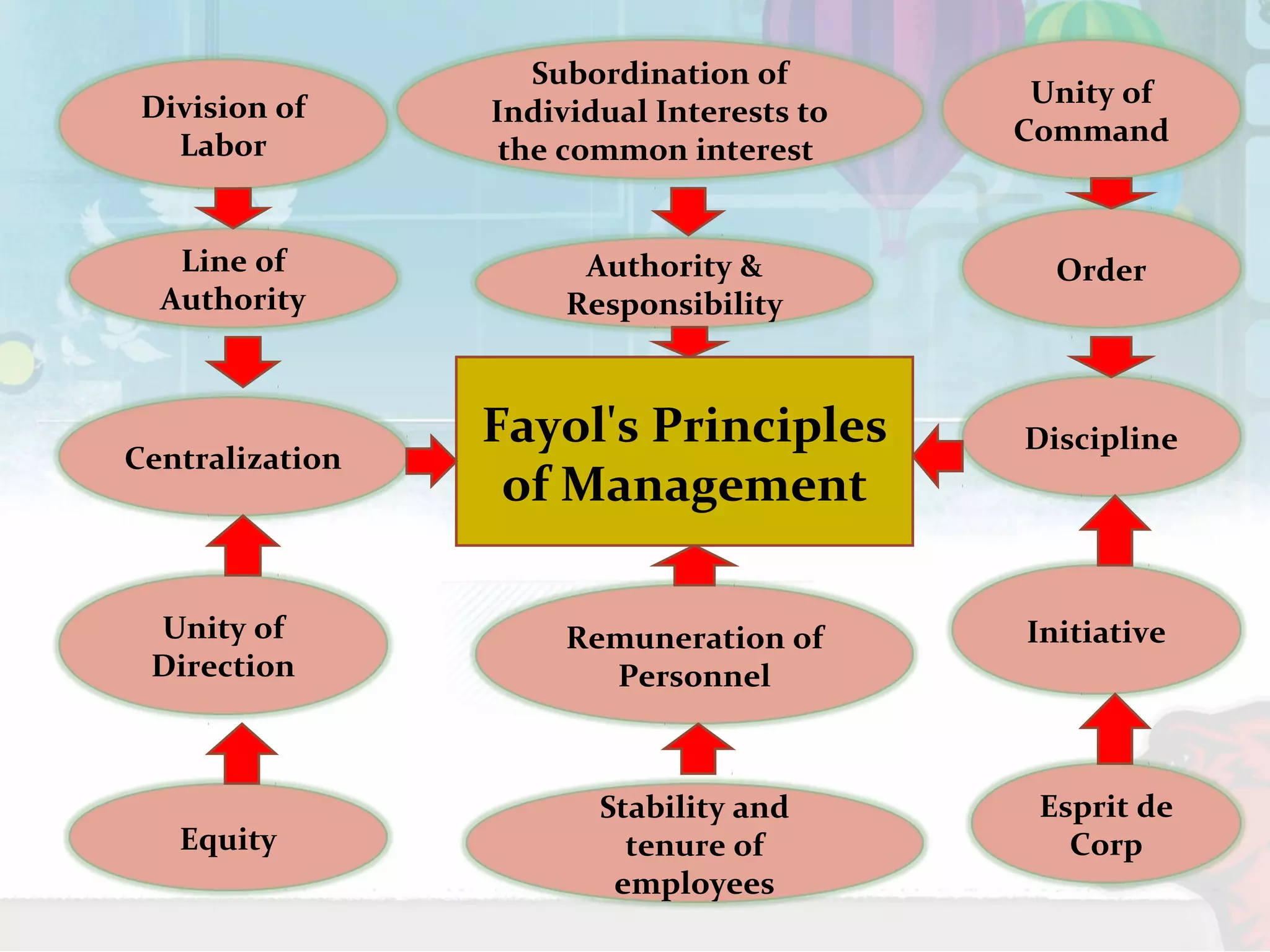
Subordination of 
Individual Interests to 
the common interest 
Division of 
Labor 
Unity of 
Command 
Line of 
Authority 
Authority & 
Responsibility 
Fayol's Principles 
of Management Centralization 
Unity of 
Direction 
Initiative 
Equity 
Order 
Discipline 
Stability and 
tenure of 
employees 
Esprit de 
Corp 
Remuneration of 
Personnel
Fayol’s Principles of Management 
1) Division of work: 
• By separating a work into smaller tasks 
• Development of proficiency 
• Focus on planning workers in right role.
Fayol’s Principles of Management 
2) Scalar chain : 
•Represents organization’s hierarchy 
•allow the workers to be familiar where the stands
Fayol’s Principles of Management 
3) Centralization : 
•Centralization refers the degree of which subordinates are 
involved in decision making process. 
•Fayol preferred a less centralized management hierarchy 
•He did not plan decision made away from the problem.
Fayol’s Principles of Management 
4) Unity of Direction : 
•This involved one head and one plan for a group of activities having the same 
objective. Whereas unity of command required that each employee should receive 
orders from one superior only, unity of direction could be summed up in the 
phrase one head, one plan. 
• In fayol’s own words, it is the condition essential to unity of action, coordination 
of strength and focusing of effort. A body with two heads is in social as in the 
animal sphere a monster and has difficulty in surviving.
5) Equity : 
Every worker should be seen with one Eye. 
There should be equal justice and impartiality and generosity. 
By this workers will perform their job with full interest, 
devotion and full ability.
6) Subordination of Individual Interests to the common interest : 
Fayol drew attention to the fact that one of the greatest 
problems of management was to reconcile the general interest 
with that of the individual and group interests. 
As he put it, ignorance, ambition, selfishness, laziness, 
weakness and all human passions tend to cause the general 
interest to be lost sight of in favor of individual interest and a 
perpetual struggle has to be waged against them.
7) Authority & Responsibility : 
This was ‘the right to give orders and the power to exact 
obedience’. Fayol drew a distinction between official authority 
( which derived from a manager’s appointed position in an 
organization) and personal authority (which stemmed from 
such attributes as intelligence, experience, integrity and 
leadership ability). His claimed that in a first class manager, 
personal authority is the indispensable component of official 
authority.
Fayol argued, authority was always allied to responsibility and 
the proper exercise of both required the ability to make 
judgments and if necessary, impose sanctions. 
Fayol thought that authority should derive from expertise, 
leadership skill, knowledge, etc., and lead to a sincere 
commitment from subordinates
8) Remuneration of Personnel : 
Fayol considered the factor that determine levels of pay but are 
independent of the employer’s will such as the cost of living, availability of 
labour, the business environment and the economic situation. He also 
examined the various modes of compensation available such as time rates, 
job rates, piece rates, bonuses, profit-sharing, payment in kind and various 
non-financial incentive. He concluded that whether wages are made up of 
money only or whether they include various additions such as heating,, 
light, housing, food, is of little consequence provided that the employee be 
satisfied.
9) Stability and tenure of employees : 
This dealt with issues relating to personnel planning, 
management development and labor turnover. Fayol called for 
suitable induction period to enable employees and particularly 
managers, to acclimatize themselves to new work and 
situations. As he observed, insecurity of tenure is especially to 
be feared in large concern in order to be in a position to decide 
on a plan of action, to gain confident in one self and inspire it 
in others.
10) Unity of Command : 
• This was the nation that an employee should receive orders from one 
superior only. According to Fayol, dual command was bound to 
generate tension, confusion and conflict. 
• He noted the tendency to divide command between individuals and 
also to blur the lines of demarcation between departments. 
• The outcome, he claimed, was a dilution of responsibility and the 
erosion of clear lines of communication. A higher manager might 
sometimes give orders directly to workers further down the hierarchy, 

thereby bypassing middle management.
• 11) Order : 
• Fayol advocated the maintenance of the tidy material order with appropriate 
and well kept storage facility, general cleanliness and the preparation of a 
diagram of plan of the premises showing the various sections and facilities. 
Similarly he insisted that ‘for social order to prevail the must… be an 
appointed place for every employee and every employee be in the appointed 
place’. 
• It is applied to both material and men. The material should be kept in order 
in the place where it is necessary. The personnel are selected scientifically 
and assigned duties according to the required KSA’s.
Fayol’s Principles of Management 
12) Discipline : 
This was in essence obedience, application, energy, behavior and 
outward marks of respect observed in accordance with standing 
agreement between the firm and its employees. Fayol conceded that 
the discipline would take different forms in various organizations but 
maintained that it was nevertheless, in all circumstances, an essential 
ingredient. In Fayol’s view the move away from individual bargaining 
toward collective bargaining merely adjusted the rule governing 
discipline. 
Managers need to enforce rules to achieve company goals.
13) Initiative : 
This was the power to conceive a plan and ensure it 
success. It was central to ensuring high motivation and job 
satisfaction, being one of the most powerful stimulants to 
human Endeavour. Broadly speaking, claimed fayol, the 
maximum opportunity to exercise initiative should be 
extended to all employees through delegated authority.
Fayol’s Principles of Management 
14) Esprit de Corp : 
•This involved the building and maintaining of 
harmony among the workforce. 
•Fayol strongly attacked the use of management 
style based on a belief in divide and rule. 
•As he put it, ‘dividing enemy force to weaken them 
is clear, but dividing one’s own team is a grave sin 
against businesses.
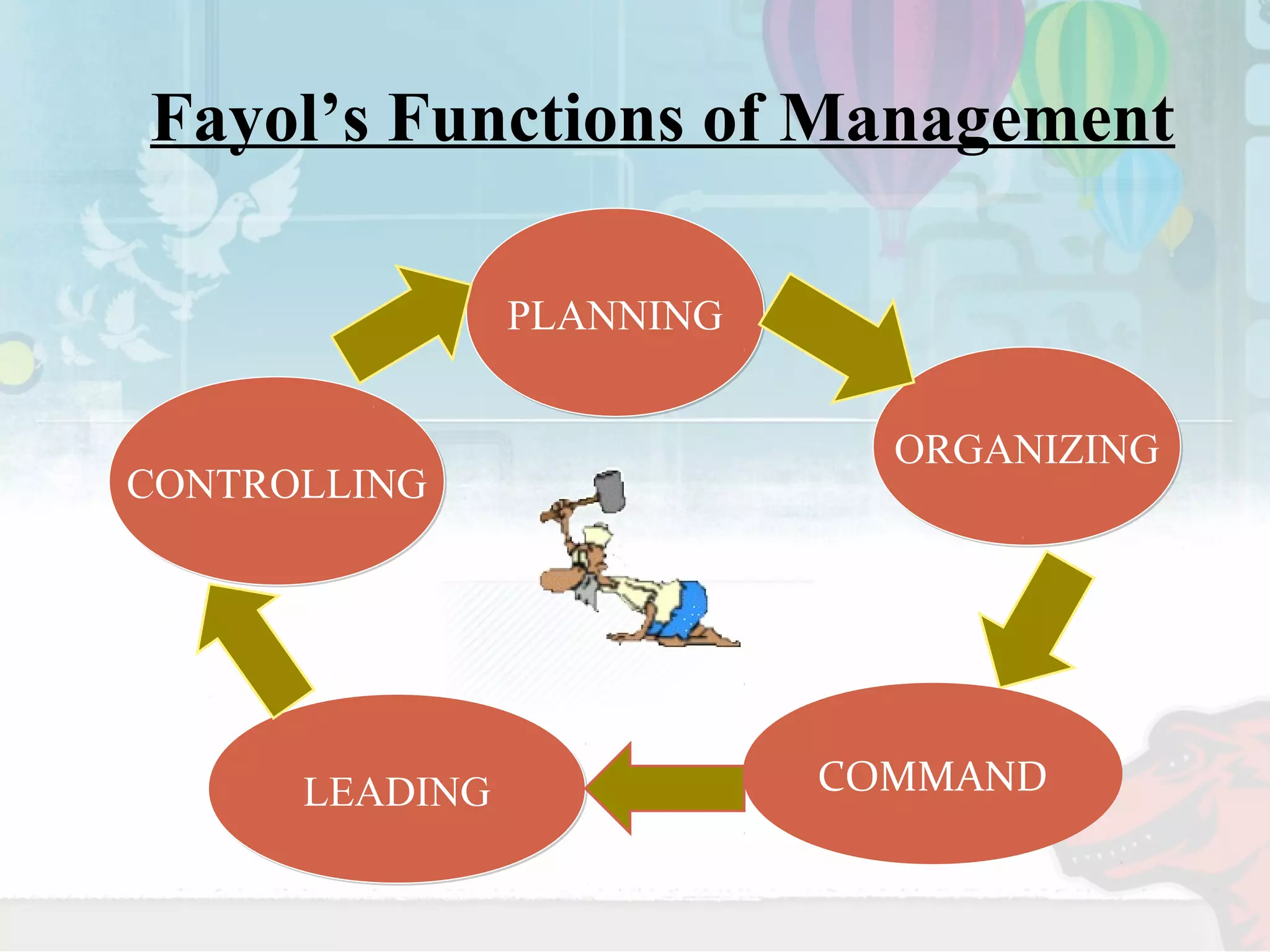
Fayol’s Functions of Management 
PPLLAANNNNIINNGG 
CCOONNTTRROOLLLLIINNGG 
LLEEAADDIINNGG 
OORRGGAANNIIZZIINNGG 
COMMAND
There are five elements of management such as planning, 
organization, command, coordination and control.
According to fayol, planning (attempting to assess the 
future and making provision for it) was an ensential 
part of management. Central to the process was the 
development of a formal plan of action that he 
described as, ‘ a kind of future picture wherein 
proximate events are outlined with some distinctness, 
whilst remote events appear progressively less 
distinct, and it entails the running of the business as 
foreseen and provided against over a definite period.
An ideal plan of action should combine UNITY(i.e an 
overall master plan supported by specific plan for 
each activity), CONTINUITY (i.e the guiding action 
must be consistent as plans develop over the time) 
FLEXIBILITY (i.e possess the ability to adjust to 
unforeseen event) and finally, PRECISE (i.e be as 
accurate as possible).
The second element of management identified by 
fayol was organizing, by which he meant providing a 
business with everything useful to its functioning : 
raw material, tool, capital and personnel. 
He paid particular attention to what he termed the 
composition of the boy corporate (the organizational 
structure) claiming that the form taken by the 
organization would depend almost entirely on the 
number of people employed. 
As organizations grew and become more complex the 
number of employees would generate the need more 
than layers of supervision.
Its objective to get the optimum return from all 
employees. Successful command depended on a 
combination of personal quality and a knowledge of 
the general principle of management
In fayol’s view a manager who has command should : 
Have a thorough knowledge of personnel. 
Eliminate the incompetent 
Be well versed in the agreement binding the bsiness 
and employees. 
Set a good example 
Conduct periodic audits of the organization and use 
summarize charts to further this. 
Bring together chief assistants by means of 
conferences, at which unity of direction and focusing 
of effort are provided for. 
Not become engrossed in detail 
Aim at making unity, energy, initiative and loyalty 
prevail among personnel.
It aimed at securing the optimum harmonization 
of all the activities of an organization in such a 
way as to facilitate its working, and its success’. 
He was concerned here with maintaining the 
balance between the various activities of the 
organization thereby ensuring, for the example, 
that expenditure was proportionate to income; 
equipment procurement to production needs and 
stocks to consumption.
The object of control in this context was to point up 
weaknesses and errors so that they might be rectified 
and prevented from reoccurring . As fayol put it, 
control operates on the everything, things, people, 
actions. Control stimulated the process of feedback 
whereby the organization adapted to changing 
circumstance and constantly renewed itself.
UNITY At any one time 
an organization should have 
only one guiding 
organizational goal 
CONTINUITY Planning 
is an ongoing process and 
previous plans should be 
modified to fit together in the 
corporate framework 
ACCURACY Managers 
should collect and utilize all 
available information to make 
a plan as accurate as possible 
FLEXIBILITY A 
manager should not be stuck 
with a static plan, but be able 
to change and alter as 
situations do.
•Common Criticism 
•Tylor’s Argument 
•Too Formal 
•Vague 
•Inconsistency
•Fayol was everything but a theorist, he had over 30 years 
of experience leading a French mining company. 
•Therefore one can’t really say that his ideas come out of 
the bloom 
•Fayol’s work was seen as a blueprint of good 
management.
Queries
Henri fayol

Henri fayol

  • 1.
    HENRI FAYOL PreparedBy: DIVYANSHU ROY DHIREN RANAWAT BHAVNESH MATHUR VAGEESH SHARMA
  • 2.
  • 3.
    Henri Fayol’s Background • Born in July,1841 in Istanbul, Turkey • His father, an engineer, was appointed superintendent of works to build the Galata Bridge, which bridged the Golden Horn. • His family then returned to France in 1847. • Graduated from the National School of Mines in Saint Etrenne in 1860
  • 4.
    Cont… •After graduationhe went to work and spent his entire career at the mining company, “CommentryFourchamboult-Decazeville”. •By 1890, the company was one of the largest producers of iron and steel in France and regarded as a vital industry. •Fayol became managing director in 1888,when the mine company employed over 10,000 people, and held that position over 30 years until 1918. •He is credited with saving the company from bankruptcy •During his career he lectured at Ecole Superievre de la Guerre •On his retirement he established the Centre of Administrative Studies
  • 5.
    Cont… • Basedlargely on his own management experience, he developed his concept of administration. • In 1916 he published these experience in the book "Administration Industrielle et Générale", and at about the same time as Frederick Winslow Taylor published his Principles of Scientific Management. • He was a director of mines who developed a general theory of business administration. • He was one of the most influential contributors to modern concepts of management.
  • 6.
    BIG CONTRIBUTIONS OFHENRI FAYOL •He was the First management thinker who provided the conceptual framework of the function of management in his book. •Due to his contribution to management theory & principles he was rightly treated as the “FATHER OF MODERN MANAGEMENT THEORY”. •He wanted the formal education of management in schools & colleges. •Provided a link between strategies and organisational theories.
  • 7.
    Subordination of IndividualInterests to the common interest Division of Labor Unity of Command Line of Authority Authority & Responsibility Fayol's Principles of Management Centralization Unity of Direction Initiative Equity Order Discipline Stability and tenure of employees Esprit de Corp Remuneration of Personnel
  • 8.
    Fayol’s Principles ofManagement 1) Division of work: • By separating a work into smaller tasks • Development of proficiency • Focus on planning workers in right role.
  • 9.
    Fayol’s Principles ofManagement 2) Scalar chain : •Represents organization’s hierarchy •allow the workers to be familiar where the stands
  • 10.
    Fayol’s Principles ofManagement 3) Centralization : •Centralization refers the degree of which subordinates are involved in decision making process. •Fayol preferred a less centralized management hierarchy •He did not plan decision made away from the problem.
  • 11.
    Fayol’s Principles ofManagement 4) Unity of Direction : •This involved one head and one plan for a group of activities having the same objective. Whereas unity of command required that each employee should receive orders from one superior only, unity of direction could be summed up in the phrase one head, one plan. • In fayol’s own words, it is the condition essential to unity of action, coordination of strength and focusing of effort. A body with two heads is in social as in the animal sphere a monster and has difficulty in surviving.
  • 12.
    5) Equity : Every worker should be seen with one Eye. There should be equal justice and impartiality and generosity. By this workers will perform their job with full interest, devotion and full ability.
  • 13.
    6) Subordination ofIndividual Interests to the common interest : Fayol drew attention to the fact that one of the greatest problems of management was to reconcile the general interest with that of the individual and group interests. As he put it, ignorance, ambition, selfishness, laziness, weakness and all human passions tend to cause the general interest to be lost sight of in favor of individual interest and a perpetual struggle has to be waged against them.
  • 14.
    7) Authority &Responsibility : This was ‘the right to give orders and the power to exact obedience’. Fayol drew a distinction between official authority ( which derived from a manager’s appointed position in an organization) and personal authority (which stemmed from such attributes as intelligence, experience, integrity and leadership ability). His claimed that in a first class manager, personal authority is the indispensable component of official authority.
  • 15.
    Fayol argued, authoritywas always allied to responsibility and the proper exercise of both required the ability to make judgments and if necessary, impose sanctions. Fayol thought that authority should derive from expertise, leadership skill, knowledge, etc., and lead to a sincere commitment from subordinates
  • 16.
    8) Remuneration ofPersonnel : Fayol considered the factor that determine levels of pay but are independent of the employer’s will such as the cost of living, availability of labour, the business environment and the economic situation. He also examined the various modes of compensation available such as time rates, job rates, piece rates, bonuses, profit-sharing, payment in kind and various non-financial incentive. He concluded that whether wages are made up of money only or whether they include various additions such as heating,, light, housing, food, is of little consequence provided that the employee be satisfied.
  • 17.
    9) Stability andtenure of employees : This dealt with issues relating to personnel planning, management development and labor turnover. Fayol called for suitable induction period to enable employees and particularly managers, to acclimatize themselves to new work and situations. As he observed, insecurity of tenure is especially to be feared in large concern in order to be in a position to decide on a plan of action, to gain confident in one self and inspire it in others.
  • 18.
    10) Unity ofCommand : • This was the nation that an employee should receive orders from one superior only. According to Fayol, dual command was bound to generate tension, confusion and conflict. • He noted the tendency to divide command between individuals and also to blur the lines of demarcation between departments. • The outcome, he claimed, was a dilution of responsibility and the erosion of clear lines of communication. A higher manager might sometimes give orders directly to workers further down the hierarchy, thereby bypassing middle management.

  • 19.
    • 11) Order: • Fayol advocated the maintenance of the tidy material order with appropriate and well kept storage facility, general cleanliness and the preparation of a diagram of plan of the premises showing the various sections and facilities. Similarly he insisted that ‘for social order to prevail the must… be an appointed place for every employee and every employee be in the appointed place’. • It is applied to both material and men. The material should be kept in order in the place where it is necessary. The personnel are selected scientifically and assigned duties according to the required KSA’s.
  • 20.
    Fayol’s Principles ofManagement 12) Discipline : This was in essence obedience, application, energy, behavior and outward marks of respect observed in accordance with standing agreement between the firm and its employees. Fayol conceded that the discipline would take different forms in various organizations but maintained that it was nevertheless, in all circumstances, an essential ingredient. In Fayol’s view the move away from individual bargaining toward collective bargaining merely adjusted the rule governing discipline. Managers need to enforce rules to achieve company goals.
  • 21.
    13) Initiative : This was the power to conceive a plan and ensure it success. It was central to ensuring high motivation and job satisfaction, being one of the most powerful stimulants to human Endeavour. Broadly speaking, claimed fayol, the maximum opportunity to exercise initiative should be extended to all employees through delegated authority.
  • 22.
    Fayol’s Principles ofManagement 14) Esprit de Corp : •This involved the building and maintaining of harmony among the workforce. •Fayol strongly attacked the use of management style based on a belief in divide and rule. •As he put it, ‘dividing enemy force to weaken them is clear, but dividing one’s own team is a grave sin against businesses.
  • 23.
    Fayol’s Functions ofManagement PPLLAANNNNIINNGG CCOONNTTRROOLLLLIINNGG LLEEAADDIINNGG OORRGGAANNIIZZIINNGG COMMAND
  • 24.
    There are fiveelements of management such as planning, organization, command, coordination and control.
  • 25.
    According to fayol,planning (attempting to assess the future and making provision for it) was an ensential part of management. Central to the process was the development of a formal plan of action that he described as, ‘ a kind of future picture wherein proximate events are outlined with some distinctness, whilst remote events appear progressively less distinct, and it entails the running of the business as foreseen and provided against over a definite period.
  • 26.
    An ideal planof action should combine UNITY(i.e an overall master plan supported by specific plan for each activity), CONTINUITY (i.e the guiding action must be consistent as plans develop over the time) FLEXIBILITY (i.e possess the ability to adjust to unforeseen event) and finally, PRECISE (i.e be as accurate as possible).
  • 27.
    The second elementof management identified by fayol was organizing, by which he meant providing a business with everything useful to its functioning : raw material, tool, capital and personnel. He paid particular attention to what he termed the composition of the boy corporate (the organizational structure) claiming that the form taken by the organization would depend almost entirely on the number of people employed. As organizations grew and become more complex the number of employees would generate the need more than layers of supervision.
  • 28.
    Its objective toget the optimum return from all employees. Successful command depended on a combination of personal quality and a knowledge of the general principle of management
  • 29.
    In fayol’s viewa manager who has command should : Have a thorough knowledge of personnel. Eliminate the incompetent Be well versed in the agreement binding the bsiness and employees. Set a good example Conduct periodic audits of the organization and use summarize charts to further this. Bring together chief assistants by means of conferences, at which unity of direction and focusing of effort are provided for. Not become engrossed in detail Aim at making unity, energy, initiative and loyalty prevail among personnel.
  • 30.
    It aimed atsecuring the optimum harmonization of all the activities of an organization in such a way as to facilitate its working, and its success’. He was concerned here with maintaining the balance between the various activities of the organization thereby ensuring, for the example, that expenditure was proportionate to income; equipment procurement to production needs and stocks to consumption.
  • 31.
    The object ofcontrol in this context was to point up weaknesses and errors so that they might be rectified and prevented from reoccurring . As fayol put it, control operates on the everything, things, people, actions. Control stimulated the process of feedback whereby the organization adapted to changing circumstance and constantly renewed itself.
  • 32.
    UNITY At anyone time an organization should have only one guiding organizational goal CONTINUITY Planning is an ongoing process and previous plans should be modified to fit together in the corporate framework ACCURACY Managers should collect and utilize all available information to make a plan as accurate as possible FLEXIBILITY A manager should not be stuck with a static plan, but be able to change and alter as situations do.
  • 33.
    •Common Criticism •Tylor’sArgument •Too Formal •Vague •Inconsistency
  • 34.
    •Fayol was everythingbut a theorist, he had over 30 years of experience leading a French mining company. •Therefore one can’t really say that his ideas come out of the bloom •Fayol’s work was seen as a blueprint of good management.
  • 35.