Major Contributor
         Of
Management Thought


         neeraj singh   1
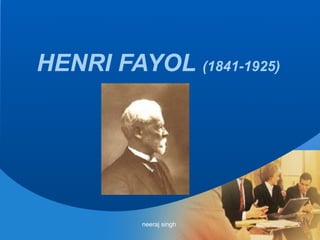
HENRI FAYOL (1841-1925)


         neeraj singh     2
INDEX
   Biography
   Contribution to the field of management
   Evaluation
   Application of Fayol’s theory in organizations
   Limitation of the theory
   Conclusion


                      neeraj singh                   3
"To manage is to forecast and to plan, to
organise, to command, to coordinate and to
control".
                               - Henri Fayol


                    neeraj singh           4
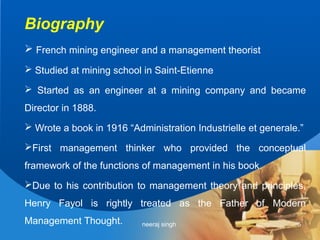
Biography
 French mining engineer and a management theorist
 Studied at mining school in Saint-Etienne

 Started as an engineer at a mining company and became
Director in 1888.
 Wrote a book in 1916 “Administration Industrielle et generale.”

First management thinker who provided the conceptual
framework of the functions of management in his book.
Due to his contribution to management theory and principles,
Henry Fayol is rightly treated as the Father of Modern
Management Thought.        neeraj singh                        5
Contribution to the field of Management

 Administrative Management Theory
 Principles of Management
 Viewed management as a profession that can
be trained and developed
 Emphasized the broad policy aspects of top
level managers ( top down approach)
 Offered universal managerial prescriptions


                  neeraj singh             6
Administrative Management Theory

The functions of management according to
Fayol are:
Planning
Organising
Staffing
Commanding
Coordinating
Controlling

                   neeraj singh            7
Principles of Management
1.   Division of work.
2.   Authority and responsibility.
3.   Discipline.
4.   Unity of command.
5.   Unity of direction.
6.   Subordination of personal interest to
     organizational interests.


                       neeraj singh          8
Contd…
 7. Remuneration
 8. Centralization
 9. Scalar chain
10. Order
11. Equity
12. Stability of tenure
13. Span of co-operation
14. Initiative

                    neeraj singh       9
Viewed management as a profession

 Fayol’s theory of management was the first
  complete theory of management as we
  understand today.

 It incorporated proven principles, elements,
  procedures and techniques based on his
  practical experience.


                    neeraj singh                 10
Offered universal managerial prescriptions

 He recommended the selection and training
  of workers and managers.

 He suggested certain qualities of manager’s
  winch include physical, mental, moral,
  educational technical and experience.


                   neeraj singh                 11
Application
 Emergence of knowledge society.
 Development of socially concerned Humanistic
  society.
 Growing use of innovations and R & D.
 Social accountability of business.
 Satisfaction of human and social values in
  man-machine system.


                   neeraj singh              12
Evaluation
 Fayol’s contribution to management theory is
  certainly remarkable.
 He gave overall concepts of general
  management and suggested the basic
  functions of management.
 In fact, the 14-principles are the outcome of
  his long experience as a practicing manager.
 He also advocated the use of organisation
  charts.
                   neeraj singh               13
Limitations

   Stressed a “one best way” way of organizing and
managing.
 Theory based on intuition and observation rather than
on empirical investigation.
   Today’s      environment     are     more   turbulent   and
unpredictable.
 Too general for today’s highly complex organization.

                          neeraj singh                        14
Conclusion

The management principles suggested by him
are universally accepted by modern authorities
on management and are treated as valid even to
this day. This is because these principles are
practical in nature and also result-oriented. These
basic   principles   are       useful   for   effective
management of business activities.
                     neeraj singh                     15
THANK YOU


   neeraj singh   16

Henri fayol ppt 1

  • 1.
    Major Contributor Of Management Thought neeraj singh 1
  • 2.
  • 3.
    INDEX  Biography  Contribution to the field of management  Evaluation  Application of Fayol’s theory in organizations  Limitation of the theory  Conclusion neeraj singh 3
  • 4.
    "To manage isto forecast and to plan, to organise, to command, to coordinate and to control". - Henri Fayol neeraj singh 4
  • 5.
    Biography  French miningengineer and a management theorist  Studied at mining school in Saint-Etienne  Started as an engineer at a mining company and became Director in 1888.  Wrote a book in 1916 “Administration Industrielle et generale.” First management thinker who provided the conceptual framework of the functions of management in his book. Due to his contribution to management theory and principles, Henry Fayol is rightly treated as the Father of Modern Management Thought. neeraj singh 5
  • 6.
    Contribution to thefield of Management  Administrative Management Theory  Principles of Management  Viewed management as a profession that can be trained and developed  Emphasized the broad policy aspects of top level managers ( top down approach)  Offered universal managerial prescriptions neeraj singh 6
  • 7.
    Administrative Management Theory Thefunctions of management according to Fayol are: Planning Organising Staffing Commanding Coordinating Controlling neeraj singh 7
  • 8.
    Principles of Management 1. Division of work. 2. Authority and responsibility. 3. Discipline. 4. Unity of command. 5. Unity of direction. 6. Subordination of personal interest to organizational interests. neeraj singh 8
  • 9.
    Contd… 7. Remuneration 8. Centralization 9. Scalar chain 10. Order 11. Equity 12. Stability of tenure 13. Span of co-operation 14. Initiative neeraj singh 9
  • 10.
    Viewed management asa profession  Fayol’s theory of management was the first complete theory of management as we understand today.  It incorporated proven principles, elements, procedures and techniques based on his practical experience. neeraj singh 10
  • 11.
    Offered universal managerialprescriptions  He recommended the selection and training of workers and managers.  He suggested certain qualities of manager’s winch include physical, mental, moral, educational technical and experience. neeraj singh 11
  • 12.
    Application  Emergence ofknowledge society.  Development of socially concerned Humanistic society.  Growing use of innovations and R & D.  Social accountability of business.  Satisfaction of human and social values in man-machine system. neeraj singh 12
  • 13.
    Evaluation  Fayol’s contributionto management theory is certainly remarkable.  He gave overall concepts of general management and suggested the basic functions of management.  In fact, the 14-principles are the outcome of his long experience as a practicing manager.  He also advocated the use of organisation charts. neeraj singh 13
  • 14.
    Limitations  Stressed a “one best way” way of organizing and managing.  Theory based on intuition and observation rather than on empirical investigation.  Today’s environment are more turbulent and unpredictable.  Too general for today’s highly complex organization. neeraj singh 14
  • 15.
    Conclusion The management principlessuggested by him are universally accepted by modern authorities on management and are treated as valid even to this day. This is because these principles are practical in nature and also result-oriented. These basic principles are useful for effective management of business activities. neeraj singh 15
  • 16.
    THANK YOU neeraj singh 16