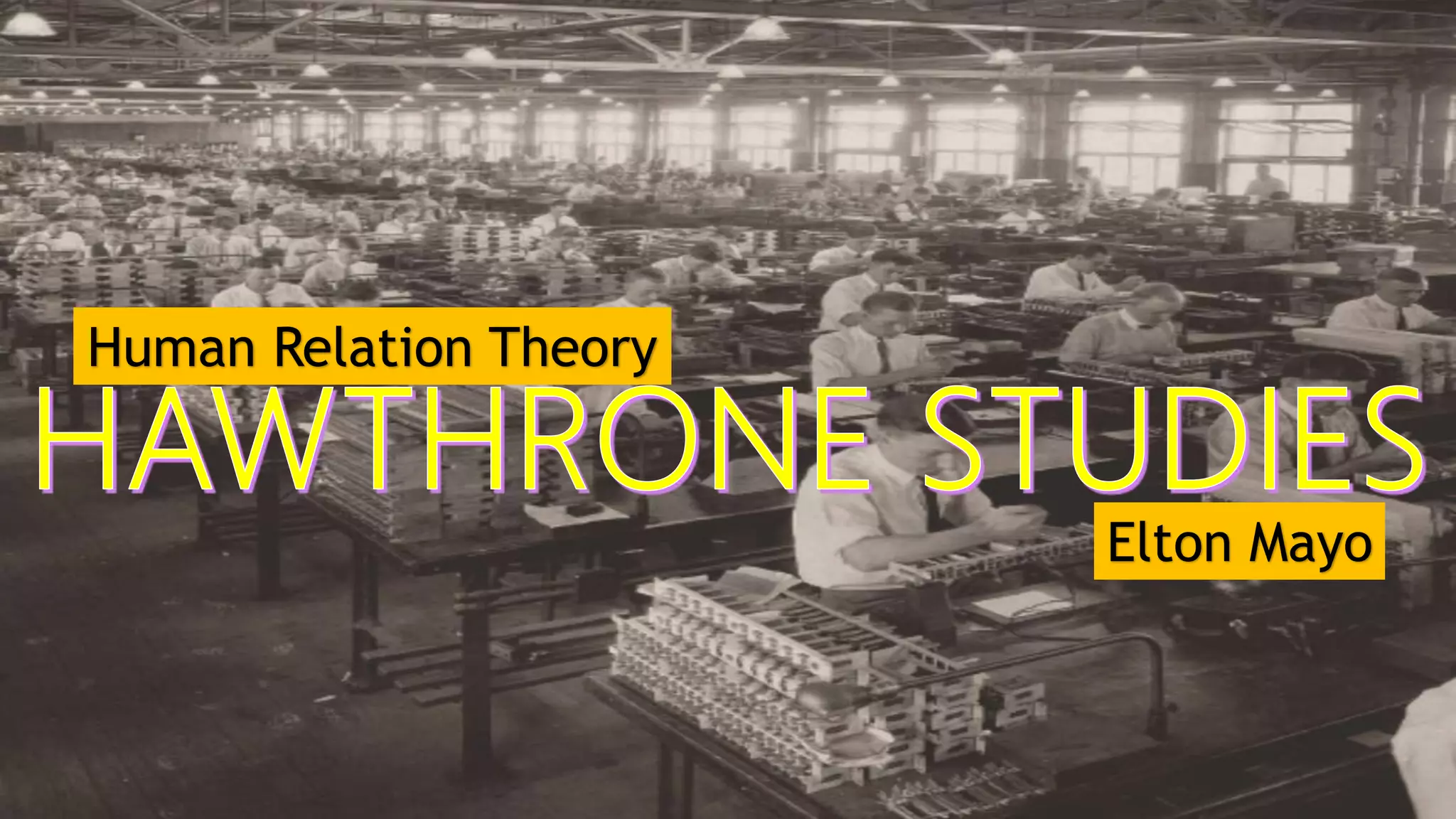
Human Relation Theory
Elton Mayo
Hawthorne Studies (1924-1933)
 This Theory gives higher importance to human relationship.
 It consider employees as a higher being rather than factor of production.
 It gives importance to workers need, feeling & interest on jobs. Its primary
focus is on human factor of an organization.
 This theory was developed by Elton Mayo.
 It is also known as Human Relation Theory.
 This Study mark the beginning of human relation theory.
 They consist a series of experiments that focuses on behavior in work place.
 Productivity is not only a technical but also social phenomenon or workers
attitude groom productivity.
 Workers are motivated by social needs.
 Team work improve Efficiency.
Hawthorne Studies (1924-1933)
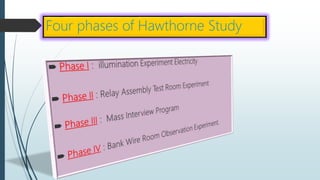
Four phases of Hawthorne Study
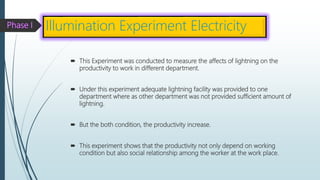
 This Experiment was conducted to measure the affects of lightning on the
productivity to work in different department.
 Under this experiment adequate lightning facility was provided to one
department where as other department was not provided sufficient amount of
lightning.
 But the both condition, the productivity increase.
 This experiment shows that the productivity not only depend on working
condition but also social relationship among the worker at the work place.
Illumination Experiment Electricity
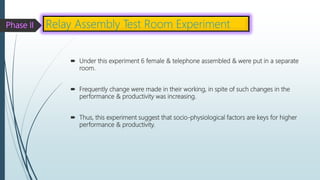
 Under this experiment 6 female & telephone assembled & were put in a separate
room.
 Frequently change were made in their working, in spite of such changes in the
performance & productivity was increasing.
 Thus, this experiment suggest that socio-physiological factors are keys for higher
performance & productivity.
Relay Assembly Test Room Experiment
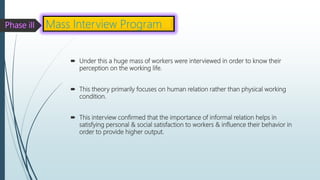
 Under this a huge mass of workers were interviewed in order to know their
perception on the working life.
 This theory primarily focuses on human relation rather than physical working
condition.
 This interview confirmed that the importance of informal relation helps in
satisfying personal & social satisfaction to workers & influence their behavior in
order to provide higher output.
Mass Interview Program
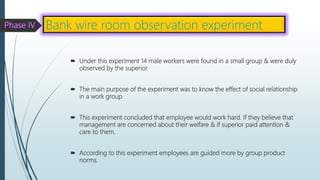
 Under this experiment 14 male workers were found in a small group & were duly
observed by the superior.
 The main purpose of the experiment was to know the effect of social relationship
in a work group.
 This experiment concluded that employee would work hard. If they believe that
management are concerned about their welfare & if superior paid attention &
care to them.
 According to this experiment employees are guided more by group product
norms.
Bank wire room observation experiment
 The Hawthorne studies have had a remarkable impact on management in
organizations & how workers react to various situations.
 The research carried out at the Western Electrics Hawthorne plant during the
1920’s & earl 1930’s helped to initiate a whole new approach to human behavior
studies.
 The final result was “he organization of teamwork-that is, of sustained
cooperation leads to success.
Conclusion
 Productivity increases when workers believe that they are being observed closely.
 Employees perform better when managers & co-workers make them feel valued.
 Financial rewards are not necessarily conductive to increasing worker productivity.
 Workers are about self-fulfillment, autonomy, empowerment, social status &
personal relationships with co-workers.
Hawthorne Effect
Thank You
Prepared By: Raj

Hawthrone studies ( Human Relation Theory)

  • 1.
  • 2.
    Hawthorne Studies (1924-1933) This Theory gives higher importance to human relationship.  It consider employees as a higher being rather than factor of production.  It gives importance to workers need, feeling & interest on jobs. Its primary focus is on human factor of an organization.  This theory was developed by Elton Mayo.  It is also known as Human Relation Theory.
  • 3.
     This Studymark the beginning of human relation theory.  They consist a series of experiments that focuses on behavior in work place.  Productivity is not only a technical but also social phenomenon or workers attitude groom productivity.  Workers are motivated by social needs.  Team work improve Efficiency. Hawthorne Studies (1924-1933)
  • 4.
    Four phases ofHawthorne Study
  • 5.
     This Experimentwas conducted to measure the affects of lightning on the productivity to work in different department.  Under this experiment adequate lightning facility was provided to one department where as other department was not provided sufficient amount of lightning.  But the both condition, the productivity increase.  This experiment shows that the productivity not only depend on working condition but also social relationship among the worker at the work place. Illumination Experiment Electricity
  • 6.
     Under thisexperiment 6 female & telephone assembled & were put in a separate room.  Frequently change were made in their working, in spite of such changes in the performance & productivity was increasing.  Thus, this experiment suggest that socio-physiological factors are keys for higher performance & productivity. Relay Assembly Test Room Experiment
  • 7.
     Under thisa huge mass of workers were interviewed in order to know their perception on the working life.  This theory primarily focuses on human relation rather than physical working condition.  This interview confirmed that the importance of informal relation helps in satisfying personal & social satisfaction to workers & influence their behavior in order to provide higher output. Mass Interview Program
  • 8.
     Under thisexperiment 14 male workers were found in a small group & were duly observed by the superior.  The main purpose of the experiment was to know the effect of social relationship in a work group.  This experiment concluded that employee would work hard. If they believe that management are concerned about their welfare & if superior paid attention & care to them.  According to this experiment employees are guided more by group product norms. Bank wire room observation experiment
  • 9.
     The Hawthornestudies have had a remarkable impact on management in organizations & how workers react to various situations.  The research carried out at the Western Electrics Hawthorne plant during the 1920’s & earl 1930’s helped to initiate a whole new approach to human behavior studies.  The final result was “he organization of teamwork-that is, of sustained cooperation leads to success. Conclusion
  • 10.
     Productivity increaseswhen workers believe that they are being observed closely.  Employees perform better when managers & co-workers make them feel valued.  Financial rewards are not necessarily conductive to increasing worker productivity.  Workers are about self-fulfillment, autonomy, empowerment, social status & personal relationships with co-workers. Hawthorne Effect
  • 11.