APPROACHES/THEORIES OF
ORGANIZATION AND
MANAGEMENT
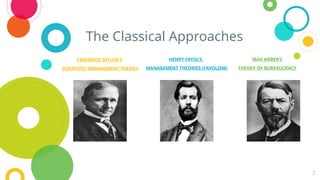
The Classical Approaches
FREDERICK TAYLOR’S
SCIENTIFIC MANAGEMENT THEORY
HENRY FAYOL’S
MANAGEMENT THEORIES (FAVOLISM)
2
MAX WEBER’S
THEORY OF BUREAUCRACY
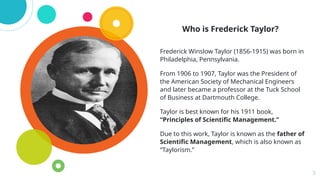
Who is Frederick Taylor?
Frederick Winslow Taylor (1856-1915) was born in
Philadelphia, Pennsylvania.
From 1906 to 1907, Taylor was the President of
the American Society of Mechanical Engineers
and later became a professor at the Tuck School
of Business at Dartmouth College.
Taylor is best known for his 1911 book,
“Principles of Scientific Management.”
Due to this work, Taylor is known as the father of
Scientific Management, which is also known as
“Taylorism.”
3
4
The Principles of Scientific
Management Theory
Through his studies that used the scientific method, Taylor
established Four Principles of Management, including to:
1. Develop a science for each element of work
2. Scientifically Select, Train, Teach, and Develop the worker
3. Cooperate with the Worker
4. Divide the Work and Responsibility
5
When Taylor spoke of “developing a science” for each element of
work, he essentially meant that management should:
1. Gather objective data on work;
2. Perform experiments; and
3. Standardize policies and procedures based on the results of
the experiments.
Principle One:
Develop a Science for each element of work
6
Given the “science” of the task, Taylor then said that individuals
“especially suited” for the work should be selected.
Regarding training and development, if a worker was performing
below standard, Taylor believed that a “competent teacher should
be sent to show the worker exactly how their work can be best
done, to guide, help, and encourage them… and give them the
time and the help required to make them proficient at their
present job.”
Principle Two:
Scientifically Select, Train, Teach,
and Develop the worker
7
Principle Three: Cooperate with the Worker
When speaking about the Bethlehem Steel Company, Taylor said that work should be
distributed among four parties and in the following fashion:
1. “One set of employees engaged in the development of the science of laboring”;
2. “Another set of employees, mostly skilled laborers themselves, who are teachers,
and who help and guide the workers in their work”;
3. “Another set of tool-room employees who provide the proper implements and
keep them in perfect order”; and
4. “Another set of clerks who [plan] the work well in advance, move the workers with
the least loss of time from one place to another, and properly record each worker’s
earnings, etc.”
8
Principle Four: Divide the Work and Responsibility
Taylor argued that Scientific Management was more effective because “even if the
[worker] was well suited to the development and use of scientific data, it would be
physically impossible for them to work at their machine and at a desk at the same
time.”
He argued that the best approach would be “an almost equal division of the
responsibility and the work between the management the worker.”
Taylor said that management’s responsibility was to ensure cooperation between
all of the aforementioned parties.
He also said that management should be “side by side with the workers, helping,
encouraging, and smoothing a way for them.”
Finally, when rewarding workers, Taylor stated that it “must come soon after the
work has been done.”
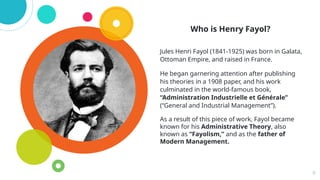
Who is Henry Fayol?
Jules Henri Fayol (1841-1925) was born in Galata,
Ottoman Empire, and raised in France.
He began garnering attention after publishing
his theories in a 1908 paper, and his work
culminated in the world-famous book,
“Administration Industrielle et Générale”
(“General and Industrial Management”).
As a result of this piece of work, Fayol became
known for his Administrative Theory, also
known as “Fayolism,” and as the father of
Modern Management.
9
The Management Theory of Henri Fayol
includes three main theories:
I. The Six Industrial Activities
II. The Five Functions of Management
III. The 14 Principles of Management
10
What are Fayol’s management
theories?
11
To begin his book, Henri Fayol states that there are six main industrial activities.
The types of activities are:
1. Technical, including production, manufacturing, and adaptation;
1. A high level of technical ability is important in order to produce excellent
products.
2. Commercial, including markets, contracts, buying, selling, and exchange;
1. Being skilled in commercial aspects is important because it has a strong
impact on revenue and cost savings.
3. Financial, involving the search for and optimum use of capital;
1. Since “many potentially prosperous enterprises die suffering from lack of
money…nor is any reform or improvement possible without finances or
credit,” optimal use of finances is critical to a business.
I. The Six Industrial Activities
12
4. Security, involving the protection of people and property;
5. Accounting, stocktaking, the balance sheet, costs, and statistics;
o “An efficient accounting system, clear and simple, giving an
accurate idea of the firm’s condition, is a powerful managerial
instrument;” and
6. Managerial, including planning, organizing, command, coordination, and
control;
o “Management…is neither an exclusive privilege nor a particular
responsibility of the head or senior members of the business; it is
an activity spread, like all other activities, between head and
members of the body corporate.”
13
II. The Five Functions of Management
Within Managerial Activities, Henri Fayol specifies five primary functions (or
elements). These functions are:
1. Planning - also labelled as a “plan of action,” “is one of the most difficult and
important matters of every business and brings into play all departments and all
functions, especially management.”
2. Organizing - involves providing everything that is necessary to a plan of action
3. Command - is described as getting “the optimum return from all employees of a
manager’s unit in the interest of the whole concern.” This includes:
4. Coordination - requires ensuring that all personnel understand their
responsibilities and resources and activities across the organization work in
harmony in order to achieve the desired goal.
5. Control - consists of “verifying whether everything occurs in conformity with the
plan adopted, the instructions issued, and the principles established.”
14
Henri Fayol’s
14 Principles of Management
Henri Fayol believed that “the soundness and good working
order of the body corporate depend on a certain number of
conditions termed...principles, laws, [or] rules.” In turn, he
produced 14 that are “flexible and capable of adaptation to
every need,” but require “intelligence, experience, decision,
and proportion.” Given that “without principles one is in
darkness and chaos,” Fayol hoped that these principles could
be relied upon and/or used for future study.
15
14 Components of Fayol’s
Administrative Principles Approach.
1. Division of work;
Specialization helps to “produce more and better work with the same
effort” by reducing “the number of objects to which attention and effort
must be directed.”
2. Authority;
“Authority is not to be conceived of apart from responsibility, that is apart
from sanction—reward or penalty—which goes with the exercise of
power”;
3. Discipline;
“Obedience, application, energy, behavior, and [the respecting of
agreements]…is absolutely essential for the smooth running of
business.”
16
4. Unity of command;
“For any action whatsoever, an employee should receive orders from one
superior only
5. Unity of direction;
A group of activities with the same objective should have one plan and one
person in charge.
6. Subordination of individual interests to the general interests;
Everyone should work in the combined best interests of everyone involved
rather than in their own best interests.
7. Remuneration;
It is dependent on a number of factors, but “it should be fair and, as far as is
possible, afford satisfaction both to the personnel and firm.”
17
8. Centralization;
“The question of centralization or decentralization…is a matter of finding
the optimum degree for the particular [decision/task]” and the capacity
and/or preferences of the manager.
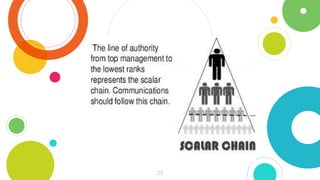
9. Scalar chain (line of authority);
Authority should move from the top down in order to maintain unity of
command, but lateral communication is possible if superiors are aware
of and support it.
The line of authority should be as short as possible.
10. Order;
Materials must have “a place appointed for each thing and each thing must be in
its appointed place.” Places should also be “suitably arranged” and “well
chosen.” This is to avoid “useless handling, lost time, [and] risk of mistakes.”
18
11. Equity;
Managers should “strive to instill [a] sense of equity” throughout their chain
of command and use “equity and equality of treatment” when dealing
with employees.
12. Stability of tenure of personnel;
“Instability of tenure is at one and the same time cause and effect of bad
running.”
13. Initiative;
“It is essential to encourage and develop [initiative],” but to also ensure
“respect for authority and for discipline.”
14. Esprit de corps
“Harmony, union among the personnel of a concern, is great strength in that
concern” and “effort…should be made to establish it.”
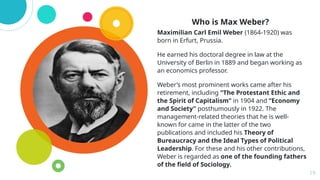
Who is Max Weber?
Maximilian Carl Emil Weber (1864-1920) was
born in Erfurt, Prussia.
He earned his doctoral degree in law at the
University of Berlin in 1889 and began working as
an economics professor.
Weber’s most prominent works came after his
retirement, including “The Protestant Ethic and
the Spirit of Capitalism” in 1904 and “Economy
and Society” posthumously in 1922. The
management-related theories that he is well-
known for came in the latter of the two
publications and included his Theory of
Bureaucracy and the Ideal Types of Political
Leadership. For these and his other contributions,
Weber is regarded as one of the founding fathers
of the field of Sociology.
19
20
Weber’s
Management Theories
While Weber may be best known for his numerous
contributions to the field of Sociology, he is also
known for two key contributions to Management
theory:
1. The Theory of Bureaucracy
2. The Ideal Types of Political Leadership.
21
The Theory of Bureaucracy
One of Weber’s greatest contributions to management theory was his
Theory of Bureaucracy. This theory states that there are six principles
of bureaucracy, including:
1. Specialization
2. Formalized rules – policies and procedures
3. Hierarchical structure - with one clear leader at the top
4. Well-trained employees
5. Managerial dedication
6. Impartiality of management – “individual privileges and bestowals
of favor” should be avoided
“
Theories without facts may be barren,
but facts without theories are
meaningless.
- Kenneth E. Boulding -
22
24
1. Having competent personnel;
2. Knowing personnel thoroughly;
3. Knowing the organization’s obligations to its personnel;
4. Working with other managers to ensure unity of direction
and effort amongst managers and personnel;
5. Setting a good example;
6. Performing regular audits of performance; and
7. Staying out of the minutiae.
25

ED 101 classical approaches-Grad School-pptx

  • 1.
  • 2.
    The Classical Approaches FREDERICKTAYLOR’S SCIENTIFIC MANAGEMENT THEORY HENRY FAYOL’S MANAGEMENT THEORIES (FAVOLISM) 2 MAX WEBER’S THEORY OF BUREAUCRACY
  • 3.
    Who is FrederickTaylor? Frederick Winslow Taylor (1856-1915) was born in Philadelphia, Pennsylvania. From 1906 to 1907, Taylor was the President of the American Society of Mechanical Engineers and later became a professor at the Tuck School of Business at Dartmouth College. Taylor is best known for his 1911 book, “Principles of Scientific Management.” Due to this work, Taylor is known as the father of Scientific Management, which is also known as “Taylorism.” 3
  • 4.
    4 The Principles ofScientific Management Theory Through his studies that used the scientific method, Taylor established Four Principles of Management, including to: 1. Develop a science for each element of work 2. Scientifically Select, Train, Teach, and Develop the worker 3. Cooperate with the Worker 4. Divide the Work and Responsibility
  • 5.
    5 When Taylor spokeof “developing a science” for each element of work, he essentially meant that management should: 1. Gather objective data on work; 2. Perform experiments; and 3. Standardize policies and procedures based on the results of the experiments. Principle One: Develop a Science for each element of work
  • 6.
    6 Given the “science”of the task, Taylor then said that individuals “especially suited” for the work should be selected. Regarding training and development, if a worker was performing below standard, Taylor believed that a “competent teacher should be sent to show the worker exactly how their work can be best done, to guide, help, and encourage them… and give them the time and the help required to make them proficient at their present job.” Principle Two: Scientifically Select, Train, Teach, and Develop the worker
  • 7.
    7 Principle Three: Cooperatewith the Worker When speaking about the Bethlehem Steel Company, Taylor said that work should be distributed among four parties and in the following fashion: 1. “One set of employees engaged in the development of the science of laboring”; 2. “Another set of employees, mostly skilled laborers themselves, who are teachers, and who help and guide the workers in their work”; 3. “Another set of tool-room employees who provide the proper implements and keep them in perfect order”; and 4. “Another set of clerks who [plan] the work well in advance, move the workers with the least loss of time from one place to another, and properly record each worker’s earnings, etc.”
  • 8.
    8 Principle Four: Dividethe Work and Responsibility Taylor argued that Scientific Management was more effective because “even if the [worker] was well suited to the development and use of scientific data, it would be physically impossible for them to work at their machine and at a desk at the same time.” He argued that the best approach would be “an almost equal division of the responsibility and the work between the management the worker.” Taylor said that management’s responsibility was to ensure cooperation between all of the aforementioned parties. He also said that management should be “side by side with the workers, helping, encouraging, and smoothing a way for them.” Finally, when rewarding workers, Taylor stated that it “must come soon after the work has been done.”
  • 9.
    Who is HenryFayol? Jules Henri Fayol (1841-1925) was born in Galata, Ottoman Empire, and raised in France. He began garnering attention after publishing his theories in a 1908 paper, and his work culminated in the world-famous book, “Administration Industrielle et Générale” (“General and Industrial Management”). As a result of this piece of work, Fayol became known for his Administrative Theory, also known as “Fayolism,” and as the father of Modern Management. 9
  • 10.
    The Management Theoryof Henri Fayol includes three main theories: I. The Six Industrial Activities II. The Five Functions of Management III. The 14 Principles of Management 10 What are Fayol’s management theories?
  • 11.
    11 To begin hisbook, Henri Fayol states that there are six main industrial activities. The types of activities are: 1. Technical, including production, manufacturing, and adaptation; 1. A high level of technical ability is important in order to produce excellent products. 2. Commercial, including markets, contracts, buying, selling, and exchange; 1. Being skilled in commercial aspects is important because it has a strong impact on revenue and cost savings. 3. Financial, involving the search for and optimum use of capital; 1. Since “many potentially prosperous enterprises die suffering from lack of money…nor is any reform or improvement possible without finances or credit,” optimal use of finances is critical to a business. I. The Six Industrial Activities
  • 12.
    12 4. Security, involvingthe protection of people and property; 5. Accounting, stocktaking, the balance sheet, costs, and statistics; o “An efficient accounting system, clear and simple, giving an accurate idea of the firm’s condition, is a powerful managerial instrument;” and 6. Managerial, including planning, organizing, command, coordination, and control; o “Management…is neither an exclusive privilege nor a particular responsibility of the head or senior members of the business; it is an activity spread, like all other activities, between head and members of the body corporate.”
  • 13.
    13 II. The FiveFunctions of Management Within Managerial Activities, Henri Fayol specifies five primary functions (or elements). These functions are: 1. Planning - also labelled as a “plan of action,” “is one of the most difficult and important matters of every business and brings into play all departments and all functions, especially management.” 2. Organizing - involves providing everything that is necessary to a plan of action 3. Command - is described as getting “the optimum return from all employees of a manager’s unit in the interest of the whole concern.” This includes: 4. Coordination - requires ensuring that all personnel understand their responsibilities and resources and activities across the organization work in harmony in order to achieve the desired goal. 5. Control - consists of “verifying whether everything occurs in conformity with the plan adopted, the instructions issued, and the principles established.”
  • 14.
    14 Henri Fayol’s 14 Principlesof Management Henri Fayol believed that “the soundness and good working order of the body corporate depend on a certain number of conditions termed...principles, laws, [or] rules.” In turn, he produced 14 that are “flexible and capable of adaptation to every need,” but require “intelligence, experience, decision, and proportion.” Given that “without principles one is in darkness and chaos,” Fayol hoped that these principles could be relied upon and/or used for future study.
  • 15.
    15 14 Components ofFayol’s Administrative Principles Approach. 1. Division of work; Specialization helps to “produce more and better work with the same effort” by reducing “the number of objects to which attention and effort must be directed.” 2. Authority; “Authority is not to be conceived of apart from responsibility, that is apart from sanction—reward or penalty—which goes with the exercise of power”; 3. Discipline; “Obedience, application, energy, behavior, and [the respecting of agreements]…is absolutely essential for the smooth running of business.”
  • 16.
    16 4. Unity ofcommand; “For any action whatsoever, an employee should receive orders from one superior only 5. Unity of direction; A group of activities with the same objective should have one plan and one person in charge. 6. Subordination of individual interests to the general interests; Everyone should work in the combined best interests of everyone involved rather than in their own best interests. 7. Remuneration; It is dependent on a number of factors, but “it should be fair and, as far as is possible, afford satisfaction both to the personnel and firm.”
  • 17.
    17 8. Centralization; “The questionof centralization or decentralization…is a matter of finding the optimum degree for the particular [decision/task]” and the capacity and/or preferences of the manager. 9. Scalar chain (line of authority); Authority should move from the top down in order to maintain unity of command, but lateral communication is possible if superiors are aware of and support it. The line of authority should be as short as possible. 10. Order; Materials must have “a place appointed for each thing and each thing must be in its appointed place.” Places should also be “suitably arranged” and “well chosen.” This is to avoid “useless handling, lost time, [and] risk of mistakes.”
  • 18.
    18 11. Equity; Managers should“strive to instill [a] sense of equity” throughout their chain of command and use “equity and equality of treatment” when dealing with employees. 12. Stability of tenure of personnel; “Instability of tenure is at one and the same time cause and effect of bad running.” 13. Initiative; “It is essential to encourage and develop [initiative],” but to also ensure “respect for authority and for discipline.” 14. Esprit de corps “Harmony, union among the personnel of a concern, is great strength in that concern” and “effort…should be made to establish it.”
  • 19.
    Who is MaxWeber? Maximilian Carl Emil Weber (1864-1920) was born in Erfurt, Prussia. He earned his doctoral degree in law at the University of Berlin in 1889 and began working as an economics professor. Weber’s most prominent works came after his retirement, including “The Protestant Ethic and the Spirit of Capitalism” in 1904 and “Economy and Society” posthumously in 1922. The management-related theories that he is well- known for came in the latter of the two publications and included his Theory of Bureaucracy and the Ideal Types of Political Leadership. For these and his other contributions, Weber is regarded as one of the founding fathers of the field of Sociology. 19
  • 20.
    20 Weber’s Management Theories While Webermay be best known for his numerous contributions to the field of Sociology, he is also known for two key contributions to Management theory: 1. The Theory of Bureaucracy 2. The Ideal Types of Political Leadership.
  • 21.
    21 The Theory ofBureaucracy One of Weber’s greatest contributions to management theory was his Theory of Bureaucracy. This theory states that there are six principles of bureaucracy, including: 1. Specialization 2. Formalized rules – policies and procedures 3. Hierarchical structure - with one clear leader at the top 4. Well-trained employees 5. Managerial dedication 6. Impartiality of management – “individual privileges and bestowals of favor” should be avoided
  • 22.
    “ Theories without factsmay be barren, but facts without theories are meaningless. - Kenneth E. Boulding - 22
  • 24.
    24 1. Having competentpersonnel; 2. Knowing personnel thoroughly; 3. Knowing the organization’s obligations to its personnel; 4. Working with other managers to ensure unity of direction and effort amongst managers and personnel; 5. Setting a good example; 6. Performing regular audits of performance; and 7. Staying out of the minutiae.
  • 25.