GROUP NAME:-
F.W.TAYLOR


    Compiled by
  Anuj Pratap
  IBM(C.S.J.M.U.)
      Kanpur
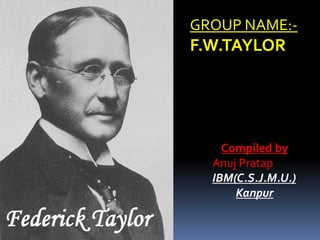
Frederick Winslow Taylor (March 20, 1856 – March
21, 1915) was an American mechanical engineer who
sought to improve industrial efficiency. He is regarded
as the father of scientific management and was one of
the first management consultants.Taylor was one of the
intellectual leaders of the Efficiency Movement and his
ideas, broadly conceived, were highly influential in the
Progressive Era.
Why study
Management
  Theory?
What is management
theory?

Why is management
theory important?

Why is management
theories important?
Evaluation of Management Thought
CLASSICAL APPROACH
  Classical theorists formulated
 principles for setting up and
 managing organizations. These
 views are labeled “classical”
 because they form the foundation
 for the field of management
 thought.
THE THREE MAJOR CONTRIBUTORS
   OF THE CLASSICAL APPROACH


                Administrative   Bureaucratic
Scientific
                Approach-:       Approach-
Management -:
F. W. Taylor    Henry Fayol      :Max weber
SCIENTIFIC MANAGEMENT / CONTRIBUTION OF TAYLOR


 The concept of scientific management was
 introduced by Fredrick Winslow Taylor in USA in the
 beginning of 20th century.

 According to Taylor, “ Scientific management is
 concerned with knowing exactly what you want men
 to do and then see in that they do it in the best and
 cheapest way.”
:-Develop a science for each element of an individual’s
work.
:-Scientifically select and then training teaching
development of the works.
:-Heartily cooperate with the workers so as to ensure that
all work is done in accordance with the principal of the
science has been developed.
:-Divide work and responsibility almost equally between
management and which it is better salted than the
workers.
ADMINISTRATIVE
APPROACH/CONTRIBUTION OF HENRY
            FAYOL

Henry Fayol, a French
industrialist, has been regarded as
the real father of modern
management. He reduced his ideas
based on practical experiences in his
book, ‘Administration industrialle at
Generali, published in 1916 in
French language.
Fayol divided the activities of an
industry into 6 groups-
:-Technical
:-Commercial
:-Financial
:-Security
:-Accounting
:-Managerial
   These activities are common all
organization, whether big or small.
Fayol’s principle of Management
1.    Division of work
2.    Authority and responsibility
3.    Discipline
4.    Unity of command
5.    Unity of direction
6.    Subordination of individual interest to general interest
7.    Remuneration of personnel
8.    Centralization
9.    Scalar chain
10.   Order
11.   Equity
12.   Stability of tenure
13.   Initiative
14.   Esprit de corps
Discussion Question
     Which of the following is the most
     important aspect of Fayol’s principles
     of management?

A.   Division of Labor
B.   Unity of Command
C.   Remuneration of Personnel
D.   Esprit de corps
Bureaucracy
Characteristics of bureaucracy


 -:Division of work
 -:Hierarchy of Position
 -:Rules and Regulations
 -:Impersonal Relationship
 -:Official records
MAX WABER
The great German sociologist and
  political economist was born on 21
  April 1864.
He worked in the field of economics
  sociology, history, law, politics and
  philosophy at the university of
  Berlin, Vienna and university of
  Munich.
On 14 jun 1920 he left the word due to
  pneumonia.
Bureaucracy / Contribution of Max Weber

  Max weber’s main
 contribution to
 management is his theory
 of authority structure and
 his description of organi-
 zations based on the
 nature of autority relations
 within them.
There are three type of legitimate authority
which run as follows-


1. Rational-Legal authority
2. Traditional authority
3. Charismatic authority
Neo classical
    Approach

It is also called BEHAVIORAL
APPROACH. The behavioral
approach to management began
with the ‘Howthorne experiment’.
a) Classical approach did not achieve
   total efficiency and workplace
   harmony.
b) Managers still encountered problem
   because workers didn’t always behave
   as they were supposed to.
     Two branches:
      1) Human Relations Approach
      2) Behavioral Sciences Approach
Human Relations Approach
-:Focus on the social environment of a job
-:Refers to the manner in which managers interact with
subordinates
-:Managers must know why subordinates behave as
they do
-:Importance of individuals in success or failure of an
organization
-:Management should recognize employees’ need for
recognition and social acceptance
-:Management should look on work group as a positive
force.
 Four phases
   Illumination experiment
   Relay room experiment
   Bank wiring observation
   Interview program
Employees are           Employees’ performance
 motivated by social        is more a result of peer
needs and association           pressure than
    with others            management’s incentives
                                   and rules

  Employees want to           Managers need to
participate in decisions    involve subordinates
   that affect them         in coordinating their
                              work to improve
                                  efficiency
Snapshot


               “Teamwork is one of the most beautiful
                experiences in life. Teamwork is our
                core value and a primary way that the
                 Container Store enriches the quality
                      of employees’ work life.”


Kip Tindell, President, The Container Store
TYPES OF MODERN SCHOOL
 1.SYSTEMS APPROACH
 2.CONTINGENCY APPROACH
SYSTEMS APPROACH
                      External
                    environment


Input (Resources)                    Output
                    Transformation
     Human                           Product
     Capital                         Services
    Materials
CONCEPT
Sub System
Synergy
Open & close System
System Boundary
Flow
Feed Back
CONTINGENCY APPROACH

   Approaches depend on the variables of the
    situations
   Draws on all past theories in attempting to analyze
    and solve problems
   Is integrative
   Summarized as an “it all depends” device
   Tells managers to look to their experiences
    and the past and to consider many options before
    choosing
   Encourages managers to stay flexible
Management thought

Management thought

  • 1.
    GROUP NAME:- F.W.TAYLOR Compiled by Anuj Pratap IBM(C.S.J.M.U.) Kanpur
  • 2.
    Frederick Winslow Taylor(March 20, 1856 – March 21, 1915) was an American mechanical engineer who sought to improve industrial efficiency. He is regarded as the father of scientific management and was one of the first management consultants.Taylor was one of the intellectual leaders of the Efficiency Movement and his ideas, broadly conceived, were highly influential in the Progressive Era.
  • 4.
  • 5.
    What is management theory? Whyis management theory important? Why is management theories important?
  • 6.
  • 7.
    CLASSICAL APPROACH Classical theorists formulated principles for setting up and managing organizations. These views are labeled “classical” because they form the foundation for the field of management thought.
  • 8.
    THE THREE MAJORCONTRIBUTORS OF THE CLASSICAL APPROACH Administrative Bureaucratic Scientific Approach-: Approach- Management -: F. W. Taylor Henry Fayol :Max weber
  • 9.
    SCIENTIFIC MANAGEMENT /CONTRIBUTION OF TAYLOR The concept of scientific management was introduced by Fredrick Winslow Taylor in USA in the beginning of 20th century. According to Taylor, “ Scientific management is concerned with knowing exactly what you want men to do and then see in that they do it in the best and cheapest way.”
  • 10.
    :-Develop a sciencefor each element of an individual’s work. :-Scientifically select and then training teaching development of the works. :-Heartily cooperate with the workers so as to ensure that all work is done in accordance with the principal of the science has been developed. :-Divide work and responsibility almost equally between management and which it is better salted than the workers.
  • 11.
    ADMINISTRATIVE APPROACH/CONTRIBUTION OF HENRY FAYOL Henry Fayol, a French industrialist, has been regarded as the real father of modern management. He reduced his ideas based on practical experiences in his book, ‘Administration industrialle at Generali, published in 1916 in French language.
  • 12.
    Fayol divided theactivities of an industry into 6 groups- :-Technical :-Commercial :-Financial :-Security :-Accounting :-Managerial These activities are common all organization, whether big or small.
  • 13.
    Fayol’s principle ofManagement 1. Division of work 2. Authority and responsibility 3. Discipline 4. Unity of command 5. Unity of direction 6. Subordination of individual interest to general interest 7. Remuneration of personnel 8. Centralization 9. Scalar chain 10. Order 11. Equity 12. Stability of tenure 13. Initiative 14. Esprit de corps
  • 14.
    Discussion Question Which of the following is the most important aspect of Fayol’s principles of management? A. Division of Labor B. Unity of Command C. Remuneration of Personnel D. Esprit de corps
  • 15.
  • 16.
    Characteristics of bureaucracy -:Division of work -:Hierarchy of Position -:Rules and Regulations -:Impersonal Relationship -:Official records
  • 17.
    MAX WABER The greatGerman sociologist and political economist was born on 21 April 1864. He worked in the field of economics sociology, history, law, politics and philosophy at the university of Berlin, Vienna and university of Munich. On 14 jun 1920 he left the word due to pneumonia.
  • 18.
    Bureaucracy / Contributionof Max Weber Max weber’s main contribution to management is his theory of authority structure and his description of organi- zations based on the nature of autority relations within them.
  • 19.
    There are threetype of legitimate authority which run as follows- 1. Rational-Legal authority 2. Traditional authority 3. Charismatic authority
  • 20.
    Neo classical Approach It is also called BEHAVIORAL APPROACH. The behavioral approach to management began with the ‘Howthorne experiment’.
  • 21.
    a) Classical approachdid not achieve total efficiency and workplace harmony. b) Managers still encountered problem because workers didn’t always behave as they were supposed to. Two branches: 1) Human Relations Approach 2) Behavioral Sciences Approach
  • 22.
    Human Relations Approach -:Focuson the social environment of a job -:Refers to the manner in which managers interact with subordinates -:Managers must know why subordinates behave as they do -:Importance of individuals in success or failure of an organization -:Management should recognize employees’ need for recognition and social acceptance -:Management should look on work group as a positive force.
  • 24.
     Four phases  Illumination experiment  Relay room experiment  Bank wiring observation  Interview program
  • 25.
    Employees are Employees’ performance motivated by social is more a result of peer needs and association pressure than with others management’s incentives and rules Employees want to Managers need to participate in decisions involve subordinates that affect them in coordinating their work to improve efficiency
  • 27.
    Snapshot “Teamwork is one of the most beautiful experiences in life. Teamwork is our core value and a primary way that the Container Store enriches the quality of employees’ work life.” Kip Tindell, President, The Container Store
  • 29.
    TYPES OF MODERNSCHOOL 1.SYSTEMS APPROACH 2.CONTINGENCY APPROACH
  • 30.
    SYSTEMS APPROACH External environment Input (Resources) Output Transformation Human Product Capital Services Materials
  • 31.
    CONCEPT Sub System Synergy Open &close System System Boundary Flow Feed Back
  • 32.
    CONTINGENCY APPROACH  Approaches depend on the variables of the situations  Draws on all past theories in attempting to analyze and solve problems  Is integrative  Summarized as an “it all depends” device  Tells managers to look to their experiences and the past and to consider many options before choosing  Encourages managers to stay flexible