
PRESTIGE INSTITUTE OF MANAGEMENT, GWALIOR 
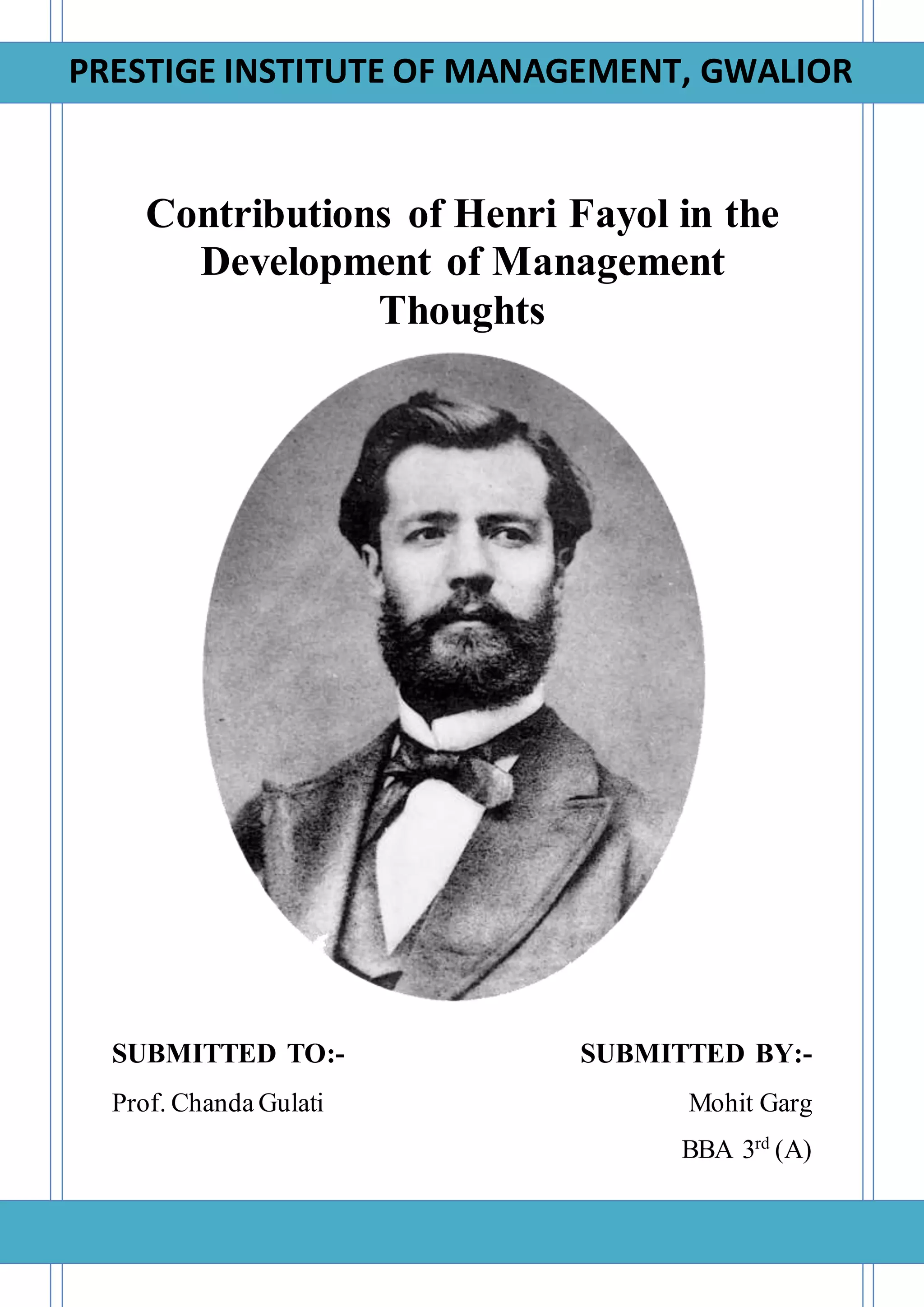
Contributions of Henri Fayol in the 
Development of Management 
Thoughts 
SUBMITTED TO:- 
Prof. Chanda Gulati 
SUBMITTED BY:- 
Mohit Garg 
BBA 3rd (A)
TABLE OF CONTENTS 
1. What is Management...............................................................1 
2. Introduction of Henri Fayol ....................................................1 
3. 14 Principles of Management..................................................1 
4. Fayol’s Gangplank Concept ....................................................4 
5. Five Elements of Management................................................5 
6. References ................................................................................
What is Management? 
Management is the organizational process that includes strategic planning, setting objectives, 
managing resources, deploying the human and financial assets needed to achieve objectives, and 
measuring results. Management also includes recording and storing facts and information for later 
use or for others within the organization. Management functions are not limited to managers and 
supervisors. Every member of the organization has some management and reporting functions as part 
of their job. 
Henri Fayol 
Henri Fayol was a French mining engineer ES DIRECTOR of mines who developed a general theory 
of business administration that is often called Fayolism. He is widely acknowledged as a founder of 
modern management methods. 
Fayol was born in 1841 in a suburb of Istanbul, Ottoman Empire. When he was 19, he began working 
as an engineer at a large mining company in France. He eventually became the director, at a time 
when the mining company employed more than 1,000 people. Through the years, Fayol began to 
develop what he considered to be the 14 most important principles of management. Essentially, these 
explained how managers should organize and interact with staff. In 1916, two years before he stepped 
down as director, he published his "14 Principles of Management" in the book "Administration 
Industrielle et Generale." 
Fayol also created a list of the six primary functions of management, which go hand in hand with the 
Principles. Fayol's "14 Principles" was one of the earliest theories of management to be created, and 
remains one of the most comprehensive. He's considered to be among the most influential 
contributors to the modern concept of management, even though people don't refer to "The 14 
Principles" often today. The theory falls under the Administrative Management school of thought. 
Henri Fayol's Principle of Management 
Followings are the 14 principles of management developed by the Henry Fayol: 
1. Division of Work: 
According to Henry Fayol under division of work, "The worker always on the same post, the manager 
always concerned with the same matters, acquire an ability, sureness and accuracy which increases 
their output. In other words, division of work means specialization. According to this principle, a 
person is not capable of doing all types of work. Each job and work should be assigned to the 
specialist of his job. Division of work promotes efficiency because it permits an organizational 
member to work in a limited area reducing the scope of his responsibility. Fayol wanted the division 
of work not only at factory but at management levels also. 
2. Authority and Responsibility: 
Authority and responsibility go together or co-existing. Both authority and responsibility are the two 
sides of a coin. In this way, if anybody is made responsible for any job, he should also have the 
concerned authority. Fayol's principle of management in this regard is that an efficient manager makes 
1 | P a g e
best possible use of his authority and does not escape from the responsibility. In other words when the 
authority is exercised the responsibility is automatically generated. 
3. Discipline: 
According to Henry Fayol discipline means sincerity about the work and enterprise, carrying out 
orders and instructions of superiors and to have faith in the policies and programs of the business 
enterprise, in other sense, discipline in terms of obedience, application, energy and respect to superior. 
However, Fayol does not advocate warming, fines, suspension and dismissals of worker for 
maintaining discipline. These punishments are rarely awarded. A well-disciplined working force is 
essential for improving the quality and quantity of the production. 
4. Unity of Command: 
A subordinate should take order from only one boss and he should be responsible and accountable to 
him. Further he claimed that if the unit of command is violated, authority is undermined, disciplined 
in danger, order disturbed and stability threatened. The violation of this principle will face some 
serious consequences. In this way, the principle of unity of command provides the enterprise 
disciplined stable and orderly existence. It creates harmonious relationship between officers and 
subordinates, congenial atmosphere of work. It is one of the Fayol's important essential principles of 
management. 
5. Unity of direction: 
Fayol advocates "One head and one plan" which means that group efforts on a particular plan be led 
and directed by a single person. This enables effective co-ordination of individual efforts and energy. 
This fulfils the principles of unity of command and brings uniformity in the work of same nature. In 
this way the principle of direction create dedication to purpose and loyalty. It emphasizes the 
attainment of common goal under one head. 
6. Subordination of individual interests to general interests: 
The interest of the business enterprise ought to come before the interests of the praise individual 
workers. In other words, principle of management states that employees should surrender their 
personnel interest before the general interest of the enterprise. Sometimes the employees due to this 
ignorance, selfishness, laziness, carelessness and emotional pleasure overlook the interest of the 
organization. This attitude proves to be very harmful to the enterprise. 
7. Fair Remuneration to employees: 
According to Fayol wage-rates and method of their payment should be fair, proper and satisfactory. 
Both employees and ex-employers should agree to it. Logical and appropriate wage-rate and methods 
of their payment reduces tension and differences between workers and management, create 
harmonious relationship and a pleasing atmosphere of work. Further Fayol recommends that 
residential facilities be provided including arrangement of electricity, water and facilities. 
8. Centralization and Decentralization: 
There should be one central point in the organization which exercises overall direction and control of 
all the parts. But the degree of centralization of authority should vary according to the needs of 
2 | P a g e
situation. According to Fayol there should be centralization in small units and proper decentralization 
in big organization. Further, Fayol does not favour centralization or decentralization of authorities but 
suggests that these should be proper and effective adjustment between centralization and 
decentralization in order to achieve maximum objectives of the business. The choice between 
centralization and decentralization is made after taking into consideration the nature of work and the 
efficiency, experience and decision-making capacity of the executives. 
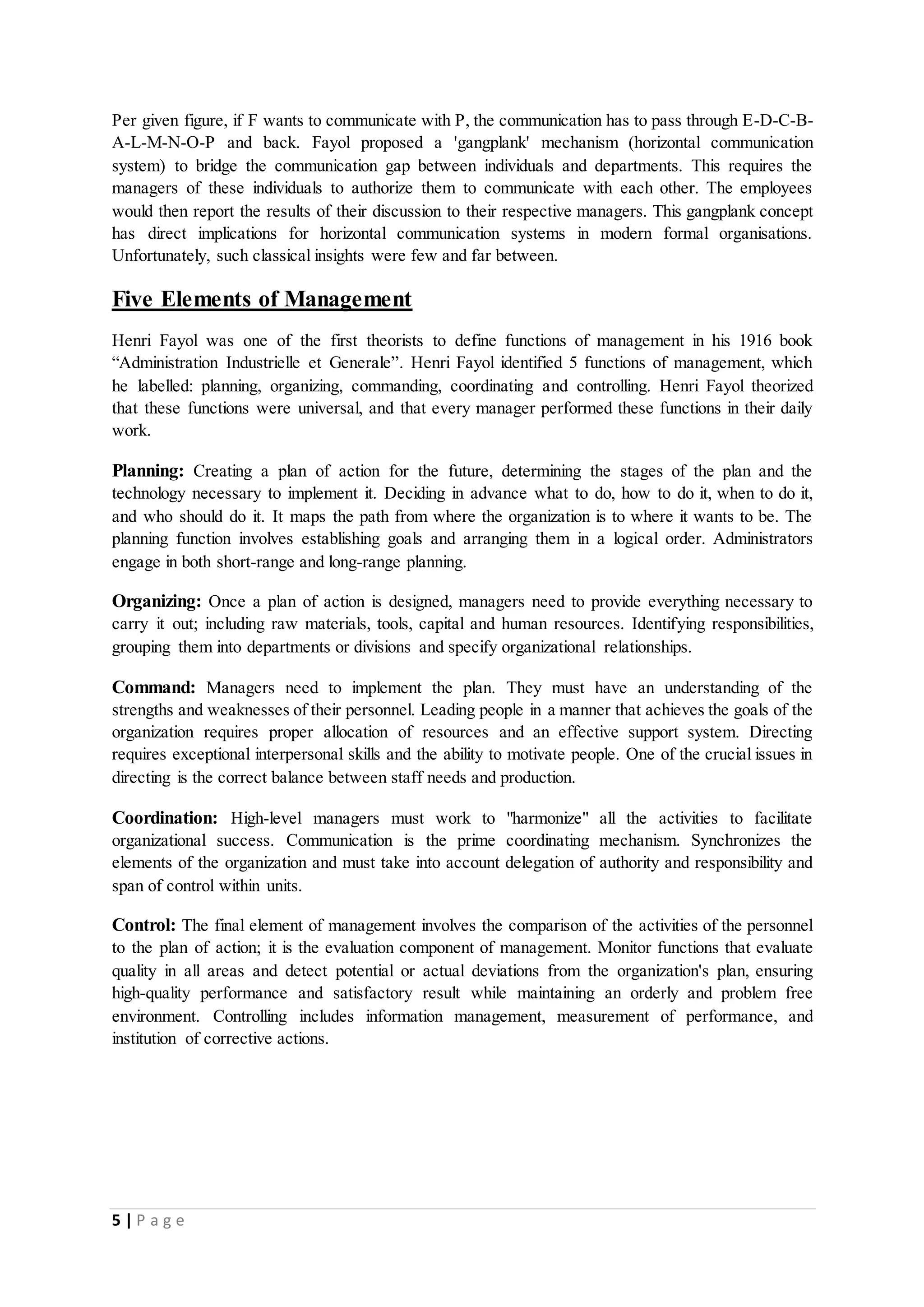
9. Scalar chain: 
The scalar chain is a chain of supervisors from the highest to the lowest rank. It should be short-circuited. 
An employee should feel the necessity to contact his superior through the scalar chain. The 
authority and responsibility is communicated through this scalar chain. Fayol defines scalar chain as 
"the chain of superiors ranging from the ultimate authority to the lowest rank." The flow of 
information between management and workers is a must. Business opportunities must be immediately 
avoided of. So we must make direct contact with the concerned employee. Business problems need 
immediate solution, so we cannot always depend on the established scalar chain. It requires that direct 
contact should be established. 
10. Order: 
According to Fayol there should be proper, systematic and orderly arrangement of physical and social 
factors, such as land, raw materials, tools and equipments and employees respectively. As per view, 
there should be safe, appropriate and specific place for every article and every place to be used 
effectively for a particular activity and commodity. In other words, principles that every piece of land 
and every article should be used properly, economically and in the best possible way, Selection and 
appointment of the most suitable person to every job. There should be specific place for everyone and 
3 | P a g e
everyone should have specific place. This principle also stresses scientific selection and appointment 
of employees on every job. 
11. Equity: 
The principle of equality should be followed and applicable at every level of management. There 
should not be any discrimination as regards caste, sex and religion. An effective management always 
accords sympathetic and human treatment. The management should be kind, honest and impartial 
with the employees. In other words, kindness and justice should be exercised by management in 
dealing with their subordinates. This will create loyalty and devotion among the employees. Thus, 
workers should be treated at par at every level. 
12. Stability of Tenure: 
Principle of stability is linked with long tenure of personnel in the organization. This means 
production being a team work, an efficient management always builds a team of good workers, if the 
members of the team go on changing the entire process of production will be disturbed. It is always in 
the interest of the enterprise that its trusted, experienced and trained employees do not leave the 
organization. Stability of job creates a sense of belongingness among workers who with this feeling 
are encouraged to improve the quality and quantity of work. 
13. Initiative: 
Under this principle, the successful management provides an opportunity to its employees to suggest 
their new ideas, experiences and more convenient methods of work. The employees, who has been 
working on the specific job since long discover now, better alternative approach and technique of 
work. It will be more useful, if initiative to do so is provided to employees. In simple, to ensure 
success, plans should be well formulated before they are implemented. 
14. Spirit of Co-operation (Esprit de corps) 
In order to achieve the best possible results, individual and group efforts are to be effectively 
integrated and coordinated. Production is a team work for which the whole-hearted support and co-operation 
of the members at all levels is required. Everyone should sacrifice his personal interest and 
contribute his best energies to achieve the best results. It refers to the spirit of loyalty, faithfulness on 
the part of the members of the group which can be achieved by strong motivating recognition and 
importance of the members for their valuable contribution, effective coordination, informal mutual 
social relationship between members of the group and positive and constructive approach of the 
management towards workers' welfare. 
Fayol’s Gangplank Concept 
In formal organizations, the design of communication channels is based on the assumption that all the 
divisions and departments are self-contained and do not facilitate communication among employees at 
the same level (horizontal communication). This poses a serious problem when circumstances demand 
such communication. If an individual wants to convey some message to an individual from another 
department, the message has to be passed up to the highest managerial level and then down to the 
individual. The reply from that individual is also received in a similar way, leading to huge delays. As 
4 | P a g e
Per given figure, if F wants to communicate with P, the communication has to pass through E-D-C-B-A- 
L-M-N-O-P and back. Fayol proposed a 'gangplank' mechanism (horizontal communication 
system) to bridge the communication gap between individuals and departments. This requires the 
managers of these individuals to authorize them to communicate with each other. The employees 
would then report the results of their discussion to their respective managers. This gangplank concept 
has direct implications for horizontal communication systems in modern formal organisations. 
Unfortunately, such classical insights were few and far between. 
Five Elements of Management 
Henri Fayol was one of the first theorists to define functions of management in his 1916 book 
“Administration Industrielle et Generale”. Henri Fayol identified 5 functions of management, which 
he labelled: planning, organizing, commanding, coordinating and controlling. Henri Fayol theorized 
that these functions were universal, and that every manager performed these functions in their daily 
work. 
Planning: Creating a plan of action for the future, determining the stages of the plan and the 
technology necessary to implement it. Deciding in advance what to do, how to do it, when to do it, 
and who should do it. It maps the path from where the organization is to where it wants to be. The 
planning function involves establishing goals and arranging them in a logical order. Administrators 
engage in both short-range and long-range planning. 
Organizing: Once a plan of action is designed, managers need to provide everything necessary to 
carry it out; including raw materials, tools, capital and human resources. Identifying responsibilities, 
grouping them into departments or divisions and specify organizational relationships. 
Command: Managers need to implement the plan. They must have an understanding of the 
strengths and weaknesses of their personnel. Leading people in a manner that achieves the goals of the 
organization requires proper allocation of resources and an effective support system. Directing 
requires exceptional interpersonal skills and the ability to motivate people. One of the crucial issues in 
directing is the correct balance between staff needs and production. 
Coordination: High-level managers must work to "harmonize" all the activities to facilitate 
organizational success. Communication is the prime coordinating mechanism. Synchronizes the 
elements of the organization and must take into account delegation of authority and responsibility and 
span of control within units. 
Control: The final element of management involves the comparison of the activities of the personnel 
to the plan of action; it is the evaluation component of management. Monitor functions that evaluate 
quality in all areas and detect potential or actual deviations from the organization's plan, ensuring 
high-quality performance and satisfactory result while maintaining an orderly and problem free 
environment. Controlling includes information management, measurement of performance, and 
institution of corrective actions. 
5 | P a g e
6 | P a g e 
REFERNCES 
http://en.wikipedia.org/wiki/Henri_Fayol 
www.analytictech.com/mb021/fayol.htm

Contribution of Henri Fayol to the development of Management theory....

  • 1.
    PRESTIGE INSTITUTE OFMANAGEMENT, GWALIOR Contributions of Henri Fayol in the Development of Management Thoughts SUBMITTED TO:- Prof. Chanda Gulati SUBMITTED BY:- Mohit Garg BBA 3rd (A)
  • 2.
    TABLE OF CONTENTS 1. What is Management...............................................................1 2. Introduction of Henri Fayol ....................................................1 3. 14 Principles of Management..................................................1 4. Fayol’s Gangplank Concept ....................................................4 5. Five Elements of Management................................................5 6. References ................................................................................
  • 3.
    What is Management? Management is the organizational process that includes strategic planning, setting objectives, managing resources, deploying the human and financial assets needed to achieve objectives, and measuring results. Management also includes recording and storing facts and information for later use or for others within the organization. Management functions are not limited to managers and supervisors. Every member of the organization has some management and reporting functions as part of their job. Henri Fayol Henri Fayol was a French mining engineer ES DIRECTOR of mines who developed a general theory of business administration that is often called Fayolism. He is widely acknowledged as a founder of modern management methods. Fayol was born in 1841 in a suburb of Istanbul, Ottoman Empire. When he was 19, he began working as an engineer at a large mining company in France. He eventually became the director, at a time when the mining company employed more than 1,000 people. Through the years, Fayol began to develop what he considered to be the 14 most important principles of management. Essentially, these explained how managers should organize and interact with staff. In 1916, two years before he stepped down as director, he published his "14 Principles of Management" in the book "Administration Industrielle et Generale." Fayol also created a list of the six primary functions of management, which go hand in hand with the Principles. Fayol's "14 Principles" was one of the earliest theories of management to be created, and remains one of the most comprehensive. He's considered to be among the most influential contributors to the modern concept of management, even though people don't refer to "The 14 Principles" often today. The theory falls under the Administrative Management school of thought. Henri Fayol's Principle of Management Followings are the 14 principles of management developed by the Henry Fayol: 1. Division of Work: According to Henry Fayol under division of work, "The worker always on the same post, the manager always concerned with the same matters, acquire an ability, sureness and accuracy which increases their output. In other words, division of work means specialization. According to this principle, a person is not capable of doing all types of work. Each job and work should be assigned to the specialist of his job. Division of work promotes efficiency because it permits an organizational member to work in a limited area reducing the scope of his responsibility. Fayol wanted the division of work not only at factory but at management levels also. 2. Authority and Responsibility: Authority and responsibility go together or co-existing. Both authority and responsibility are the two sides of a coin. In this way, if anybody is made responsible for any job, he should also have the concerned authority. Fayol's principle of management in this regard is that an efficient manager makes 1 | P a g e
  • 4.
    best possible useof his authority and does not escape from the responsibility. In other words when the authority is exercised the responsibility is automatically generated. 3. Discipline: According to Henry Fayol discipline means sincerity about the work and enterprise, carrying out orders and instructions of superiors and to have faith in the policies and programs of the business enterprise, in other sense, discipline in terms of obedience, application, energy and respect to superior. However, Fayol does not advocate warming, fines, suspension and dismissals of worker for maintaining discipline. These punishments are rarely awarded. A well-disciplined working force is essential for improving the quality and quantity of the production. 4. Unity of Command: A subordinate should take order from only one boss and he should be responsible and accountable to him. Further he claimed that if the unit of command is violated, authority is undermined, disciplined in danger, order disturbed and stability threatened. The violation of this principle will face some serious consequences. In this way, the principle of unity of command provides the enterprise disciplined stable and orderly existence. It creates harmonious relationship between officers and subordinates, congenial atmosphere of work. It is one of the Fayol's important essential principles of management. 5. Unity of direction: Fayol advocates "One head and one plan" which means that group efforts on a particular plan be led and directed by a single person. This enables effective co-ordination of individual efforts and energy. This fulfils the principles of unity of command and brings uniformity in the work of same nature. In this way the principle of direction create dedication to purpose and loyalty. It emphasizes the attainment of common goal under one head. 6. Subordination of individual interests to general interests: The interest of the business enterprise ought to come before the interests of the praise individual workers. In other words, principle of management states that employees should surrender their personnel interest before the general interest of the enterprise. Sometimes the employees due to this ignorance, selfishness, laziness, carelessness and emotional pleasure overlook the interest of the organization. This attitude proves to be very harmful to the enterprise. 7. Fair Remuneration to employees: According to Fayol wage-rates and method of their payment should be fair, proper and satisfactory. Both employees and ex-employers should agree to it. Logical and appropriate wage-rate and methods of their payment reduces tension and differences between workers and management, create harmonious relationship and a pleasing atmosphere of work. Further Fayol recommends that residential facilities be provided including arrangement of electricity, water and facilities. 8. Centralization and Decentralization: There should be one central point in the organization which exercises overall direction and control of all the parts. But the degree of centralization of authority should vary according to the needs of 2 | P a g e
  • 5.
    situation. According toFayol there should be centralization in small units and proper decentralization in big organization. Further, Fayol does not favour centralization or decentralization of authorities but suggests that these should be proper and effective adjustment between centralization and decentralization in order to achieve maximum objectives of the business. The choice between centralization and decentralization is made after taking into consideration the nature of work and the efficiency, experience and decision-making capacity of the executives. 9. Scalar chain: The scalar chain is a chain of supervisors from the highest to the lowest rank. It should be short-circuited. An employee should feel the necessity to contact his superior through the scalar chain. The authority and responsibility is communicated through this scalar chain. Fayol defines scalar chain as "the chain of superiors ranging from the ultimate authority to the lowest rank." The flow of information between management and workers is a must. Business opportunities must be immediately avoided of. So we must make direct contact with the concerned employee. Business problems need immediate solution, so we cannot always depend on the established scalar chain. It requires that direct contact should be established. 10. Order: According to Fayol there should be proper, systematic and orderly arrangement of physical and social factors, such as land, raw materials, tools and equipments and employees respectively. As per view, there should be safe, appropriate and specific place for every article and every place to be used effectively for a particular activity and commodity. In other words, principles that every piece of land and every article should be used properly, economically and in the best possible way, Selection and appointment of the most suitable person to every job. There should be specific place for everyone and 3 | P a g e
  • 6.
    everyone should havespecific place. This principle also stresses scientific selection and appointment of employees on every job. 11. Equity: The principle of equality should be followed and applicable at every level of management. There should not be any discrimination as regards caste, sex and religion. An effective management always accords sympathetic and human treatment. The management should be kind, honest and impartial with the employees. In other words, kindness and justice should be exercised by management in dealing with their subordinates. This will create loyalty and devotion among the employees. Thus, workers should be treated at par at every level. 12. Stability of Tenure: Principle of stability is linked with long tenure of personnel in the organization. This means production being a team work, an efficient management always builds a team of good workers, if the members of the team go on changing the entire process of production will be disturbed. It is always in the interest of the enterprise that its trusted, experienced and trained employees do not leave the organization. Stability of job creates a sense of belongingness among workers who with this feeling are encouraged to improve the quality and quantity of work. 13. Initiative: Under this principle, the successful management provides an opportunity to its employees to suggest their new ideas, experiences and more convenient methods of work. The employees, who has been working on the specific job since long discover now, better alternative approach and technique of work. It will be more useful, if initiative to do so is provided to employees. In simple, to ensure success, plans should be well formulated before they are implemented. 14. Spirit of Co-operation (Esprit de corps) In order to achieve the best possible results, individual and group efforts are to be effectively integrated and coordinated. Production is a team work for which the whole-hearted support and co-operation of the members at all levels is required. Everyone should sacrifice his personal interest and contribute his best energies to achieve the best results. It refers to the spirit of loyalty, faithfulness on the part of the members of the group which can be achieved by strong motivating recognition and importance of the members for their valuable contribution, effective coordination, informal mutual social relationship between members of the group and positive and constructive approach of the management towards workers' welfare. Fayol’s Gangplank Concept In formal organizations, the design of communication channels is based on the assumption that all the divisions and departments are self-contained and do not facilitate communication among employees at the same level (horizontal communication). This poses a serious problem when circumstances demand such communication. If an individual wants to convey some message to an individual from another department, the message has to be passed up to the highest managerial level and then down to the individual. The reply from that individual is also received in a similar way, leading to huge delays. As 4 | P a g e
  • 7.
    Per given figure,if F wants to communicate with P, the communication has to pass through E-D-C-B-A- L-M-N-O-P and back. Fayol proposed a 'gangplank' mechanism (horizontal communication system) to bridge the communication gap between individuals and departments. This requires the managers of these individuals to authorize them to communicate with each other. The employees would then report the results of their discussion to their respective managers. This gangplank concept has direct implications for horizontal communication systems in modern formal organisations. Unfortunately, such classical insights were few and far between. Five Elements of Management Henri Fayol was one of the first theorists to define functions of management in his 1916 book “Administration Industrielle et Generale”. Henri Fayol identified 5 functions of management, which he labelled: planning, organizing, commanding, coordinating and controlling. Henri Fayol theorized that these functions were universal, and that every manager performed these functions in their daily work. Planning: Creating a plan of action for the future, determining the stages of the plan and the technology necessary to implement it. Deciding in advance what to do, how to do it, when to do it, and who should do it. It maps the path from where the organization is to where it wants to be. The planning function involves establishing goals and arranging them in a logical order. Administrators engage in both short-range and long-range planning. Organizing: Once a plan of action is designed, managers need to provide everything necessary to carry it out; including raw materials, tools, capital and human resources. Identifying responsibilities, grouping them into departments or divisions and specify organizational relationships. Command: Managers need to implement the plan. They must have an understanding of the strengths and weaknesses of their personnel. Leading people in a manner that achieves the goals of the organization requires proper allocation of resources and an effective support system. Directing requires exceptional interpersonal skills and the ability to motivate people. One of the crucial issues in directing is the correct balance between staff needs and production. Coordination: High-level managers must work to "harmonize" all the activities to facilitate organizational success. Communication is the prime coordinating mechanism. Synchronizes the elements of the organization and must take into account delegation of authority and responsibility and span of control within units. Control: The final element of management involves the comparison of the activities of the personnel to the plan of action; it is the evaluation component of management. Monitor functions that evaluate quality in all areas and detect potential or actual deviations from the organization's plan, ensuring high-quality performance and satisfactory result while maintaining an orderly and problem free environment. Controlling includes information management, measurement of performance, and institution of corrective actions. 5 | P a g e
  • 8.
    6 | Pa g e REFERNCES http://en.wikipedia.org/wiki/Henri_Fayol www.analytictech.com/mb021/fayol.htm