INTRODUCTION TO
CLASSICAL APPROACH
DEFINITION OF CLASSICAL APPROACH

“Classical approach of management professes
the body of management thought based on
the belief that employees have only
economical and physical needs and that the
social needs & need for job satisfaction either
does not exist or are unimportant. Accordingly
it advocates high specialization of
labour,centralized decision making & profit
maximization.”
• Classical approach is the oldest formal school of thought
which began around 1900 and continued into the 1920s.
• Its mainly concerned with the increasing the efficiency of
workers and organizations based on management
practices, which were an outcome of careful observation.
• Classical approach mainly looks for the universal
principles of operation in the striving for economic
efficiency.
• Classical approach includes scientific, administrative &
bureaucratic management.
• SCIENTIFIC MANAGEMENT focuses on the
“one best way” to do a job.
• ADMINISTRATIVE MANAGEMENT focuses on
the manager & basic managerial functions.
• BUREAUCRACTIC MANAGEMENT focuses on
the guidelines for structuring with
formaliazation of rules,procedures and a clear
division of labour.
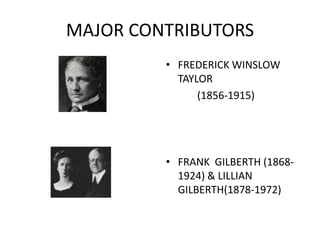
MAJOR CONTRIBUTORS
• FREDERICK WINSLOW
TAYLOR
(1856-1915)

• FRANK GILBERTH (18681924) & LILLIAN
GILBERTH(1878-1972)
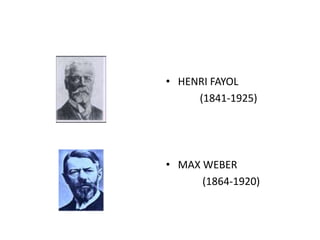
• HENRI FAYOL
(1841-1925)

• MAX WEBER
(1864-1920)
CLASSICAL APPROACH
• SCIENTIFIC MANAGEMENT
THEORY

• GENERAL ADMINSTRATIVE
MANAGEMENT THEORY

•

•

FREDERICK W.TAYLOR

(1856-1915)

- FATHER OF SCIENTIFIC
MANAGEMENT
• ANALYSED MANAGEMENT
SCIENTIFICALLY TO FIND OUT THE
MOST EFFICTIVE WAY TO DO A
JOB - “ONE BEST WAY” TO DO
THE JOB.

HENRI FAYOL (1841- 1925)

- FATHER OF MODERN
MANAGEMENT
• ANALYSED MANAGEMENT AS A
UNIVERSAL PROCESS OF
PLANNING,ORGANIZING,
COMMANDING,COORDINATING& CONTROLLING. ALSO
INTRODUCED FOURTEEN
PRINCIPLES OF MANAGEMENT.
THEORIES
• TAYLOR’S THEORY OF SCIENTIFIC
MANAGEMENT
• FAYOL’S ADMINISTRATIVE THEORY
• WEBER’S THEORY OF BUREAUCRACY
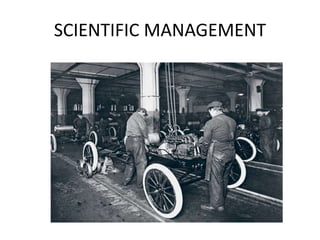
SCIENTIFIC MANAGEMENT
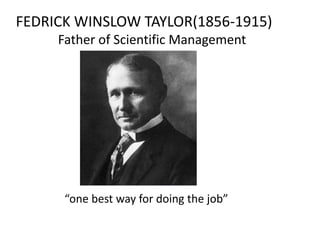
FEDRICK WINSLOW TAYLOR(1856-1915)
Father of Scientific Management

“one best way for doing the job”
Definition
Scientific management was a theory of management
that analyzed and workflows, with the objective of
improving labor productivity

management of a business, industry, or economy,
according to principles of efficiency derived from
experiments in methods of work and production,
especially from time-and-motion studies- (mass noun)
In 1898, Taylor joined Bethlehem Steel.

Taylor was a mechanical engineer who sought to
improve industrial efficiency.
Working in the steel industry, Taylor had observed
the phenomenon of workers' purposely operating
well below their capacity, that is, soldiering. He
attributed soldiering to three causes:
The almost universally held belief among workers that if
they became more productive, fewer of them would be
needed and jobs would be eliminated.
Employees take great care never to work at a good pace for fear
that this faster pace would become the new standard. If
employees are paid by the quantity they produce, they fear that
management will decrease their per-unit pay if the quantity
increases.

Workers waste much of their effort by relying on rule-ofthumb methods rather than on optimal work methods that
can be determined by scientific study of the task.
Taylor insisted that management itself would
have to change and further, that the manner
of change could be determined only by
scientific study.

Hence, term ‘Scientific Management’ evolved.
Taylor suggested that decisions based on rules
of thumb and tradition be replaced with
precise procedures developed after careful
study of individual situations
Time Studies
Taylor argued that even the most basic, mindless tasks could be
planned in a way that dramatically would increase productivity,
and that scientific management of the work was more effective
than the "initiative and incentive" method of motivating workers.
To scientifically determine the optimal way to perform a job,
Taylor performed experiments that he called time studies, (also
known as time and motion studies).

He use stop watches to measure the workers efficiency
The main things Taylor noticed for inefficiency

The lack of
standard tools
or techniques

There is no
match between
skill and job

No motivation
from the
management
Taylor's 4
Principles of
Scientific
Management
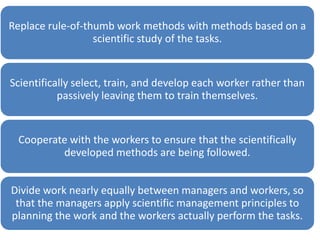
Replace rule-of-thumb work methods with methods based on a
scientific study of the tasks.

Scientifically select, train, and develop each worker rather than
passively leaving them to train themselves.

Cooperate with the workers to ensure that the scientifically
developed methods are being followed.
Divide work nearly equally between managers and workers, so
that the managers apply scientific management principles to
planning the work and the workers actually perform the tasks.
Basic idea of
Scientific Management
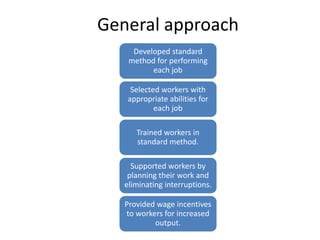
General approach
Developed standard
method for performing
each job
Selected workers with
appropriate abilities for
each job
Trained workers in
standard method.

Supported workers by
planning their work and
eliminating interruptions.
Provided wage incentives
to workers for increased
output.
Contributions
Demonstrated the importance
of compensation for
performance

Initiated the careful study of
tasks and jobs

Demonstrated the importance
of personal selection and
training
Criticism
Did not appreciate the social context
of work and higher needs of workers.
Did not acknowledge variance among
individuals.
Tended to regard workers as
uninformed and ignored their ideas
for suggestions
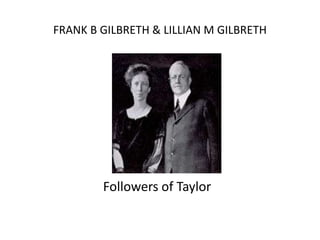
FRANK B GILBRETH & LILLIAN M GILBRETH

Followers of Taylor
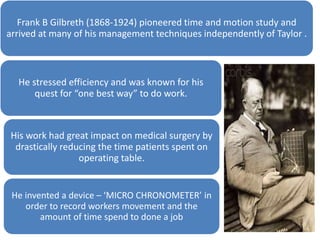
Frank B Gilbreth (1868-1924) pioneered time and motion study and
arrived at many of his management techniques independently of Taylor .

He stressed efficiency and was known for his
quest for “one best way” to do work.

His work had great impact on medical surgery by
drastically reducing the time patients spent on
operating table.

He invented a device – ‘MICRO CHRONOMETER’ in
order to record workers movement and the
amount of time spend to done a job
Experiments
Gilbreth performed experiments that
focused on specific motions, such as
bricklaying experiments that resulted in a
dramatic decrease in the number of
motions required to lay bricks. The
husband and wife Gilbreth team used
motion picture technology to study the
motions of the workers in some of their
experiments.
Lady Gilbreth was more interested in human
aspect of work

On the basis of their study and experiments
frank give shape to 17 principles known as
“Therblig”
Implementation
Frederick Taylor’s scientific management
techniques were expanded by automaker Henry
Ford

Replaced workers with machines for heavy lifting
and moving
Applied to total car assembly, Improving
efficiency and reducing worker-hours required to
produce a model-t ford to less than two
Drawbacks of Scientific Management
While scientific management principles improved
productivity and had a substantial impact on industry, they
also increased the monotony of work
While in many cases the new ways of working were
accepted by the workers, in some cases they were not.

The use of stopwatches often was a protested issue and led
to a strike at one factory where "Taylorism" was being
tested.
Complaints that Taylorism was dehumanizing led to an
investigation by the United States Congress.
Despite its controversy, scientific
management changed the way that
work was done, and forms of it continue
to be used today.
General
Management Theory
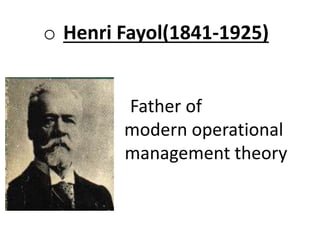
o Henri Fayol(1841-1925)
Father of
modern operational
management theory
Fayol:
-French mining engineer and a management
theorist.

-Started as an engineer at a mining company and
became Director in 1888.

- Viewed management as a profession that can be
trained and developed.
-First one to analyze the functions of management.
Contd.
-Made three major contributions to the

theory of Management:
(A)A clear distinction b/n technical &
managerial skills.
(B)Identified functions constituting the
management process.
(C)Developed principles of management.
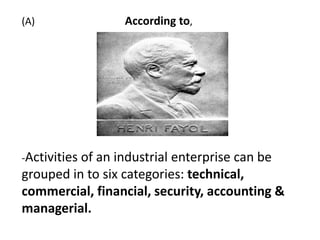
(A)

According to,

-Activities of an industrial

enterprise can be
grouped in to six categories: technical,
commercial, financial, security, accounting &
managerial.
(1)Technical Processing production &
operation
(2)Commercial Buying, selling &
exchange
(3)Financial Optimum use of capital
(4)Security Protection of asset and
resources
(5)Accounting Ascertaining the
financial position
(6)Managerial Optimum use of
resources for optimum result
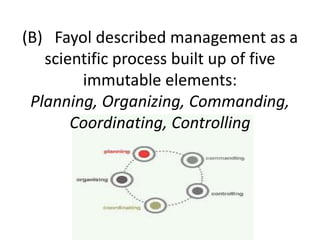
(B) Fayol described management as a
scientific process built up of five
immutable elements:
Planning, Organizing, Commanding,
Coordinating, Controlling
Functions of Management
1. Planning –process of activities required
to meet a goal.
2. Organizing – making orderly determination &
arrangement of a task.
3. Commanding(Directing) – involves guiding,
supervising, motivating & leading people for
attainment of the time-oriented tasks.
Contd.
4. Coordinating- bringing together the elements

5. Controlling- having control over all of the aspects
that contribute to meeting the goal.
(C)

Fayol’s Principles

• Henri Fayol, developed a set of 14 principles:
1. Division of Labour: allows for job specialization.
• Fayol noted firms can have too much specialization
leading to poor quality and worker involvement.
2.. Authority and Responsibility: Fayol included both
formal and informal authority resulting from special
expertise.
3. Discipline: obedient, applied, respectful employees
needed
4. Line of Authority: a clear chain from top to bottom of
the firm[ ‘Gang Plank’]
5. Centralization: the degree to which authority rests at
the very top.
Fayol’s Principles
6.

Unity of Direction: One plan of action to
guide the organization.

7. Unity of Command: Employees should have
only one boss.

8. Order: Each employee is put where they
have the most value.
9. Initiative: Encourage innovation.

10. Equity: Treat all employees fairly in justice
and respect.
Fayol’s Principles
11. Remuneration of Personnel: The payment

system contributes to success.
12. Stability of Tenure: Long-term employment
is important.
13. General interest over individual interest:
The organization takes precedence over the
individual.
14. Esprit de corps: ‘Union is strength’- refers
to harmony & mutual understanding among
the members of an organization.
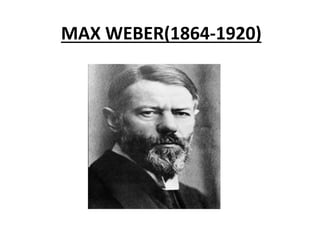
MAX WEBER(1864-1920)
• German theorist and sociologist.
• Follower of General Administrative Theory
proposed by Henry Fayol.
• Introduced most of the concepts on
Bureaucratic Organizations.
Birth of Bureaucracy
• During 1800’s, European Org. were managed on a
personal, family-like basis.
• Employees loyal towards a single individual.
• Resources used to realize individual desires.
• Weber envisioned Org. would be managed on an
impersonal, rational basis. This form of Org. is
known as Bureaucracy.
Characteristics
• Org. based on rational authority would be
more efficient and adaptable to changes.
• Employee selection and advancement is based
on competence and technical qualification.
• Org. relies on rules and regulations which are
impersonal and applied uniformly to all
employees.
Cont…
• Division of labour.
• Positions in an Org. are organised in a
hierarchy.
• Managers depends not on personality for
successfully giving orders but on legal power
invested in managerial position.
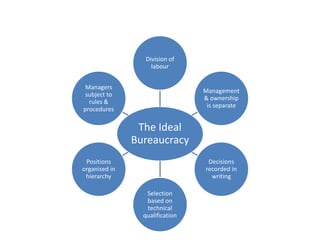
Division of
labour
Managers
subject to
rules &
procedures

Management
& ownership
is separate

The Ideal
Bureaucracy
Positions
organised in
hierarchy

Decisions
recorded in
writing
Selection
based on
technical
qualification

Classical approach (2)

  • 1.
  • 2.
    DEFINITION OF CLASSICALAPPROACH “Classical approach of management professes the body of management thought based on the belief that employees have only economical and physical needs and that the social needs & need for job satisfaction either does not exist or are unimportant. Accordingly it advocates high specialization of labour,centralized decision making & profit maximization.”
  • 3.
    • Classical approachis the oldest formal school of thought which began around 1900 and continued into the 1920s. • Its mainly concerned with the increasing the efficiency of workers and organizations based on management practices, which were an outcome of careful observation. • Classical approach mainly looks for the universal principles of operation in the striving for economic efficiency. • Classical approach includes scientific, administrative & bureaucratic management.
  • 4.
    • SCIENTIFIC MANAGEMENTfocuses on the “one best way” to do a job. • ADMINISTRATIVE MANAGEMENT focuses on the manager & basic managerial functions. • BUREAUCRACTIC MANAGEMENT focuses on the guidelines for structuring with formaliazation of rules,procedures and a clear division of labour.
  • 5.
    MAJOR CONTRIBUTORS • FREDERICKWINSLOW TAYLOR (1856-1915) • FRANK GILBERTH (18681924) & LILLIAN GILBERTH(1878-1972)
  • 6.
    • HENRI FAYOL (1841-1925) •MAX WEBER (1864-1920)
  • 7.
    CLASSICAL APPROACH • SCIENTIFICMANAGEMENT THEORY • GENERAL ADMINSTRATIVE MANAGEMENT THEORY • • FREDERICK W.TAYLOR (1856-1915) - FATHER OF SCIENTIFIC MANAGEMENT • ANALYSED MANAGEMENT SCIENTIFICALLY TO FIND OUT THE MOST EFFICTIVE WAY TO DO A JOB - “ONE BEST WAY” TO DO THE JOB. HENRI FAYOL (1841- 1925) - FATHER OF MODERN MANAGEMENT • ANALYSED MANAGEMENT AS A UNIVERSAL PROCESS OF PLANNING,ORGANIZING, COMMANDING,COORDINATING& CONTROLLING. ALSO INTRODUCED FOURTEEN PRINCIPLES OF MANAGEMENT.
  • 8.
    THEORIES • TAYLOR’S THEORYOF SCIENTIFIC MANAGEMENT • FAYOL’S ADMINISTRATIVE THEORY • WEBER’S THEORY OF BUREAUCRACY
  • 9.
  • 10.
    FEDRICK WINSLOW TAYLOR(1856-1915) Fatherof Scientific Management “one best way for doing the job”
  • 11.
    Definition Scientific management wasa theory of management that analyzed and workflows, with the objective of improving labor productivity management of a business, industry, or economy, according to principles of efficiency derived from experiments in methods of work and production, especially from time-and-motion studies- (mass noun)
  • 12.
    In 1898, Taylorjoined Bethlehem Steel. Taylor was a mechanical engineer who sought to improve industrial efficiency. Working in the steel industry, Taylor had observed the phenomenon of workers' purposely operating well below their capacity, that is, soldiering. He attributed soldiering to three causes:
  • 13.
    The almost universallyheld belief among workers that if they became more productive, fewer of them would be needed and jobs would be eliminated. Employees take great care never to work at a good pace for fear that this faster pace would become the new standard. If employees are paid by the quantity they produce, they fear that management will decrease their per-unit pay if the quantity increases. Workers waste much of their effort by relying on rule-ofthumb methods rather than on optimal work methods that can be determined by scientific study of the task.
  • 14.
    Taylor insisted thatmanagement itself would have to change and further, that the manner of change could be determined only by scientific study. Hence, term ‘Scientific Management’ evolved. Taylor suggested that decisions based on rules of thumb and tradition be replaced with precise procedures developed after careful study of individual situations
  • 15.
    Time Studies Taylor arguedthat even the most basic, mindless tasks could be planned in a way that dramatically would increase productivity, and that scientific management of the work was more effective than the "initiative and incentive" method of motivating workers. To scientifically determine the optimal way to perform a job, Taylor performed experiments that he called time studies, (also known as time and motion studies). He use stop watches to measure the workers efficiency
  • 16.
    The main thingsTaylor noticed for inefficiency The lack of standard tools or techniques There is no match between skill and job No motivation from the management
  • 17.
  • 18.
    Replace rule-of-thumb workmethods with methods based on a scientific study of the tasks. Scientifically select, train, and develop each worker rather than passively leaving them to train themselves. Cooperate with the workers to ensure that the scientifically developed methods are being followed. Divide work nearly equally between managers and workers, so that the managers apply scientific management principles to planning the work and the workers actually perform the tasks.
  • 19.
  • 20.
    General approach Developed standard methodfor performing each job Selected workers with appropriate abilities for each job Trained workers in standard method. Supported workers by planning their work and eliminating interruptions. Provided wage incentives to workers for increased output.
  • 21.
    Contributions Demonstrated the importance ofcompensation for performance Initiated the careful study of tasks and jobs Demonstrated the importance of personal selection and training
  • 22.
    Criticism Did not appreciatethe social context of work and higher needs of workers. Did not acknowledge variance among individuals. Tended to regard workers as uninformed and ignored their ideas for suggestions
  • 23.
    FRANK B GILBRETH& LILLIAN M GILBRETH Followers of Taylor
  • 24.
    Frank B Gilbreth(1868-1924) pioneered time and motion study and arrived at many of his management techniques independently of Taylor . He stressed efficiency and was known for his quest for “one best way” to do work. His work had great impact on medical surgery by drastically reducing the time patients spent on operating table. He invented a device – ‘MICRO CHRONOMETER’ in order to record workers movement and the amount of time spend to done a job
  • 25.
    Experiments Gilbreth performed experimentsthat focused on specific motions, such as bricklaying experiments that resulted in a dramatic decrease in the number of motions required to lay bricks. The husband and wife Gilbreth team used motion picture technology to study the motions of the workers in some of their experiments.
  • 26.
    Lady Gilbreth wasmore interested in human aspect of work On the basis of their study and experiments frank give shape to 17 principles known as “Therblig”
  • 27.
    Implementation Frederick Taylor’s scientificmanagement techniques were expanded by automaker Henry Ford Replaced workers with machines for heavy lifting and moving Applied to total car assembly, Improving efficiency and reducing worker-hours required to produce a model-t ford to less than two
  • 28.
    Drawbacks of ScientificManagement While scientific management principles improved productivity and had a substantial impact on industry, they also increased the monotony of work While in many cases the new ways of working were accepted by the workers, in some cases they were not. The use of stopwatches often was a protested issue and led to a strike at one factory where "Taylorism" was being tested. Complaints that Taylorism was dehumanizing led to an investigation by the United States Congress.
  • 29.
    Despite its controversy,scientific management changed the way that work was done, and forms of it continue to be used today.
  • 30.
  • 31.
    o Henri Fayol(1841-1925) Fatherof modern operational management theory
  • 32.
    Fayol: -French mining engineerand a management theorist. -Started as an engineer at a mining company and became Director in 1888. - Viewed management as a profession that can be trained and developed. -First one to analyze the functions of management.
  • 33.
    Contd. -Made three majorcontributions to the theory of Management: (A)A clear distinction b/n technical & managerial skills. (B)Identified functions constituting the management process. (C)Developed principles of management.
  • 34.
    (A) According to, -Activities ofan industrial enterprise can be grouped in to six categories: technical, commercial, financial, security, accounting & managerial.
  • 35.
    (1)Technical Processing production& operation (2)Commercial Buying, selling & exchange (3)Financial Optimum use of capital (4)Security Protection of asset and resources (5)Accounting Ascertaining the financial position (6)Managerial Optimum use of resources for optimum result
  • 36.
    (B) Fayol describedmanagement as a scientific process built up of five immutable elements: Planning, Organizing, Commanding, Coordinating, Controlling
  • 37.
    Functions of Management 1.Planning –process of activities required to meet a goal. 2. Organizing – making orderly determination & arrangement of a task. 3. Commanding(Directing) – involves guiding, supervising, motivating & leading people for attainment of the time-oriented tasks.
  • 38.
    Contd. 4. Coordinating- bringingtogether the elements 5. Controlling- having control over all of the aspects that contribute to meeting the goal.
  • 39.
    (C) Fayol’s Principles • HenriFayol, developed a set of 14 principles: 1. Division of Labour: allows for job specialization. • Fayol noted firms can have too much specialization leading to poor quality and worker involvement. 2.. Authority and Responsibility: Fayol included both formal and informal authority resulting from special expertise. 3. Discipline: obedient, applied, respectful employees needed 4. Line of Authority: a clear chain from top to bottom of the firm[ ‘Gang Plank’] 5. Centralization: the degree to which authority rests at the very top.
  • 40.
    Fayol’s Principles 6. Unity ofDirection: One plan of action to guide the organization. 7. Unity of Command: Employees should have only one boss. 8. Order: Each employee is put where they have the most value. 9. Initiative: Encourage innovation. 10. Equity: Treat all employees fairly in justice and respect.
  • 41.
    Fayol’s Principles 11. Remunerationof Personnel: The payment system contributes to success. 12. Stability of Tenure: Long-term employment is important. 13. General interest over individual interest: The organization takes precedence over the individual. 14. Esprit de corps: ‘Union is strength’- refers to harmony & mutual understanding among the members of an organization.
  • 42.
  • 43.
    • German theoristand sociologist. • Follower of General Administrative Theory proposed by Henry Fayol. • Introduced most of the concepts on Bureaucratic Organizations.
  • 44.
    Birth of Bureaucracy •During 1800’s, European Org. were managed on a personal, family-like basis. • Employees loyal towards a single individual. • Resources used to realize individual desires. • Weber envisioned Org. would be managed on an impersonal, rational basis. This form of Org. is known as Bureaucracy.
  • 45.
    Characteristics • Org. basedon rational authority would be more efficient and adaptable to changes. • Employee selection and advancement is based on competence and technical qualification. • Org. relies on rules and regulations which are impersonal and applied uniformly to all employees.
  • 46.
    Cont… • Division oflabour. • Positions in an Org. are organised in a hierarchy. • Managers depends not on personality for successfully giving orders but on legal power invested in managerial position.
  • 47.
    Division of labour Managers subject to rules& procedures Management & ownership is separate The Ideal Bureaucracy Positions organised in hierarchy Decisions recorded in writing Selection based on technical qualification