Heat Transfer (2151909)
Mechanical Department
Sem.: 5th
D (D2)
Fundamentals
Guided By: Jyotin Kateshia
Prepared By: Dubey Manish S. (160123119009)
Content
1.Modes of Heat Transfer
2.Effect of Temperature on Thermal
Conductivity of different solids,Liquids and gases
3.Derivation of genralized equation in Cartisan
Modes of Heat Transfer
• The Literature on heat transfer generally Recognizes three distinct
modes of heat transfer;
1) Conduction
2) Convection
3) Radiation
• Heat always flow from higher temperature to lower temperature.
Conduction
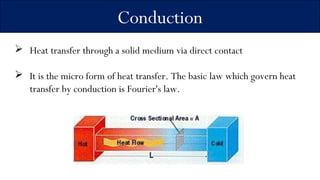
 Heat transfer through a solid medium via direct contact
 It is the micro form of heat transfer. The basic law which govern heat
transfer by conduction is Fourier's law.
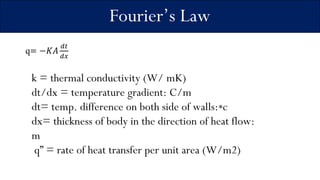
Fourier’s Law
k = thermal conductivity (W/ mK)
dt/dx = temperature gradient: C/m
dt= temp. difference on both side of walls:*c
dx= thickness of body in the direction of heat flow:
m
q” = rate of heat transfer per unit area (W/m2)
Energy transfer by fluid motion
Two kinds of convection
 Forced convection: Fluid is forced
 Natural or free convection: fluid is induced by temperature
difference
Convection
Radiation
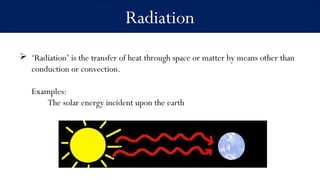
 ‘Radiation’ is the transfer of heat through space or matter by means other than
conduction or convection.
Examples:
The solar energy incident upon the earth
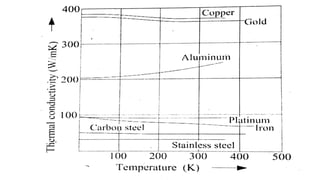
Effect of Temperature on Thermal Conductivity of Different
Solids
• Thermals conductivity of pure metals is due to migration
of three electrons (Ke) and lattice vibrations (Kl).
• K = Ke + Kl
• In pure metals, heat is transferred due to movement of
free electron in clouds and also due to vibrational energy
in lattice structure.
• Thermal conductivity of pure metal is decreases with the
increasing in temperature.
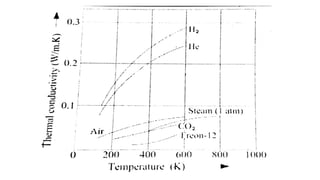
Effect of Temperature on Thermal Conductivity of Gases
• Thermal conductivity of gases is smaller then that of solids
because there intermolecular spacing is much larger.
• The thermal conductivity of all the gases increases with
increases with increases in temperature.
• This is because at high temperature collision among gas
particles increases and heat transfer increases.
• K = 0.006 to 0.05 W/mK
Effect of Temperature on Thermal Conductivity of
Liquids
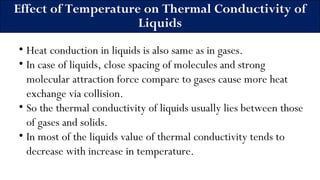
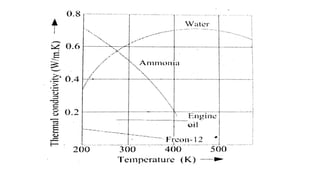
• Heat conduction in liquids is also same as in gases.
• In case of liquids, close spacing of molecules and strong
molecular attraction force compare to gases cause more heat
exchange via collision.
• So the thermal conductivity of liquids usually lies between those
of gases and solids.
• In most of the liquids value of thermal conductivity tends to
decrease with increase in temperature.
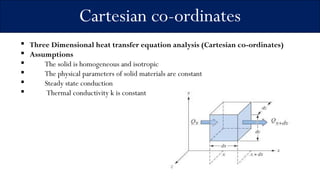
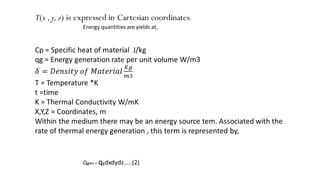
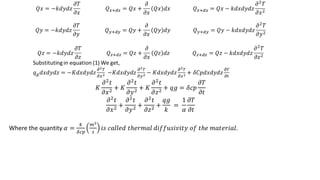
Cartesian co-ordinates
 Three Dimensional heat transfer equation analysis (Cartesian co-ordinates)
 Assumptions
 The solid is homogeneous and isotropic
 The physical parameters of solid materials are constant
 Steady state conduction
 Thermal conductivity k is constant
Heat transfer fundamentals

Heat transfer fundamentals

  • 1.
    Heat Transfer (2151909) MechanicalDepartment Sem.: 5th D (D2) Fundamentals Guided By: Jyotin Kateshia Prepared By: Dubey Manish S. (160123119009)
  • 2.
    Content 1.Modes of HeatTransfer 2.Effect of Temperature on Thermal Conductivity of different solids,Liquids and gases 3.Derivation of genralized equation in Cartisan
  • 3.
    Modes of HeatTransfer • The Literature on heat transfer generally Recognizes three distinct modes of heat transfer; 1) Conduction 2) Convection 3) Radiation • Heat always flow from higher temperature to lower temperature.
  • 4.
    Conduction  Heat transferthrough a solid medium via direct contact  It is the micro form of heat transfer. The basic law which govern heat transfer by conduction is Fourier's law.
  • 5.
    Fourier’s Law k =thermal conductivity (W/ mK) dt/dx = temperature gradient: C/m dt= temp. difference on both side of walls:*c dx= thickness of body in the direction of heat flow: m q” = rate of heat transfer per unit area (W/m2)
  • 6.
    Energy transfer byfluid motion Two kinds of convection  Forced convection: Fluid is forced  Natural or free convection: fluid is induced by temperature difference Convection
  • 7.
    Radiation  ‘Radiation’ isthe transfer of heat through space or matter by means other than conduction or convection. Examples: The solar energy incident upon the earth
  • 8.
    Effect of Temperatureon Thermal Conductivity of Different Solids • Thermals conductivity of pure metals is due to migration of three electrons (Ke) and lattice vibrations (Kl). • K = Ke + Kl • In pure metals, heat is transferred due to movement of free electron in clouds and also due to vibrational energy in lattice structure. • Thermal conductivity of pure metal is decreases with the increasing in temperature.
  • 10.
    Effect of Temperatureon Thermal Conductivity of Gases • Thermal conductivity of gases is smaller then that of solids because there intermolecular spacing is much larger. • The thermal conductivity of all the gases increases with increases with increases in temperature. • This is because at high temperature collision among gas particles increases and heat transfer increases. • K = 0.006 to 0.05 W/mK
  • 12.
    Effect of Temperatureon Thermal Conductivity of Liquids • Heat conduction in liquids is also same as in gases. • In case of liquids, close spacing of molecules and strong molecular attraction force compare to gases cause more heat exchange via collision. • So the thermal conductivity of liquids usually lies between those of gases and solids. • In most of the liquids value of thermal conductivity tends to decrease with increase in temperature.
  • 14.
    Cartesian co-ordinates  ThreeDimensional heat transfer equation analysis (Cartesian co-ordinates)  Assumptions  The solid is homogeneous and isotropic  The physical parameters of solid materials are constant  Steady state conduction  Thermal conductivity k is constant