Koya University
Faculty of Engineering
Chemical Engineering Department
3rd Stage (2021-2022)
Heat Transfer Laboratory
Lab Report
Number of Experiment: 3
Experiment Name:
Linear Heat Conduction
Experiment Date: 06/04/2022
Submission Date: 13/04/2022
Instructor: Mr. Soran Dlawar Jalal
Group: A2
Prepared by:
Safeen Yaseen Jafar
Ramazan Shkur Kakl
Rokan Mohammad Omer
Ibrahim Ali
Ahmed Mamand Aziz
Rivan Dler Ali
Rekan Kazm
Rekar Hamza
Anas Yousif
Table of Content
1. Purpose of the Experiment.....................................................................................................................1
2. Theory/Introduction ...............................................................................................................................2
3. Tools and Apparatus...............................................................................................................................3
4. Procedure.................................................................................................................................................4
5. Table of Reading (Data Sheet)...............................................................................................................5
6. Calculation and Results..........................................................................................................................7
7. References................................................................................................................................................9
1
1. Purpose of the Experiment
1) To calculate the thermal conductivity (K).
2) To study the effect of distance (X) on temperature (T).
2
2. Theory/Introduction
Heat transfer occurs in three main ways: conduction, convection, and
radiation. More than one of these may take place at the same time. Heat is
transferred from warmer objects to colder ones, and not vice versa. It is of great
interest to physical scientists and engineers, for it has applications in varied fields
such as construction and medicine. Engineers and architects study it to design
heating and cooling systems, and physicians use thermometers to measure the
temperature of their patients, for example. [1]
Figure (1) – There are many example for heat transfer
Fourier’s theory of heat conduction: has now almost two centuries,
however it remains a fascinating topic that leads to numerous experiences in
experimental physics. [2]
dQ/dt = -k*A*(dT/dx)
Where A is the surface area and k is the thermal conductivity of the material.
What is the effect of average temperature on the values of thermal
conductivity for brass?
The heat flow through a material cannot always be evaluated at steady state
for instance through the wall of a furnace that is being heated or cooled. calculate
the heat flow under these conditions it is necessary to find the temperature
distribution through the solid and how distribution Vanes With time, Using the
equipment set-up described above, it is a simple matter of monitoring the
temperature profile variation during either a heating or cooling cycle thus facilitating
the Study Of unsteady State conduction. [3]
3
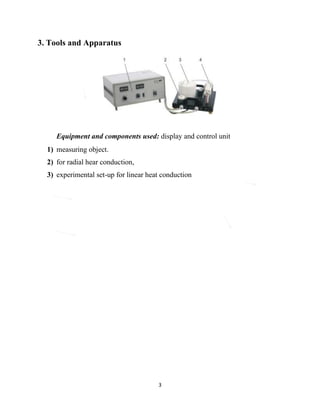
3. Tools and Apparatus
Equipment and components used: display and control unit
1) measuring object.
2) for radial hear conduction,
3) experimental set-up for linear heat conduction
TEMP 4, 5 and 6 Display respectively
4
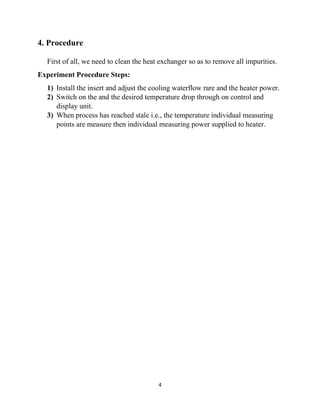
4. Procedure
First of all, we need to clean the heat exchanger so as to remove all impurities.
Experiment Procedure Steps:
1) Install the insert and adjust the cooling waterflow rare and the heater power.
2) Switch on the and the desired temperature drop through on control and
display unit.
3) When process has reached stale i.e., the temperature individual measuring
points are measure then individual measuring power supplied to heater.
5
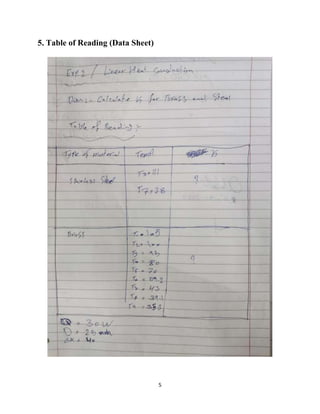
5. Table of Reading (Data Sheet)
6
7
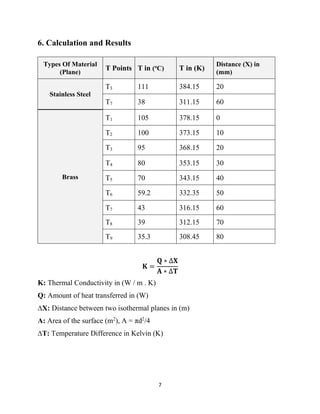
6. Calculation and Results
Types Of Material
(Plane)
T Points T in (o
C) T in (K)
Distance (X) in
(mm)
Stainless Steel
T3 111 384.15 20
T7 38 311.15 60
Brass
T1 105 378.15 0
T2 100 373.15 10
T3 95 368.15 20
T4 80 353.15 30
T5 70 343.15 40
T6 59.2 332.35 50
T7 43 316.15 60
T8 39 312.15 70
T9 35.3 308.45 80
𝐊 =
𝐐 ∗ ∆𝐗
𝐀 ∗ ∆𝐓
K: Thermal Conductivity in (W / m . K)
Q: Amount of heat transferred in (W)
∆X: Distance between two isothermal planes in (m)
A: Area of the surface (m2
), A = πd2
/4
∆T: Temperature Difference in Kelvin (K)
8
Calculate thermal conductivity (K) For Stainless Steel:
Q = 30 W, D = 25 mm = 0.025 m, dx = 40 mm = 0.040 m, K = ?,
A = ? → A = πd2
/4 = π(0.0252
/4) = 0.0004908 m2
dT = T3 – T7 = (384.15 – 311.15) o
C = 73 o
C
K =
Q ∗ ∆X
A ∗ ∆T
=
Q ∗ ∆X
𝜋𝑑2
4
∗ ∆T
K =
30 W ∗ 0.040 m
0.0004908 m2 ∗ 73 K
K = 33.49 W / m K
Calculate thermal conductivity (K) For Brass:
dT = T3 – T7 = (368.15 – 316.15) o
C = 52 K
K =
30 W ∗ 0.040 m
0.0004908 m2 ∗ 52 K
K = 47.02 W / m K
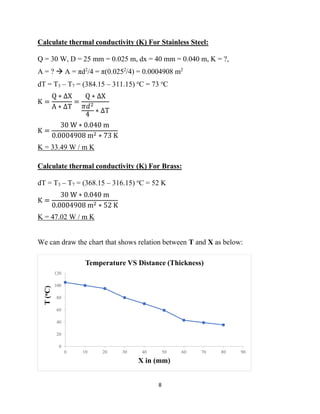
We can draw the chart that shows relation between T and X as below:
0
20
40
60
80
100
120
0 10 20 30 40 50 60 70 80 90
T
(
o
C)
X in (mm)
Temperature VS Distance (Thickness)
9
7. References
1. www.brighthubengineering.com. (2009). What is Thermal Conduction?
Introduction to Heat Transfer: Part One. [online] Available at:
https://www.brighthubengineering.com/hvac/47238-what-is-thermal-
conduction/. [Accessed 12 Apr. 2022].
2. PhysicsOpenLab. (n.d.). Temperature Logging & Heat Conduction. [online]
Available at: https://physicsopenlab.org/2020/04/14/temperature-logging-
heat-conduction/ [Accessed 12 Apr. 2022].
3. Hahn, D.W. (2012). Heat conduction. Hoboken, N.J.: Wiley. [eBook]
Available at:
https://books.google.iq/books?id=C9qwb9Vymy8C&dq=heat+conduction+b
ook&source=gbs_navlinks_s [Accessed 12 Apr. 2022].

HTR Lab - Exp-03 - G-A2.pdf

  • 1.
    Koya University Faculty ofEngineering Chemical Engineering Department 3rd Stage (2021-2022) Heat Transfer Laboratory Lab Report Number of Experiment: 3 Experiment Name: Linear Heat Conduction Experiment Date: 06/04/2022 Submission Date: 13/04/2022 Instructor: Mr. Soran Dlawar Jalal Group: A2 Prepared by: Safeen Yaseen Jafar Ramazan Shkur Kakl Rokan Mohammad Omer Ibrahim Ali Ahmed Mamand Aziz Rivan Dler Ali Rekan Kazm Rekar Hamza Anas Yousif
  • 2.
    Table of Content 1.Purpose of the Experiment.....................................................................................................................1 2. Theory/Introduction ...............................................................................................................................2 3. Tools and Apparatus...............................................................................................................................3 4. Procedure.................................................................................................................................................4 5. Table of Reading (Data Sheet)...............................................................................................................5 6. Calculation and Results..........................................................................................................................7 7. References................................................................................................................................................9
  • 3.
    1 1. Purpose ofthe Experiment 1) To calculate the thermal conductivity (K). 2) To study the effect of distance (X) on temperature (T).
  • 4.
    2 2. Theory/Introduction Heat transferoccurs in three main ways: conduction, convection, and radiation. More than one of these may take place at the same time. Heat is transferred from warmer objects to colder ones, and not vice versa. It is of great interest to physical scientists and engineers, for it has applications in varied fields such as construction and medicine. Engineers and architects study it to design heating and cooling systems, and physicians use thermometers to measure the temperature of their patients, for example. [1] Figure (1) – There are many example for heat transfer Fourier’s theory of heat conduction: has now almost two centuries, however it remains a fascinating topic that leads to numerous experiences in experimental physics. [2] dQ/dt = -k*A*(dT/dx) Where A is the surface area and k is the thermal conductivity of the material. What is the effect of average temperature on the values of thermal conductivity for brass? The heat flow through a material cannot always be evaluated at steady state for instance through the wall of a furnace that is being heated or cooled. calculate the heat flow under these conditions it is necessary to find the temperature distribution through the solid and how distribution Vanes With time, Using the equipment set-up described above, it is a simple matter of monitoring the temperature profile variation during either a heating or cooling cycle thus facilitating the Study Of unsteady State conduction. [3]
  • 5.
    3 3. Tools andApparatus Equipment and components used: display and control unit 1) measuring object. 2) for radial hear conduction, 3) experimental set-up for linear heat conduction TEMP 4, 5 and 6 Display respectively
  • 6.
    4 4. Procedure First ofall, we need to clean the heat exchanger so as to remove all impurities. Experiment Procedure Steps: 1) Install the insert and adjust the cooling waterflow rare and the heater power. 2) Switch on the and the desired temperature drop through on control and display unit. 3) When process has reached stale i.e., the temperature individual measuring points are measure then individual measuring power supplied to heater.
  • 7.
    5 5. Table ofReading (Data Sheet)
  • 8.
  • 9.
    7 6. Calculation andResults Types Of Material (Plane) T Points T in (o C) T in (K) Distance (X) in (mm) Stainless Steel T3 111 384.15 20 T7 38 311.15 60 Brass T1 105 378.15 0 T2 100 373.15 10 T3 95 368.15 20 T4 80 353.15 30 T5 70 343.15 40 T6 59.2 332.35 50 T7 43 316.15 60 T8 39 312.15 70 T9 35.3 308.45 80 𝐊 = 𝐐 ∗ ∆𝐗 𝐀 ∗ ∆𝐓 K: Thermal Conductivity in (W / m . K) Q: Amount of heat transferred in (W) ∆X: Distance between two isothermal planes in (m) A: Area of the surface (m2 ), A = πd2 /4 ∆T: Temperature Difference in Kelvin (K)
  • 10.
    8 Calculate thermal conductivity(K) For Stainless Steel: Q = 30 W, D = 25 mm = 0.025 m, dx = 40 mm = 0.040 m, K = ?, A = ? → A = πd2 /4 = π(0.0252 /4) = 0.0004908 m2 dT = T3 – T7 = (384.15 – 311.15) o C = 73 o C K = Q ∗ ∆X A ∗ ∆T = Q ∗ ∆X 𝜋𝑑2 4 ∗ ∆T K = 30 W ∗ 0.040 m 0.0004908 m2 ∗ 73 K K = 33.49 W / m K Calculate thermal conductivity (K) For Brass: dT = T3 – T7 = (368.15 – 316.15) o C = 52 K K = 30 W ∗ 0.040 m 0.0004908 m2 ∗ 52 K K = 47.02 W / m K We can draw the chart that shows relation between T and X as below: 0 20 40 60 80 100 120 0 10 20 30 40 50 60 70 80 90 T ( o C) X in (mm) Temperature VS Distance (Thickness)
  • 11.
    9 7. References 1. www.brighthubengineering.com.(2009). What is Thermal Conduction? Introduction to Heat Transfer: Part One. [online] Available at: https://www.brighthubengineering.com/hvac/47238-what-is-thermal- conduction/. [Accessed 12 Apr. 2022]. 2. PhysicsOpenLab. (n.d.). Temperature Logging & Heat Conduction. [online] Available at: https://physicsopenlab.org/2020/04/14/temperature-logging- heat-conduction/ [Accessed 12 Apr. 2022]. 3. Hahn, D.W. (2012). Heat conduction. Hoboken, N.J.: Wiley. [eBook] Available at: https://books.google.iq/books?id=C9qwb9Vymy8C&dq=heat+conduction+b ook&source=gbs_navlinks_s [Accessed 12 Apr. 2022].