HEAT TRANSFER
NAME: KEMKAR JAIMIN AJITKUMAR
EN. NO.: 160123119014
SEMESTER AND CLASS: 5TH D
BATCH: D2
SUBJECT: HEAT TRANSFER (2151909)
SUBJECT GUIDE: PROF. J. A. KATESHIA
CONTENT LAYOUT
▪ Wein’s displacement
▪ Kirchhoff’s law
▪ solid angle
▪ Lambert’s cosine law
▪ Radiation heat exchange between black bodies
▪ shape factor
WIEN’S DISPLACEMENT LAW
▪ Wien’s established a relationship between the wavelength at which the maximum value of
monochromatic emissive power occurs and absolute temperature of black body
▪ Wien’s displacement law states that the product of T and 𝜆 𝑚𝑎𝑥 is constant i.e. 𝜆 𝑚𝑎𝑥 &
T=constant
▪ The relationship between the true temperature of a blackbody (T) in degree kelvin and its
peak spectral existence or dominant wavelength (𝜆 𝑚𝑎𝑥) is described by the
𝜆 𝑚𝑎𝑥 =
𝑘
𝑇
=
2898𝜇𝑚(°𝐾)
𝑇
▪ Where K is constant equaling 2898 𝜇𝑚°𝐾
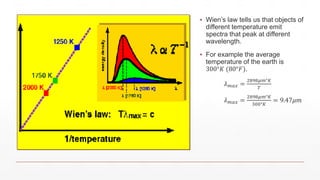
▪ Wien’s law tells us that objects of
different temperature emit
spectra that peak at different
wavelength.
▪ For example the average
temperature of the earth is
300°𝐾 (80°𝐹).
𝜆 𝑚𝑎𝑥 =
2898𝜇𝑚°𝐾
𝑇
𝜆 𝑚𝑎𝑥 =
2898𝜇𝑚°𝐾
300°𝐾
= 9.47𝜇𝑚
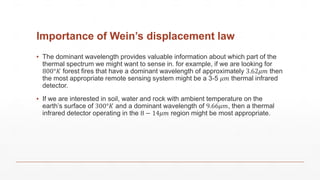
Importance of Wein’s displacement law
▪ The dominant wavelength provides valuable information about which part of the
thermal spectrum we might want to sense in. for example, if we are looking for
800°𝐾 forest fires that have a dominant wavelength of approximately 3.62𝜇𝑚 then
the most appropriate remote sensing system might be a 3-5 𝜇𝑚 thermal infrared
detector.
▪ If we are interested in soil, water and rock with ambient temperature on the
earth’s surface of 300°𝐾 and a dominant wavelength of 9.66𝜇𝑚, then a thermal
infrared detector operating in the 8 − 14𝜇𝑚 region might be most appropriate.
KIRCHHOFF’S LAW
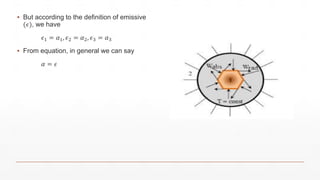
▪ At thermal equilibrium, the emissivity of a body (or surface) equals its absorptivity.
▪ This law states that the ratio of total emissive power to absorptivity is constant for all
substances which are in thermal equilibrium with the surroundings. (books India)
▪ This can be written in mathematical form for four bodies as follow:
𝐸1
𝛼1
=
𝐸2
𝛼2
=
𝐸3
𝛼3
=
𝐸4
𝛼4
▪ Assume out of any four body, any one body, say fourth one is a black body. Then
𝐸1
𝛼1
=
𝐸2
𝛼2
=
𝐸3
𝛼3
=
𝐸 𝑏
𝛼 𝑏
[𝛼 𝑏 = 1]
𝐸1
𝐸 𝑏
= 𝛼1,
𝐸2
𝐸 𝑏
= 𝛼2,
𝐸3
𝐸 𝑏
= 𝛼3
▪ But according to the definition of emissive
(𝜖), we have
𝜖1 = 𝛼1, 𝜖2 = 𝛼2, 𝜖3 = 𝛼3
▪ From equation, in general we can say
𝛼 = 𝜖
SOLID ANGLE
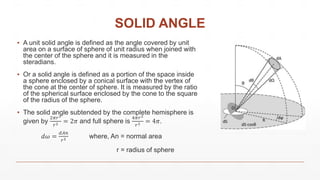
▪ A unit solid angle is defined as the angle covered by unit
area on a surface of sphere of unit radius when joined with
the center of the sphere and it is measured in the
steradians.
▪ Or a solid angle is defined as a portion of the space inside
a sphere enclosed by a conical surface with the vertex of
the cone at the center of sphere. It is measured by the ratio
of the spherical surface enclosed by the cone to the square
of the radius of the sphere.
▪ The solid angle subtended by the complete hemisphere is
given by
2𝜋𝑟2
𝑟2 = 2𝜋 and full sphere is
4𝜋𝑟2
𝑟2 = 4𝜋.
𝑑𝜔 =
𝑑𝐴𝑛
𝑟2 where, An = normal area
r = radius of sphere
LAMBERT’S COSINE LAW
▪ Monochromic or spectral intensity of radiation is defined as the radiant energy emitted by a
black body at a temperature T, streaming through a unit area normal to the direction of
propagation per unit wavelength about a wavelength per unit solid angle about the
propagation of beam.
▪ it is denoted by 𝐼 𝑏𝜆 and can be expressed as:
𝐼 𝑏𝜆 =
𝑒𝑛𝑒𝑟𝑔𝑦 𝑒𝑚𝑖𝑡𝑡𝑒𝑑
(𝑝𝑟𝑜𝑗𝑒𝑐𝑡𝑒𝑑 𝑎𝑟𝑒𝑎)×(𝑤𝑎𝑣𝑒 𝑙𝑒𝑛𝑔𝑡ℎ)×(𝑠𝑜𝑙𝑖𝑑 𝑎𝑛𝑔𝑙𝑒)
𝑊
𝑚2∙𝜇𝑚∙𝑆𝑟
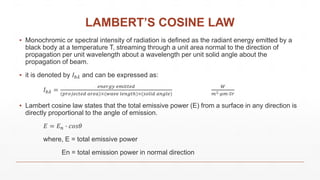
▪ Lambert cosine law states that the total emissive power (E) from a surface in any direction is
directly proportional to the angle of emission.
𝐸 = 𝐸 𝑛 ∙ 𝑐𝑜𝑠𝜃
where, E = total emissive power
En = total emission power in normal direction
RADIATION HEAT EXCHANGER BETWEEN TWO
BLACK BODIES
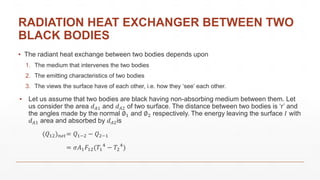
▪ The radiant heat exchange between two bodies depends upon
1. The medium that intervenes the two bodies
2. The emitting characteristics of two bodies
3. The views the surface have of each other, i.e. how they ‘see’ each other.
▪ Let us assume that two bodies are black having non-absorbing medium between them. Let
us consider the area 𝑑 𝐴1 and 𝑑 𝐴2 of two surface. The distance between two bodies is ‘r’ and
the angles made by the normal ∅1 and ∅2 respectively. The energy leaving the surface 𝐼 with
𝑑 𝐴1 area and absorbed by 𝑑 𝐴2is
(𝑄12) 𝑛𝑒𝑡= 𝑄1−2 − 𝑄2−1
= 𝜎𝐴1 𝐹12(𝑇1
4
− 𝑇2
4
)
SHAPE FACTOR
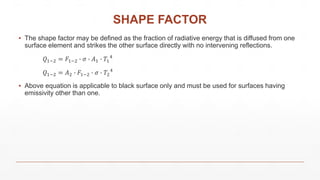
▪ The shape factor may be defined as the fraction of radiative energy that is diffused from one
surface element and strikes the other surface directly with no intervening reflections.
𝑄1−2 = 𝐹1−2 ∙ 𝜎 ∙ 𝐴1 ∙ 𝑇1
4
𝑄1−2 = 𝐴2 ∙ 𝐹1−2 ∙ 𝜎 ∙ 𝑇2
4
▪ Above equation is applicable to black surface only and must be used for surfaces having
emissivity other than one.
THANK YOU

Heat transfer

  • 1.
    HEAT TRANSFER NAME: KEMKARJAIMIN AJITKUMAR EN. NO.: 160123119014 SEMESTER AND CLASS: 5TH D BATCH: D2 SUBJECT: HEAT TRANSFER (2151909) SUBJECT GUIDE: PROF. J. A. KATESHIA
  • 2.
    CONTENT LAYOUT ▪ Wein’sdisplacement ▪ Kirchhoff’s law ▪ solid angle ▪ Lambert’s cosine law ▪ Radiation heat exchange between black bodies ▪ shape factor
  • 3.
    WIEN’S DISPLACEMENT LAW ▪Wien’s established a relationship between the wavelength at which the maximum value of monochromatic emissive power occurs and absolute temperature of black body ▪ Wien’s displacement law states that the product of T and 𝜆 𝑚𝑎𝑥 is constant i.e. 𝜆 𝑚𝑎𝑥 & T=constant ▪ The relationship between the true temperature of a blackbody (T) in degree kelvin and its peak spectral existence or dominant wavelength (𝜆 𝑚𝑎𝑥) is described by the 𝜆 𝑚𝑎𝑥 = 𝑘 𝑇 = 2898𝜇𝑚(°𝐾) 𝑇 ▪ Where K is constant equaling 2898 𝜇𝑚°𝐾
  • 4.
    ▪ Wien’s lawtells us that objects of different temperature emit spectra that peak at different wavelength. ▪ For example the average temperature of the earth is 300°𝐾 (80°𝐹). 𝜆 𝑚𝑎𝑥 = 2898𝜇𝑚°𝐾 𝑇 𝜆 𝑚𝑎𝑥 = 2898𝜇𝑚°𝐾 300°𝐾 = 9.47𝜇𝑚
  • 5.
    Importance of Wein’sdisplacement law ▪ The dominant wavelength provides valuable information about which part of the thermal spectrum we might want to sense in. for example, if we are looking for 800°𝐾 forest fires that have a dominant wavelength of approximately 3.62𝜇𝑚 then the most appropriate remote sensing system might be a 3-5 𝜇𝑚 thermal infrared detector. ▪ If we are interested in soil, water and rock with ambient temperature on the earth’s surface of 300°𝐾 and a dominant wavelength of 9.66𝜇𝑚, then a thermal infrared detector operating in the 8 − 14𝜇𝑚 region might be most appropriate.
  • 6.
    KIRCHHOFF’S LAW ▪ Atthermal equilibrium, the emissivity of a body (or surface) equals its absorptivity. ▪ This law states that the ratio of total emissive power to absorptivity is constant for all substances which are in thermal equilibrium with the surroundings. (books India) ▪ This can be written in mathematical form for four bodies as follow: 𝐸1 𝛼1 = 𝐸2 𝛼2 = 𝐸3 𝛼3 = 𝐸4 𝛼4 ▪ Assume out of any four body, any one body, say fourth one is a black body. Then 𝐸1 𝛼1 = 𝐸2 𝛼2 = 𝐸3 𝛼3 = 𝐸 𝑏 𝛼 𝑏 [𝛼 𝑏 = 1] 𝐸1 𝐸 𝑏 = 𝛼1, 𝐸2 𝐸 𝑏 = 𝛼2, 𝐸3 𝐸 𝑏 = 𝛼3
  • 7.
    ▪ But accordingto the definition of emissive (𝜖), we have 𝜖1 = 𝛼1, 𝜖2 = 𝛼2, 𝜖3 = 𝛼3 ▪ From equation, in general we can say 𝛼 = 𝜖
  • 8.
    SOLID ANGLE ▪ Aunit solid angle is defined as the angle covered by unit area on a surface of sphere of unit radius when joined with the center of the sphere and it is measured in the steradians. ▪ Or a solid angle is defined as a portion of the space inside a sphere enclosed by a conical surface with the vertex of the cone at the center of sphere. It is measured by the ratio of the spherical surface enclosed by the cone to the square of the radius of the sphere. ▪ The solid angle subtended by the complete hemisphere is given by 2𝜋𝑟2 𝑟2 = 2𝜋 and full sphere is 4𝜋𝑟2 𝑟2 = 4𝜋. 𝑑𝜔 = 𝑑𝐴𝑛 𝑟2 where, An = normal area r = radius of sphere
  • 9.
    LAMBERT’S COSINE LAW ▪Monochromic or spectral intensity of radiation is defined as the radiant energy emitted by a black body at a temperature T, streaming through a unit area normal to the direction of propagation per unit wavelength about a wavelength per unit solid angle about the propagation of beam. ▪ it is denoted by 𝐼 𝑏𝜆 and can be expressed as: 𝐼 𝑏𝜆 = 𝑒𝑛𝑒𝑟𝑔𝑦 𝑒𝑚𝑖𝑡𝑡𝑒𝑑 (𝑝𝑟𝑜𝑗𝑒𝑐𝑡𝑒𝑑 𝑎𝑟𝑒𝑎)×(𝑤𝑎𝑣𝑒 𝑙𝑒𝑛𝑔𝑡ℎ)×(𝑠𝑜𝑙𝑖𝑑 𝑎𝑛𝑔𝑙𝑒) 𝑊 𝑚2∙𝜇𝑚∙𝑆𝑟 ▪ Lambert cosine law states that the total emissive power (E) from a surface in any direction is directly proportional to the angle of emission. 𝐸 = 𝐸 𝑛 ∙ 𝑐𝑜𝑠𝜃 where, E = total emissive power En = total emission power in normal direction
  • 10.
    RADIATION HEAT EXCHANGERBETWEEN TWO BLACK BODIES ▪ The radiant heat exchange between two bodies depends upon 1. The medium that intervenes the two bodies 2. The emitting characteristics of two bodies 3. The views the surface have of each other, i.e. how they ‘see’ each other. ▪ Let us assume that two bodies are black having non-absorbing medium between them. Let us consider the area 𝑑 𝐴1 and 𝑑 𝐴2 of two surface. The distance between two bodies is ‘r’ and the angles made by the normal ∅1 and ∅2 respectively. The energy leaving the surface 𝐼 with 𝑑 𝐴1 area and absorbed by 𝑑 𝐴2is (𝑄12) 𝑛𝑒𝑡= 𝑄1−2 − 𝑄2−1 = 𝜎𝐴1 𝐹12(𝑇1 4 − 𝑇2 4 )
  • 11.
    SHAPE FACTOR ▪ Theshape factor may be defined as the fraction of radiative energy that is diffused from one surface element and strikes the other surface directly with no intervening reflections. 𝑄1−2 = 𝐹1−2 ∙ 𝜎 ∙ 𝐴1 ∙ 𝑇1 4 𝑄1−2 = 𝐴2 ∙ 𝐹1−2 ∙ 𝜎 ∙ 𝑇2 4 ▪ Above equation is applicable to black surface only and must be used for surfaces having emissivity other than one.
  • 12.