TORQUE
MEASUREMENT
NAME: JAIMIN AJITKUMAR KEMKAR
EN. NO.: 160123119014
SEM. AND BATCH: 4TH D2
SUBJECT: MECHANICAL MEASUREMENT AND METROLOGY (2141901)
GUIDED BY: PROF. NAMAN M. DAVE
CONTENTS
• INTRODUCTION OF TORQUE
• DIFFERENCE BETWEEN TORQUE, ANGULAR VELOCITY AND POWER
• METHODS FOR MEASURING TORQUE
INTRODUCTION OF TORQUE
Torque is defined as a twisting force that tends to cause rotation.
or
Torque is by definition a quantity that represents the tendency of a force to rotate an
object about an axis.
Unit. 𝑁𝑚
E.g. the force generated by an internal-combustion engine to turn a vehicle's drive or
shaft.
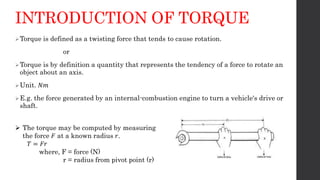
 The torque may be computed by measuring
the force 𝐹 at a known radius 𝑟.
𝑇 = 𝐹𝑟
where, F = force (N)
r = radius from pivot point (r)
DIFFERENCE BETWEEN TORQUE,
ANGULAR VELOCITY & POWER
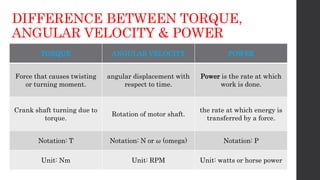
TORQUE ANGULAR VELOCITY POWER
Force that causes twisting
or turning moment.
angular displacement with
respect to time.
Power is the rate at which
work is done.
Crank shaft turning due to
torque.
Rotation of motor shaft.
the rate at which energy is
transferred by a force.
Notation: T Notation: N or 𝜔 (omega) Notation: P
Unit: Nm Unit: RPM Unit: watts or horse power
METHODS FOR MEASURING
TORQUE
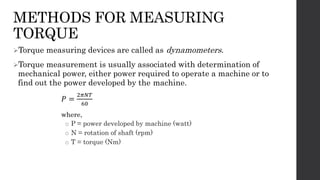
Torque measuring devices are called as dynamometers.
Torque measurement is usually associated with determination of
mechanical power, either power required to operate a machine or to
find out the power developed by the machine.
𝑃 =
2𝜋𝑁𝑇
60
where,
o P = power developed by machine (watt)
o N = rotation of shaft (rpm)
o T = torque (Nm)
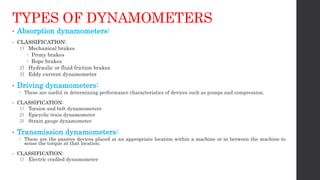
TYPES OF DYNAMOMETERS
• Absorption dynamometers:
• CLASSIFICATION:
1) Mechanical brakes
 Prony brakes
 Rope brakes
2) Hydraulic or fluid friction brakes
3) Eddy current dynamometer
• Driving dynamometers:
 These are useful in determining performance characteristics of devices such as pumps and compression.
• CLASSIFICATION:
1) Torsion and belt dynamometers
2) Epicyclic train dynamometer
3) Strain gauge dynamometer
• Transmission dynamometers:
 These are the passive devices placed at an appropriate location within a machine or in between the machine to
sense the torque at that location.
• CLASSIFICATION:
1) Electric cradled dynamometer
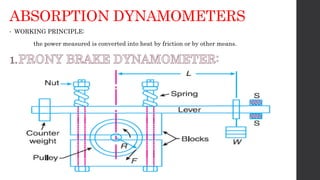
ABSORPTION DYNAMOMETERS
• WORKING PRINCIPLE:
the power measured is converted into heat by friction or by other means.
CONSTRUCTION
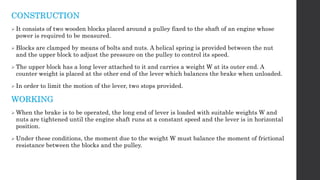
 It consists of two wooden blocks placed around a pulley fixed to the shaft of an engine whose
power is required to be measured.
 Blocks are clamped by means of bolts and nuts. A helical spring is provided between the nut
and the upper block to adjust the pressure on the pulley to control its speed.
 The upper block has a long lever attached to it and carries a weight W at its outer end. A
counter weight is placed at the other end of the lever which balances the brake when unloaded.
 In order to limit the motion of the lever, two stops provided.
WORKING
 When the brake is to be operated, the long end of lever is loaded with suitable weights W and
nuts are tightened until the engine shaft runs at a constant speed and the lever is in horizontal
position.
 Under these conditions, the moment due to the weight W must balance the moment of frictional
resistance between the blocks and the pulley.
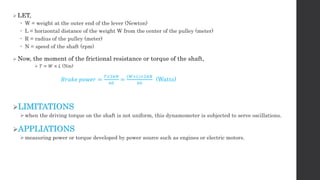
 LET,
 W = weight at the outer end of the lever (Newton)
 L = horizontal distance of the weight W from the center of the pulley (meter)
 R = radius of the pulley (meter)
 N = speed of the shaft (rpm)
 Now, the moment of the frictional resistance or torque of the shaft,
 𝑇 = 𝑊 × 𝐿 (Nm)
𝐵𝑟𝑎𝑘𝑒 𝑝𝑜𝑤𝑒𝑟 =
𝑇×2𝜋𝑁
60
=
(𝑊×𝐿)×2𝜋𝑁
60
(Watts)
LIMITATIONS
when the driving torque on the shaft is not uniform, this dynamometer is subjected to serve oscillations.
APPLIATIONS
measuring power or torque developed by power source such as engines or electric motors.
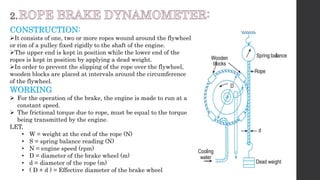
CONSTRUCTION:
It consists of one, two or more ropes wound around the flywheel
or rim of a pulley fixed rigidly to the shaft of the engine.
The upper end is kept in position while the lower end of the
ropes is kept in position by applying a dead weight.
In order to prevent the slipping of the rope over the flywheel,
wooden blocks are placed at intervals around the circumference
of the flywheel.
WORKING
 For the operation of the brake, the engine is made to run at a
constant speed.
 The frictional torque due to rope, must be equal to the torque
being transmitted by the engine.
LET,
• W = weight at the end of the rope (N)
• S = spring balance reading (N)
• N = engine speed (rpm)
• D = diameter of the brake wheel (m)
• d = diameter of the rope (m)
• ( D + d ) = Effective diameter of the brake wheel
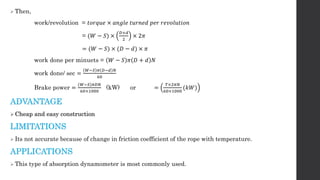
 Then,
work/revolution = 𝑡𝑜𝑟𝑞𝑢𝑒 × 𝑎𝑛𝑔𝑙𝑒 𝑡𝑢𝑟𝑛𝑒𝑑 𝑝𝑒𝑟 𝑟𝑒𝑣𝑜𝑙𝑢𝑡𝑖𝑜𝑛
= (𝑊 − 𝑆) ×
𝐷+𝑑
2
× 2𝜋
= (𝑊 − 𝑆) × (𝐷 − 𝑑) × 𝜋
work done per minuets = 𝑊 − 𝑆 𝜋 𝐷 + 𝑑 𝑁
work done/ sec =
𝑊−𝑆 𝜋 𝐷−𝑑 𝑁
60
Brake power =
(𝑊−𝑆)𝜋𝐷𝑁
60×1000
(kW) or =
𝑇×2𝜋𝑁
60×1000
(𝑘𝑊)
ADVANTAGE
 Cheap and easy construction
LIMITATIONS
 Its not accurate because of change in friction coefficient of the rope with temperature.
APPLICATIONS
 This type of absorption dynamometer is most commonly used.
DRIVING DYNAMOMETERS
• Working principle:
These dynamometers measure power or torque and as well provide energy to operate the device to be
tested.
WORKING:
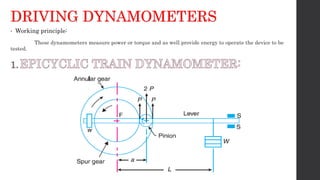
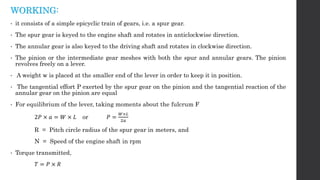
• it consists of a simple epicyclic train of gears, i.e. a spur gear.
• The spur gear is keyed to the engine shaft and rotates in anticlockwise direction.
• The annular gear is also keyed to the driving shaft and rotates in clockwise direction.
• The pinion or the intermediate gear meshes with both the spur and annular gears. The pinion
revolves freely on a lever.
• A weight w is placed at the smaller end of the lever in order to keep it in position.
• The tangential effort P exerted by the spur gear on the pinion and the tangential reaction of the
annular gear on the pinion are equal
• For equilibrium of the lever, taking moments about the fulcrum F
2𝑃 × 𝑎 = 𝑊 × 𝐿 or 𝑃 =
𝑊×𝐿
2𝑎
R = Pitch circle radius of the spur gear in meters, and
N = Speed of the engine shaft in rpm
• Torque transmitted,
𝑇 = 𝑃 × 𝑅
• Now power 𝑃 =
𝑇×2𝜋𝑁
60
=
(𝑃×𝑅)×2𝜋𝑁
60
(Watts)
WORKING PRINCIPAL:
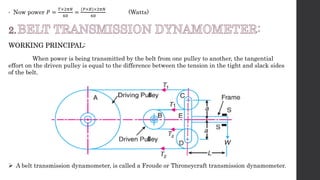
When power is being transmitted by the belt from one pulley to another, the tangential
effort on the driven pulley is equal to the difference between the tension in the tight and slack sides
of the belt.
 A belt transmission dynamometer, is called a Froude or Throneycraft transmission dynamometer.
CONSTRUCTION:
• It consists of a pulley A (called driving pulley) which is rigidly fixed tothe shaft of an engine
whose power is required to be measured.
• There is another pulley B (called driven pulley) mounted on another shaft to which the power
from pulley A is transmitted. The pulleys
• A and B are connected by means of a continuous belt passing round the two loose pulleys C and
D which are mounted on a T-shaped frame.
• The frame is pivoted at E and its movement is controlled by two stops.
WORKING:
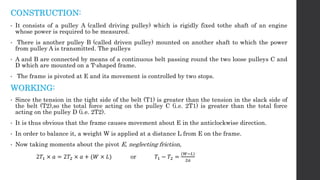
• Since the tension in the tight side of the belt (T1) is greater than the tension in the slack side of
the belt (T2),so the total force acting on the pulley C (i.e. 2T1) is greater than the total force
acting on the pulley D (i.e. 2T2).
• It is thus obvious that the frame causes movement about E in the anticlockwise direction.
• In order to balance it, a weight W is applied at a distance L from E on the frame.
• Now taking moments about the pivot E, neglecting friction,
2𝑇1 × 𝑎 = 2𝑇2 × 𝑎 + (𝑊 × 𝐿) or 𝑇1 − 𝑇2 =
(𝑊−𝐿)
2𝑎
• Work done in one revolution= (𝑇1 − 𝑇2)𝜋𝐷 (Nm)
• workdone per minute= (𝑇1 − 𝑇2)𝜋𝐷𝑁 (Nm)
• Brake power =
(𝑇1−𝑇2)𝜋𝐷𝑁
60
(Watts)
REFERANCES
TEXTS:
 Mechanical measurement and instrumentation (R.K. RAJPUT)
 WEB CONTENTS
 BRITANICA
 WIKIPEDIA
 ME MECHANICAL
IMAGES:
 GOOGLE IMAGIS
 ME MECHANICAL
Torque and power measurement

Torque and power measurement

  • 1.
    TORQUE MEASUREMENT NAME: JAIMIN AJITKUMARKEMKAR EN. NO.: 160123119014 SEM. AND BATCH: 4TH D2 SUBJECT: MECHANICAL MEASUREMENT AND METROLOGY (2141901) GUIDED BY: PROF. NAMAN M. DAVE
  • 2.
    CONTENTS • INTRODUCTION OFTORQUE • DIFFERENCE BETWEEN TORQUE, ANGULAR VELOCITY AND POWER • METHODS FOR MEASURING TORQUE
  • 3.
    INTRODUCTION OF TORQUE Torqueis defined as a twisting force that tends to cause rotation. or Torque is by definition a quantity that represents the tendency of a force to rotate an object about an axis. Unit. 𝑁𝑚 E.g. the force generated by an internal-combustion engine to turn a vehicle's drive or shaft.  The torque may be computed by measuring the force 𝐹 at a known radius 𝑟. 𝑇 = 𝐹𝑟 where, F = force (N) r = radius from pivot point (r)
  • 4.
    DIFFERENCE BETWEEN TORQUE, ANGULARVELOCITY & POWER TORQUE ANGULAR VELOCITY POWER Force that causes twisting or turning moment. angular displacement with respect to time. Power is the rate at which work is done. Crank shaft turning due to torque. Rotation of motor shaft. the rate at which energy is transferred by a force. Notation: T Notation: N or 𝜔 (omega) Notation: P Unit: Nm Unit: RPM Unit: watts or horse power
  • 5.
    METHODS FOR MEASURING TORQUE Torquemeasuring devices are called as dynamometers. Torque measurement is usually associated with determination of mechanical power, either power required to operate a machine or to find out the power developed by the machine. 𝑃 = 2𝜋𝑁𝑇 60 where, o P = power developed by machine (watt) o N = rotation of shaft (rpm) o T = torque (Nm)
  • 6.
    TYPES OF DYNAMOMETERS •Absorption dynamometers: • CLASSIFICATION: 1) Mechanical brakes  Prony brakes  Rope brakes 2) Hydraulic or fluid friction brakes 3) Eddy current dynamometer • Driving dynamometers:  These are useful in determining performance characteristics of devices such as pumps and compression. • CLASSIFICATION: 1) Torsion and belt dynamometers 2) Epicyclic train dynamometer 3) Strain gauge dynamometer • Transmission dynamometers:  These are the passive devices placed at an appropriate location within a machine or in between the machine to sense the torque at that location. • CLASSIFICATION: 1) Electric cradled dynamometer
  • 7.
    ABSORPTION DYNAMOMETERS • WORKINGPRINCIPLE: the power measured is converted into heat by friction or by other means.
  • 8.
    CONSTRUCTION  It consistsof two wooden blocks placed around a pulley fixed to the shaft of an engine whose power is required to be measured.  Blocks are clamped by means of bolts and nuts. A helical spring is provided between the nut and the upper block to adjust the pressure on the pulley to control its speed.  The upper block has a long lever attached to it and carries a weight W at its outer end. A counter weight is placed at the other end of the lever which balances the brake when unloaded.  In order to limit the motion of the lever, two stops provided. WORKING  When the brake is to be operated, the long end of lever is loaded with suitable weights W and nuts are tightened until the engine shaft runs at a constant speed and the lever is in horizontal position.  Under these conditions, the moment due to the weight W must balance the moment of frictional resistance between the blocks and the pulley.
  • 9.
     LET,  W= weight at the outer end of the lever (Newton)  L = horizontal distance of the weight W from the center of the pulley (meter)  R = radius of the pulley (meter)  N = speed of the shaft (rpm)  Now, the moment of the frictional resistance or torque of the shaft,  𝑇 = 𝑊 × 𝐿 (Nm) 𝐵𝑟𝑎𝑘𝑒 𝑝𝑜𝑤𝑒𝑟 = 𝑇×2𝜋𝑁 60 = (𝑊×𝐿)×2𝜋𝑁 60 (Watts) LIMITATIONS when the driving torque on the shaft is not uniform, this dynamometer is subjected to serve oscillations. APPLIATIONS measuring power or torque developed by power source such as engines or electric motors.
  • 10.
    CONSTRUCTION: It consists ofone, two or more ropes wound around the flywheel or rim of a pulley fixed rigidly to the shaft of the engine. The upper end is kept in position while the lower end of the ropes is kept in position by applying a dead weight. In order to prevent the slipping of the rope over the flywheel, wooden blocks are placed at intervals around the circumference of the flywheel. WORKING  For the operation of the brake, the engine is made to run at a constant speed.  The frictional torque due to rope, must be equal to the torque being transmitted by the engine. LET, • W = weight at the end of the rope (N) • S = spring balance reading (N) • N = engine speed (rpm) • D = diameter of the brake wheel (m) • d = diameter of the rope (m) • ( D + d ) = Effective diameter of the brake wheel
  • 11.
     Then, work/revolution =𝑡𝑜𝑟𝑞𝑢𝑒 × 𝑎𝑛𝑔𝑙𝑒 𝑡𝑢𝑟𝑛𝑒𝑑 𝑝𝑒𝑟 𝑟𝑒𝑣𝑜𝑙𝑢𝑡𝑖𝑜𝑛 = (𝑊 − 𝑆) × 𝐷+𝑑 2 × 2𝜋 = (𝑊 − 𝑆) × (𝐷 − 𝑑) × 𝜋 work done per minuets = 𝑊 − 𝑆 𝜋 𝐷 + 𝑑 𝑁 work done/ sec = 𝑊−𝑆 𝜋 𝐷−𝑑 𝑁 60 Brake power = (𝑊−𝑆)𝜋𝐷𝑁 60×1000 (kW) or = 𝑇×2𝜋𝑁 60×1000 (𝑘𝑊) ADVANTAGE  Cheap and easy construction LIMITATIONS  Its not accurate because of change in friction coefficient of the rope with temperature. APPLICATIONS  This type of absorption dynamometer is most commonly used.
  • 12.
    DRIVING DYNAMOMETERS • Workingprinciple: These dynamometers measure power or torque and as well provide energy to operate the device to be tested.
  • 13.
    WORKING: • it consistsof a simple epicyclic train of gears, i.e. a spur gear. • The spur gear is keyed to the engine shaft and rotates in anticlockwise direction. • The annular gear is also keyed to the driving shaft and rotates in clockwise direction. • The pinion or the intermediate gear meshes with both the spur and annular gears. The pinion revolves freely on a lever. • A weight w is placed at the smaller end of the lever in order to keep it in position. • The tangential effort P exerted by the spur gear on the pinion and the tangential reaction of the annular gear on the pinion are equal • For equilibrium of the lever, taking moments about the fulcrum F 2𝑃 × 𝑎 = 𝑊 × 𝐿 or 𝑃 = 𝑊×𝐿 2𝑎 R = Pitch circle radius of the spur gear in meters, and N = Speed of the engine shaft in rpm • Torque transmitted, 𝑇 = 𝑃 × 𝑅
  • 14.
    • Now power𝑃 = 𝑇×2𝜋𝑁 60 = (𝑃×𝑅)×2𝜋𝑁 60 (Watts) WORKING PRINCIPAL: When power is being transmitted by the belt from one pulley to another, the tangential effort on the driven pulley is equal to the difference between the tension in the tight and slack sides of the belt.  A belt transmission dynamometer, is called a Froude or Throneycraft transmission dynamometer.
  • 15.
    CONSTRUCTION: • It consistsof a pulley A (called driving pulley) which is rigidly fixed tothe shaft of an engine whose power is required to be measured. • There is another pulley B (called driven pulley) mounted on another shaft to which the power from pulley A is transmitted. The pulleys • A and B are connected by means of a continuous belt passing round the two loose pulleys C and D which are mounted on a T-shaped frame. • The frame is pivoted at E and its movement is controlled by two stops. WORKING: • Since the tension in the tight side of the belt (T1) is greater than the tension in the slack side of the belt (T2),so the total force acting on the pulley C (i.e. 2T1) is greater than the total force acting on the pulley D (i.e. 2T2). • It is thus obvious that the frame causes movement about E in the anticlockwise direction. • In order to balance it, a weight W is applied at a distance L from E on the frame. • Now taking moments about the pivot E, neglecting friction, 2𝑇1 × 𝑎 = 2𝑇2 × 𝑎 + (𝑊 × 𝐿) or 𝑇1 − 𝑇2 = (𝑊−𝐿) 2𝑎
  • 16.
    • Work donein one revolution= (𝑇1 − 𝑇2)𝜋𝐷 (Nm) • workdone per minute= (𝑇1 − 𝑇2)𝜋𝐷𝑁 (Nm) • Brake power = (𝑇1−𝑇2)𝜋𝐷𝑁 60 (Watts)
  • 17.
    REFERANCES TEXTS:  Mechanical measurementand instrumentation (R.K. RAJPUT)  WEB CONTENTS  BRITANICA  WIKIPEDIA  ME MECHANICAL IMAGES:  GOOGLE IMAGIS  ME MECHANICAL