

• INTRODUCTION TO INFLATION
• CHARACTERISTICS OF INFLATION
• TYPES OF INFLATION
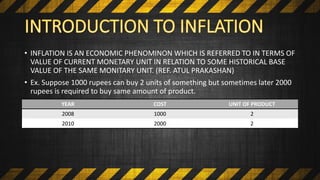
• INFLATION IS AN ECONOMIC PHENOMINON WHICH IS REFERRED TO IN TERMS OF
VALUE OF CURRENT MONETARY UNIT IN RELATION TO SOME HISTORICAL BASE
VALUE OF THE SAME MONITARY UNIT. (REF. ATUL PRAKASHAN)
• Ex. Suppose 1000 rupees can buy 2 units of something but sometimes later 2000
rupees is required to buy same amount of product.
YEAR COST UNIT OF PRODUCT
2008 1000 2
2010 2000 2
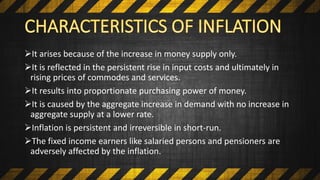
It arises because of the increase in money supply only.
It is reflected in the persistent rise in input costs and ultimately in
rising prices of commodes and services.
It results into proportionate purchasing power of money.
It is caused by the aggregate increase in demand with no increase in
aggregate supply at a lower rate.
Inflation is persistent and irreversible in short-run.
The fixed income earners like salaried persons and pensioners are
adversely affected by the inflation.
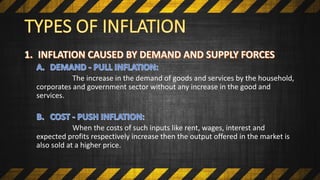
The increase in the demand of goods and services by the household,
corporates and government sector without any increase in the good and
services.
When the costs of such inputs like rent, wages, interest and
expected profits respectively increase then the output offered in the market is
also sold at a higher price.
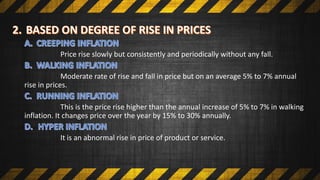
Price rise slowly but consistently and periodically without any fall.
Moderate rate of rise and fall in price but on an average 5% to 7% annual
rise in prices.
This is the price rise higher than the annual increase of 5% to 7% in walking
inflation. It changes price over the year by 15% to 30% annually.
It is an abnormal rise in price of product or service.
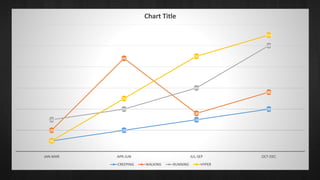
50
100
150
200
100
440
180
280
150
200
300
500
50
250
450
550
JAN-MAR APR-JUN JUL-SEP OCT-DEC
Chart Title
CREEPING WALKING RUNNING HYPER
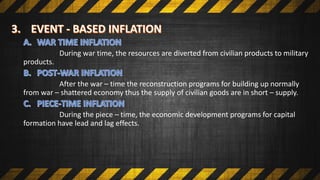
During war time, the resources are diverted from civilian products to military
products.
After the war – time the reconstruction programs for building up normally
from war – shattered economy thus the supply of civilian goods are in short – supply.
During the piece – time, the economic development programs for capital
formation have lead and lag effects.
• ENGINEERING ECONOMICS AND MANAGEMENT (ATUL)
INFLATION

INFLATION

  • 2.
    • INTRODUCTION TOINFLATION • CHARACTERISTICS OF INFLATION • TYPES OF INFLATION
  • 3.
    • INFLATION ISAN ECONOMIC PHENOMINON WHICH IS REFERRED TO IN TERMS OF VALUE OF CURRENT MONETARY UNIT IN RELATION TO SOME HISTORICAL BASE VALUE OF THE SAME MONITARY UNIT. (REF. ATUL PRAKASHAN) • Ex. Suppose 1000 rupees can buy 2 units of something but sometimes later 2000 rupees is required to buy same amount of product. YEAR COST UNIT OF PRODUCT 2008 1000 2 2010 2000 2
  • 4.
    It arises becauseof the increase in money supply only. It is reflected in the persistent rise in input costs and ultimately in rising prices of commodes and services. It results into proportionate purchasing power of money. It is caused by the aggregate increase in demand with no increase in aggregate supply at a lower rate. Inflation is persistent and irreversible in short-run. The fixed income earners like salaried persons and pensioners are adversely affected by the inflation.
  • 5.
    The increase inthe demand of goods and services by the household, corporates and government sector without any increase in the good and services. When the costs of such inputs like rent, wages, interest and expected profits respectively increase then the output offered in the market is also sold at a higher price.
  • 6.
    Price rise slowlybut consistently and periodically without any fall. Moderate rate of rise and fall in price but on an average 5% to 7% annual rise in prices. This is the price rise higher than the annual increase of 5% to 7% in walking inflation. It changes price over the year by 15% to 30% annually. It is an abnormal rise in price of product or service.
  • 7.
  • 8.
    During war time,the resources are diverted from civilian products to military products. After the war – time the reconstruction programs for building up normally from war – shattered economy thus the supply of civilian goods are in short – supply. During the piece – time, the economic development programs for capital formation have lead and lag effects.
  • 9.
    • ENGINEERING ECONOMICSAND MANAGEMENT (ATUL)