PRESENTATION ON
INSTANTANEOUS CENTER
Introduction
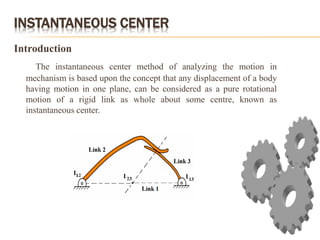
The instantaneous center method of analyzing the motion in
mechanism is based upon the concept that any displacement of a body
having motion in one plane, can be considered as a pure rotational
motion of a rigid link as whole about some centre, known as
instantaneous center.
INSTANTANEOUS CENTER
What Is Instantaneous Center ?
There are two definitions for instantaneous centre:
 Instantaneous center is a point on a member which another member
rotates around, permanently or instantaneously.
 Instantaneous center is a point in common between two members
where the velocities are equal, both in direction and magnitude.
Types of Instantaneous Centers
The instantaneous centers for a mechanism are of the following three
types:
1. Fixed instantaneous centers
2. Permanent instantaneous centers
3. Neither fixed nor permanent instantaneous centers
The first two types are together known as primary instantaneous centers
and the third type is known as secondary instantaneous centers
PROPERTIES OF INSTANTANEOUS CENTER
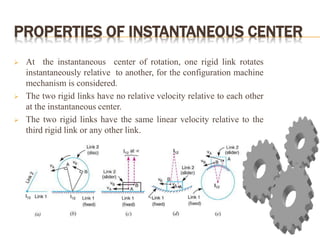
 At the instantaneous center of rotation, one rigid link rotates
instantaneously relative to another, for the configuration machine
mechanism is considered.
 The two rigid links have no relative velocity relative to each other
at the instantaneous center.
 The two rigid links have the same linear velocity relative to the
third rigid link or any other link.
LOCATING THE INSTANTANEOUS CENTERS
 First of all, determine the number of instantaneous centers.
N = n ( n - 1) n = Number of links
2
 Locate the fixed and permanent centers by inspection.
 Locate the remaining neither fixed nor permanent centers by Kennedy’s
theorem (this is done by circle diagram)
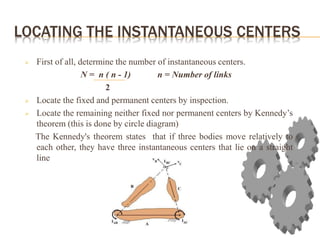
The Kennedy's theorem states that if three bodies move relatively to
each other, they have three instantaneous centers that lie on a straight
line
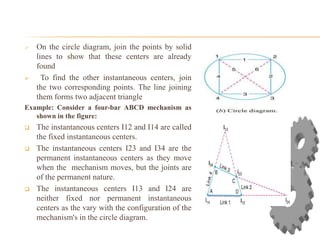
 On the circle diagram, join the points by solid
lines to show that these centers are already
found
 To find the other instantaneous centers, join
the two corresponding points. The line joining
them forms two adjacent triangle
Example: Consider a four-bar ABCD mechanism as
shown in the figure:
 The instantaneous centers I12 and I14 are called
the fixed instantaneous centers.
 The instantaneous centers I23 and I34 are the
permanent instantaneous centers as they move
when the mechanism moves, but the joints are
of the permanent nature.
 The instantaneous centers I13 and I24 are
neither fixed nor permanent instantaneous
centers as the vary with the configuration of the
mechanism's in the circle diagram.
THANK YOU

Instantaneous centre

  • 1.
  • 2.
    INSTANTANEOUS CENTER Introduction The instantaneouscenter method of analyzing the motion in mechanism is based upon the concept that any displacement of a body having motion in one plane, can be considered as a pure rotational motion of a rigid link as whole about some centre, known as instantaneous center.
  • 3.
    INSTANTANEOUS CENTER What IsInstantaneous Center ? There are two definitions for instantaneous centre:  Instantaneous center is a point on a member which another member rotates around, permanently or instantaneously.  Instantaneous center is a point in common between two members where the velocities are equal, both in direction and magnitude. Types of Instantaneous Centers The instantaneous centers for a mechanism are of the following three types: 1. Fixed instantaneous centers 2. Permanent instantaneous centers 3. Neither fixed nor permanent instantaneous centers The first two types are together known as primary instantaneous centers and the third type is known as secondary instantaneous centers
  • 4.
    PROPERTIES OF INSTANTANEOUSCENTER  At the instantaneous center of rotation, one rigid link rotates instantaneously relative to another, for the configuration machine mechanism is considered.  The two rigid links have no relative velocity relative to each other at the instantaneous center.  The two rigid links have the same linear velocity relative to the third rigid link or any other link.
  • 5.
    LOCATING THE INSTANTANEOUSCENTERS  First of all, determine the number of instantaneous centers. N = n ( n - 1) n = Number of links 2  Locate the fixed and permanent centers by inspection.  Locate the remaining neither fixed nor permanent centers by Kennedy’s theorem (this is done by circle diagram) The Kennedy's theorem states that if three bodies move relatively to each other, they have three instantaneous centers that lie on a straight line
  • 6.
     On thecircle diagram, join the points by solid lines to show that these centers are already found  To find the other instantaneous centers, join the two corresponding points. The line joining them forms two adjacent triangle Example: Consider a four-bar ABCD mechanism as shown in the figure:  The instantaneous centers I12 and I14 are called the fixed instantaneous centers.  The instantaneous centers I23 and I34 are the permanent instantaneous centers as they move when the mechanism moves, but the joints are of the permanent nature.  The instantaneous centers I13 and I24 are neither fixed nor permanent instantaneous centers as the vary with the configuration of the mechanism's in the circle diagram.
  • 7.