z Name: kemkar jaimin ajitkumar
En. No.: 160123119014
class and batch: 5th D2
subject: theory of machine (2151902)
Subject Guide: Prof. Vipal panchal
ANALYSIS OF ROPE
BRAKE DYNAMOMETER
z
CONTENTS
1. INTRO. TO DYNAMOMETERS
2. ROPE BRAKE DYNAMOMETER
3. DERIVATION
4. EXAMPLE
5. REFERENCES
z
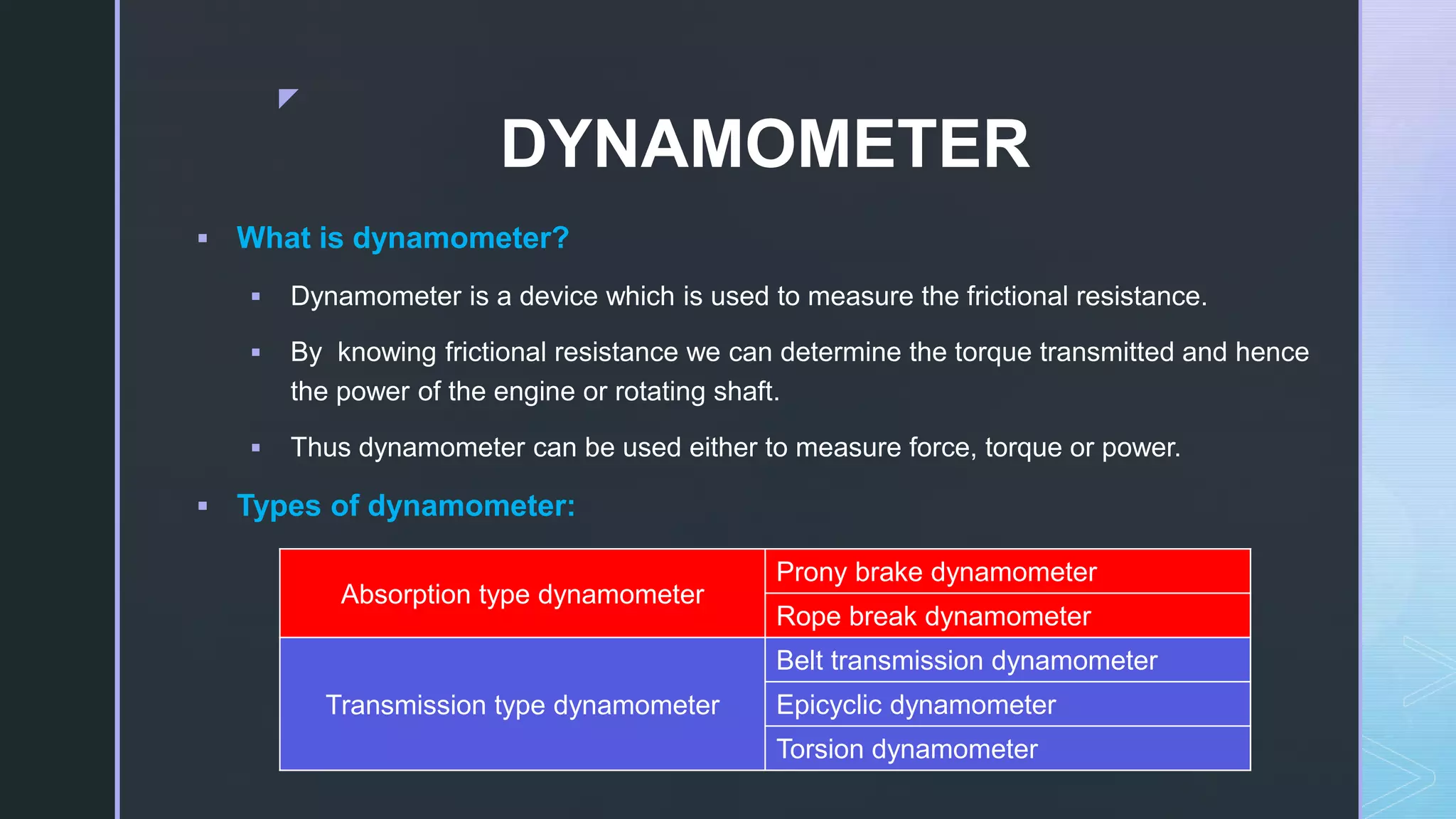
DYNAMOMETER
 What is dynamometer?
 Dynamometer is a device which is used to measure the frictional resistance.
 By knowing frictional resistance we can determine the torque transmitted and hence
the power of the engine or rotating shaft.
 Thus dynamometer can be used either to measure force, torque or power.
 Types of dynamometer:
Absorption type dynamometer
Prony brake dynamometer
Rope break dynamometer
Transmission type dynamometer
Belt transmission dynamometer
Epicyclic dynamometer
Torsion dynamometer
z
ROPE BREAK DYNAMOMETER
 Absorption dynamometer
 the work done by the engine is absorbed by the frictional resistance of the brake which
is converted into heat during the process of measurement.
 Rope break dynamometer
 It consists of one, two or more ropes wrapped over the rim of a pulley keyed to the shaft
of the engine.
 The upper end of the ropes is attached to a spring balance (S) while the lower end
carries a dead weight (W).
 In order to prevent the slipping of the rope over the pulley, 3 to 4 ‘U’ shaped wooden
blocks are placed at the interval around the circumference of pulley.
 If high power is produced, then heat is generated due to friction between rope and
pulley or drum. To prevent this, pulley is provided with internal flanges on the rim,
forming channel for flow of water to cool the pulley or drum.
z
z
ACTUAL APPLICATIONS
z
EQUATION OF BREAK POWER
 Let,
 W = dead weight of suspended weight
 S = spring balance reading
 D = diameter of pulley or drum
 N = speed of the engine
 d = diameter of the rope
 (W-s) = net break load
 Frictional torque due to rope =
[ (𝑛𝑒𝑡 𝑙𝑜𝑎𝑑 𝑜𝑛 𝑏𝑟𝑒𝑎𝑘 × 𝑑𝑖𝑠𝑡𝑎𝑎𝑛𝑐𝑒 𝑜𝑓 𝑙𝑜𝑎𝑑 𝑙𝑖𝑛𝑒 𝑓𝑟𝑜𝑚 𝑐𝑒𝑛𝑡𝑒𝑟 𝑜𝑓 𝑠ℎ𝑎𝑓𝑡) ]
= (𝑊 − 𝑆) ×
𝐷 + 𝑑
2
z
 But the torque transmitted by engine at constant speed equal to frictional torque due
to ropes.
∴ 𝐵𝑟𝑒𝑎𝑘 𝑝𝑜𝑤𝑒𝑟 𝑃 = 𝑡𝑜𝑟𝑞𝑢𝑒 𝑡𝑟𝑎𝑛𝑠𝑚𝑖𝑡𝑡𝑒𝑑 × 𝑎𝑛𝑔𝑢𝑙𝑎𝑟 𝑠𝑝𝑒𝑒𝑑 𝑜𝑓 𝑒𝑛𝑔𝑖𝑛𝑒
𝑃 = 𝑊 − 𝑆 ×
𝐷 + 𝑑
2
× 𝜔 = (𝑊 − 𝑆) ×
𝐷 + 𝑑
2
×
2𝜋𝑁
60
∴ 𝑃 =
(𝑊 − 𝑆)(𝐷 + 𝑑)𝜋𝑁
60
(𝑤𝑎𝑡𝑡)
 If diameter of rope (d) is neglected,
𝑩𝒓𝒆𝒂𝒌 𝒑𝒐𝒘𝒆𝒓, 𝑷 =
(𝑾 − 𝑺)𝝅𝑫𝑵
𝟔𝟎
(𝒘𝒂𝒕𝒕)
z
EXAMPLE
 The following data is given from lab. experiment:
 Diameter of drum (D) = 1 m
 Diameter of rope (d) = 10 mm = 0.01 m
 Weight on the brake (W) = 50 kg = 50 × 9.81 = 490.5 N
 Speed of engine (N) = 200 rpm
 Spring balance reading (s) = 120 N
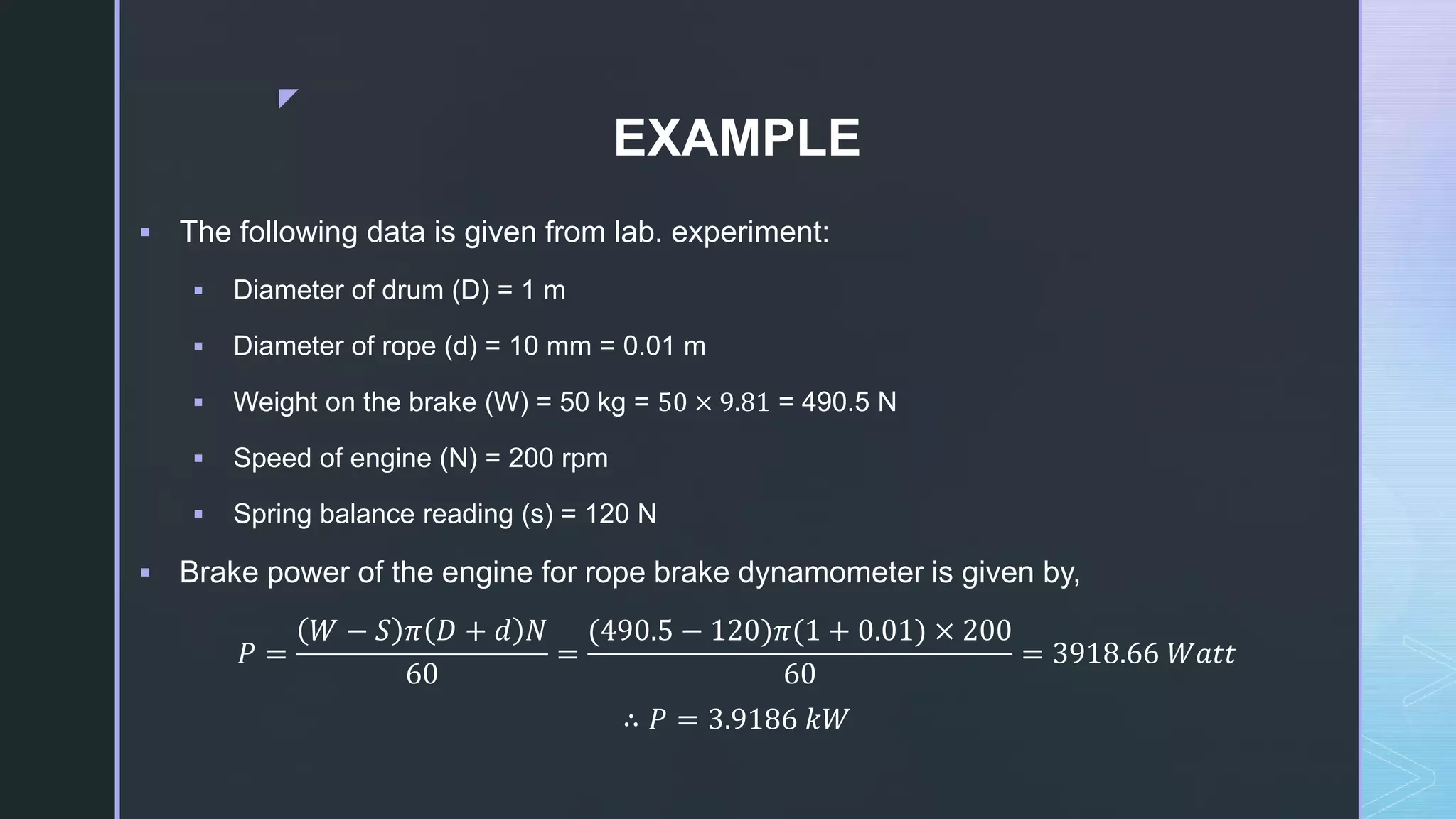
 Brake power of the engine for rope brake dynamometer is given by,
𝑃 =
𝑊 − 𝑆 𝜋 𝐷 + 𝑑 𝑁
60
=
(490.5 − 120)𝜋(1 + 0.01) × 200
60
= 3918.66 𝑊𝑎𝑡𝑡
∴ 𝑃 = 3.9186 𝑘𝑊
z
REFERENCES
 Book: Tech-Max (by Dr. F. B. Sayyad)
 Images:
 indiamart: https://4.imimg.com/data4/DB/VL/MY-2200754/engines-500x500.jpg
 me-mechanicalengineering.com: https://cdn.me-mechanicalengineering.com/wp-
content/uploads/2015/12/transmission-dynamometer.png
z

rope brake dynamometer

  • 1.
    z Name: kemkarjaimin ajitkumar En. No.: 160123119014 class and batch: 5th D2 subject: theory of machine (2151902) Subject Guide: Prof. Vipal panchal ANALYSIS OF ROPE BRAKE DYNAMOMETER
  • 2.
    z CONTENTS 1. INTRO. TODYNAMOMETERS 2. ROPE BRAKE DYNAMOMETER 3. DERIVATION 4. EXAMPLE 5. REFERENCES
  • 3.
    z DYNAMOMETER  What isdynamometer?  Dynamometer is a device which is used to measure the frictional resistance.  By knowing frictional resistance we can determine the torque transmitted and hence the power of the engine or rotating shaft.  Thus dynamometer can be used either to measure force, torque or power.  Types of dynamometer: Absorption type dynamometer Prony brake dynamometer Rope break dynamometer Transmission type dynamometer Belt transmission dynamometer Epicyclic dynamometer Torsion dynamometer
  • 4.
    z ROPE BREAK DYNAMOMETER Absorption dynamometer  the work done by the engine is absorbed by the frictional resistance of the brake which is converted into heat during the process of measurement.  Rope break dynamometer  It consists of one, two or more ropes wrapped over the rim of a pulley keyed to the shaft of the engine.  The upper end of the ropes is attached to a spring balance (S) while the lower end carries a dead weight (W).  In order to prevent the slipping of the rope over the pulley, 3 to 4 ‘U’ shaped wooden blocks are placed at the interval around the circumference of pulley.  If high power is produced, then heat is generated due to friction between rope and pulley or drum. To prevent this, pulley is provided with internal flanges on the rim, forming channel for flow of water to cool the pulley or drum.
  • 5.
  • 6.
  • 7.
    z EQUATION OF BREAKPOWER  Let,  W = dead weight of suspended weight  S = spring balance reading  D = diameter of pulley or drum  N = speed of the engine  d = diameter of the rope  (W-s) = net break load  Frictional torque due to rope = [ (𝑛𝑒𝑡 𝑙𝑜𝑎𝑑 𝑜𝑛 𝑏𝑟𝑒𝑎𝑘 × 𝑑𝑖𝑠𝑡𝑎𝑎𝑛𝑐𝑒 𝑜𝑓 𝑙𝑜𝑎𝑑 𝑙𝑖𝑛𝑒 𝑓𝑟𝑜𝑚 𝑐𝑒𝑛𝑡𝑒𝑟 𝑜𝑓 𝑠ℎ𝑎𝑓𝑡) ] = (𝑊 − 𝑆) × 𝐷 + 𝑑 2
  • 8.
    z  But thetorque transmitted by engine at constant speed equal to frictional torque due to ropes. ∴ 𝐵𝑟𝑒𝑎𝑘 𝑝𝑜𝑤𝑒𝑟 𝑃 = 𝑡𝑜𝑟𝑞𝑢𝑒 𝑡𝑟𝑎𝑛𝑠𝑚𝑖𝑡𝑡𝑒𝑑 × 𝑎𝑛𝑔𝑢𝑙𝑎𝑟 𝑠𝑝𝑒𝑒𝑑 𝑜𝑓 𝑒𝑛𝑔𝑖𝑛𝑒 𝑃 = 𝑊 − 𝑆 × 𝐷 + 𝑑 2 × 𝜔 = (𝑊 − 𝑆) × 𝐷 + 𝑑 2 × 2𝜋𝑁 60 ∴ 𝑃 = (𝑊 − 𝑆)(𝐷 + 𝑑)𝜋𝑁 60 (𝑤𝑎𝑡𝑡)  If diameter of rope (d) is neglected, 𝑩𝒓𝒆𝒂𝒌 𝒑𝒐𝒘𝒆𝒓, 𝑷 = (𝑾 − 𝑺)𝝅𝑫𝑵 𝟔𝟎 (𝒘𝒂𝒕𝒕)
  • 9.
    z EXAMPLE  The followingdata is given from lab. experiment:  Diameter of drum (D) = 1 m  Diameter of rope (d) = 10 mm = 0.01 m  Weight on the brake (W) = 50 kg = 50 × 9.81 = 490.5 N  Speed of engine (N) = 200 rpm  Spring balance reading (s) = 120 N  Brake power of the engine for rope brake dynamometer is given by, 𝑃 = 𝑊 − 𝑆 𝜋 𝐷 + 𝑑 𝑁 60 = (490.5 − 120)𝜋(1 + 0.01) × 200 60 = 3918.66 𝑊𝑎𝑡𝑡 ∴ 𝑃 = 3.9186 𝑘𝑊
  • 10.
    z REFERENCES  Book: Tech-Max(by Dr. F. B. Sayyad)  Images:  indiamart: https://4.imimg.com/data4/DB/VL/MY-2200754/engines-500x500.jpg  me-mechanicalengineering.com: https://cdn.me-mechanicalengineering.com/wp- content/uploads/2015/12/transmission-dynamometer.png
  • 11.