H a l d i a I n s t i t u t e o f Te c h n o lo g y
Heat Exchangers
Presented by:
Jamirul Islam
Roll No- 10300614019
H a l d i a I n s t i t u t e o f Te c h n o lo g y
Contents
 Introduction
 Principles of Heat Exchangers
 Flow Arrangement
 Types of Heat Exchangers
 Selection Criteria Of The Heat Exchangers
 TEMA
 Conclusion
H a l d i a I n s t i t u t e o f Te c h n o lo g y
Introduction
 A heat exchanger is a piece of equipment built for
efficient heat transfer from one medium to another.
 They are widely used in space heating, refrigeration, air
conditioning, power plants, chemical plants,
petrochemical plants, petroleum refineries, natural gas
processing and sewage treatment.
H a l d i a I n s t i t u t e o f Te c h n o lo g y
Principles of Heat Exchangers
 Heat transferred from hot fluid to cold fluid
 Heat transferred through the wall,
𝑸 = 𝑼 ∙ 𝑨 ∙ 𝑳𝑴𝑻𝑫
H a l d i a I n s t i t u t e o f Te c h n o lo g y
Flow Arrangement
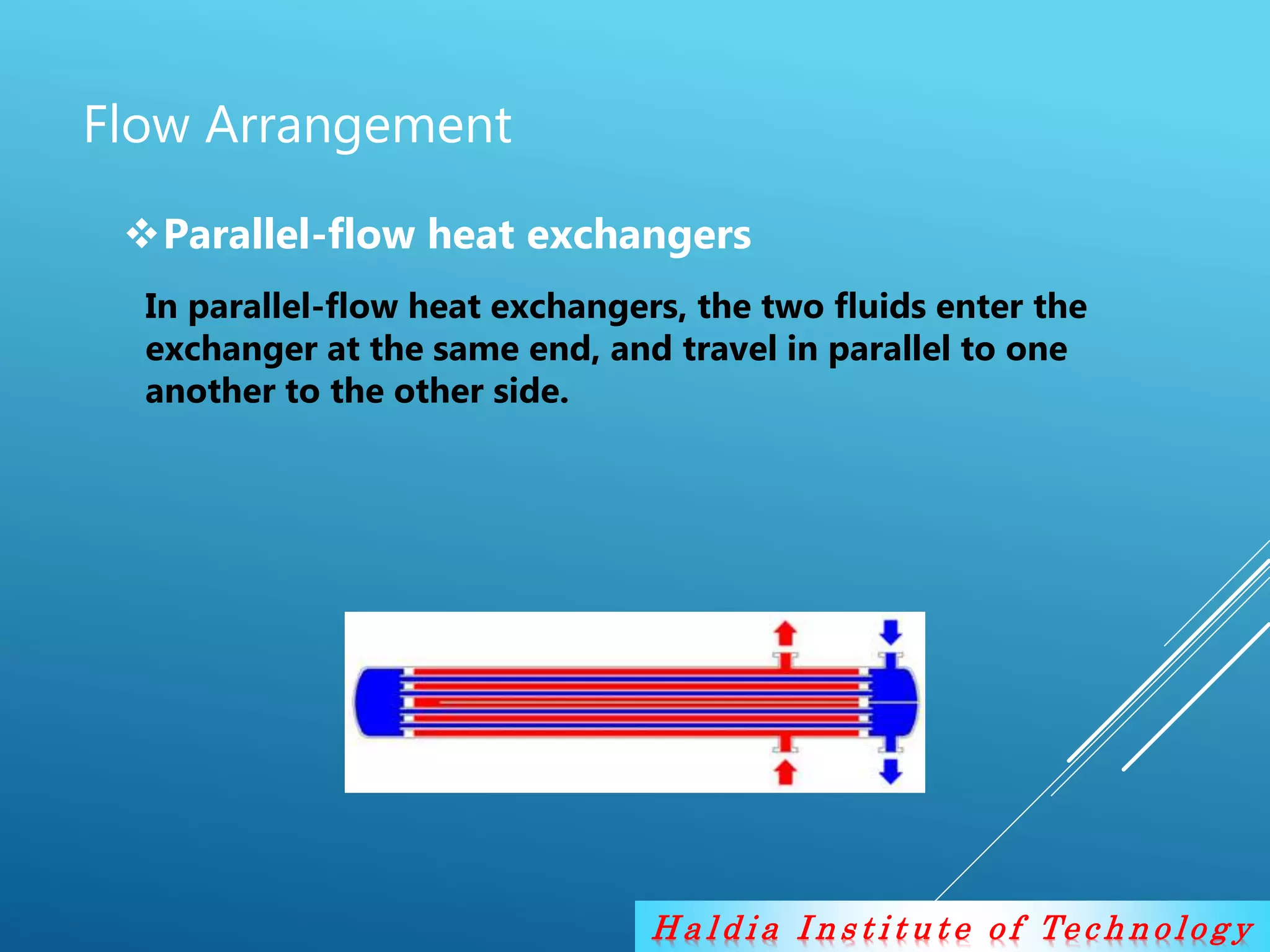
In parallel-flow heat exchangers, the two fluids enter the
exchanger at the same end, and travel in parallel to one
another to the other side.
Parallel-flow heat exchangers
H a l d i a I n s t i t u t e o f Te c h n o lo g y
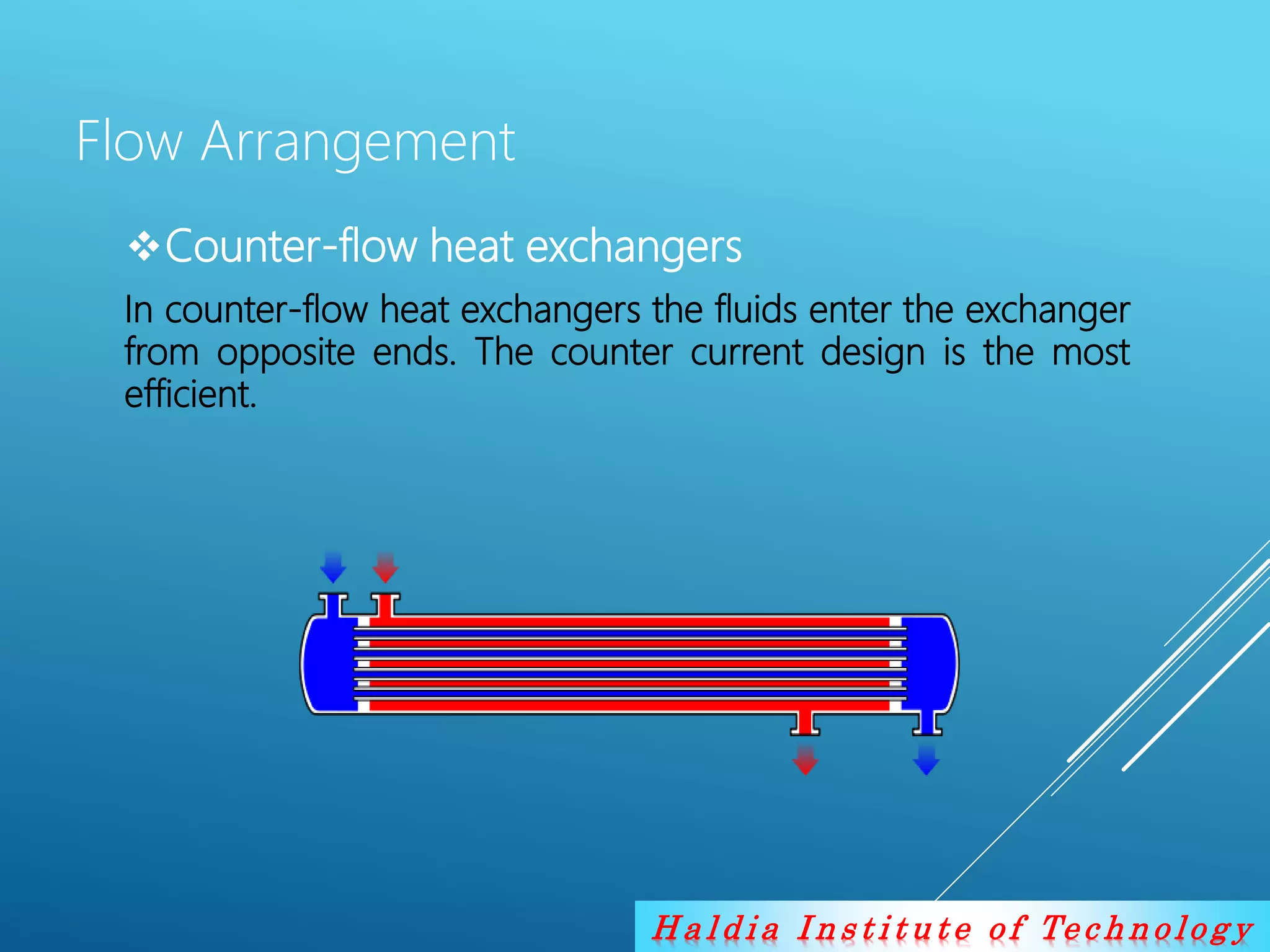
In counter-flow heat exchangers the fluids enter the exchanger
from opposite ends. The counter current design is the most
efficient.
Counter-flow heat exchangers
Flow Arrangement
H a l d i a I n s t i t u t e o f Te c h n o lo g y
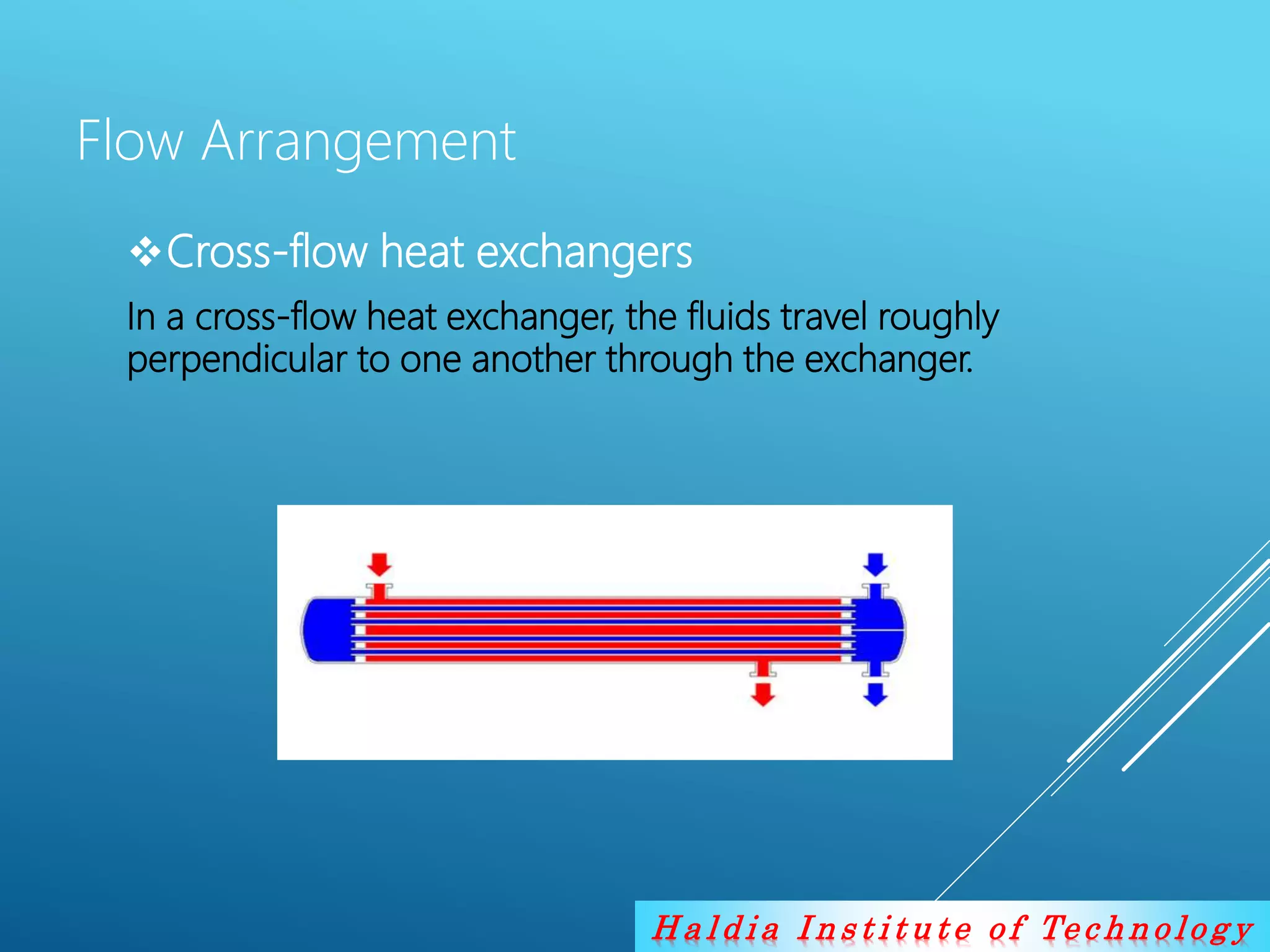
In a cross-flow heat exchanger, the fluids travel roughly
perpendicular to one another through the exchanger.
Cross-flow heat exchangers
Flow Arrangement
H a l d i a I n s t i t u t e o f Te c h n o lo g y
Types Of Heat Exchangers
 Double pipe heat exchanger
 Plate heat exchanger
 Shell and tube heat exchanger
 Adiabatic wheel heat exchanger
 Plate fin heat exchanger
 Pillow plate heat exchanger
 Fluid heat exchangers
 Waste heat recovery units
 Dynamic scraped surface heat exchanger
 Spiral heat exchangers
H a l d i a I n s t i t u t e o f Te c h n o lo g y
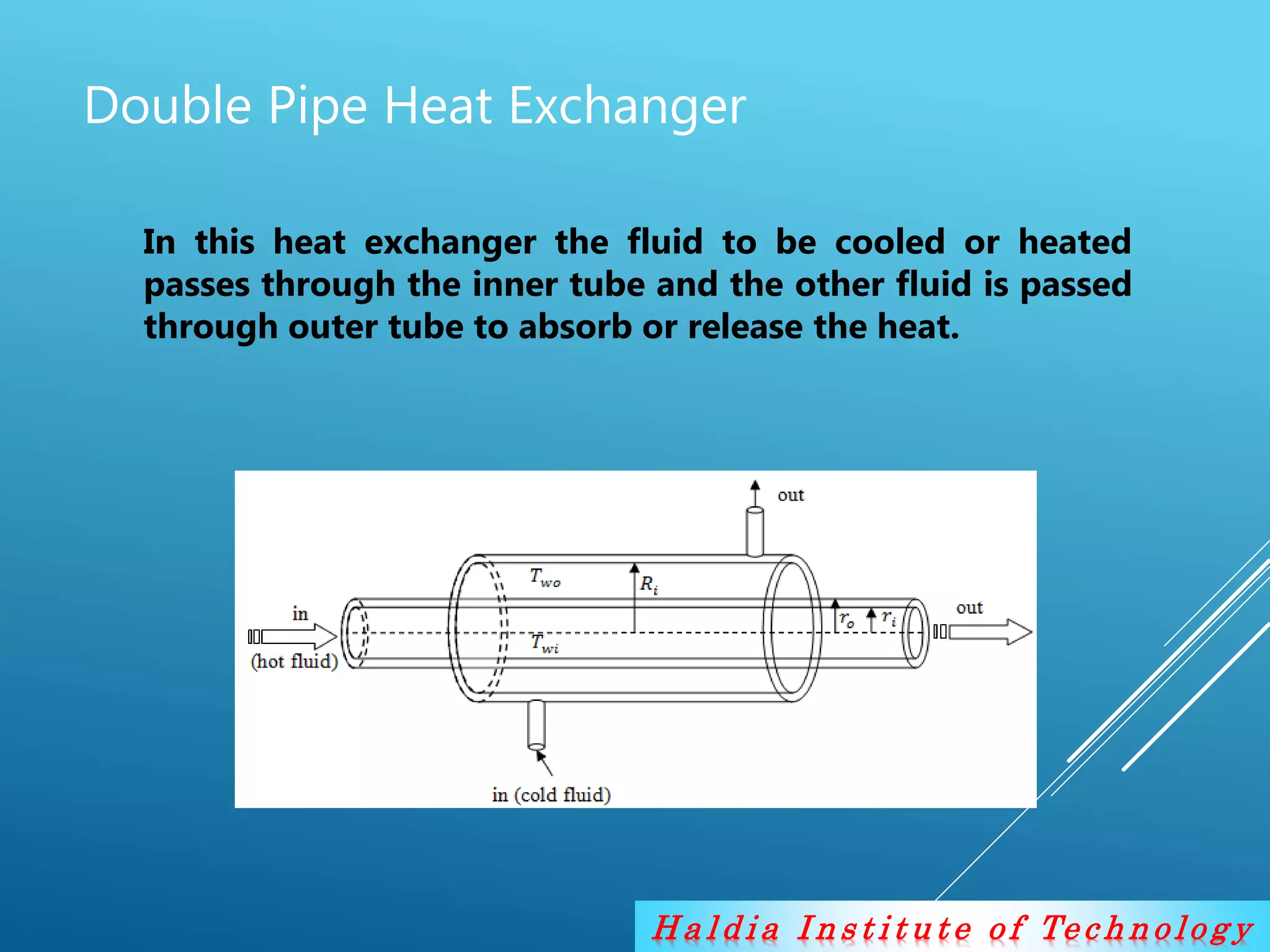
Double Pipe Heat Exchanger
In this heat exchanger the fluid to be cooled or heated
passes through the inner tube and the other fluid is passed
through outer tube to absorb or release the heat.
H a l d i a I n s t i t u t e o f Te c h n o lo g y
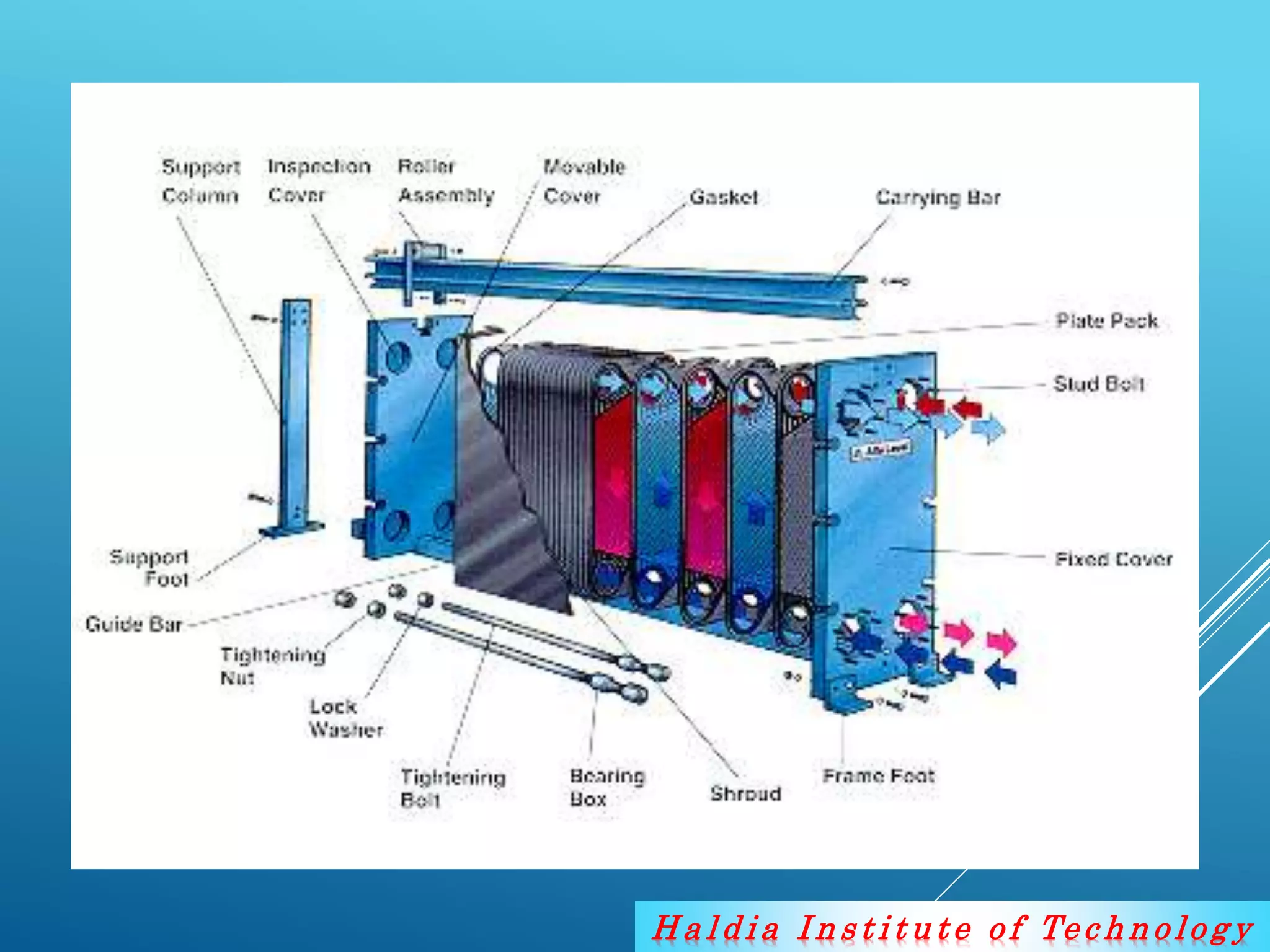
Plate Heat Exchanger (PHE)
 It is composed of multiple, thin, slightly separated
plates that have very large surface areas and fluid flow
passages for heat transfer.
 The plates are often spaced by rubber sealing gaskets
which are cemented into a section around the edge of
the plates. The plates are pressed to form troughs at
right angles to the direction of flow of the liquid which
runs through the channels in the heat exchanger.
These troughs are arranged so that they interlink with
the other plates which forms the channel with gaps of
1.3–1.5 mm between the plates.
H a l d i a I n s t i t u t e o f Te c h n o lo g y
Shell And Tube Heat Exchangers
 Shell-and-Tube Heat Exchangers are the most important type
of Heat Exchangers.
 It is used in almost every type of industry.
 This type of heat exchanger consists of a set of tubes in a
container called a shell.
 The fluid flowing inside the tubes is called the tube side fluid
and the fluid flowing on the outside of the tubes is the shell
side fluid.
H a l d i a I n s t i t u t e o f Te c h n o lo g y
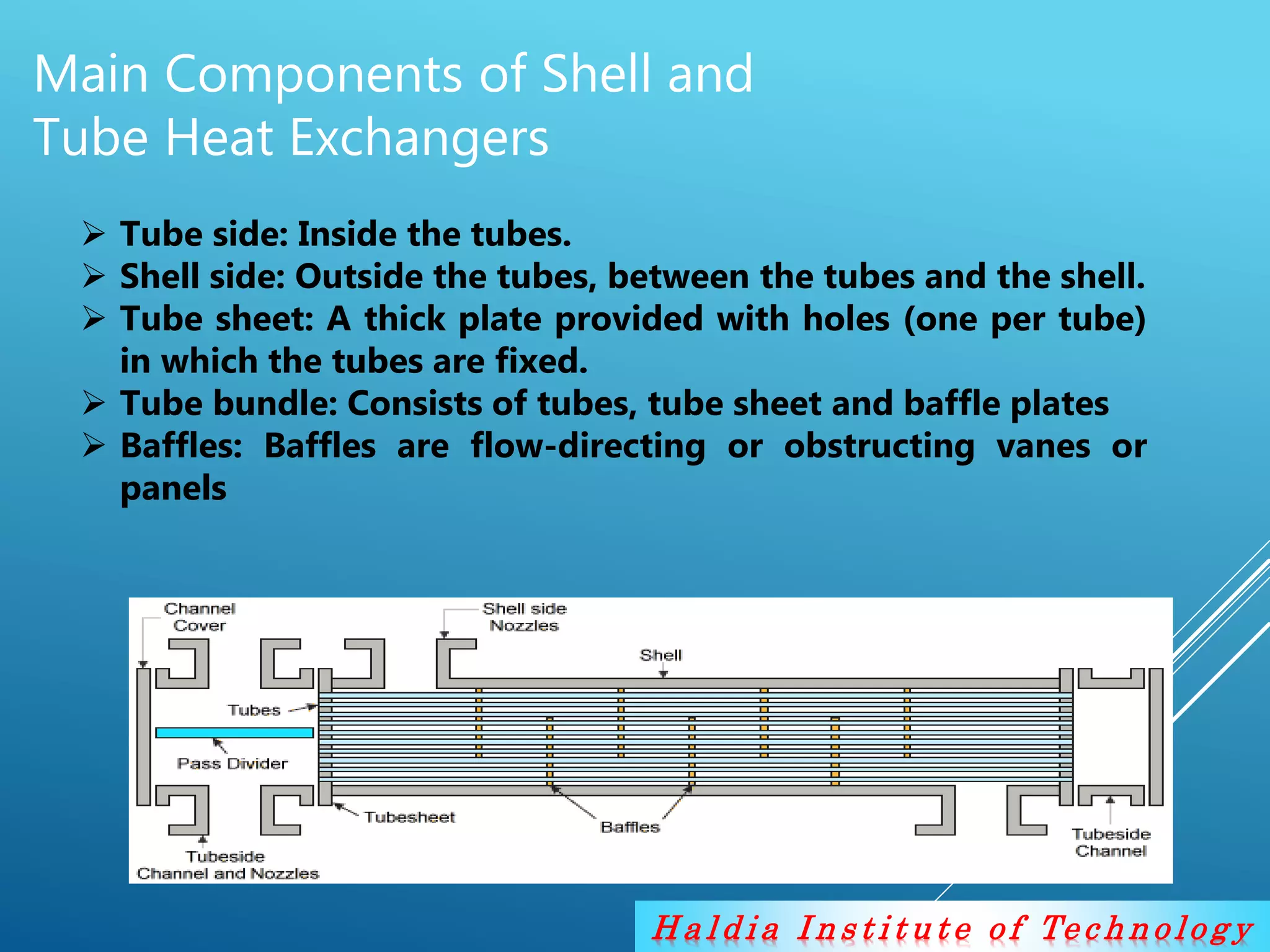
Main Components of Shell and
Tube Heat Exchangers
 Tube side: Inside the tubes.
 Shell side: Outside the tubes, between the tubes and the shell.
 Tube sheet: A thick plate provided with holes (one per tube)
in which the tubes are fixed.
 Tube bundle: Consists of tubes, tube sheet and baffle plates
 Baffles: Baffles are flow-directing or obstructing vanes or
panels
H a l d i a I n s t i t u t e o f Te c h n o lo g y
Selection Criteria Of The Heat Exchangers
 Heat Transfer rate
 Cost
 Pumping Power
 Size and Weight
 Materials of Construction
 Cleanability, maintenance and repair
H a l d i a I n s t i t u t e o f Te c h n o lo g y
Tubular Exchanger Manufacture’s Association(TEMA) is the
most widely used ‘standard’ or ‘stipulated’ heat exchanger
‘design code'. This is a US code and is used together with
ASME Section VIII(for the design of unfired pressure
vessels).The TEMA code specifies the mechanical design
procedure, tolerances allowed and the dimensions of the
various parts of an exchanger.
TEMA
H a l d i a I n s t i t u t e o f Te c h n o lo g y
Conclusion
 Heat exchangers are widely used in industries for both
heating and cooling.
 Proper selection required sufficient knowledge of heat
exchangers types and operating requirements.
 Mostly used heat exchangers are shell and tube heat
exchangers.
 For any type of Heat exchangers counter flow pattern
has better efficiency
H a l d i a I n s t i t u t e o f Te c h n o lo g y
THANK YOU

Heat exchangers

  • 1.
    H a ld i a I n s t i t u t e o f Te c h n o lo g y Heat Exchangers Presented by: Jamirul Islam Roll No- 10300614019
  • 2.
    H a ld i a I n s t i t u t e o f Te c h n o lo g y Contents  Introduction  Principles of Heat Exchangers  Flow Arrangement  Types of Heat Exchangers  Selection Criteria Of The Heat Exchangers  TEMA  Conclusion
  • 3.
    H a ld i a I n s t i t u t e o f Te c h n o lo g y Introduction  A heat exchanger is a piece of equipment built for efficient heat transfer from one medium to another.  They are widely used in space heating, refrigeration, air conditioning, power plants, chemical plants, petrochemical plants, petroleum refineries, natural gas processing and sewage treatment.
  • 4.
    H a ld i a I n s t i t u t e o f Te c h n o lo g y Principles of Heat Exchangers  Heat transferred from hot fluid to cold fluid  Heat transferred through the wall, 𝑸 = 𝑼 ∙ 𝑨 ∙ 𝑳𝑴𝑻𝑫
  • 5.
    H a ld i a I n s t i t u t e o f Te c h n o lo g y Flow Arrangement In parallel-flow heat exchangers, the two fluids enter the exchanger at the same end, and travel in parallel to one another to the other side. Parallel-flow heat exchangers
  • 6.
    H a ld i a I n s t i t u t e o f Te c h n o lo g y In counter-flow heat exchangers the fluids enter the exchanger from opposite ends. The counter current design is the most efficient. Counter-flow heat exchangers Flow Arrangement
  • 7.
    H a ld i a I n s t i t u t e o f Te c h n o lo g y In a cross-flow heat exchanger, the fluids travel roughly perpendicular to one another through the exchanger. Cross-flow heat exchangers Flow Arrangement
  • 8.
    H a ld i a I n s t i t u t e o f Te c h n o lo g y Types Of Heat Exchangers  Double pipe heat exchanger  Plate heat exchanger  Shell and tube heat exchanger  Adiabatic wheel heat exchanger  Plate fin heat exchanger  Pillow plate heat exchanger  Fluid heat exchangers  Waste heat recovery units  Dynamic scraped surface heat exchanger  Spiral heat exchangers
  • 9.
    H a ld i a I n s t i t u t e o f Te c h n o lo g y Double Pipe Heat Exchanger In this heat exchanger the fluid to be cooled or heated passes through the inner tube and the other fluid is passed through outer tube to absorb or release the heat.
  • 10.
    H a ld i a I n s t i t u t e o f Te c h n o lo g y Plate Heat Exchanger (PHE)  It is composed of multiple, thin, slightly separated plates that have very large surface areas and fluid flow passages for heat transfer.  The plates are often spaced by rubber sealing gaskets which are cemented into a section around the edge of the plates. The plates are pressed to form troughs at right angles to the direction of flow of the liquid which runs through the channels in the heat exchanger. These troughs are arranged so that they interlink with the other plates which forms the channel with gaps of 1.3–1.5 mm between the plates.
  • 11.
    H a ld i a I n s t i t u t e o f Te c h n o lo g y
  • 12.
    H a ld i a I n s t i t u t e o f Te c h n o lo g y Shell And Tube Heat Exchangers  Shell-and-Tube Heat Exchangers are the most important type of Heat Exchangers.  It is used in almost every type of industry.  This type of heat exchanger consists of a set of tubes in a container called a shell.  The fluid flowing inside the tubes is called the tube side fluid and the fluid flowing on the outside of the tubes is the shell side fluid.
  • 13.
    H a ld i a I n s t i t u t e o f Te c h n o lo g y Main Components of Shell and Tube Heat Exchangers  Tube side: Inside the tubes.  Shell side: Outside the tubes, between the tubes and the shell.  Tube sheet: A thick plate provided with holes (one per tube) in which the tubes are fixed.  Tube bundle: Consists of tubes, tube sheet and baffle plates  Baffles: Baffles are flow-directing or obstructing vanes or panels
  • 14.
    H a ld i a I n s t i t u t e o f Te c h n o lo g y Selection Criteria Of The Heat Exchangers  Heat Transfer rate  Cost  Pumping Power  Size and Weight  Materials of Construction  Cleanability, maintenance and repair
  • 15.
    H a ld i a I n s t i t u t e o f Te c h n o lo g y Tubular Exchanger Manufacture’s Association(TEMA) is the most widely used ‘standard’ or ‘stipulated’ heat exchanger ‘design code'. This is a US code and is used together with ASME Section VIII(for the design of unfired pressure vessels).The TEMA code specifies the mechanical design procedure, tolerances allowed and the dimensions of the various parts of an exchanger. TEMA
  • 16.
    H a ld i a I n s t i t u t e o f Te c h n o lo g y Conclusion  Heat exchangers are widely used in industries for both heating and cooling.  Proper selection required sufficient knowledge of heat exchangers types and operating requirements.  Mostly used heat exchangers are shell and tube heat exchangers.  For any type of Heat exchangers counter flow pattern has better efficiency
  • 17.
    H a ld i a I n s t i t u t e o f Te c h n o lo g y THANK YOU