1
Evaporation
Separation
Process
Presented by
Umer Farooq
BEC-FA11-093
Evaporation
2
• Vaporization of a solvent from a solution to make it
concentrated.
 Solvent volatile
 Solute non-volatile in nature.
Introduction
• We are left with thick liquor
• It is different from drying only, as in drying the solvent is
vaporized to have a solid end product
• Distillation and Evaporation
Evaporation
3
 Concentration of solution
 Temperature sensitivity
 Foaming
 Scale formation
 Other properties like freezing point, specific heat, gas
liberation, toxicity level, radioactivity etc
Feed characteristics
Influencing Evaporation
Evaporation
4
• Mostly made of steel
• For highly corrosive fluids, special materials are used like, Cu,
Nickle, Stainless steel, aluminium etc
Material of
Construction
Economy of
Evaporator
5
Economy of evaporator is the total mass of water vaporized per unit
mass of steam input to the evaporator.
Capacity of
Evaporator
Capacity of an evaporator is the amount of water vaporized in the
evaporator per unit time.
Ratio of capacity to economy is called the steam consumption
per hour.
Evaporation
6
• Nearly always the material to be evaporated flows inside the tubes.
• The boiling liquid is subjected under moderate vacuum
• Reducing the boiling temp of the liquid increases the temperature
difference b/w the steam and the boiling liquid and thus increases the heat
transfer rate in the evaporator.
• When a single evaporator is used, the vapor from the boiling liquid is
condensed and discarded.
• Simple but does not use steam effectively.
Single effect
Evaporation
Evaporation
7
• If the vapor from one evaporator is fed into the steam chest of a
second evaporator and the vapor from the second is sent to the
condenser, the operation becomes double effect.
• The heat in the original steam is reused in the second effect and
the evaporation economy increased.
• Also useful one the feed temp is very low, preheating
Multiple effect
Evaporation
Evaporation
8
• Forward feed
• Backward feed
• Mixed feed
• Parallel feed
Method of feeding
There are four possible feeding arrangements
Variations in the Multiple effect has come from the mode
of feed supply
9
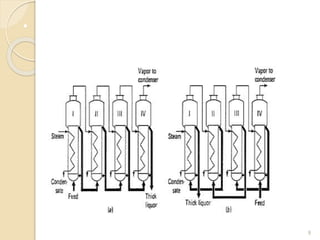
• Figure: (a) Forward feed (b) Backward feed flow patterns in four
effect evaporator.
10
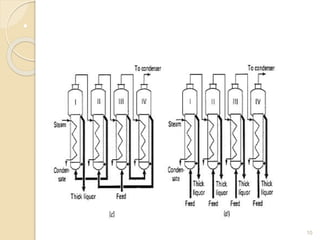
• Figure: (c) Mixed feed (d) Parallel feed flow patterns in four
effect evaporator.
Evaporation
11
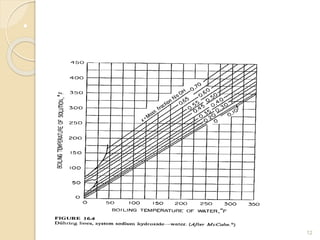
• Boiling point of solvent increases when some solute is added,
this phenomenon is called boiling point elevation.
• Duhring’s rule states that a linear relationship exists b/w the
temperatures at which two solutions exert the same vapor
pressure. The rule is often used to compare a pure liquid and a
solution at a given concentration.
Boiling point
elevation
12
• Duhring’s rule is a graphical representation of such a
relationship
Evaporation
13
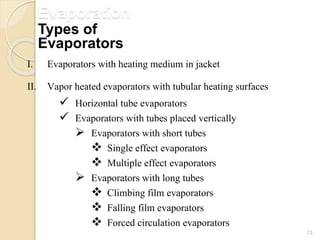
I. Evaporators with heating medium in jacket
II. Vapor heated evaporators with tubular heating surfaces
 Horizontal tube evaporators
 Evaporators with tubes placed vertically
 Evaporators with short tubes
 Single effect evaporators
 Multiple effect evaporators
 Evaporators with long tubes
 Climbing film evaporators
 Falling film evaporators
 Forced circulation evaporators
Types of
Evaporators
Evaporation
14
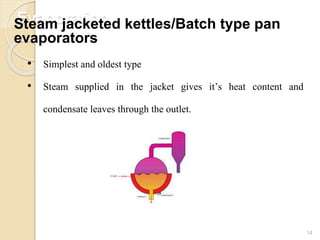
• Simplest and oldest type
• Steam supplied in the jacket gives it’s heat content and
condensate leaves through the outlet.
Steam jacketed kettles/Batch type pan
evaporators
Evaporation
15
• Used for both small scale and large scale operations
• Simple in construction and easy to operate
• Low maintenance and installation
Disadvantages
• Heat economy is less
• Not suitable for heat sensitive materials
• Heat transfer rate decreases drastically when the conc. increased
Advantages
Evaporation
16
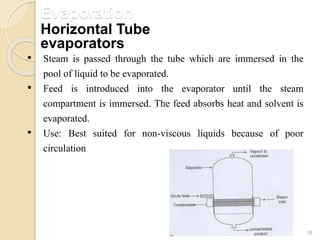
• Steam is passed through the tube which are immersed in the
pool of liquid to be evaporated.
• Feed is introduced into the evaporator until the steam
compartment is immersed. The feed absorbs heat and solvent is
evaporated.
• Use: Best suited for non-viscous liquids because of poor
circulation
Horizontal Tube
evaporators
Evaporation
17
• Liquid is passed through the vertical tubes and steam is supplied
from outside the tubes
• It consists of short vertical tubes, typically 1-2 m long and 50 –
100 mm in diameter are arranged inside the steam chest.
• The tube bundle is located in the bottom of the vessel
• Provides more heat transfer surface area
• Liquid level is to be maintained above the tubes/calandria
• Not suitable for solution which have solid particles
Vertical Tube
evaporators
Evaporation
18
• Liquid is passed through the vertical tubes and steam is supplied
from outside the tubes
• It consists of short vertical tubes, typically 1-2 m long and 50 –
100 mm in diameter are arranged inside the steam chest.
• The tube bundle is located in the bottom of the vessel
• Provides more heat transfer surface area
• Liquid level is to be maintained above the tubes/calandria
Climbing Film
evaporators
Evaporation
19
• The heat flux and the evaporator capacity are affected by the
overall heat transfer coefficient.
• The heat transfer coefficient is influenced by the design and
method of operation of the evaporator.
• Coefficient is a reciprocal of five individual resistances: the
steam film resistance, the two scale resistances, the tube wall
resistance, and the resistance from boiling liquid.
• Tube side solution, shell side steam
Heat transfer
coefficient
Evaporation
20
• Steam will have high heat transfer coefficient.
• Depends upon the type of condensation.
• No scaling as there is no solute
• The presence of noncondensable gas seriously reduces the steam
film coefficient.
• Tube side high possibility of scaling, thus often cleaning is
necessary
Steam film
coefficient
Evaporation
21
• Liquid side coefficient depends upon the velocity of liquid.
• In case of viscous materials, the resistance of the liquid side
controls the overall rate of heat transfer to the boiling liquid.
• Forced circulation gives higher heat transfer coefficient.
• Tube side high possibility of scaling, thus often cleaning is
necessary
Liquid-side
coefficient
22
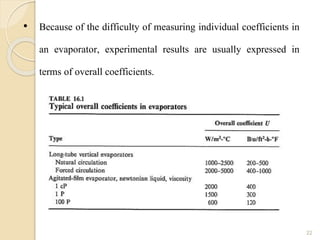
• Because of the difficulty of measuring individual coefficients in
an evaporator, experimental results are usually expressed in
terms of overall coefficients.
Evaporation
23
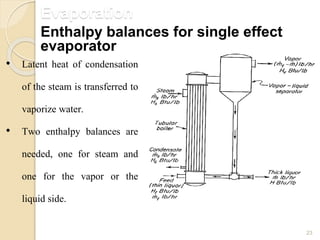
• Latent heat of condensation
of the steam is transferred to
vaporize water.
• Two enthalpy balances are
needed, one for steam and
one for the vapor or the
liquid side.
Enthalpy balances for single effect
evaporator
Evaporation
24
• In sugar industry
• In dehydrating milk, which is then used in many food products
• In fertilizer plants
Evaporation is not only removing water
• In the production of refined petroleum products, more volatile
compounds are evaporated off to separate the more crude
components
Industrial
applications

Evaporation ppt

  • 1.
  • 2.
    Evaporation 2 • Vaporization ofa solvent from a solution to make it concentrated.  Solvent volatile  Solute non-volatile in nature. Introduction • We are left with thick liquor • It is different from drying only, as in drying the solvent is vaporized to have a solid end product • Distillation and Evaporation
  • 3.
    Evaporation 3  Concentration ofsolution  Temperature sensitivity  Foaming  Scale formation  Other properties like freezing point, specific heat, gas liberation, toxicity level, radioactivity etc Feed characteristics Influencing Evaporation
  • 4.
    Evaporation 4 • Mostly madeof steel • For highly corrosive fluids, special materials are used like, Cu, Nickle, Stainless steel, aluminium etc Material of Construction
  • 5.
    Economy of Evaporator 5 Economy ofevaporator is the total mass of water vaporized per unit mass of steam input to the evaporator. Capacity of Evaporator Capacity of an evaporator is the amount of water vaporized in the evaporator per unit time. Ratio of capacity to economy is called the steam consumption per hour.
  • 6.
    Evaporation 6 • Nearly alwaysthe material to be evaporated flows inside the tubes. • The boiling liquid is subjected under moderate vacuum • Reducing the boiling temp of the liquid increases the temperature difference b/w the steam and the boiling liquid and thus increases the heat transfer rate in the evaporator. • When a single evaporator is used, the vapor from the boiling liquid is condensed and discarded. • Simple but does not use steam effectively. Single effect Evaporation
  • 7.
    Evaporation 7 • If thevapor from one evaporator is fed into the steam chest of a second evaporator and the vapor from the second is sent to the condenser, the operation becomes double effect. • The heat in the original steam is reused in the second effect and the evaporation economy increased. • Also useful one the feed temp is very low, preheating Multiple effect Evaporation
  • 8.
    Evaporation 8 • Forward feed •Backward feed • Mixed feed • Parallel feed Method of feeding There are four possible feeding arrangements Variations in the Multiple effect has come from the mode of feed supply
  • 9.
    9 • Figure: (a)Forward feed (b) Backward feed flow patterns in four effect evaporator.
  • 10.
    10 • Figure: (c)Mixed feed (d) Parallel feed flow patterns in four effect evaporator.
  • 11.
    Evaporation 11 • Boiling pointof solvent increases when some solute is added, this phenomenon is called boiling point elevation. • Duhring’s rule states that a linear relationship exists b/w the temperatures at which two solutions exert the same vapor pressure. The rule is often used to compare a pure liquid and a solution at a given concentration. Boiling point elevation
  • 12.
    12 • Duhring’s ruleis a graphical representation of such a relationship
  • 13.
    Evaporation 13 I. Evaporators withheating medium in jacket II. Vapor heated evaporators with tubular heating surfaces  Horizontal tube evaporators  Evaporators with tubes placed vertically  Evaporators with short tubes  Single effect evaporators  Multiple effect evaporators  Evaporators with long tubes  Climbing film evaporators  Falling film evaporators  Forced circulation evaporators Types of Evaporators
  • 14.
    Evaporation 14 • Simplest andoldest type • Steam supplied in the jacket gives it’s heat content and condensate leaves through the outlet. Steam jacketed kettles/Batch type pan evaporators
  • 15.
    Evaporation 15 • Used forboth small scale and large scale operations • Simple in construction and easy to operate • Low maintenance and installation Disadvantages • Heat economy is less • Not suitable for heat sensitive materials • Heat transfer rate decreases drastically when the conc. increased Advantages
  • 16.
    Evaporation 16 • Steam ispassed through the tube which are immersed in the pool of liquid to be evaporated. • Feed is introduced into the evaporator until the steam compartment is immersed. The feed absorbs heat and solvent is evaporated. • Use: Best suited for non-viscous liquids because of poor circulation Horizontal Tube evaporators
  • 17.
    Evaporation 17 • Liquid ispassed through the vertical tubes and steam is supplied from outside the tubes • It consists of short vertical tubes, typically 1-2 m long and 50 – 100 mm in diameter are arranged inside the steam chest. • The tube bundle is located in the bottom of the vessel • Provides more heat transfer surface area • Liquid level is to be maintained above the tubes/calandria • Not suitable for solution which have solid particles Vertical Tube evaporators
  • 18.
    Evaporation 18 • Liquid ispassed through the vertical tubes and steam is supplied from outside the tubes • It consists of short vertical tubes, typically 1-2 m long and 50 – 100 mm in diameter are arranged inside the steam chest. • The tube bundle is located in the bottom of the vessel • Provides more heat transfer surface area • Liquid level is to be maintained above the tubes/calandria Climbing Film evaporators
  • 19.
    Evaporation 19 • The heatflux and the evaporator capacity are affected by the overall heat transfer coefficient. • The heat transfer coefficient is influenced by the design and method of operation of the evaporator. • Coefficient is a reciprocal of five individual resistances: the steam film resistance, the two scale resistances, the tube wall resistance, and the resistance from boiling liquid. • Tube side solution, shell side steam Heat transfer coefficient
  • 20.
    Evaporation 20 • Steam willhave high heat transfer coefficient. • Depends upon the type of condensation. • No scaling as there is no solute • The presence of noncondensable gas seriously reduces the steam film coefficient. • Tube side high possibility of scaling, thus often cleaning is necessary Steam film coefficient
  • 21.
    Evaporation 21 • Liquid sidecoefficient depends upon the velocity of liquid. • In case of viscous materials, the resistance of the liquid side controls the overall rate of heat transfer to the boiling liquid. • Forced circulation gives higher heat transfer coefficient. • Tube side high possibility of scaling, thus often cleaning is necessary Liquid-side coefficient
  • 22.
    22 • Because ofthe difficulty of measuring individual coefficients in an evaporator, experimental results are usually expressed in terms of overall coefficients.
  • 23.
    Evaporation 23 • Latent heatof condensation of the steam is transferred to vaporize water. • Two enthalpy balances are needed, one for steam and one for the vapor or the liquid side. Enthalpy balances for single effect evaporator
  • 24.
    Evaporation 24 • In sugarindustry • In dehydrating milk, which is then used in many food products • In fertilizer plants Evaporation is not only removing water • In the production of refined petroleum products, more volatile compounds are evaporated off to separate the more crude components Industrial applications