INTRODUCTION TO ICT
https://www.slideshare.net/reygiebumagat/empo
werment-technology
EMPOWERMENTTECHNOLOGY
• How many times have you checked your phone this morning?
• How many status updates have you posted in Facebook,
Twitter or Instagram today?
• Do you follow a celebrity/crush via his/her social media
account?
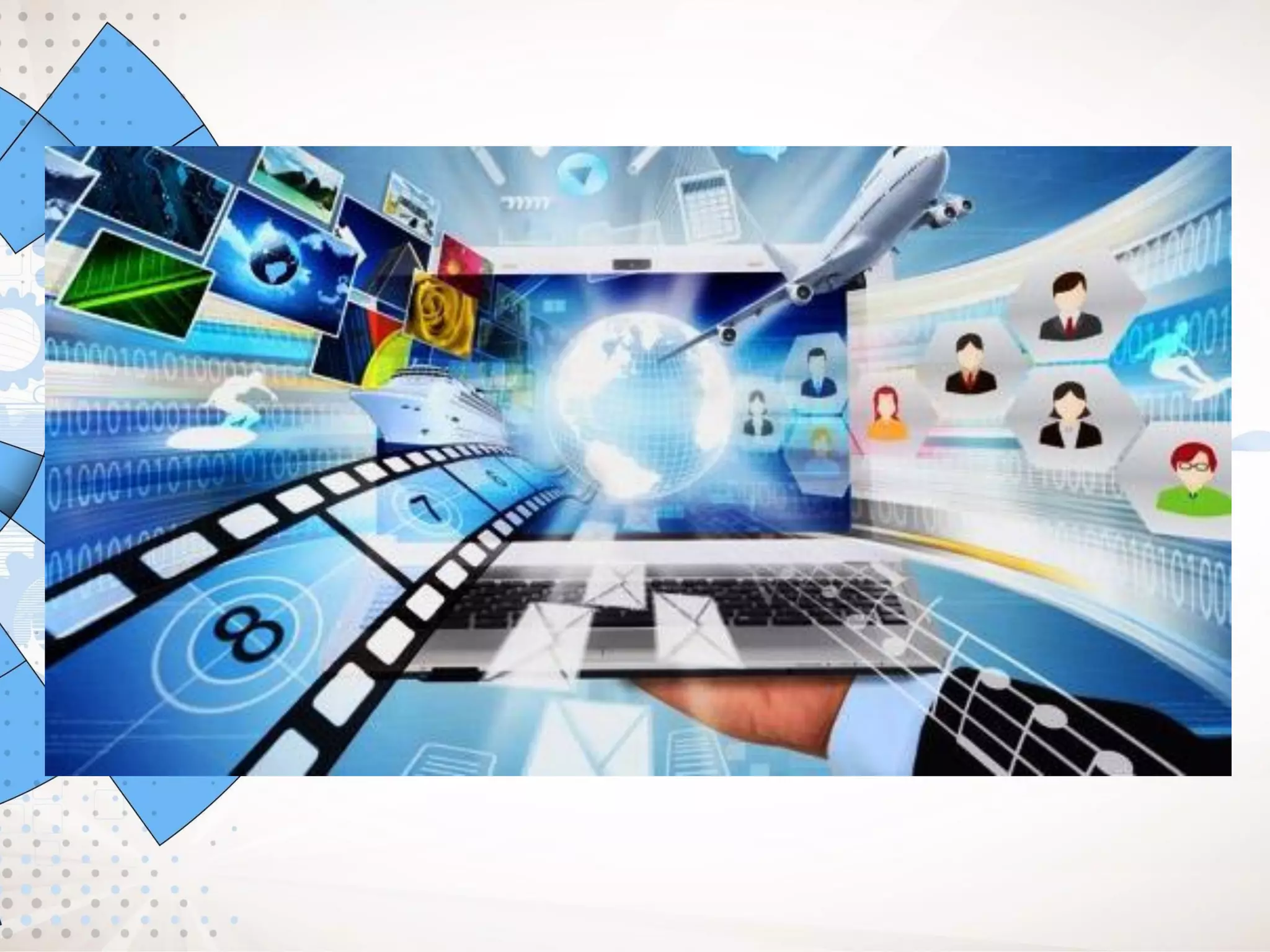
Information and Communication Technologies
- It deals with the use of different
communication technologies such as
mobile phones, telephone, Internet to
locate, save, send and edit information.
- Information and communications
technology (ICT) refers to all technology that
is used to handle telecommunication and
access information.
• the primary focus is on the access and
sharing of information and
communications.
• use of computers, radio, television,
cellular phones, internet connections,
satellite systems, applications needed
for video conferencing and distance
learning in the field of education.
ICT nowadays has also widened its
horizons in developing new tools or
emerging technologies. Mobile
devices can communicate through
the following communication
technologies:
• Wireless fidelity (Wi-Fi) – a type of
wireless local area network
technology.
• Bluetooth – uses packet-based
transmission over short range radio
signals.
• 3rd Generation (3G), 4th
Generation (4G)
• virtual private networks (VPN) –
secure access to a private network.
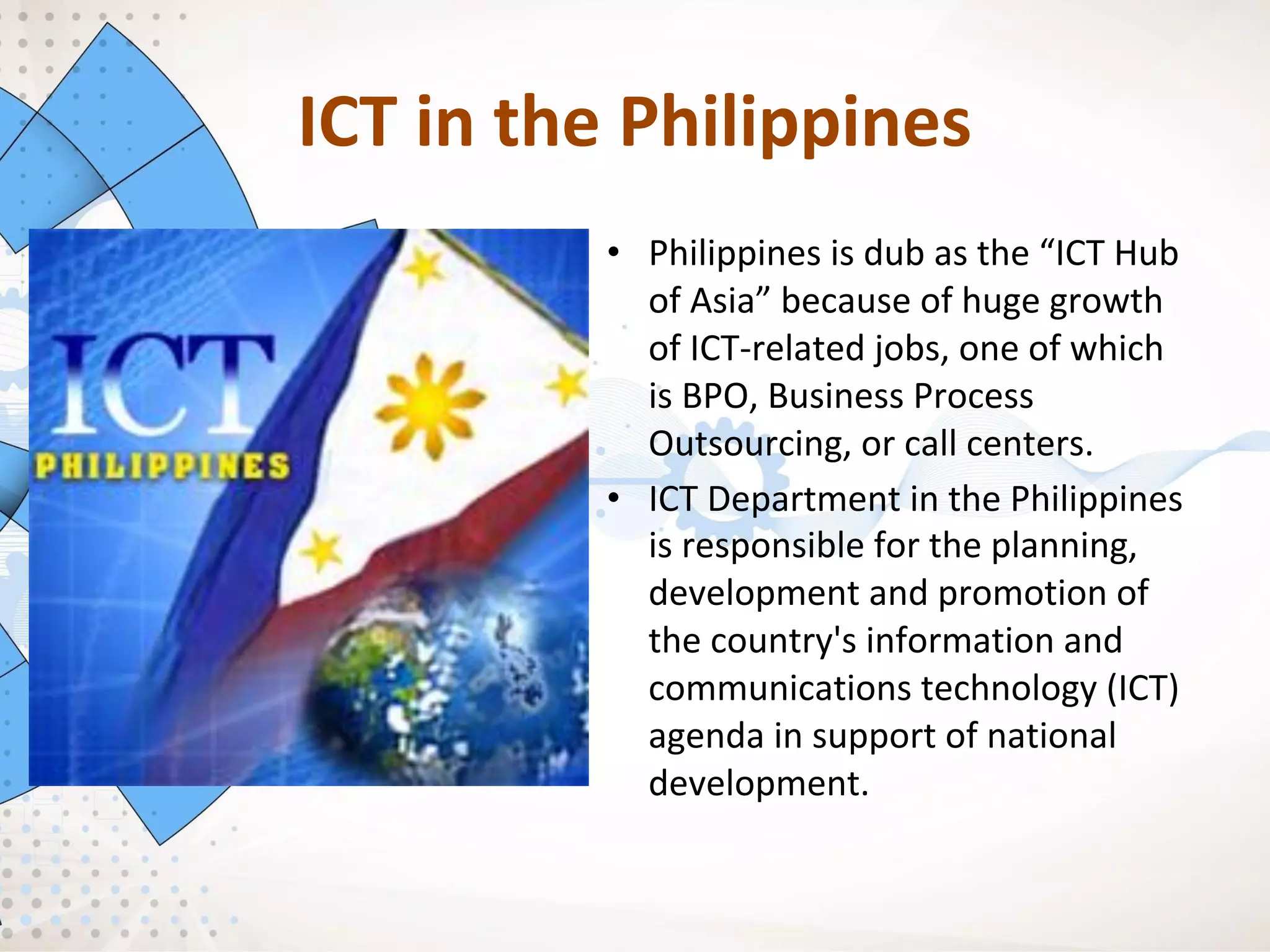
ICT in the Philippines
• Philippines is dub as the “ICT Hub
of Asia” because of huge growth
of ICT-related jobs, one of which
is BPO, Business Process
Outsourcing, or call centers.
• ICT Department in the Philippines
is responsible for the planning,
development and promotion of
the country's information and
communications technology (ICT)
agenda in support of national
development.
Internet
• is the global system of interconnected
computer networks that use
the Internet protocol (IP) to link billions of
devices worldwide.
• means of connecting a computer to any
other computer anywhere in the world via
dedicated routers and servers.
• sometimes called simply "the Net," is a
worldwide system of computer networks -
a network of networks in which users at
any one computer can get information
from any other computer
World Wide Web
• an information system on the Internet that
allows documents to be connected to other
documents by hypertext links, enabling the
user to search for information by moving
from one document to another.
• is an information space where documents
and other web resources are identified by
URLs, interlinked by hypertext links, and can
be accessed via the Internet.
• Invented by Tim-Berners Lee
Web Pages
• Web page is a hypertext document
connected to the World Wide Web.
• It is a document that is suitable for the
World Wide Web
Websites
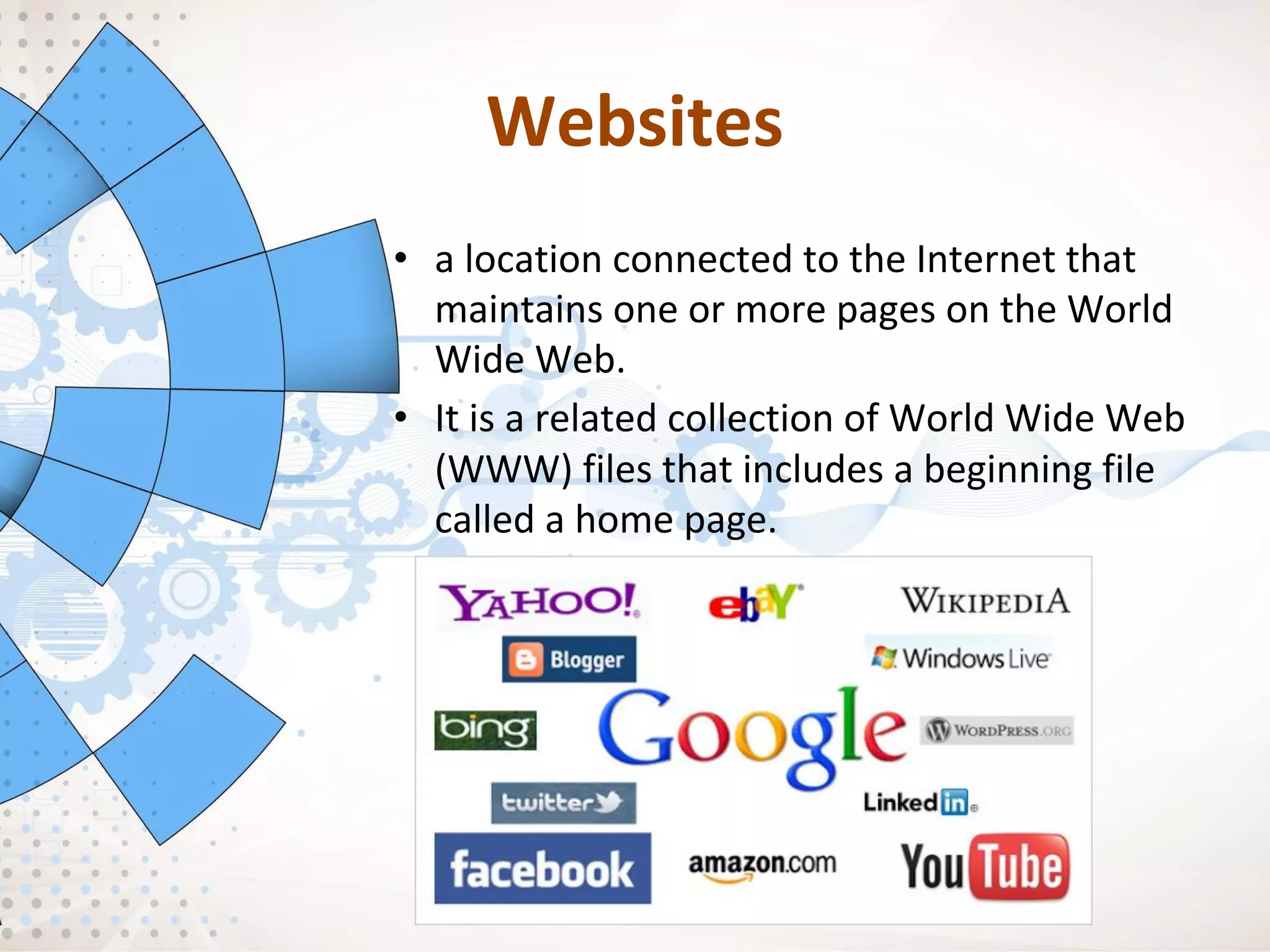
• a location connected to the Internet that
maintains one or more pages on the World
Wide Web.
• It is a related collection of World Wide Web
(WWW) files that includes a beginning file
called a home page.
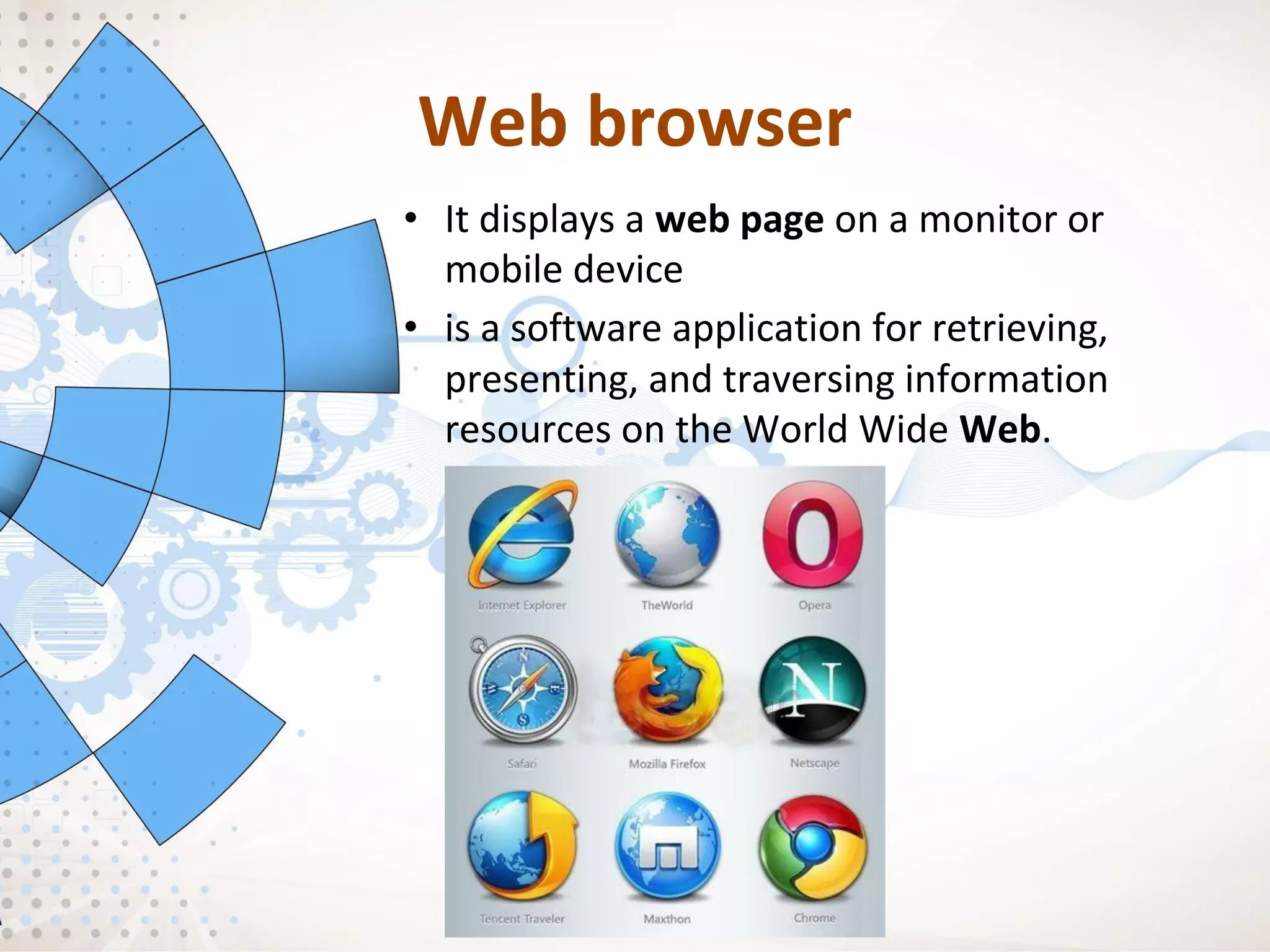
Web browser
• It displays a web page on a monitor or
mobile device
• is a software application for retrieving,
presenting, and traversing information
resources on the World Wide Web.
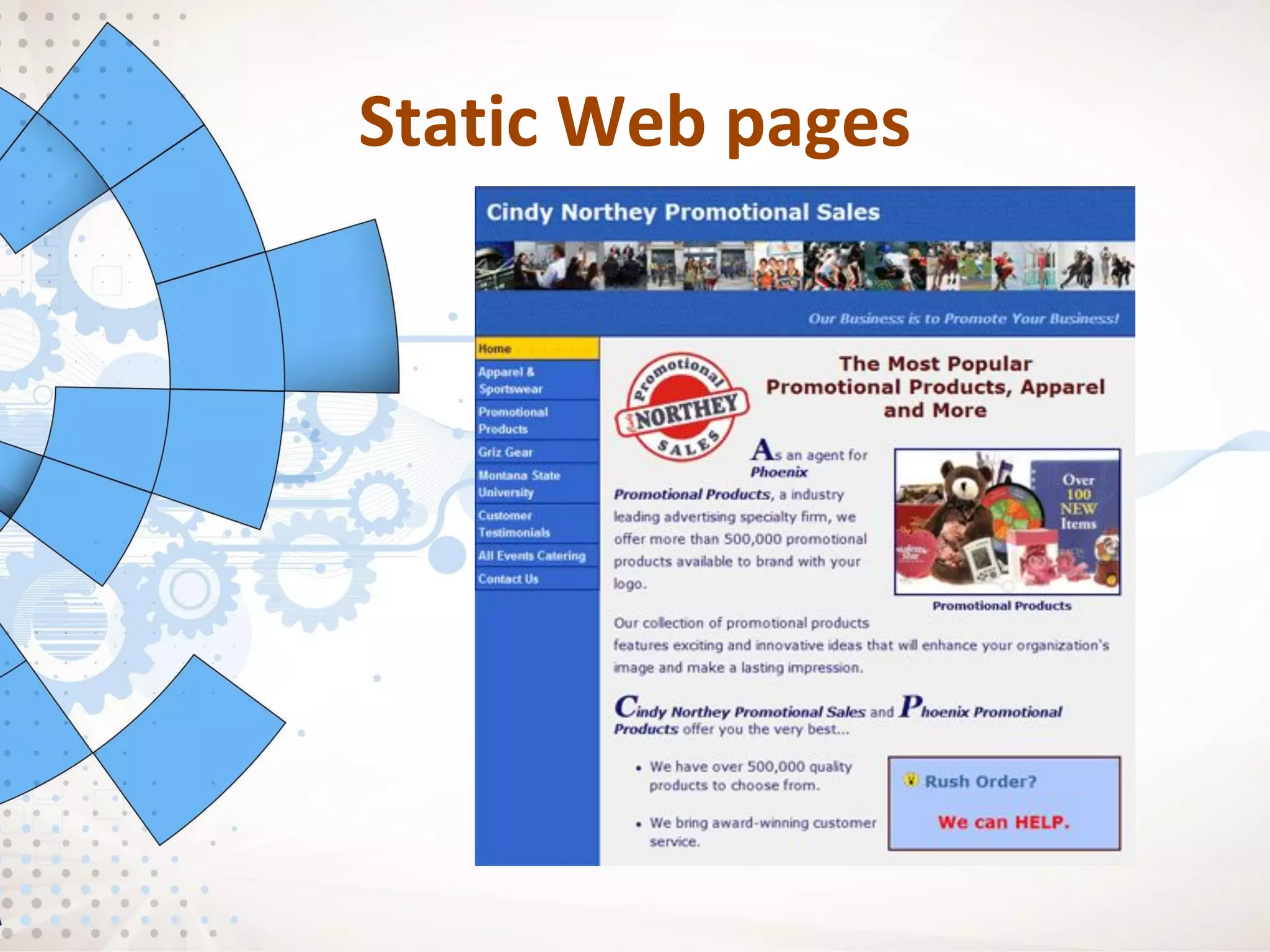
Static Web pages
• Static is Web 1.0
• Static web page is known as flat page or
stationary page in the sense that the page is
“as is” and cannot be manipulated by the
user.
• The content is also the same for all users
that is referred to as Web 1.0
Static Web pages
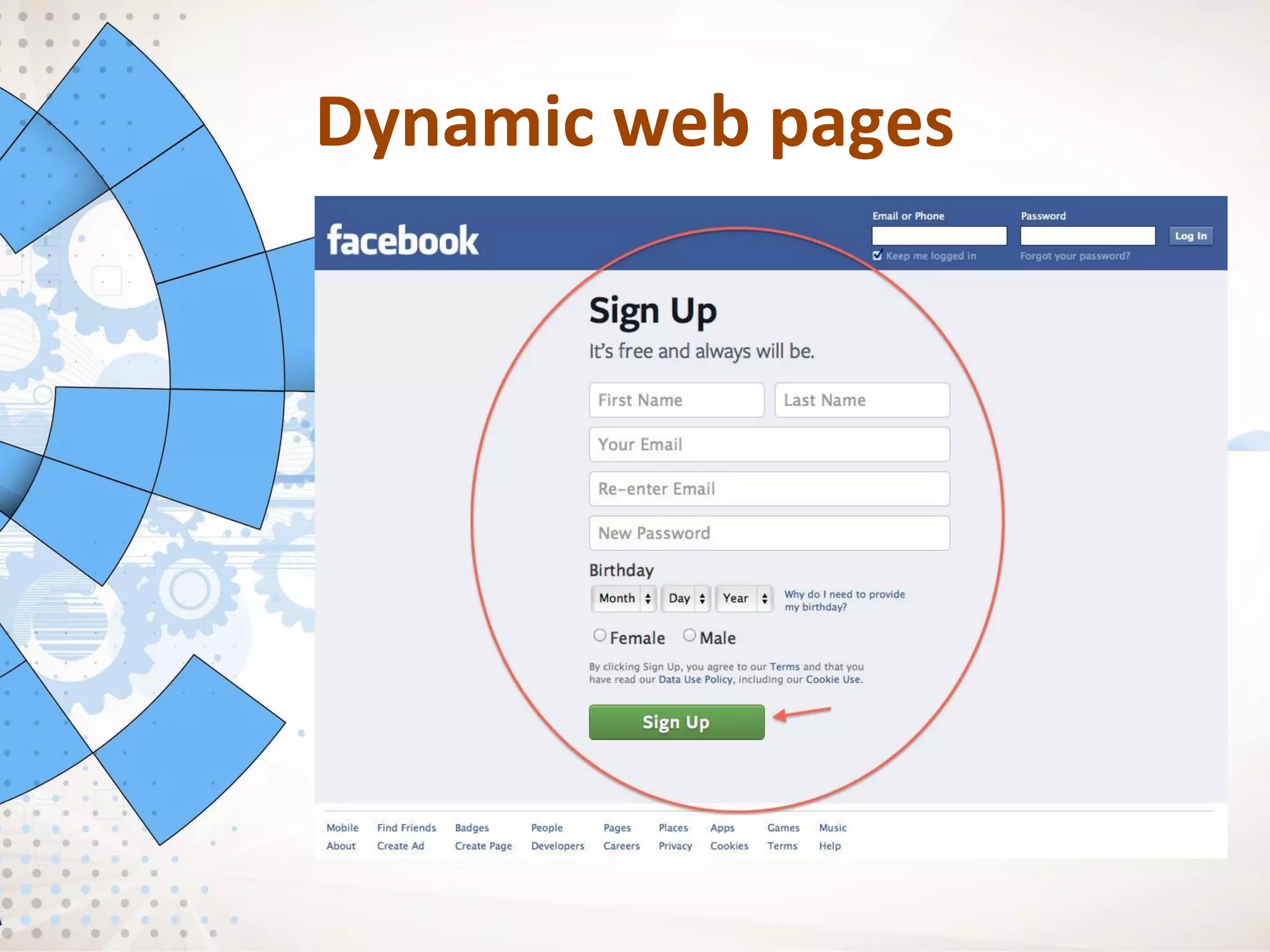
Dynamic Web pages
• web 2.0 is the evolution of Web 1.0 by
adding dynamic web pages
• The user is able to see website differently
than others e.g social networking sites,
wikis, video sharing sites
• Web 2.0 allows users to interact with the
page, the user may be able to comment or
create a user account
• Most website the we visit today are Web
2.0
Dynamic web pages
Static vs. Dynamic Web page
• Static" means unchanged or constant, while
"dynamic" means changing or lively.
• A static site is one that is usually written in
plain HTML and what is in the code of
the page is what is displayed to the user.
A dynamic site is one that is written using a
server-side scripting language such as PHP,
ASP, JSP, or ColdFusion.
Features of Web 2.0
1. Folksonomy- allows user to categorize and
classify information e.g tagging by facebook,
twitter, use tags that start with the pound
sign #, referred to as hashtag
2. Rich User Experience- content is dynamic
and is responsive to user’s input
3. User Participation- The owner of the website
is not the only one who is able to put
content. Others are able to place a content of
their own by means of comments, reviews,
and evaluation e.g lazada.com, amazon.com
Features of Web 2.0
5. Mass Participation- diverse information sharing
through universal web access. Web 2.0’s content
is based on people from various cultures
Trends in ICT
1. Convergence- is the synergy of technological
advancements to work on a similar goal or task
2. Social media- is a website, application, or online
channel that enables web users to create, co-create,
discuss, modify, and exchange user-generated
content.
Six Types of Social Media:
a. Social Networks- these are sites that allow you to
connect with other people with the same interests or
background.
b. Bookmarking Sites- these are sites that allow you
to store and manage links to various websites and
resources.
Trends in ICT
c. Social news- these are sites that allow users to post their
own news items or links to other news sources. The users can
also comment on the post and comments may also be ranked .
d. Media Sharing- these are sites that allow you to upload
and share media content like images, music, and video.
e. Microblogging- these are sites that focus on short
updates from the user. Those subscribed to the user will be
able to receive these updates.
f. Blogs and Forums- these websites allow users to post
their content. Other users are able to comment on the said
topic.
Trends in ICT
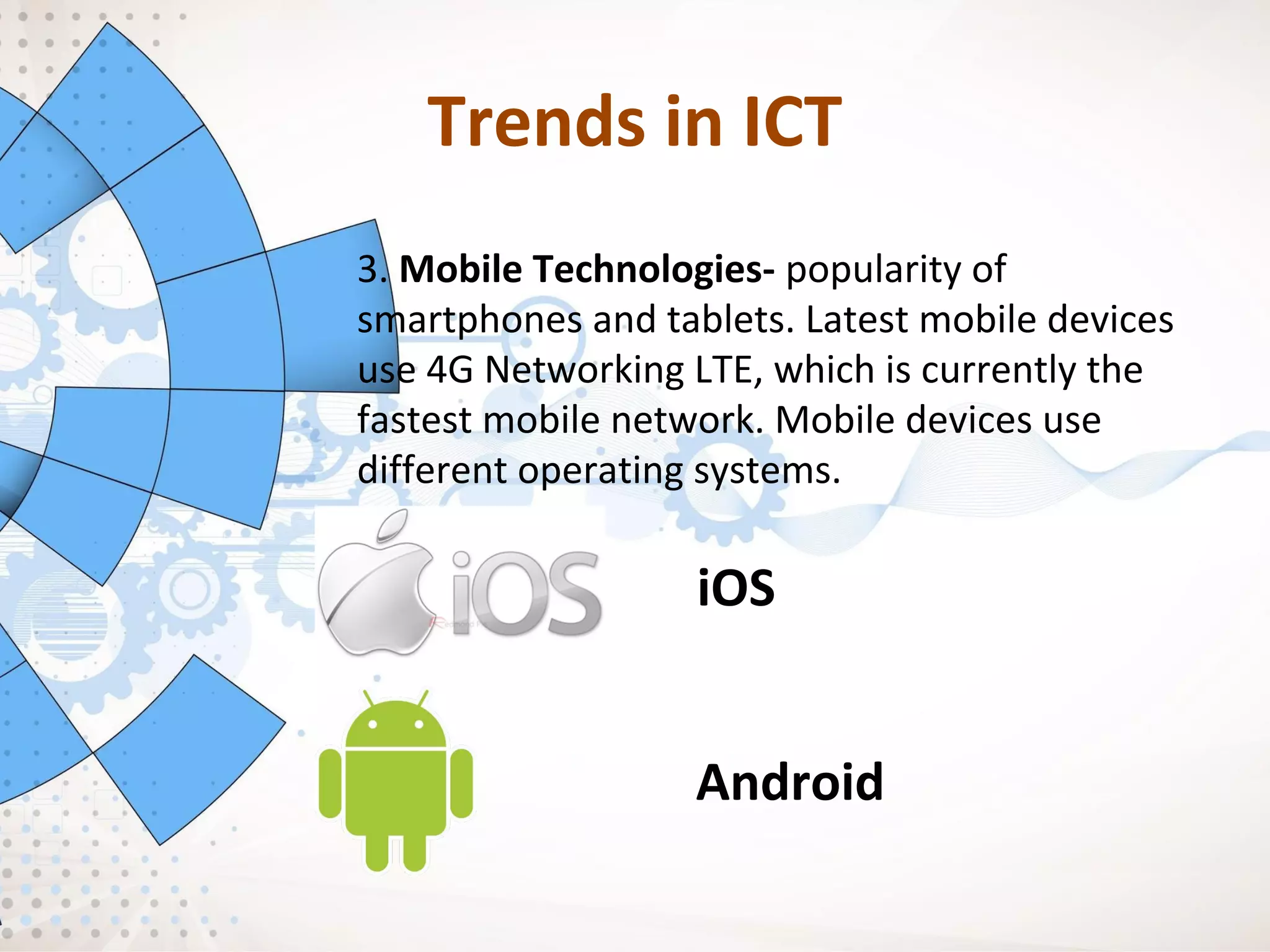
3. Mobile Technologies- popularity of
smartphones and tablets. Latest mobile devices
use 4G Networking LTE, which is currently the
fastest mobile network. Mobile devices use
different operating systems.
iOS
Android
Blackberry OS
Windows Phone OS
Symbian
Web OS
Windows Mobile
Trends in ICT
4. Assistive Media- is a nonprofit service
designed to help people who have visual and
reading impartments. A database of audio
recordings is used to read to the user.
Emerging Technologies
• 1. Artificial Intelligence (AI) – the
branch of computer science that
focused with making computers work
and act like humans.
• 2. Robotics – the field of computer
science and engineering concerned
with creating devices that can move
and react to sensory input. It is a form
of artificial intelligence.
3. Biometrics – in ICT, biometrics is
the technology used to measure and
analyze human body characteristics
such as DNA, fingerprints, eye retinas
and irises, voice patterns, facial
patterns, and hand measurements,
mainly for authentication purposes.
4. Quantum cryptography – the
science of encoding and decoding
information or messages. It is used for
information privacy and security.
5. Computer-assisted translation
(CAT) – the use of computers to
assist in the translation of one or
more natural languages into
another or others, and vice versa.
6. 3-D imaging and holography –
Holography is a photographic
technique that uses light to
project objects in a way that
appears three-dimensional.
7. Virtual reality – the term used
to describe a three-dimensional,
computer-generated
environment that can be explored
and interacted with by a person.
Pre-Learning Check
1. Give the meaning of
the ff. acronyms and
abbreviations
a) ICT
b) WAN
c) .com
d) .edu
Pre-Learning Check
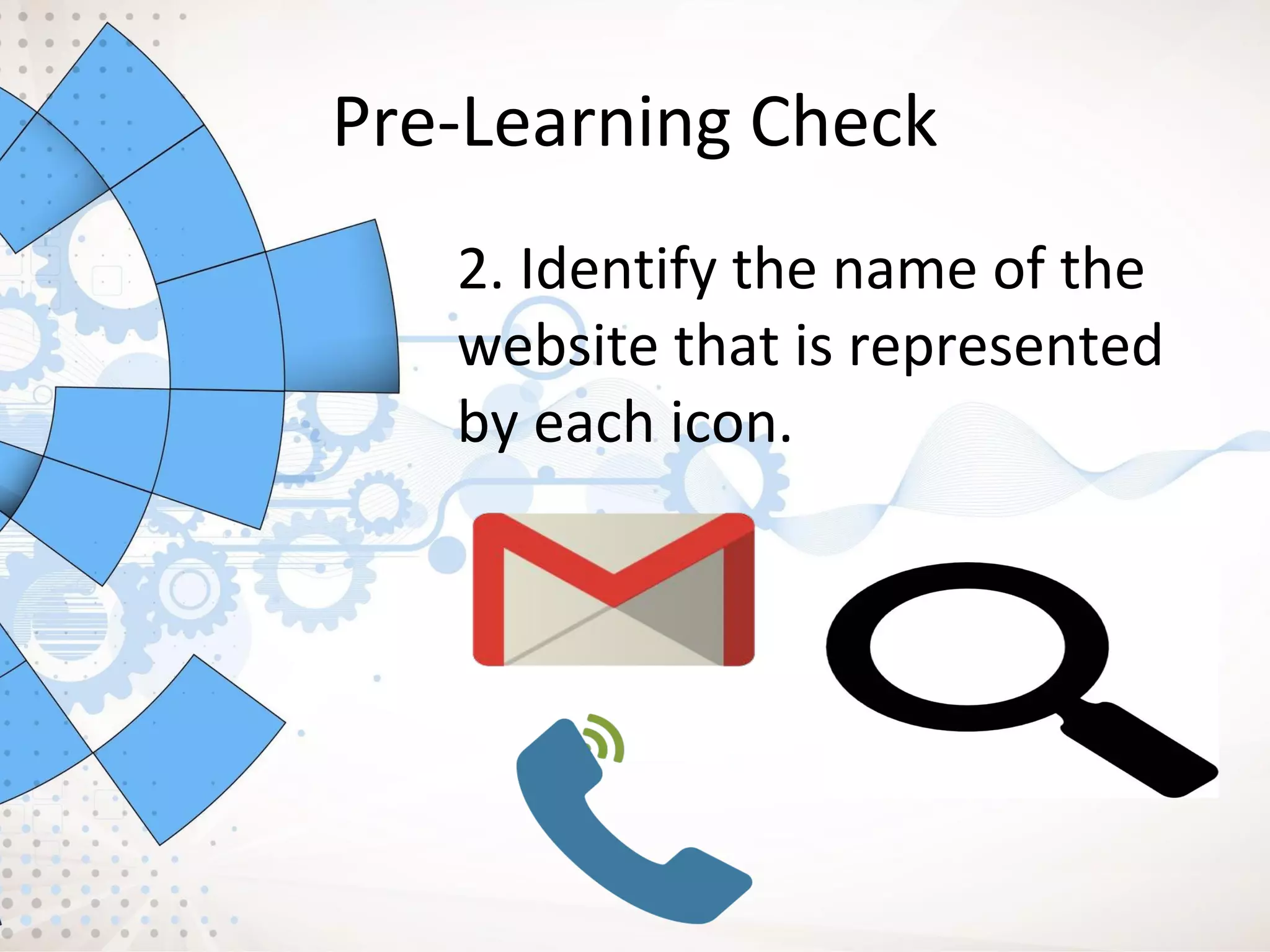
2. Identify the name of the
website that is represented
by each icon.
Quick Quiz
1. Which of the ff. devices
uses Bluetooth or Wi-Fi to
communicate?
a) Landline phone
b) Tablet
c) Fax machine
d) radio
Quick Quiz
2. Using word
processing software,
create an essay
describing the roles
of ICT in your daily
living.
Key Terms
• Web 1.0- static website without interactivity
• Web 2.0- websites that contain dynamic content
• Web 3.0- a concept of the World Wide Web that is designed to
cater to the individual user
• Static-refers to the web that are the same regardless of the user
• Folksonomy- allows users to categorize and classify/ arrange
information
• Hashtag- used to categorize posts in website
• Convergence- the synergy of technological advancements to work
on a similar goal or task
• Social media- websites, applications, or online channels that
enable users to create, co-create, discuss, modify, and exchange
user-generated content.

Introduction to ICT

  • 1.
  • 2.
    • How manytimes have you checked your phone this morning? • How many status updates have you posted in Facebook, Twitter or Instagram today? • Do you follow a celebrity/crush via his/her social media account?
  • 4.
    Information and CommunicationTechnologies - It deals with the use of different communication technologies such as mobile phones, telephone, Internet to locate, save, send and edit information. - Information and communications technology (ICT) refers to all technology that is used to handle telecommunication and access information.
  • 5.
    • the primaryfocus is on the access and sharing of information and communications. • use of computers, radio, television, cellular phones, internet connections, satellite systems, applications needed for video conferencing and distance learning in the field of education.
  • 6.
    ICT nowadays hasalso widened its horizons in developing new tools or emerging technologies. Mobile devices can communicate through the following communication technologies:
  • 7.
    • Wireless fidelity(Wi-Fi) – a type of wireless local area network technology. • Bluetooth – uses packet-based transmission over short range radio signals. • 3rd Generation (3G), 4th Generation (4G) • virtual private networks (VPN) – secure access to a private network.
  • 8.
    ICT in thePhilippines • Philippines is dub as the “ICT Hub of Asia” because of huge growth of ICT-related jobs, one of which is BPO, Business Process Outsourcing, or call centers. • ICT Department in the Philippines is responsible for the planning, development and promotion of the country's information and communications technology (ICT) agenda in support of national development.
  • 9.
    Internet • is theglobal system of interconnected computer networks that use the Internet protocol (IP) to link billions of devices worldwide. • means of connecting a computer to any other computer anywhere in the world via dedicated routers and servers. • sometimes called simply "the Net," is a worldwide system of computer networks - a network of networks in which users at any one computer can get information from any other computer
  • 10.
    World Wide Web •an information system on the Internet that allows documents to be connected to other documents by hypertext links, enabling the user to search for information by moving from one document to another. • is an information space where documents and other web resources are identified by URLs, interlinked by hypertext links, and can be accessed via the Internet. • Invented by Tim-Berners Lee
  • 12.
    Web Pages • Webpage is a hypertext document connected to the World Wide Web. • It is a document that is suitable for the World Wide Web
  • 13.
    Websites • a locationconnected to the Internet that maintains one or more pages on the World Wide Web. • It is a related collection of World Wide Web (WWW) files that includes a beginning file called a home page.
  • 14.
    Web browser • Itdisplays a web page on a monitor or mobile device • is a software application for retrieving, presenting, and traversing information resources on the World Wide Web.
  • 15.
    Static Web pages •Static is Web 1.0 • Static web page is known as flat page or stationary page in the sense that the page is “as is” and cannot be manipulated by the user. • The content is also the same for all users that is referred to as Web 1.0
  • 16.
  • 17.
    Dynamic Web pages •web 2.0 is the evolution of Web 1.0 by adding dynamic web pages • The user is able to see website differently than others e.g social networking sites, wikis, video sharing sites • Web 2.0 allows users to interact with the page, the user may be able to comment or create a user account • Most website the we visit today are Web 2.0
  • 18.
  • 19.
    Static vs. DynamicWeb page • Static" means unchanged or constant, while "dynamic" means changing or lively. • A static site is one that is usually written in plain HTML and what is in the code of the page is what is displayed to the user. A dynamic site is one that is written using a server-side scripting language such as PHP, ASP, JSP, or ColdFusion.
  • 20.
    Features of Web2.0 1. Folksonomy- allows user to categorize and classify information e.g tagging by facebook, twitter, use tags that start with the pound sign #, referred to as hashtag 2. Rich User Experience- content is dynamic and is responsive to user’s input 3. User Participation- The owner of the website is not the only one who is able to put content. Others are able to place a content of their own by means of comments, reviews, and evaluation e.g lazada.com, amazon.com
  • 21.
    Features of Web2.0 5. Mass Participation- diverse information sharing through universal web access. Web 2.0’s content is based on people from various cultures
  • 22.
    Trends in ICT 1.Convergence- is the synergy of technological advancements to work on a similar goal or task 2. Social media- is a website, application, or online channel that enables web users to create, co-create, discuss, modify, and exchange user-generated content. Six Types of Social Media: a. Social Networks- these are sites that allow you to connect with other people with the same interests or background. b. Bookmarking Sites- these are sites that allow you to store and manage links to various websites and resources.
  • 23.
    Trends in ICT c.Social news- these are sites that allow users to post their own news items or links to other news sources. The users can also comment on the post and comments may also be ranked . d. Media Sharing- these are sites that allow you to upload and share media content like images, music, and video. e. Microblogging- these are sites that focus on short updates from the user. Those subscribed to the user will be able to receive these updates. f. Blogs and Forums- these websites allow users to post their content. Other users are able to comment on the said topic.
  • 24.
    Trends in ICT 3.Mobile Technologies- popularity of smartphones and tablets. Latest mobile devices use 4G Networking LTE, which is currently the fastest mobile network. Mobile devices use different operating systems. iOS Android
  • 25.
    Blackberry OS Windows PhoneOS Symbian Web OS Windows Mobile
  • 26.
    Trends in ICT 4.Assistive Media- is a nonprofit service designed to help people who have visual and reading impartments. A database of audio recordings is used to read to the user.
  • 27.
    Emerging Technologies • 1.Artificial Intelligence (AI) – the branch of computer science that focused with making computers work and act like humans. • 2. Robotics – the field of computer science and engineering concerned with creating devices that can move and react to sensory input. It is a form of artificial intelligence.
  • 28.
    3. Biometrics –in ICT, biometrics is the technology used to measure and analyze human body characteristics such as DNA, fingerprints, eye retinas and irises, voice patterns, facial patterns, and hand measurements, mainly for authentication purposes. 4. Quantum cryptography – the science of encoding and decoding information or messages. It is used for information privacy and security.
  • 29.
    5. Computer-assisted translation (CAT)– the use of computers to assist in the translation of one or more natural languages into another or others, and vice versa. 6. 3-D imaging and holography – Holography is a photographic technique that uses light to project objects in a way that appears three-dimensional.
  • 30.
    7. Virtual reality– the term used to describe a three-dimensional, computer-generated environment that can be explored and interacted with by a person.
  • 31.
    Pre-Learning Check 1. Givethe meaning of the ff. acronyms and abbreviations a) ICT b) WAN c) .com d) .edu
  • 32.
    Pre-Learning Check 2. Identifythe name of the website that is represented by each icon.
  • 33.
    Quick Quiz 1. Whichof the ff. devices uses Bluetooth or Wi-Fi to communicate? a) Landline phone b) Tablet c) Fax machine d) radio
  • 34.
    Quick Quiz 2. Usingword processing software, create an essay describing the roles of ICT in your daily living.
  • 35.
    Key Terms • Web1.0- static website without interactivity • Web 2.0- websites that contain dynamic content • Web 3.0- a concept of the World Wide Web that is designed to cater to the individual user • Static-refers to the web that are the same regardless of the user • Folksonomy- allows users to categorize and classify/ arrange information • Hashtag- used to categorize posts in website • Convergence- the synergy of technological advancements to work on a similar goal or task • Social media- websites, applications, or online channels that enable users to create, co-create, discuss, modify, and exchange user-generated content.