Volume B Chapter 25 Transmission of Heat
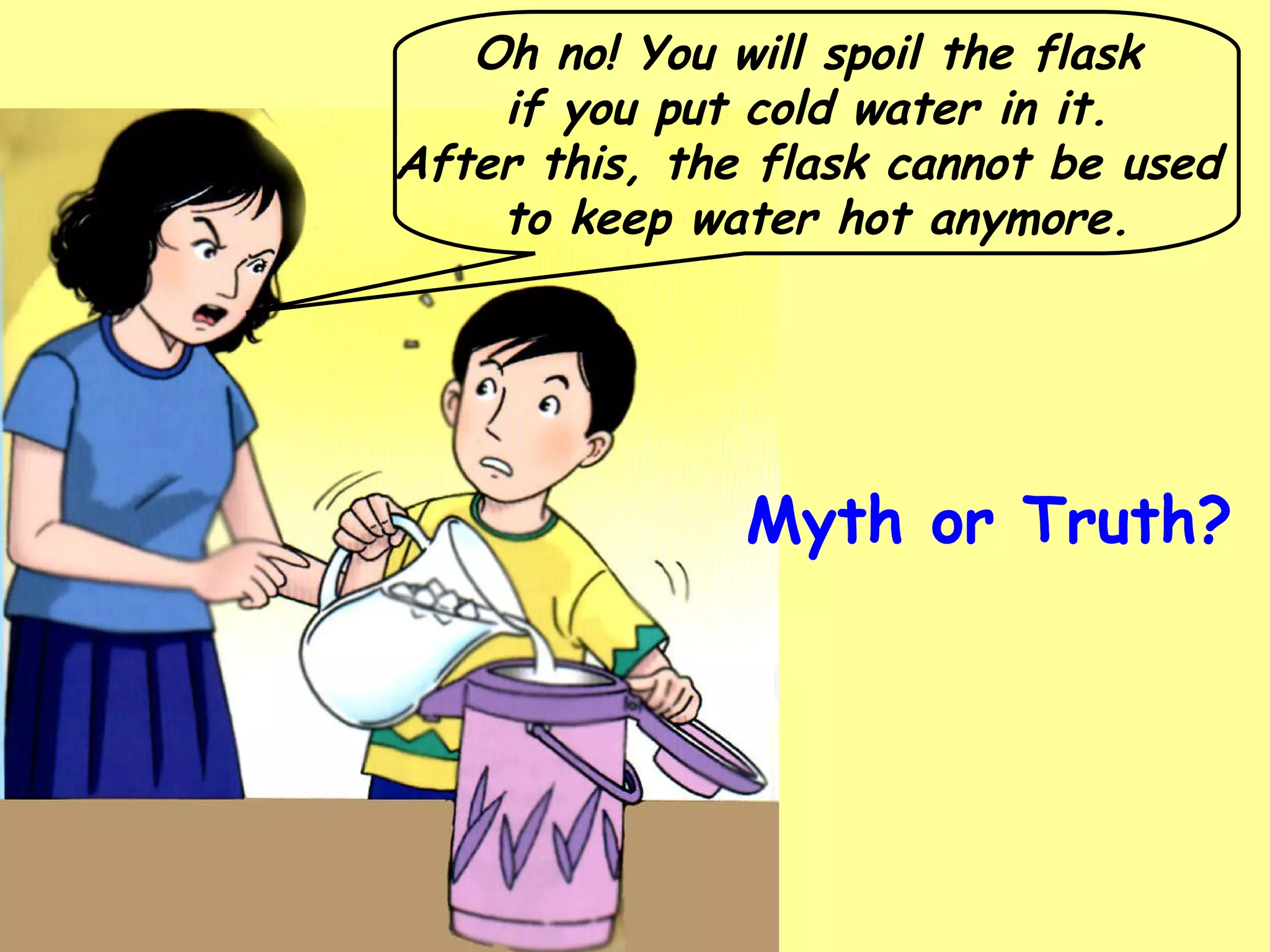
Oh no! You will spoil the flask  if you put cold water in it.  After this, the flask cannot be used  to keep water hot anymore. Myth or Truth?
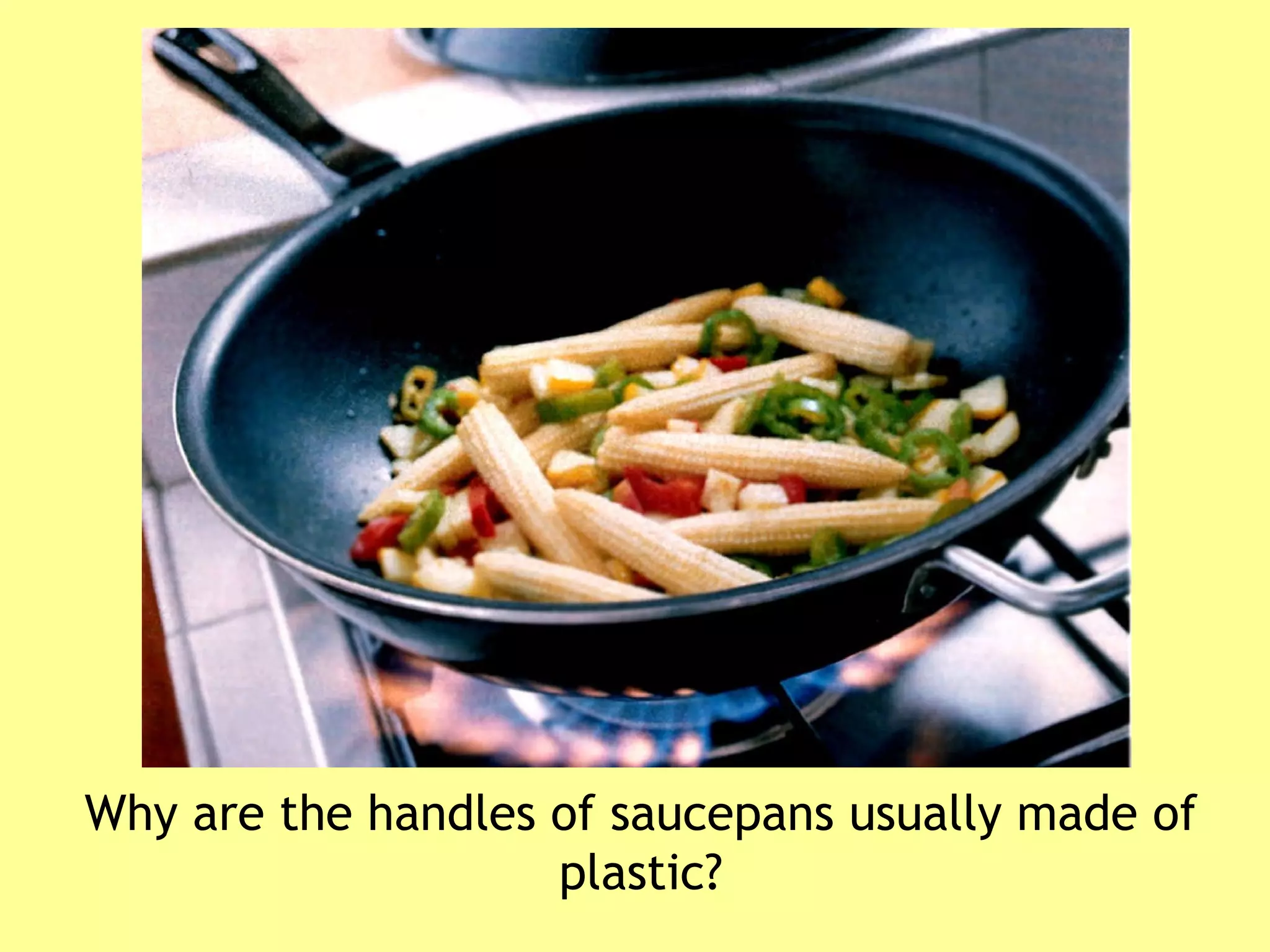
Why are the handles of saucepans usually made of plastic?
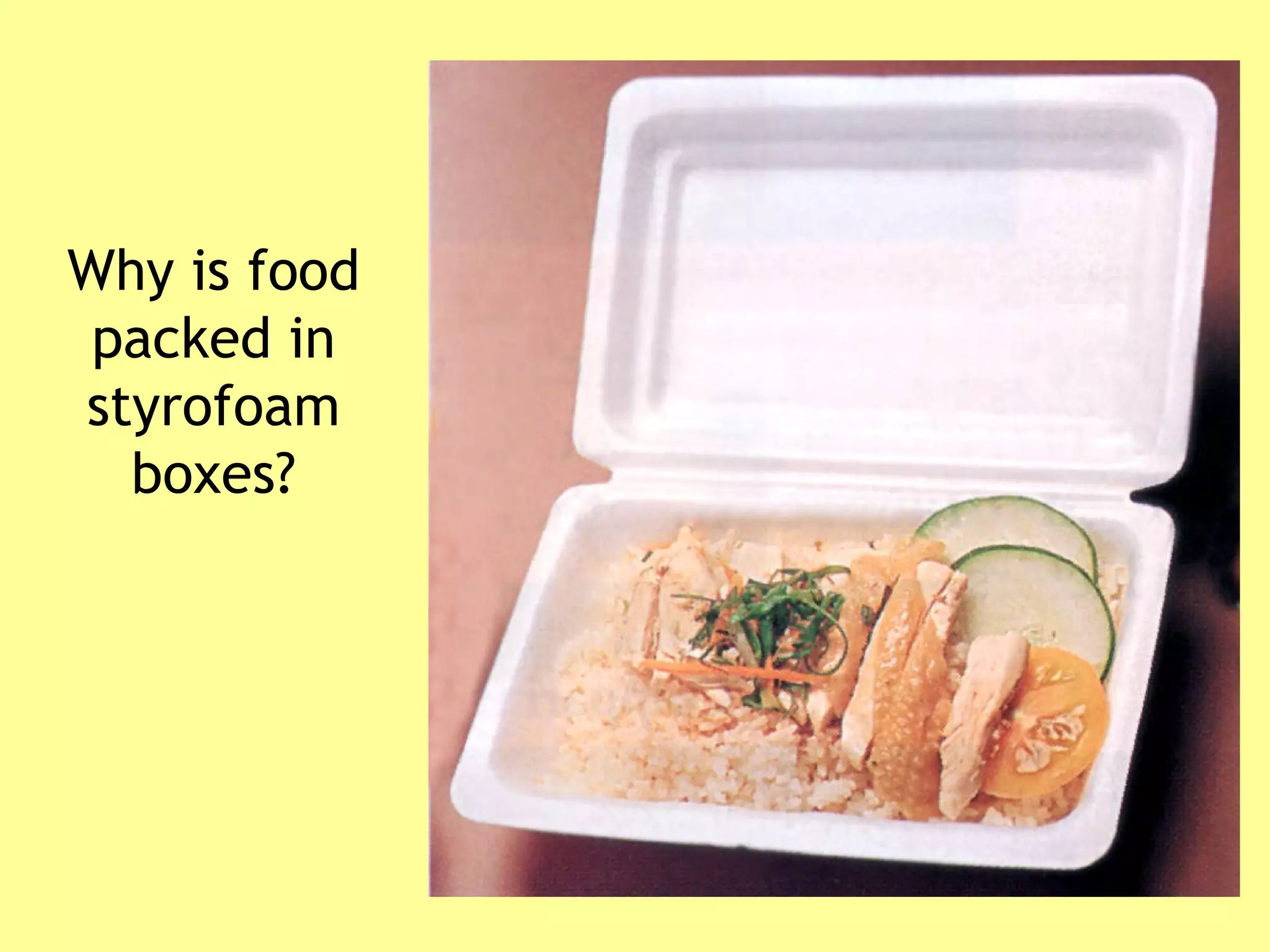
Why is food packed in styrofoam boxes?
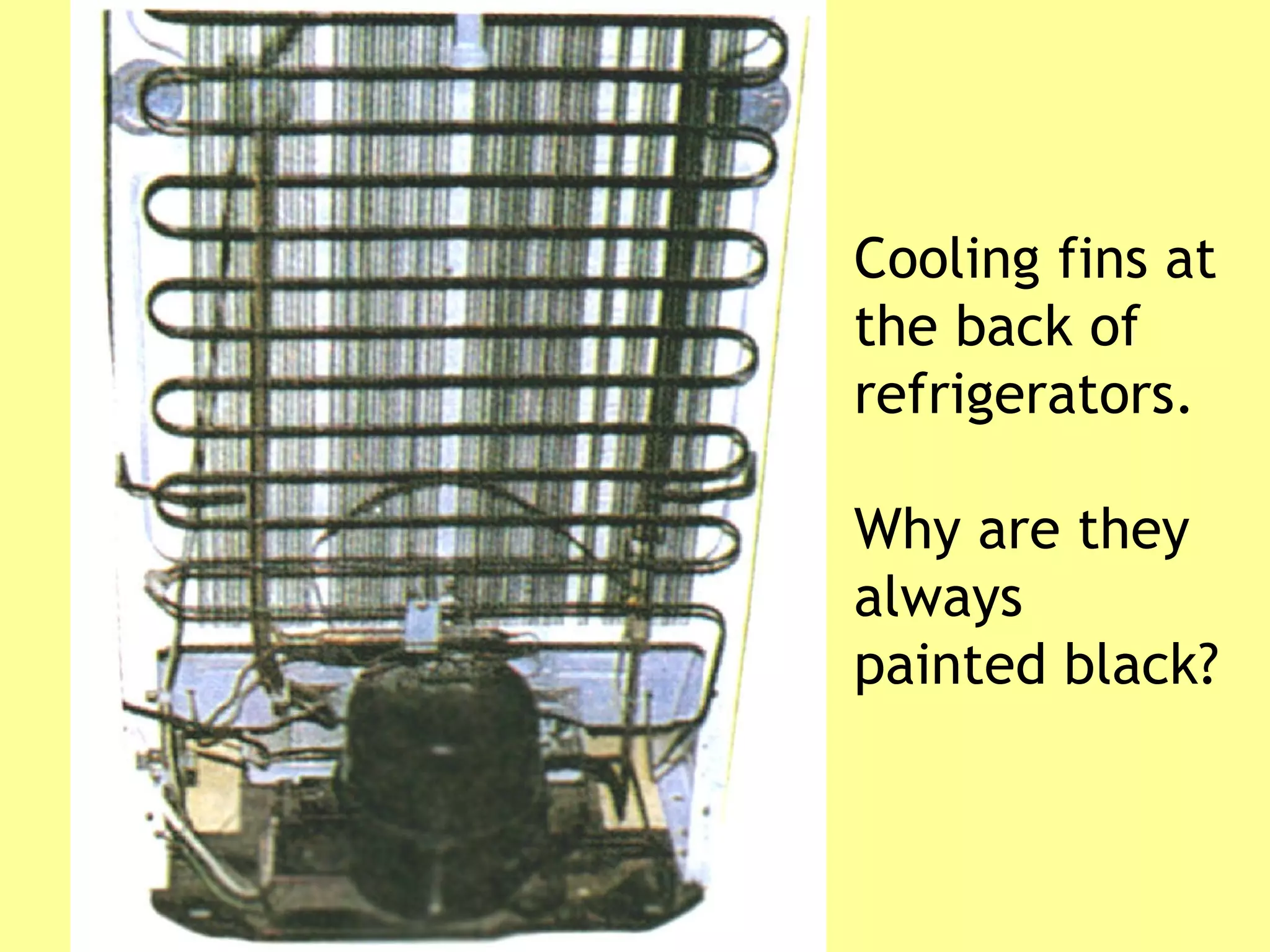
Cooling fins at the back of refrigerators. Why are they always painted black?
Explain what is meant by conduction, convection & radiation The volume & density of a substance will change during thermal expansion Different materials have different rates of heat flow What we will learn…
Heat is a form of  energy  that is transmitted from a  region of higher to lower temperature . Heat Moves!
IN 3 WAYS… CONDUCTION CONVECTION RADIATION Heat Moves!
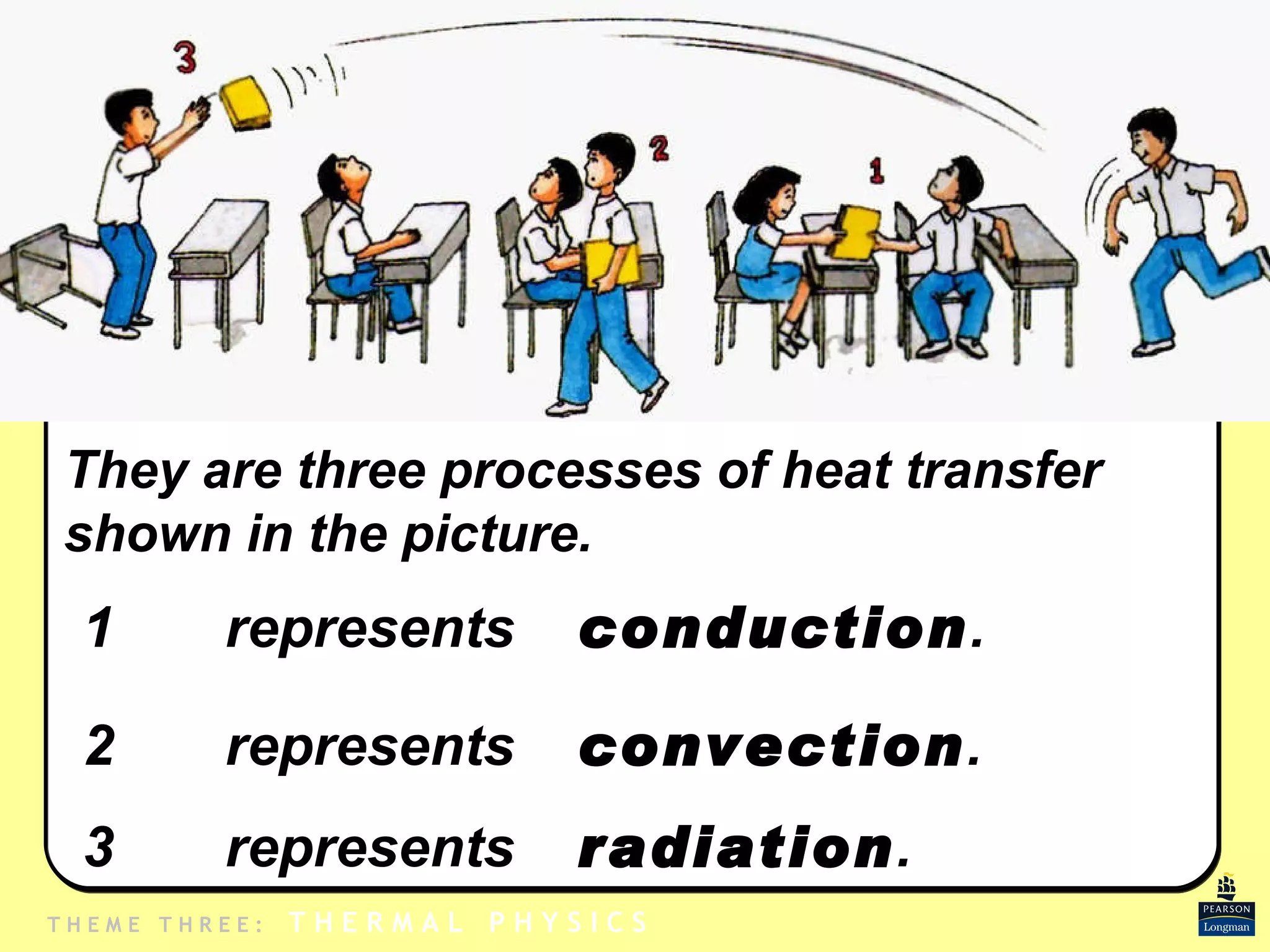
They are three processes of heat transfer shown in the picture. 1  represents  2  represents 3  represents conduction . convection . radiation .
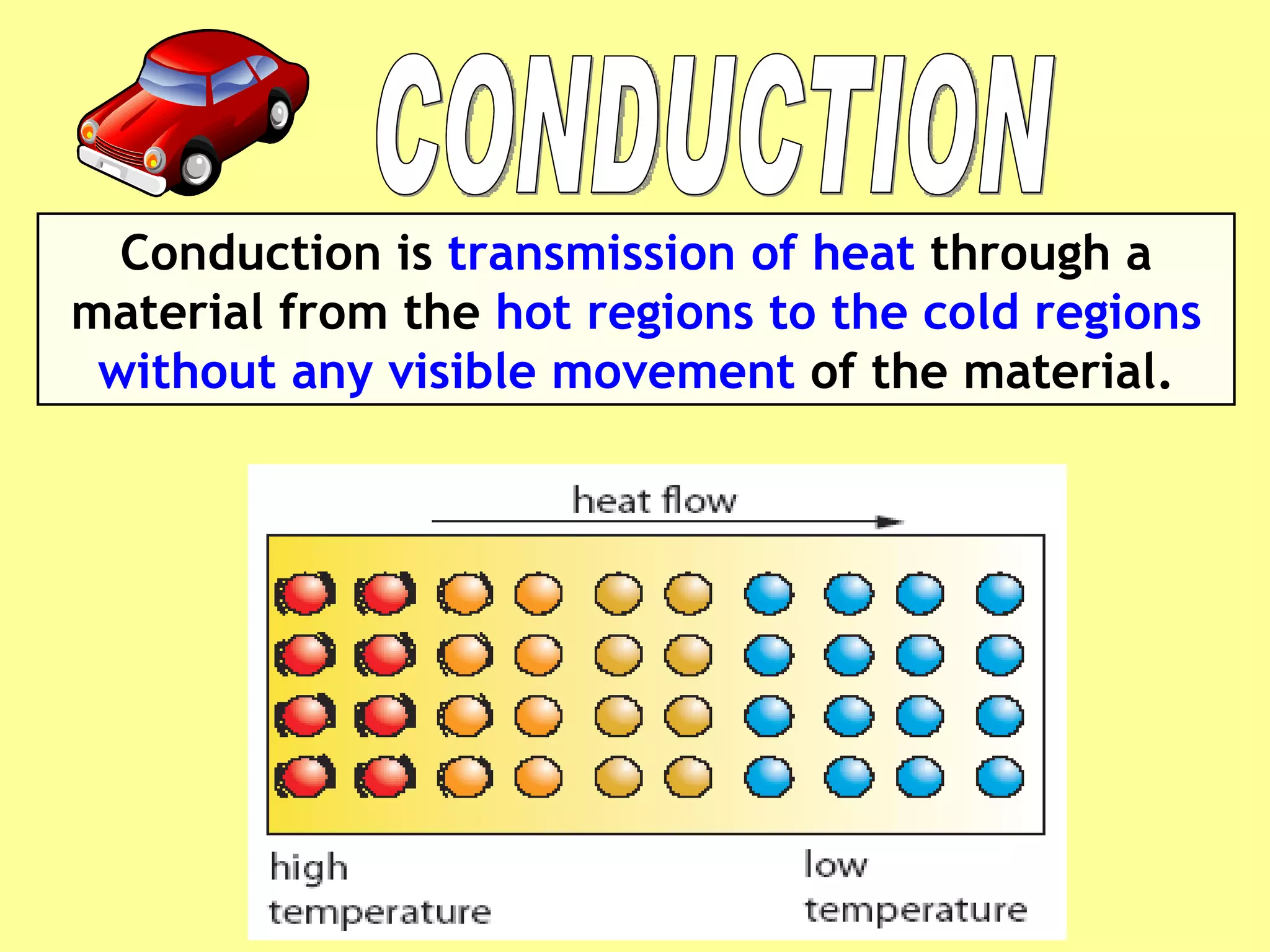
Conduction is  transmission of heat  through a material from the  hot regions to the cold regions   without any visible movement  of the material. CONDUCTION
CONDUCTION Solids are  better conductors  of heat than liquids and gases as solid particles are  closer  together.  Thus, kinetic energy is transferred  more quickly  in solids. See movie
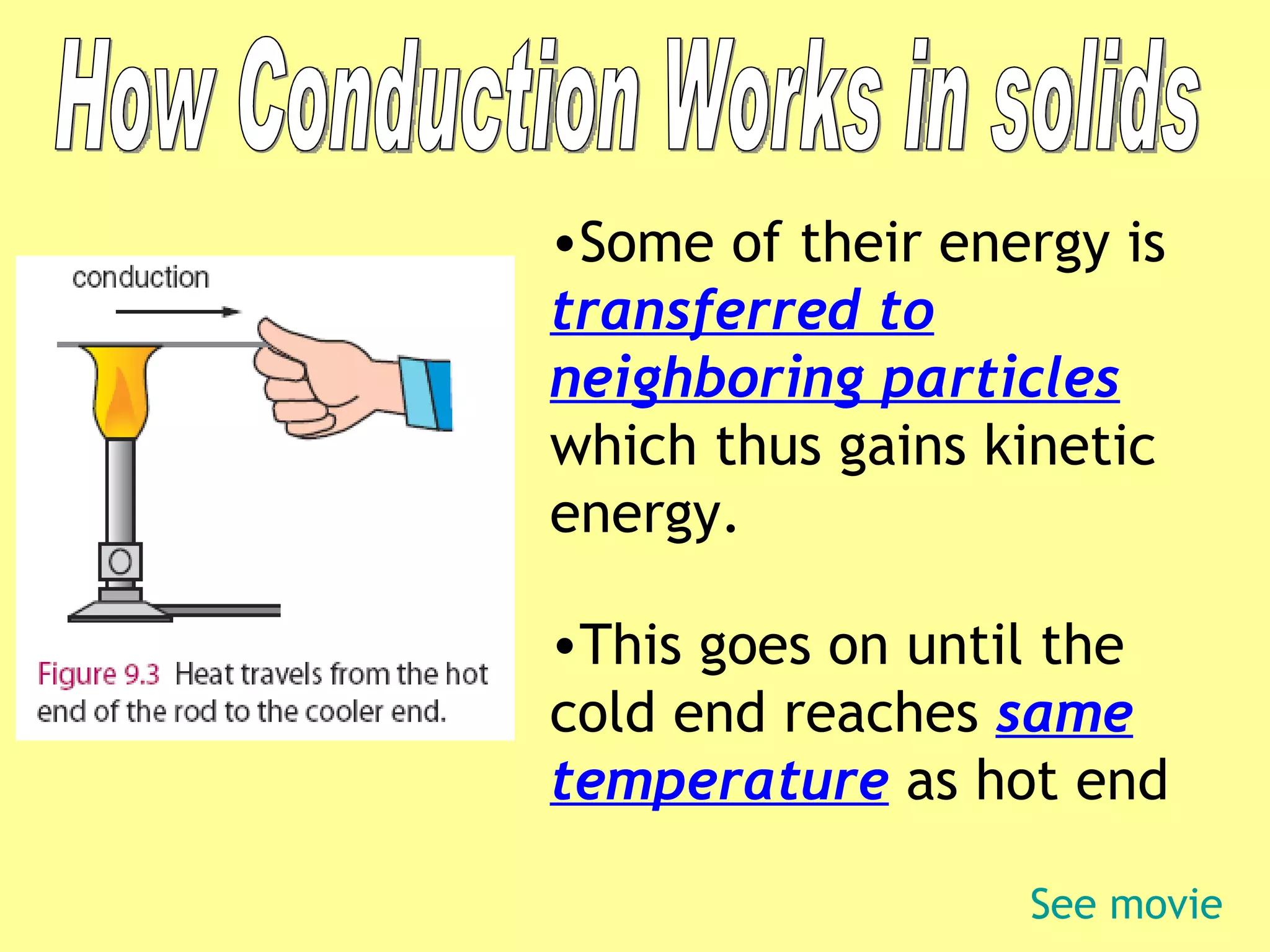
How Conduction Works in solids When one end of a rod is heated, particles there  gain energy  and  vibrate faster . These particles  collide   with less energetic neighbors.
How Conduction Works in solids Some of their energy is  transferred to neighboring particles   which thus gains kinetic energy. This goes on until the cold end reaches  same temperature  as hot end See movie
Conduction of heat through solids Observation :  Observe the lengths of wax that have melted on the different rods in a given interval of time . Wood Iron Aluminium Copper
Process : When a metal is heated,  free electrons  gain energy and move faster. They move in the  spaces between atoms  before  colliding  with some atoms and  transferring energy  to them. Metals conduct heat much  faster   then non-metals as they have  free electrons. Conduction of heat by metals
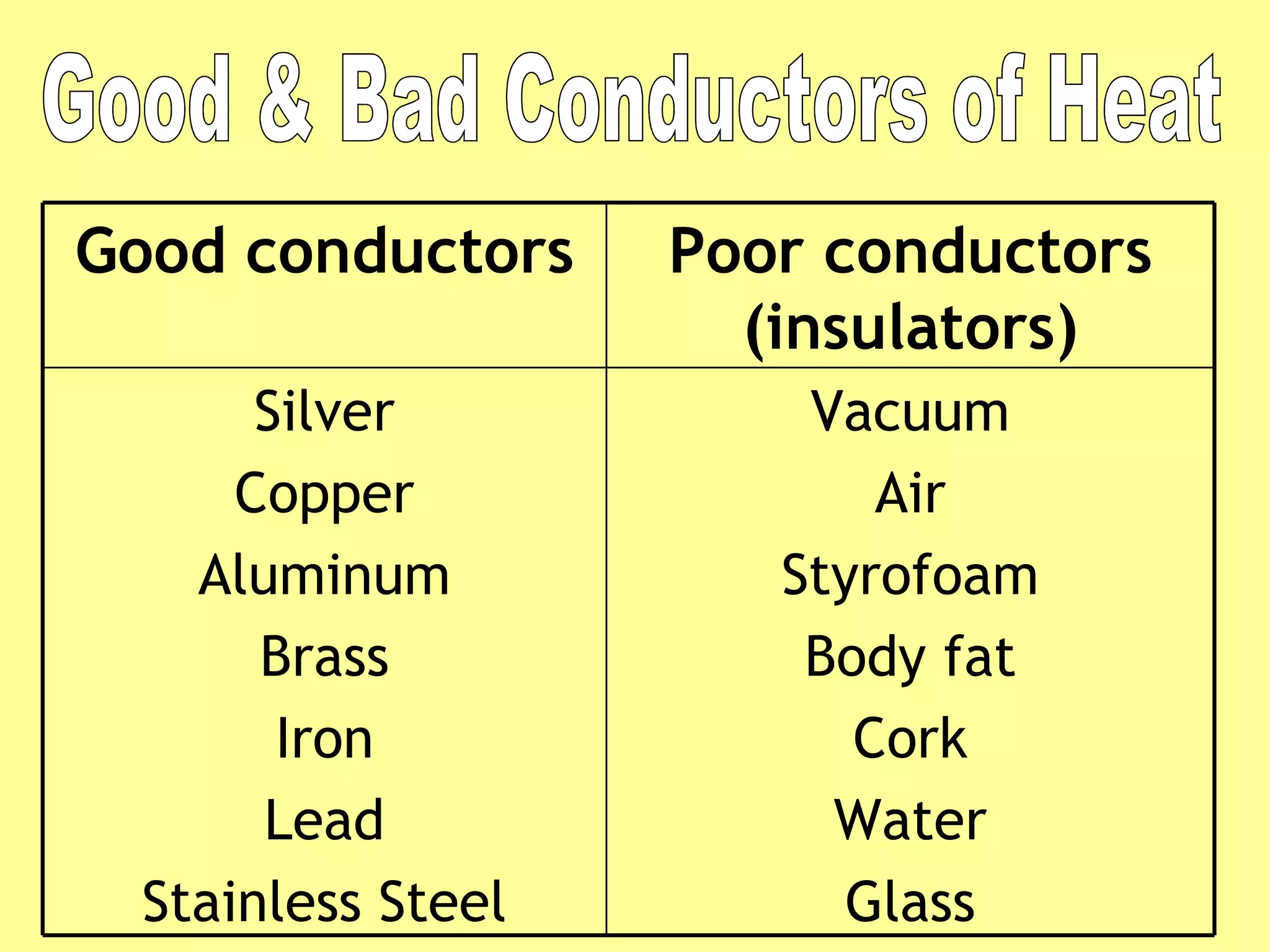
Materials conduct heat at  different rates Good conductors  of heat allow heat to flow through  rapidly Bad conductors or  good insulators  of heat allow heat to flow through  slowly Good & Bad Conductors of Heat
Good & Bad Conductors of Heat Good conductors Poor conductors (insulators) Silver Copper Aluminum Brass Iron Lead Stainless Steel Vacuum Air Styrofoam Body fat Cork Water Glass
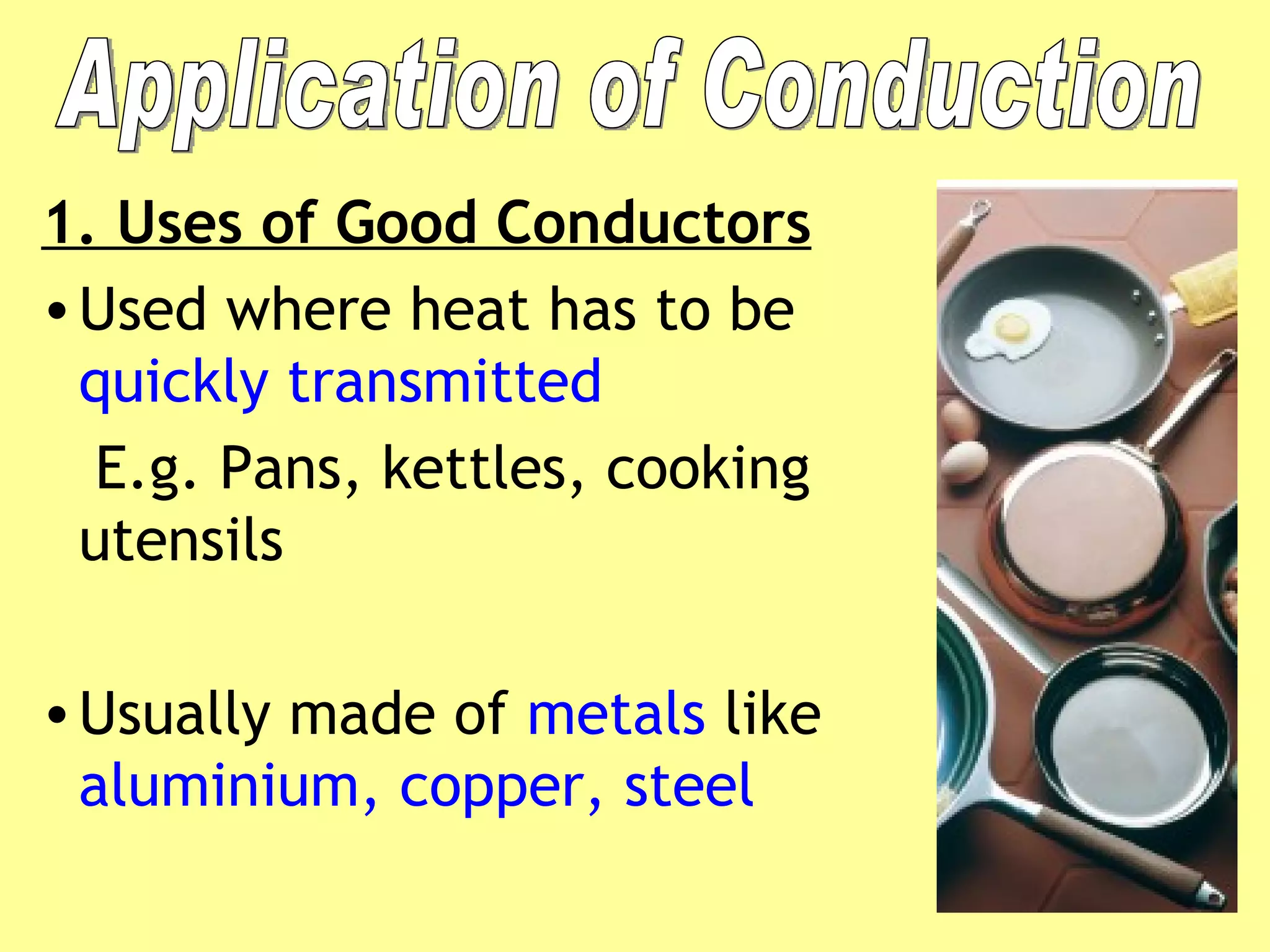
1. Uses of Good Conductors Used where heat has to be  quickly transmitted E.g. Pans, kettles, cooking utensils Usually made of  metals  like  aluminium, copper, steel Application of Conduction
2. Uses of Poor Conductors (Insulators) Use where  unwanted heat has to be kept away  or to  prevent heat loss .  E.g. vacuum flask, handles of saucepan Made of  Cloth, plastics, wood  etc insulator  Application of Conduction
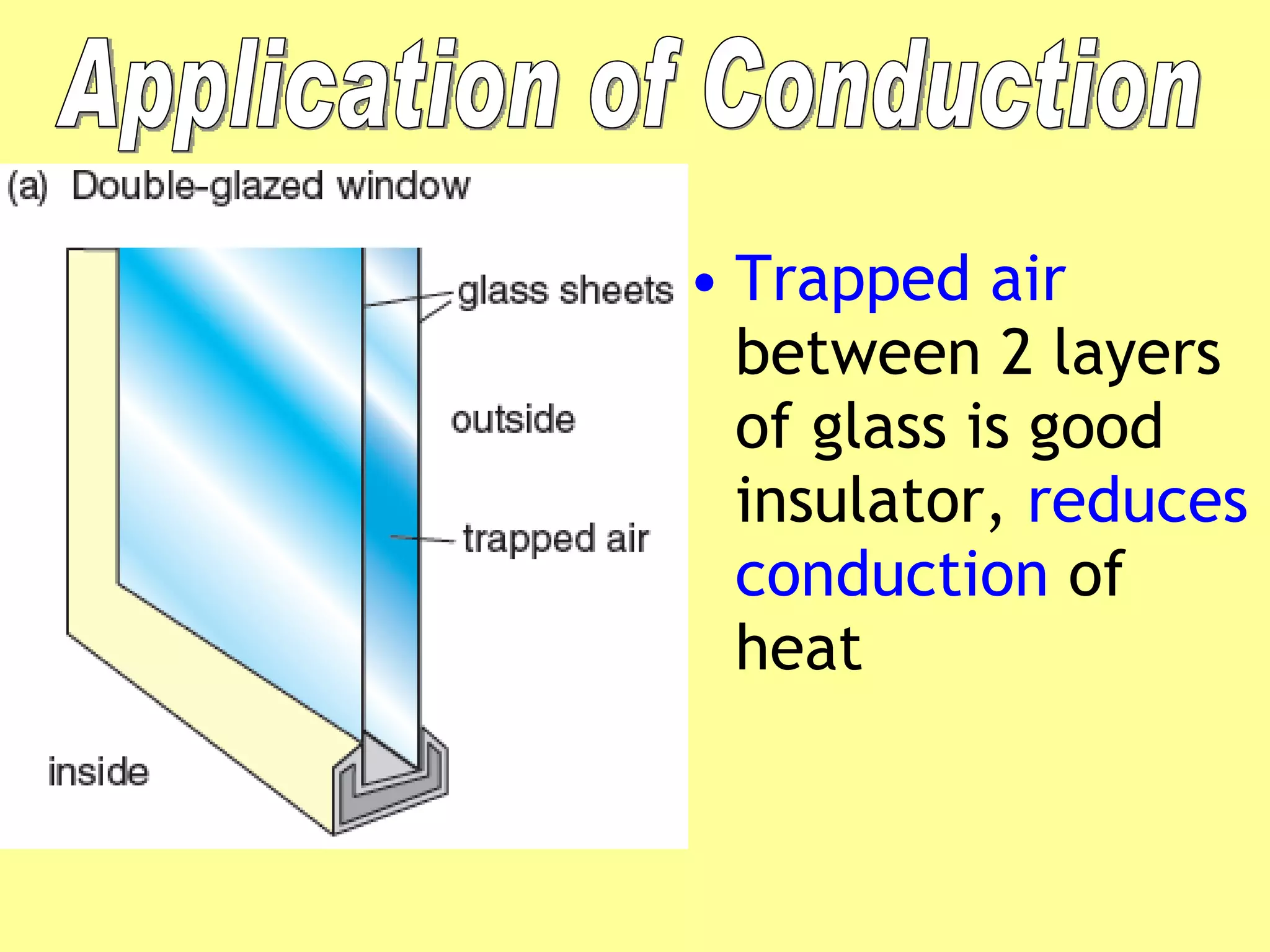
Trapped air  between 2 layers of glass is good insulator,  reduces conduction  of heat Application of Conduction
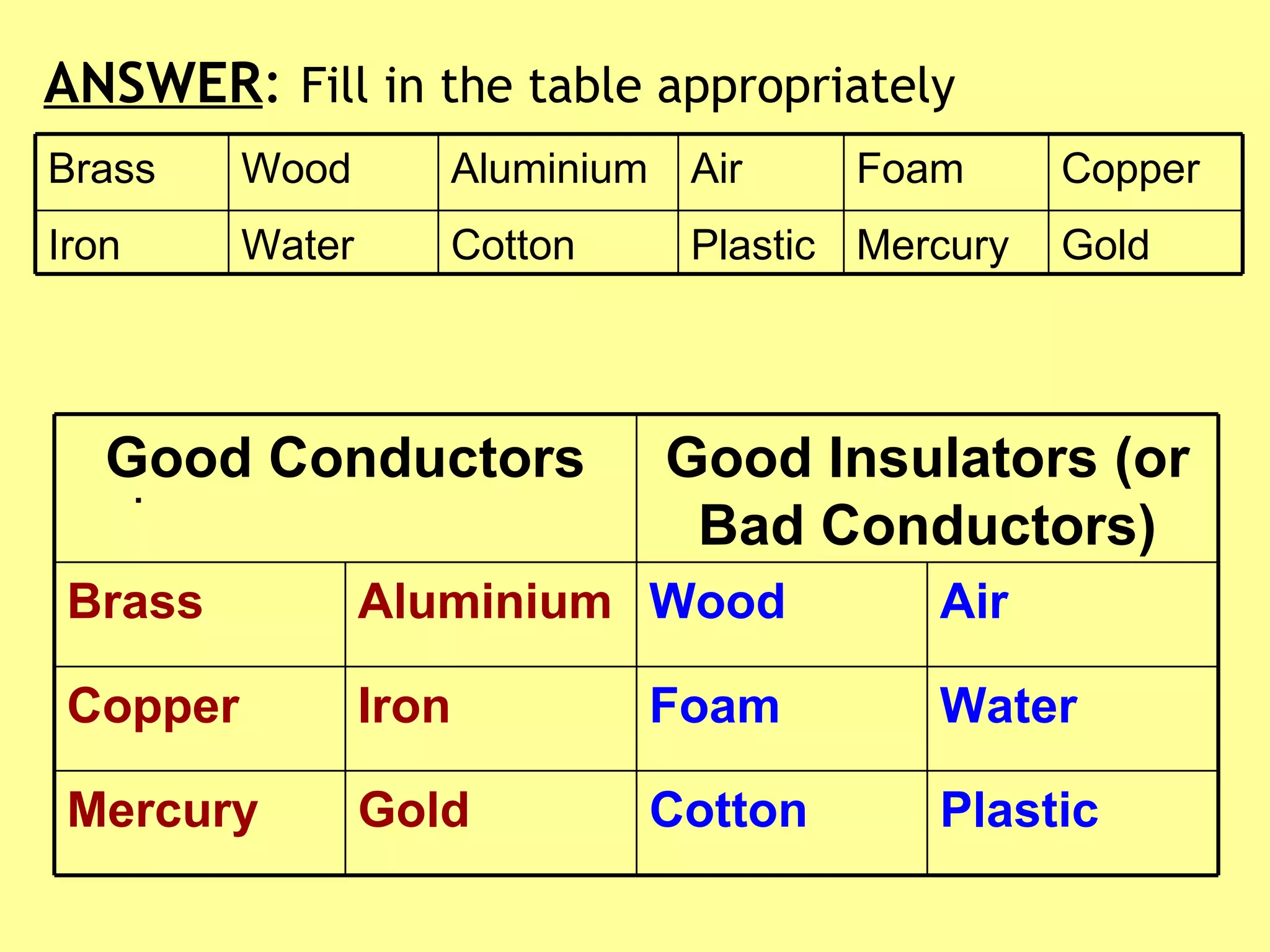
. Try This :  Fill in the table appropriately Brass Wood Aluminium Air Foam Copper Iron Water Cotton Plastic Mercury Gold Good Conductors Good Insulators
. ANSWER :  Fill in the table appropriately Brass Wood Aluminium Air Foam Copper Iron Water Cotton Plastic Mercury Gold Good Conductors Good Insulators (or Bad Conductors) Brass Aluminium Wood Air Copper Iron Foam Water Mercury  Gold Cotton Plastic
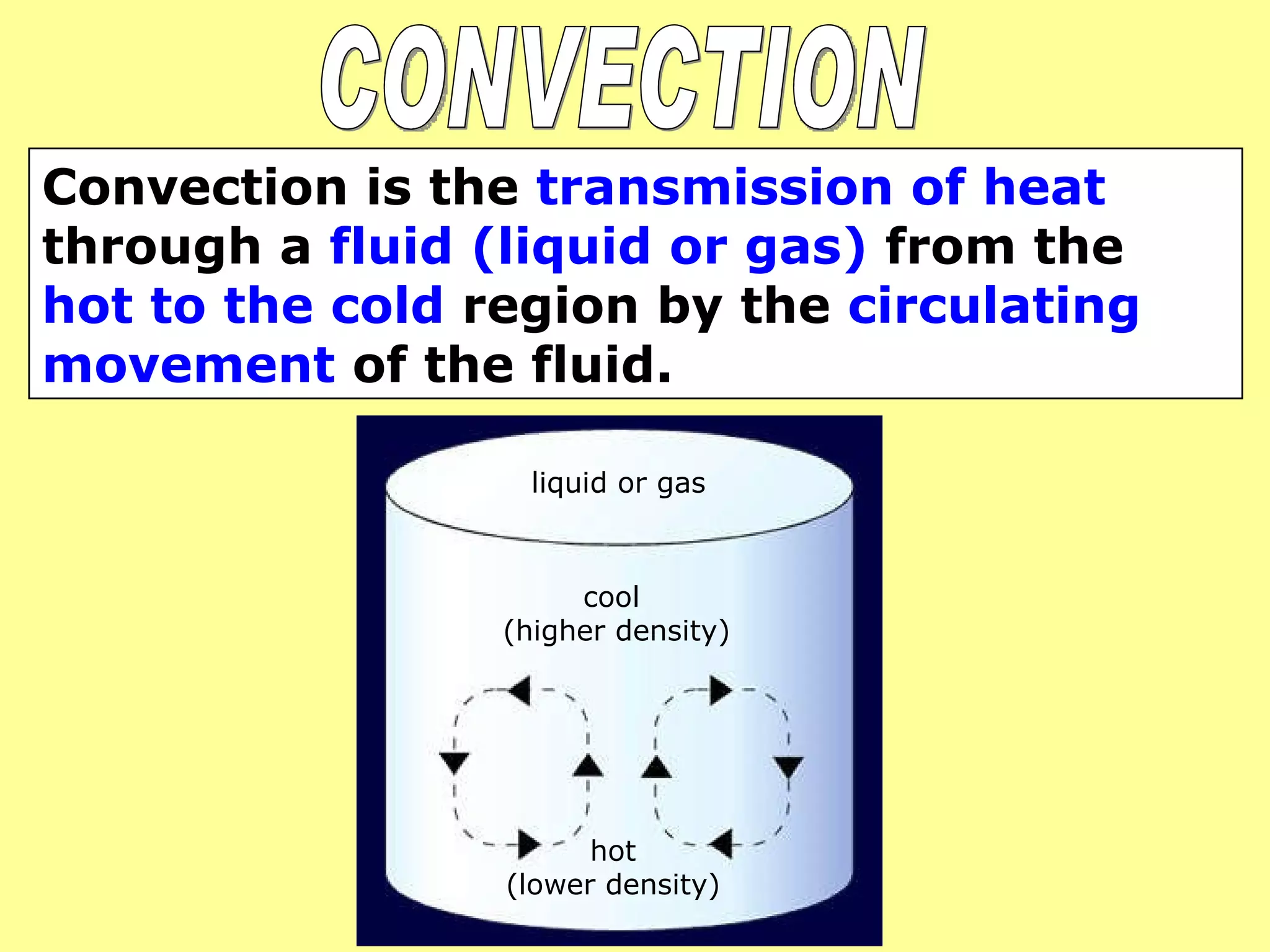
Convection is the  transmission of heat  through a  fluid (liquid or gas)  from the  hot to the cold  region by the  circulating movement  of the fluid. CONVECTION cool  (higher density) hot (lower density) liquid or gas
occurs in  fluids  (liquids and gases), but not in solids When one part of fluid is  heated , it  expands , becomes  less dense  and  rises The surrounding  cooler and denser fluid sinks  This produces a circulating movement called  convection current . CONVECTION
CONVECTION IN LIQUIDS See movie
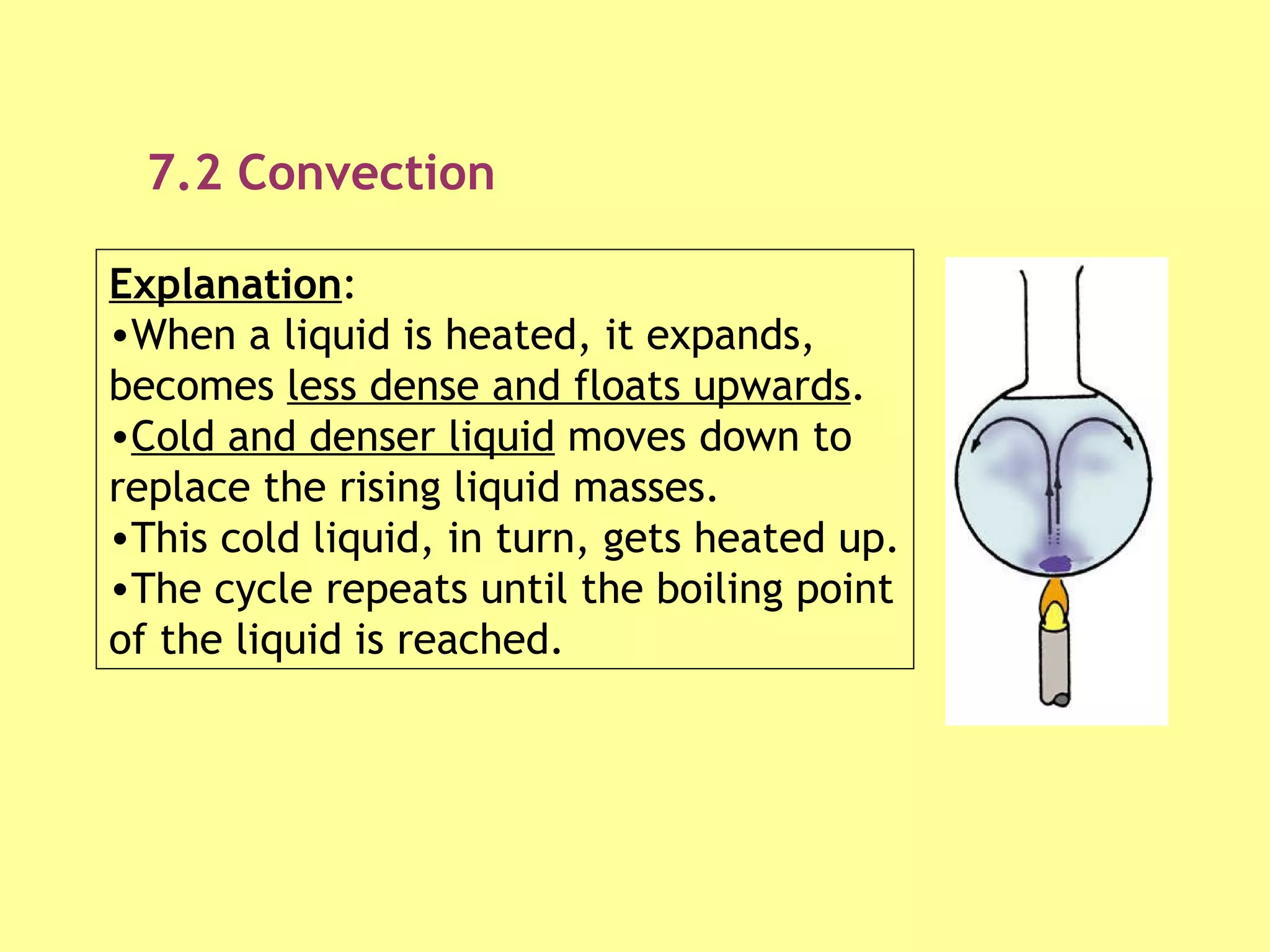
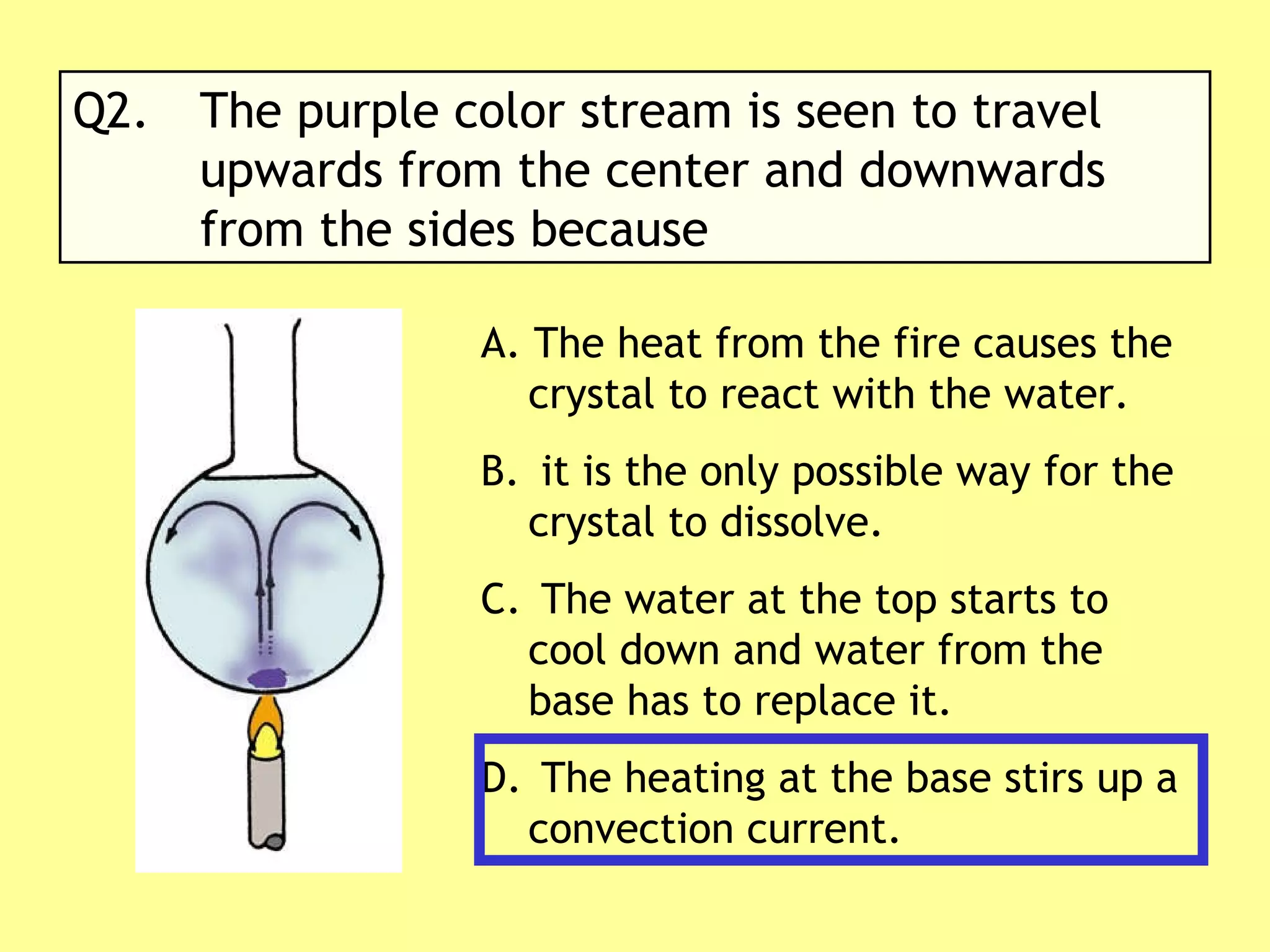
Add  potassium permanganate  (purple) crystals into a flask of water Heat  flask gently just below the crystals Purple-streaked water  rises upwards  and fan outwards. Water becomes  evenly purple in colour  after a while. CONVECTION IN LIQUIDS
7.2 Convection Explanation :  When a liquid is heated, it expands, becomes  less dense and floats upwards . Cold and denser liquid  moves down to replace the rising liquid masses. This cold liquid, in turn, gets heated up.  The cycle repeats until the boiling point of the liquid is reached.
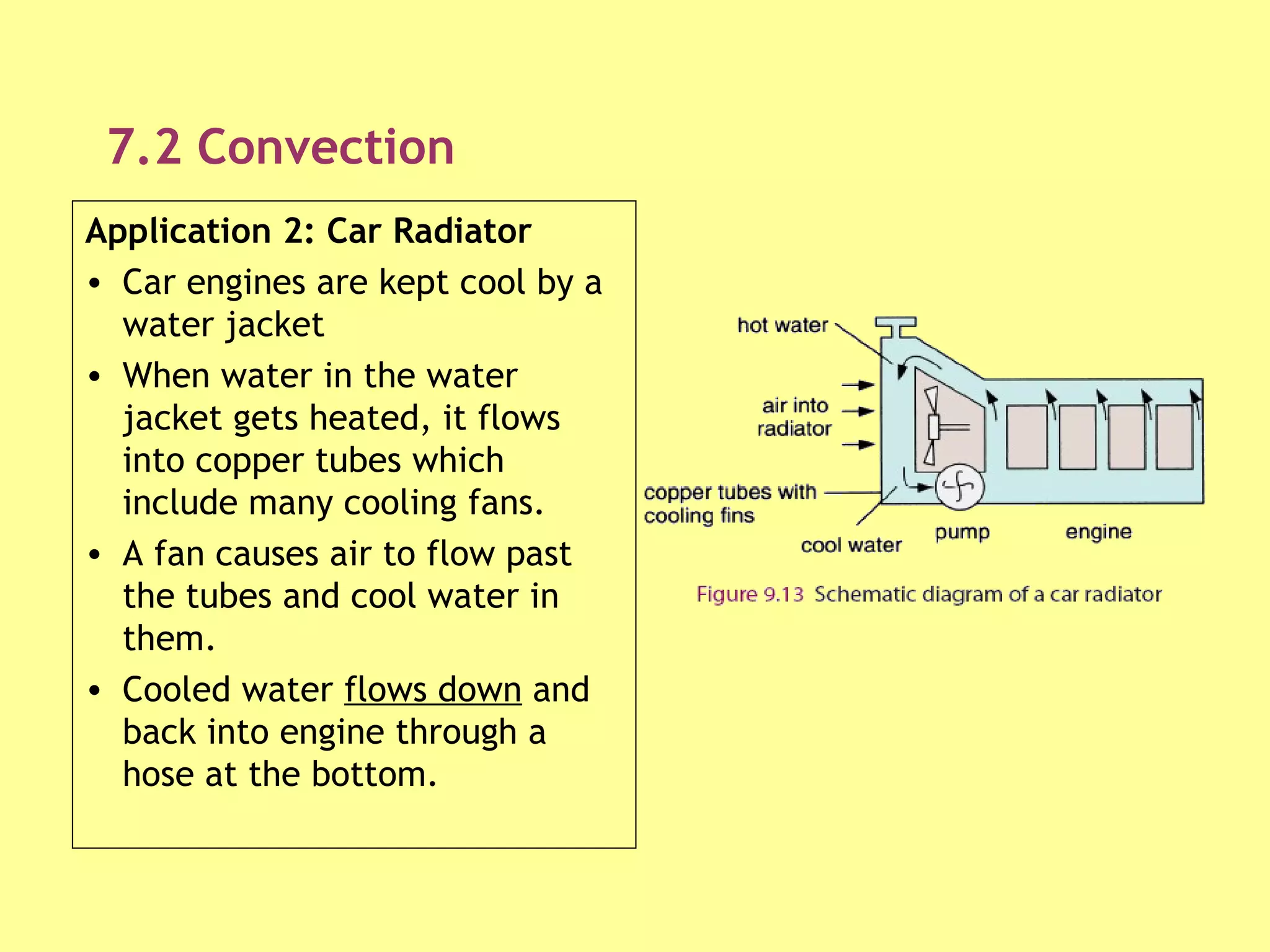
7.2 Convection Application 2: Car Radiator  Car engines are kept cool by a water jacket  When water in the water jacket gets heated, it flows into copper tubes which include many cooling fans. A fan causes air to flow past the tubes and cool water in them. Cooled water  flows down  and back into engine through a hose at the bottom.
CONVECTION IN GASES
Fit two glass chimneys to the top of a wooden box with plane glass window  Light a candle  below one chimney Heat from this initiates a  convection current Hot air flows out  of this chimney  Cold air flows in  through other chimney CONVECTION IN GASES
Application of Convection Sea and Land Breezes
1. Sea Breeze (Daytime) In the day,  land heats up faster   than the sea Air above land  expands and rises Cool air  above sea  moves in  towards the land  This result in  sea breeze Application of Convection
Application of Convection Sea and Land Breezes
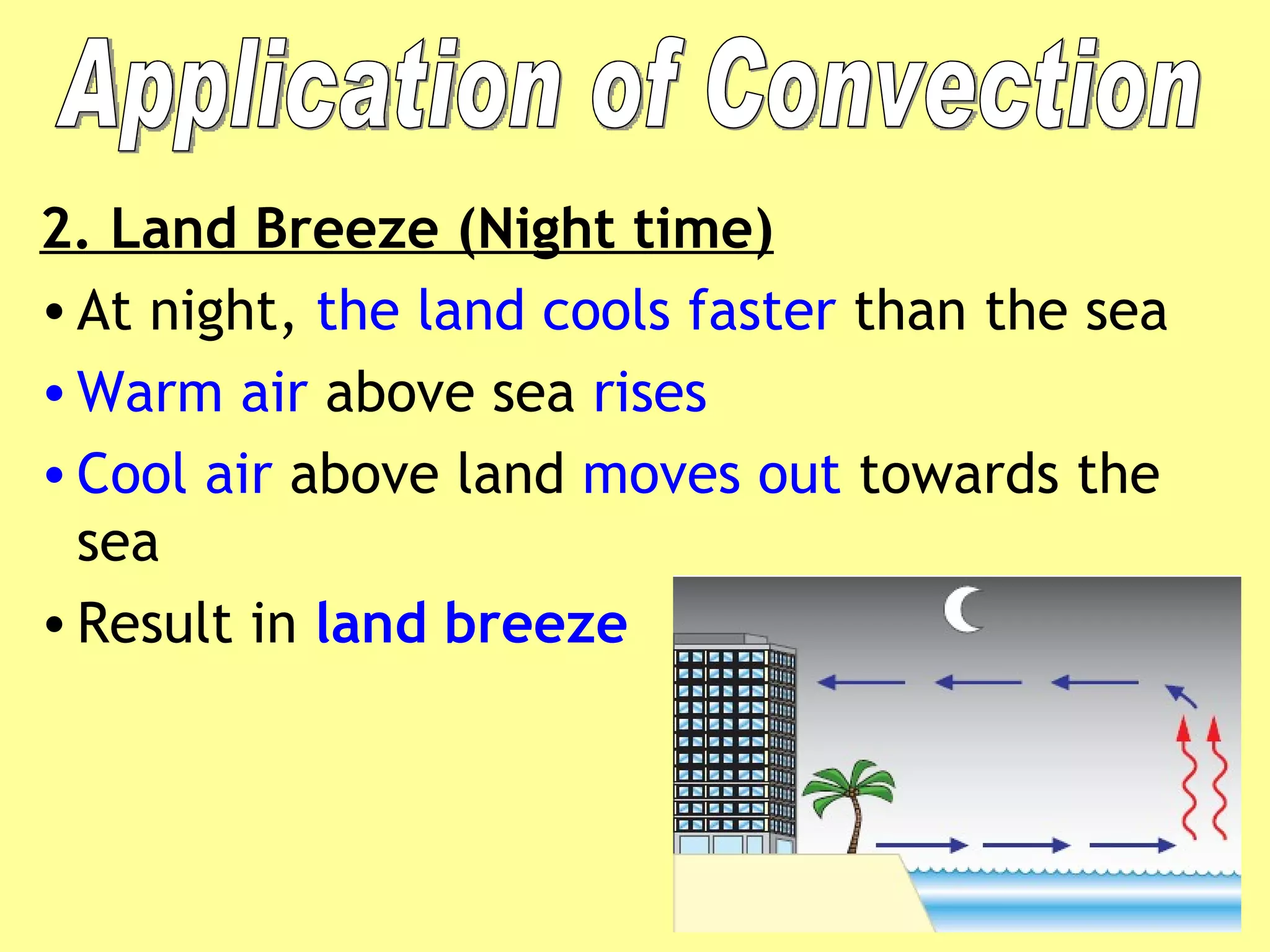
2. Land Breeze (Night time) At night,  the land cools faster  than the sea Warm air  above sea  rises   Cool air  above land  moves out  towards the sea  Result in  land breeze Application of Convection
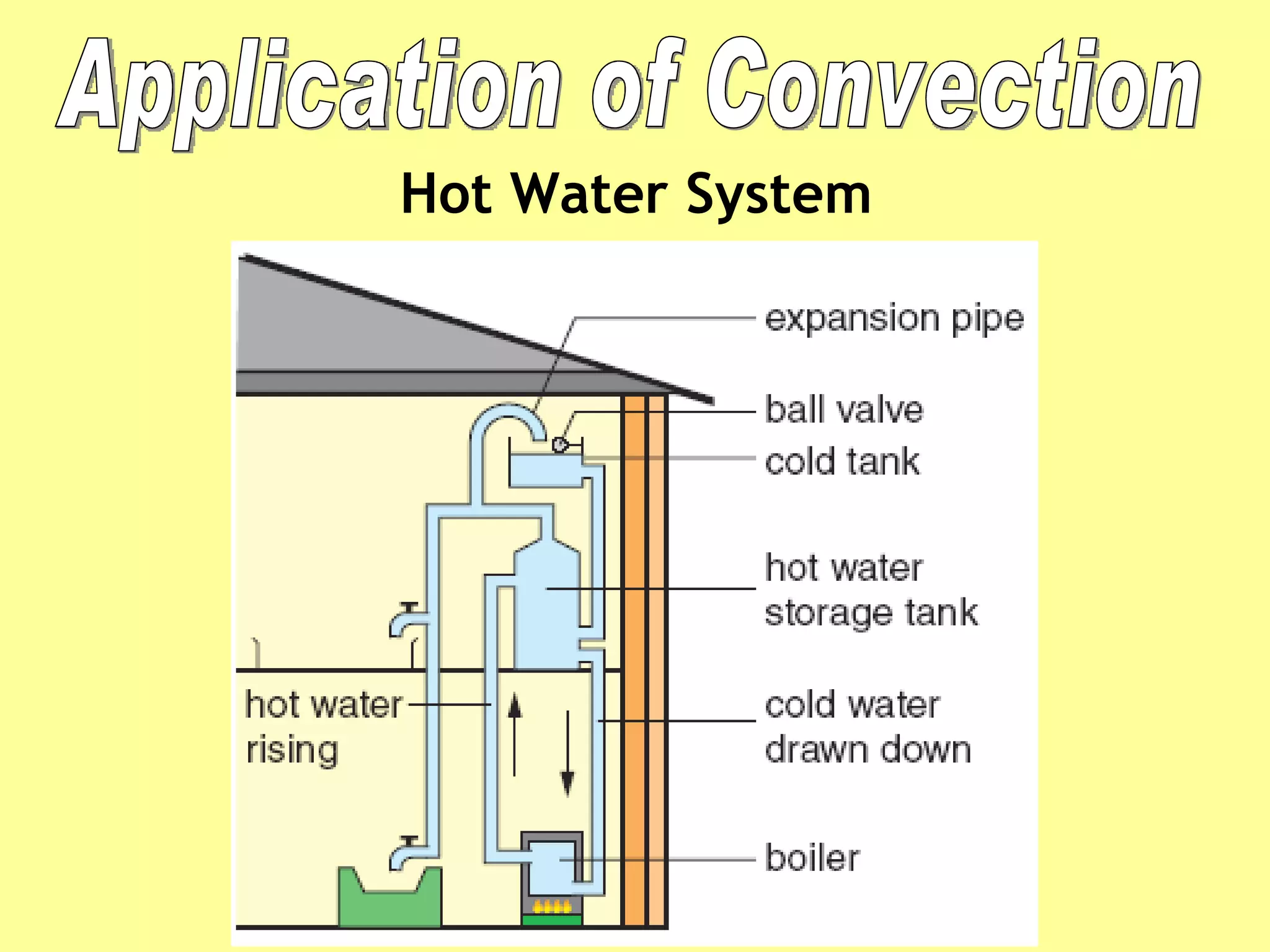
Application of Convection Hot Water System
Boiler at bottom  heats up water  and causes the hot water to  rise Hot water then moves to the  hot water storage tank Cold water from the cold tank then  moves down  to replace the hot water A  convection current  is set up Application of Convection Hot Water System
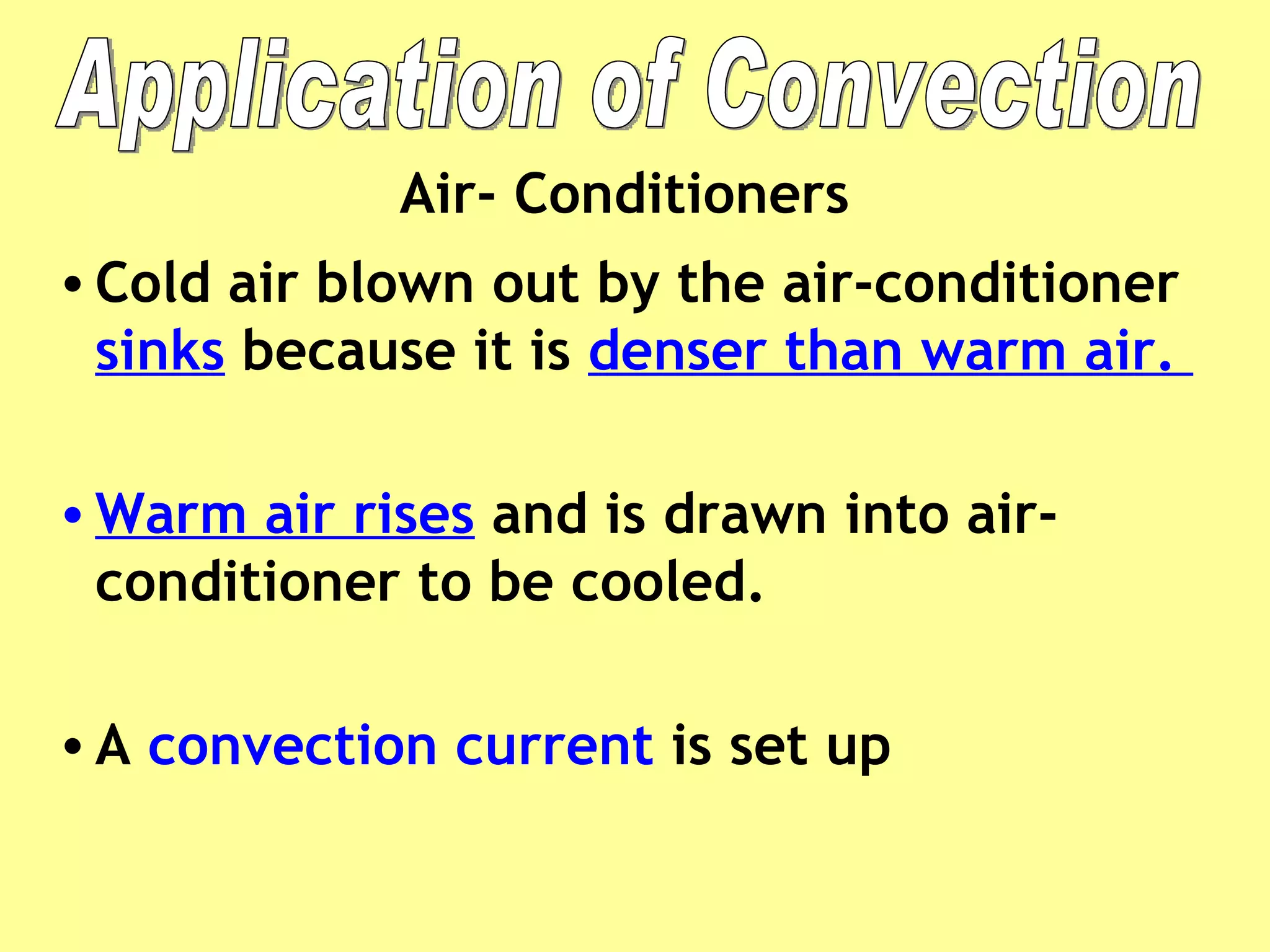
Application of Convection Air- Conditioners
Cold air blown out by the air-conditioner  sinks  because it is  denser than warm air.  Warm air rises  and is drawn into air-conditioner to be cooled. A  convection current  is set up Application of Convection Air- Conditioners
QUIZ TIME!!
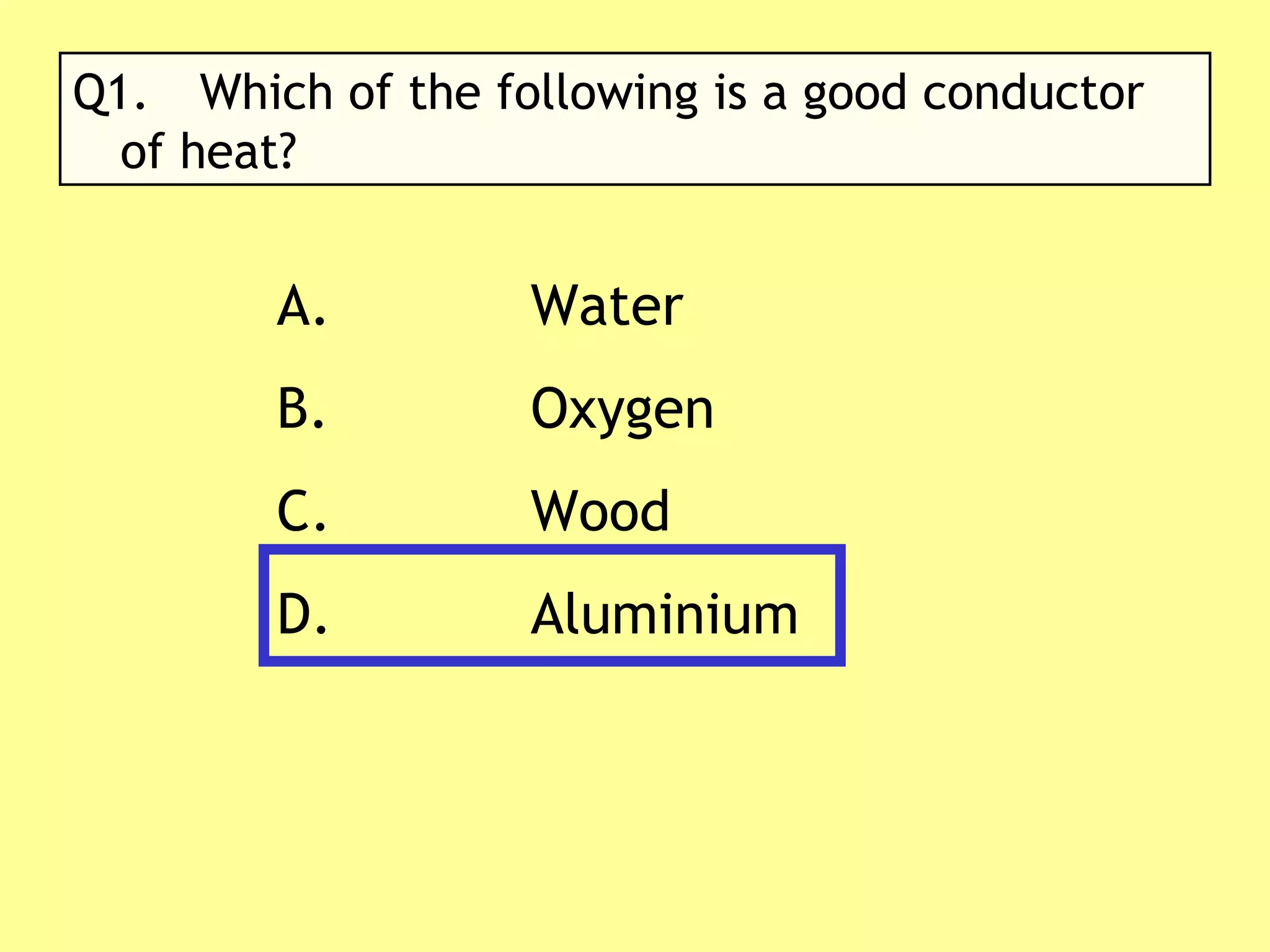
Q1. Which of the following is a good conductor of heat? A. Water B. Oxygen C. Wood D. Aluminium
Q2. Why does heat conduction take place faster in metals? A. The molecules are larger than non-metals and this reduces the amount of time taken for energy to transfer. B. The presence of free electrons causes heat energy to transmit quickly. The molecules are packed closer than non-metals and this reduces the time taken for energy to transfer.  The molecules gain energy faster in metals.
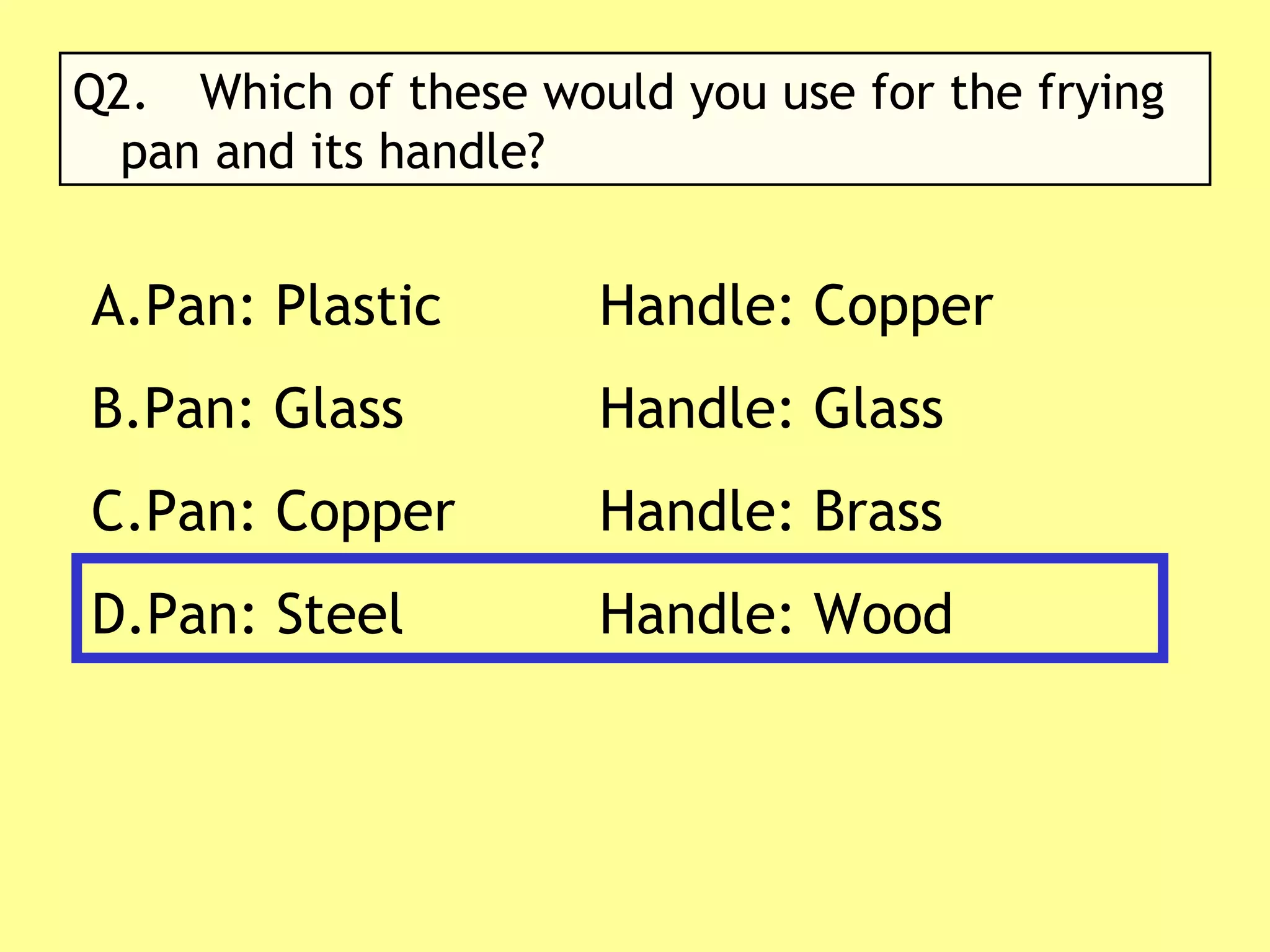
Q2. Which of these would you use for the frying pan and its handle? A.Pan: Plastic Handle: Copper Pan: Glass Handle: Glass  Pan: Copper Handle: Brass  Pan: Steel Handle: Wood
Q3. The purpose of using a double-glazed window is to A. Save money because glass is expensive. Provide a double protection against harmful projectiles.  Reduce heat conduction by trapping air inside.  Improve heat convection by trapping air inside.
Q4. We need to put on more clothes in winter because A. The air is cold and we do not want heat to escape from our bodies. The clothes is able to trap cold air.  The air is cold and we will lose water too quickly.  Winter clothes are nice and trendy.
QUIZ TIME!!
Q1. Convection takes place because A. Free electrons make the heat energy travel faster in the fluid. Hot liquid and cold liquid separates themselves from each other. Hot fluid rises and colder fluid sinks. Hot fluid sinks and colder fluid rises.
Q2. The purple color stream is seen to travel  upwards from the center and downwards  from the sides because A. The heat from the fire causes the crystal to react with the water. it is the only possible way for the crystal to dissolve. The water at the top starts to cool down and water from the base has to replace it. The heating at the base stirs up a convection current.
Q3. Convection of heat cannot take place in A. Alcohol Bricks Nitrogen Paraffin
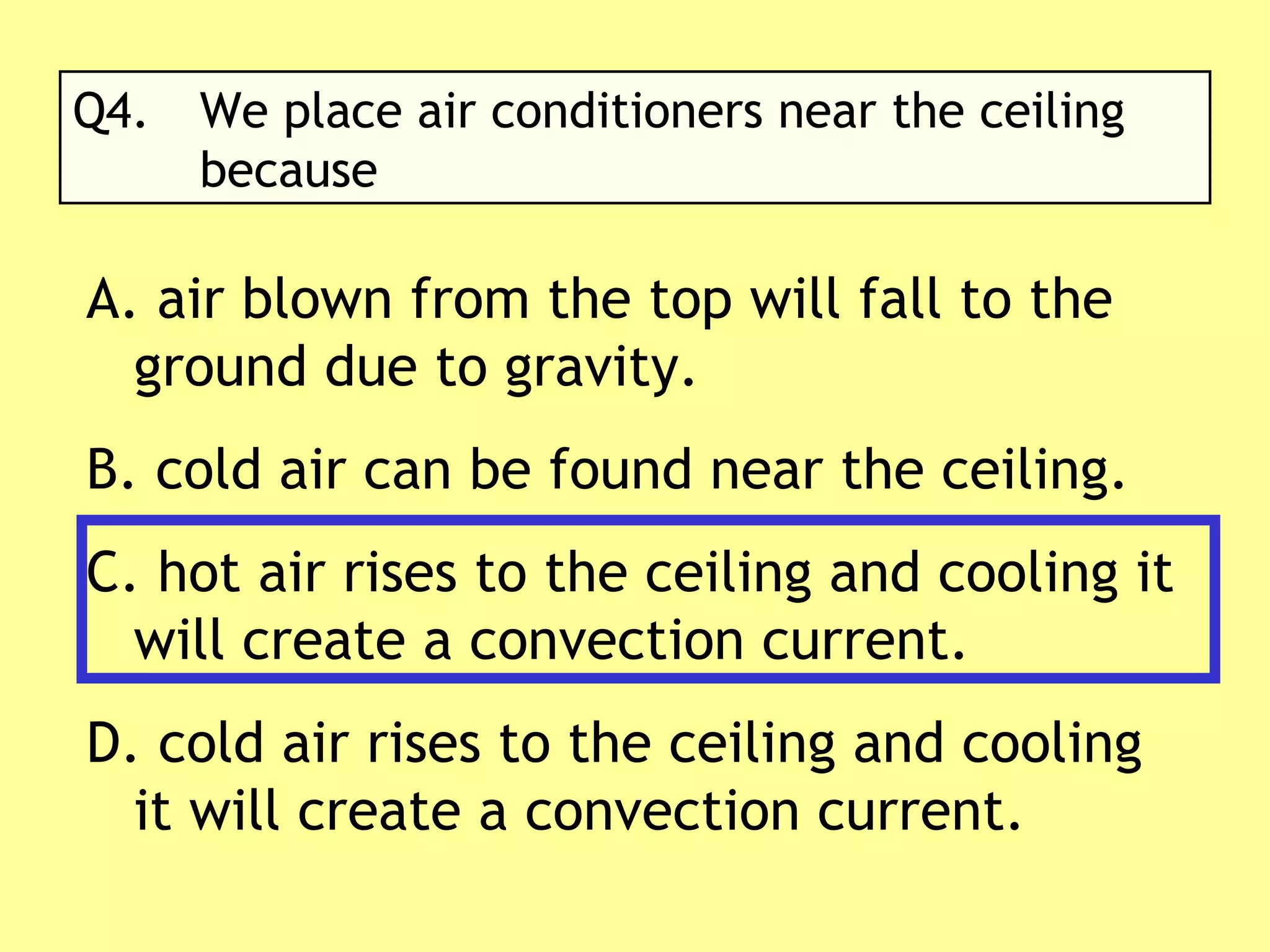
Q4. We place air conditioners near the ceiling  because A. air blown from the top will fall to the ground due to gravity. cold air can be found near the ceiling. hot air rises to the ceiling and cooling it will create a convection current. cold air rises to the ceiling and cooling it will create a convection current.
Q5. Sea breeze occurs A. In the daytime. in the night time. only at midnight. only when it rains.
Radiation is the  transmission of heat  from one place to another by means of  infra-red radiation  which can travel through  vacuum or air Radiation
Rate of Emitting (giving out) and Absorbing Heat by Radiation is affected by:   (a)  surface temperature (b)  colour and texture of the surface (c)  surface area Radiation
Dull black surfaces  are  good emitters and absorbers of heat   Shiny white surfaces  are  good reflectors  (bad emitter and absorber) of heat Radiation
Radiation Why does the cork on the dull black surface fall off first? Ans: Dull black surfaces are good absorbers of heat, thus it melts the wax faster
Application of Radiation Good Emitters Poor Emitters Cooling fins  at the back of a refrigerator painted  dull black A  shiny metal  teapot and  aluminum foil keep contents  warm
Application of Radiation Good Absorbers Poor Absorbers Solar heating panels  are painted in  dull black paint to absorb  heat  from sun Houses in hot countries are painted in  white or light-coloured paint ,  to keep them  cooler . Light colours  are chosen for clothes and cars in hot weather
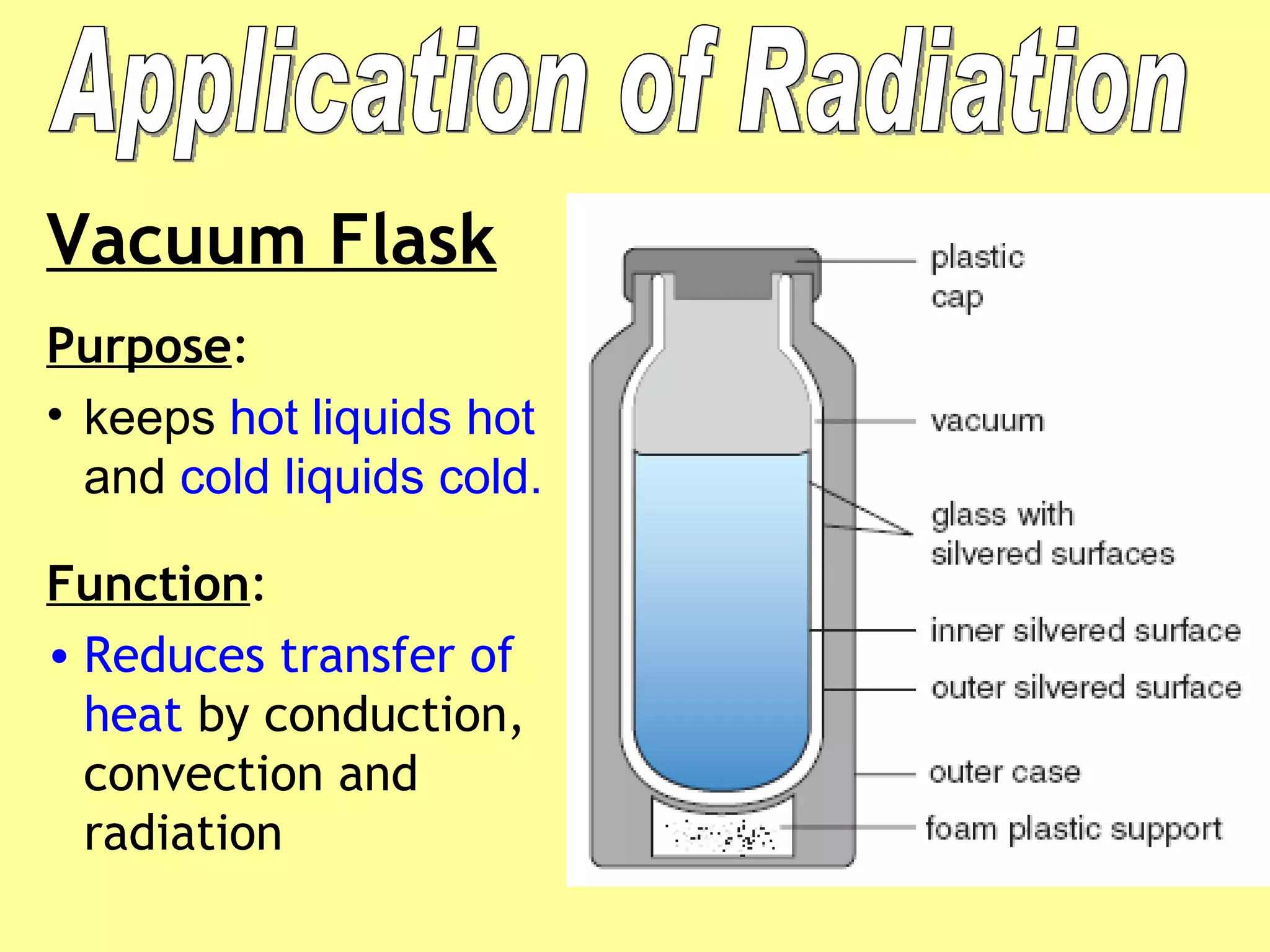
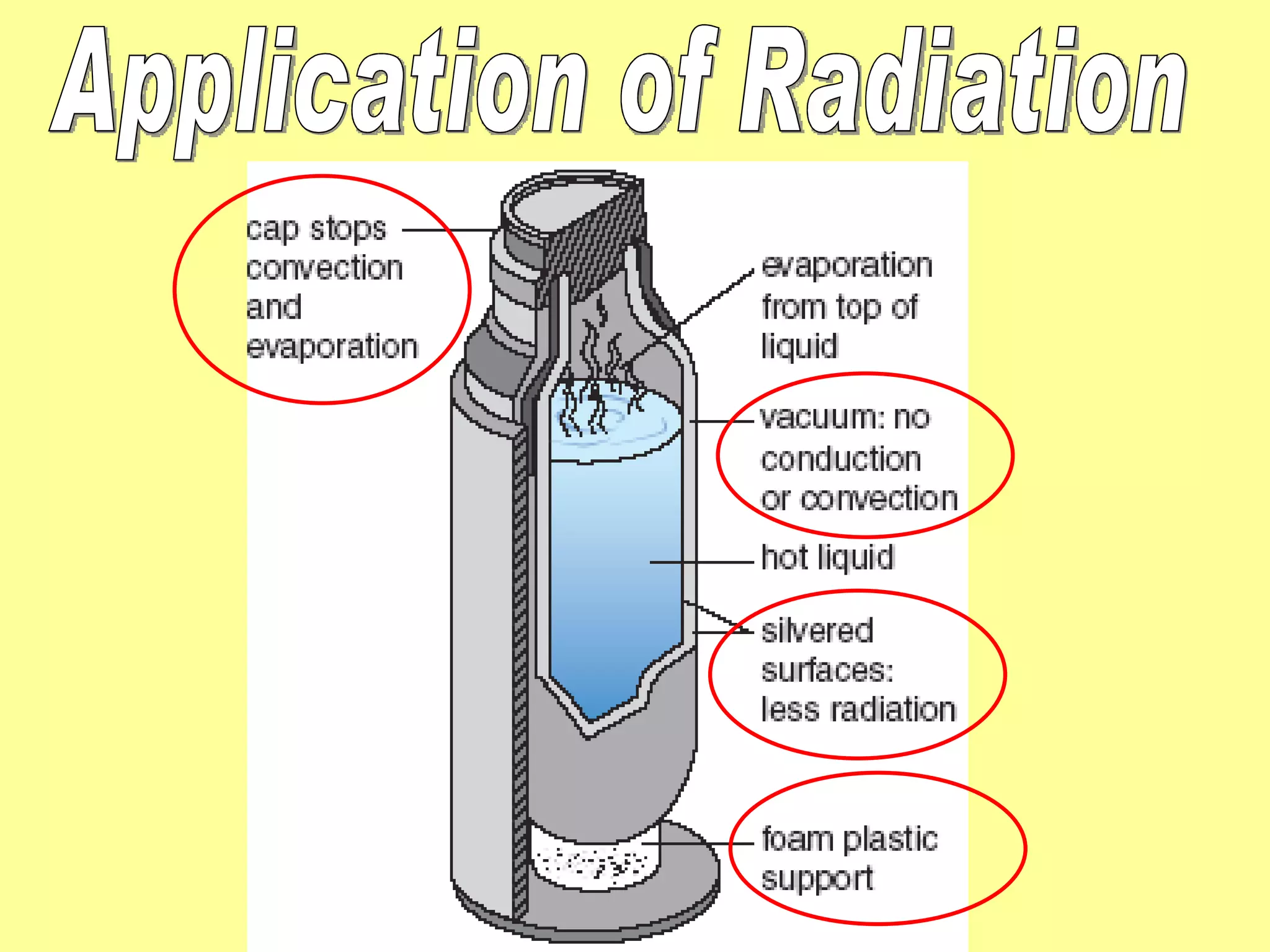
Vacuum Flask Purpose :  keeps  hot liquids hot  and  cold liquids cold. Function :  Reduces transfer of heat  by conduction, convection and radiation Application of Radiation
Application of Radiation
Application of Radiation Structure Reduces heat loss/gained by: vacuum  in between the double glass walls  conduction or convection  Silvered walls Outer silvered surface Inner silvered surface Radiation reflects radiation in external surroundings away from flask reflects radiation from hot fluids back into flask Foam plastic  support conduction Plastic  cap convection
 
LET'S RECAP State the parts of a vacuum flask and explain what their functions are. Structure Purpose (reduces heat loss/gained by)
They are three processes of heat transfer shown in the picture. 1  represents  2  represents 3  represents conduction . convection . radiation .

Transmission of heat (ppt)

  • 1.
    Volume B Chapter25 Transmission of Heat
  • 2.
    Oh no! Youwill spoil the flask if you put cold water in it. After this, the flask cannot be used to keep water hot anymore. Myth or Truth?
  • 3.
    Why are thehandles of saucepans usually made of plastic?
  • 4.
    Why is foodpacked in styrofoam boxes?
  • 5.
    Cooling fins atthe back of refrigerators. Why are they always painted black?
  • 6.
    Explain what ismeant by conduction, convection & radiation The volume & density of a substance will change during thermal expansion Different materials have different rates of heat flow What we will learn…
  • 7.
    Heat is aform of energy that is transmitted from a region of higher to lower temperature . Heat Moves!
  • 8.
    IN 3 WAYS…CONDUCTION CONVECTION RADIATION Heat Moves!
  • 9.
    They are threeprocesses of heat transfer shown in the picture. 1 represents 2 represents 3 represents conduction . convection . radiation .
  • 10.
    Conduction is transmission of heat through a material from the hot regions to the cold regions without any visible movement of the material. CONDUCTION
  • 11.
    CONDUCTION Solids are better conductors of heat than liquids and gases as solid particles are closer together. Thus, kinetic energy is transferred more quickly in solids. See movie
  • 12.
    How Conduction Worksin solids When one end of a rod is heated, particles there gain energy and vibrate faster . These particles collide with less energetic neighbors.
  • 13.
    How Conduction Worksin solids Some of their energy is transferred to neighboring particles which thus gains kinetic energy. This goes on until the cold end reaches same temperature as hot end See movie
  • 14.
    Conduction of heatthrough solids Observation : Observe the lengths of wax that have melted on the different rods in a given interval of time . Wood Iron Aluminium Copper
  • 15.
    Process : Whena metal is heated, free electrons gain energy and move faster. They move in the spaces between atoms before colliding with some atoms and transferring energy to them. Metals conduct heat much faster then non-metals as they have free electrons. Conduction of heat by metals
  • 16.
    Materials conduct heatat different rates Good conductors of heat allow heat to flow through rapidly Bad conductors or good insulators of heat allow heat to flow through slowly Good & Bad Conductors of Heat
  • 17.
    Good & BadConductors of Heat Good conductors Poor conductors (insulators) Silver Copper Aluminum Brass Iron Lead Stainless Steel Vacuum Air Styrofoam Body fat Cork Water Glass
  • 18.
    1. Uses ofGood Conductors Used where heat has to be quickly transmitted E.g. Pans, kettles, cooking utensils Usually made of metals like aluminium, copper, steel Application of Conduction
  • 19.
    2. Uses ofPoor Conductors (Insulators) Use where unwanted heat has to be kept away or to prevent heat loss . E.g. vacuum flask, handles of saucepan Made of Cloth, plastics, wood etc insulator Application of Conduction
  • 20.
    Trapped air between 2 layers of glass is good insulator, reduces conduction of heat Application of Conduction
  • 21.
    . Try This: Fill in the table appropriately Brass Wood Aluminium Air Foam Copper Iron Water Cotton Plastic Mercury Gold Good Conductors Good Insulators
  • 22.
    . ANSWER : Fill in the table appropriately Brass Wood Aluminium Air Foam Copper Iron Water Cotton Plastic Mercury Gold Good Conductors Good Insulators (or Bad Conductors) Brass Aluminium Wood Air Copper Iron Foam Water Mercury Gold Cotton Plastic
  • 23.
    Convection is the transmission of heat through a fluid (liquid or gas) from the hot to the cold region by the circulating movement of the fluid. CONVECTION cool (higher density) hot (lower density) liquid or gas
  • 24.
    occurs in fluids (liquids and gases), but not in solids When one part of fluid is heated , it expands , becomes less dense and rises The surrounding cooler and denser fluid sinks This produces a circulating movement called convection current . CONVECTION
  • 25.
  • 26.
    Add potassiumpermanganate (purple) crystals into a flask of water Heat flask gently just below the crystals Purple-streaked water rises upwards and fan outwards. Water becomes evenly purple in colour after a while. CONVECTION IN LIQUIDS
  • 27.
    7.2 Convection Explanation: When a liquid is heated, it expands, becomes less dense and floats upwards . Cold and denser liquid moves down to replace the rising liquid masses. This cold liquid, in turn, gets heated up. The cycle repeats until the boiling point of the liquid is reached.
  • 28.
    7.2 Convection Application2: Car Radiator Car engines are kept cool by a water jacket When water in the water jacket gets heated, it flows into copper tubes which include many cooling fans. A fan causes air to flow past the tubes and cool water in them. Cooled water flows down and back into engine through a hose at the bottom.
  • 29.
  • 30.
    Fit two glasschimneys to the top of a wooden box with plane glass window Light a candle below one chimney Heat from this initiates a convection current Hot air flows out of this chimney Cold air flows in through other chimney CONVECTION IN GASES
  • 31.
    Application of ConvectionSea and Land Breezes
  • 32.
    1. Sea Breeze(Daytime) In the day, land heats up faster than the sea Air above land expands and rises Cool air above sea moves in towards the land This result in sea breeze Application of Convection
  • 33.
    Application of ConvectionSea and Land Breezes
  • 34.
    2. Land Breeze(Night time) At night, the land cools faster than the sea Warm air above sea rises Cool air above land moves out towards the sea Result in land breeze Application of Convection
  • 35.
    Application of ConvectionHot Water System
  • 36.
    Boiler at bottom heats up water and causes the hot water to rise Hot water then moves to the hot water storage tank Cold water from the cold tank then moves down to replace the hot water A convection current is set up Application of Convection Hot Water System
  • 37.
    Application of ConvectionAir- Conditioners
  • 38.
    Cold air blownout by the air-conditioner sinks because it is denser than warm air. Warm air rises and is drawn into air-conditioner to be cooled. A convection current is set up Application of Convection Air- Conditioners
  • 39.
  • 40.
    Q1. Which ofthe following is a good conductor of heat? A. Water B. Oxygen C. Wood D. Aluminium
  • 41.
    Q2. Why doesheat conduction take place faster in metals? A. The molecules are larger than non-metals and this reduces the amount of time taken for energy to transfer. B. The presence of free electrons causes heat energy to transmit quickly. The molecules are packed closer than non-metals and this reduces the time taken for energy to transfer. The molecules gain energy faster in metals.
  • 42.
    Q2. Which ofthese would you use for the frying pan and its handle? A.Pan: Plastic Handle: Copper Pan: Glass Handle: Glass Pan: Copper Handle: Brass Pan: Steel Handle: Wood
  • 43.
    Q3. The purposeof using a double-glazed window is to A. Save money because glass is expensive. Provide a double protection against harmful projectiles. Reduce heat conduction by trapping air inside. Improve heat convection by trapping air inside.
  • 44.
    Q4. We needto put on more clothes in winter because A. The air is cold and we do not want heat to escape from our bodies. The clothes is able to trap cold air. The air is cold and we will lose water too quickly. Winter clothes are nice and trendy.
  • 45.
  • 46.
    Q1. Convection takesplace because A. Free electrons make the heat energy travel faster in the fluid. Hot liquid and cold liquid separates themselves from each other. Hot fluid rises and colder fluid sinks. Hot fluid sinks and colder fluid rises.
  • 47.
    Q2. The purplecolor stream is seen to travel upwards from the center and downwards from the sides because A. The heat from the fire causes the crystal to react with the water. it is the only possible way for the crystal to dissolve. The water at the top starts to cool down and water from the base has to replace it. The heating at the base stirs up a convection current.
  • 48.
    Q3. Convection ofheat cannot take place in A. Alcohol Bricks Nitrogen Paraffin
  • 49.
    Q4. We placeair conditioners near the ceiling because A. air blown from the top will fall to the ground due to gravity. cold air can be found near the ceiling. hot air rises to the ceiling and cooling it will create a convection current. cold air rises to the ceiling and cooling it will create a convection current.
  • 50.
    Q5. Sea breezeoccurs A. In the daytime. in the night time. only at midnight. only when it rains.
  • 51.
    Radiation is the transmission of heat from one place to another by means of infra-red radiation which can travel through vacuum or air Radiation
  • 52.
    Rate of Emitting(giving out) and Absorbing Heat by Radiation is affected by: (a) surface temperature (b) colour and texture of the surface (c) surface area Radiation
  • 53.
    Dull black surfaces are good emitters and absorbers of heat Shiny white surfaces are good reflectors (bad emitter and absorber) of heat Radiation
  • 54.
    Radiation Why doesthe cork on the dull black surface fall off first? Ans: Dull black surfaces are good absorbers of heat, thus it melts the wax faster
  • 55.
    Application of RadiationGood Emitters Poor Emitters Cooling fins at the back of a refrigerator painted dull black A shiny metal teapot and aluminum foil keep contents warm
  • 56.
    Application of RadiationGood Absorbers Poor Absorbers Solar heating panels are painted in dull black paint to absorb heat from sun Houses in hot countries are painted in white or light-coloured paint , to keep them cooler . Light colours are chosen for clothes and cars in hot weather
  • 57.
    Vacuum Flask Purpose: keeps hot liquids hot and cold liquids cold. Function : Reduces transfer of heat by conduction, convection and radiation Application of Radiation
  • 58.
  • 59.
    Application of RadiationStructure Reduces heat loss/gained by: vacuum in between the double glass walls conduction or convection Silvered walls Outer silvered surface Inner silvered surface Radiation reflects radiation in external surroundings away from flask reflects radiation from hot fluids back into flask Foam plastic support conduction Plastic cap convection
  • 60.
  • 61.
    LET'S RECAP Statethe parts of a vacuum flask and explain what their functions are. Structure Purpose (reduces heat loss/gained by)
  • 62.
    They are threeprocesses of heat transfer shown in the picture. 1 represents 2 represents 3 represents conduction . convection . radiation .