Head Injuries Sarah Sharpe
Head Injury  A head injury is any trauma resulting in injury to the scalp, skull or brain.  A head injury is particularly dangerous as, at first the injury may appear only minor however major internal injuries have occurred.  A victim with a suspected head injury should be monitored for a number of days after the incident There are five main types of head injuries: Lacerations Concussion Contusions Haemorrhage Compression Skull Fracture
What are Lacerations A laceration is a tear in the  skin as a result of an injury. In the case of visible bones  or tendons, or excessive  bleeding or pain, the casualty should be seen to by a doctor
Symptoms of Lacerations Bleeding Pain Numbness Swelling of Injured  Skin
Treating Lacerations  Conduct Primary Survey (DRABC) If symptoms appear serious, an ambulance should be called immediately Place a dry, sterile dressing onto wound and apply direct pressure.  If skull fracture is suspected, minimise pressure. If injury has resulted in an attached flap of skin  (avulsion), using clean water gently flush the  area, fold flap back over laceration and apply  dressing with pressure Use a roller gauze to secure dressings to the  head.  Do not remove dressings Casualty should be monitored for the next couple of days
What is a concussion? A concussion is a temporary change in the way the brain works when it is suddenly moved or jarred, it occurs when the brain suddenly shifts inside the skull and knocks against the skulls bony surface.  Concussions can last from a few moments, to an unconscious state for over 3 minutes.
Symptoms of a Concussion Amnesia, short term memory loss Nausea, vomiting Headache Blurred Vision Confusion Ringing in Ears  Neck Pain Dizziness Unconsciousness  Irritability Convulsions
Treating a Concussion Conduct Primary Survey (DRABC) Determine the severity or ‘grade’ of the concussion. Grade 1 – conscious, symptoms last under 15 minutes Grade 2 – conscious, symptoms last over 15 minutes  Grade 3 - unconscious  Call an ambulance immediately, lay casualty down with head and shoulders slightly raised, try to keep them awake and talking.  If casualty falls unconscious and is not breathing, commence CPR and monitor vital signs  Seek professional medical assistance, lay the casualty down with the head and shoulders slightly raised. Try to keep casualty awake and talking  Allow casualty to rest, however continually monitor in case their condition changes.  Lay casualty down with their head and shoulders slightly raised   Grade 3 Grade 2 Grade 1
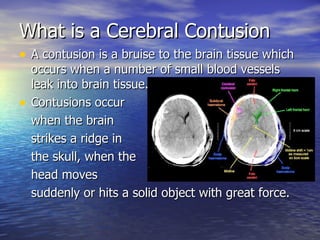
What is a Cerebral Contusion  A contusion is a bruise to the brain tissue which occurs when a number of small blood vessels leak into brain tissue.  Contusions occur  when the brain  strikes a ridge in  the skull, when the head moves  suddenly or hits a solid object with great force.
Symptoms of a Contusion Severe Headache Dizziness Nausea / Vomiting Dilated Pupil Weakness of limbs  Restless, irritable Memory Loss Confusion Drowsiness Unconsciousness
Treating a Contusion Conduct Primary Survey (DRABC) Seek medical assistance, if symptoms indicate severe head trauma, call ambulance immediately  Monitor casualty’s level of  consciousness Encourage the casualty to  stay awake and talk,  reassure them If casualty falls unconscious and breathing ceases, commence  CPR until further help arrives  Bilateral Cerebral Contusions
What is a Haemorrhage A brain or subarachnoid haemorrhage occurs when blood leaks out of the blood vessels and onto the surface of the brain.  The blood then damages the brain tissue which, along with the blood loss, can cause serious and potentially life threatening brain damage
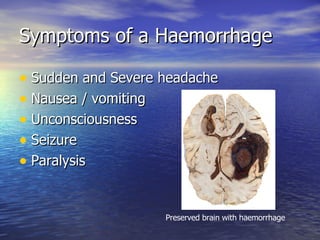
Symptoms of a Haemorrhage  Sudden and Severe headache Nausea / vomiting  Unconsciousness  Seizure Paralysis Preserved brain with haemorrhage
Treating a Haemorrhage Conduct primary survey (DRABC)  Call an ambulance immediately Monitor level of consciousness If casualty falls unconscious, commence CPR and continue until further help arrives  If casualty has a seizure, clear them of any dangers and position them on the ground in a comfortable position and wait for seizure to end.  Once ended, roll casualty into recovery position Monitor Vital signs until ambulance arrives
What is a Cerebral Compression A cerebral compression involves a build up of pressure on the brain and can be life threatening, most often requiring surgery.  Cerebral compression occurs when there is an accumulation of blood within the skull or injured brain tissue swells
Symptoms of a cerebral compression Recent head injury Headache Noisy, slow breathing Slow pulse Unequal pupil size  Weakness of paralysis down one side of body High temperature Drowsiness Change in behaviour Disorientation Unconsciousness
Treating a cerebral compression Conduct Primary Survey (DRABC)  Call for an ambulance  If conscious, rest casualty in comfortable position, reassure them and monitor vital signs until help arrives  If unconscious and not breathing, commence CPR and continue until help arrives. If breathing, ensure airway is open.
What is a Skull Fracture A skull fracture occurs after a head injury and can be life threatening as the fractured bone may cause damage to the brain.
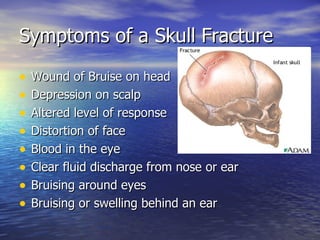
Symptoms of a Skull Fracture Wound of Bruise on head Depression on scalp Altered level of response Distortion of face Blood in the eye Clear fluid discharge from nose or ear Bruising around eyes Bruising or swelling behind an ear
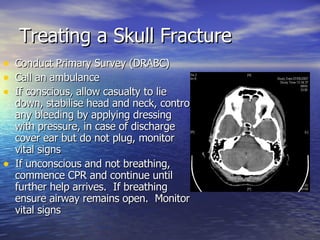
Treating a Skull Fracture Conduct Primary Survey (DRABC) Call an ambulance If conscious, allow casualty to lie down, stabilise head and neck, control any bleeding by applying dressing with pressure, in case of discharge cover ear but do not plug, monitor vital signs If unconscious and not breathing, commence CPR and continue until further help arrives.  If breathing ensure airway remains open.  Monitor vital signs
Bibliography Health First (2002) Concussion (online)  http://www.healthfirst.net.au/content/view/242/42/  Retrieved 29-8-08 Brain Foundation (2003) Concussion (online)  http://www.brainaustralia.org.au/AZ_of_Brain_Disorders/concussion   Retrieved 29/8/08 Medical Encyclopaedia (2008) Head Injury (online)  http://www.nlm.nih.gov/medlineplus/ency/article/000028.htm   Retrieved 29/8/08 Texas Pediatric Surgical Associates (no date) Lacerations (online)  http://www.pedisurg.com/PtEduc/Lacerations.htm   Retrieved 29/8/08  Health Encyclopedia (2007) Concussion (online)  http://www.faqs.org/health/Sick-V1/Concussion.html   Retrieved 29/8/08 Health Care Clinic (no date) Cerebral Contusion (online)  http://www.health-care-clinic.org/diseases/cerebral-contusion.htm   Retrieved 29/8/08 Brain and Spine Foundation (2005) sub-arachnoid haemorrhage (online)  http://www.brainandspine.org.uk/information/publications/brain_and_spine_booklets/subarachnoid_haemorrhage/symptoms.html   Retrieved 29/8/08

Head Injury

  • 1.
  • 2.
    Head Injury A head injury is any trauma resulting in injury to the scalp, skull or brain. A head injury is particularly dangerous as, at first the injury may appear only minor however major internal injuries have occurred. A victim with a suspected head injury should be monitored for a number of days after the incident There are five main types of head injuries: Lacerations Concussion Contusions Haemorrhage Compression Skull Fracture
  • 3.
    What are LacerationsA laceration is a tear in the skin as a result of an injury. In the case of visible bones or tendons, or excessive bleeding or pain, the casualty should be seen to by a doctor
  • 4.
    Symptoms of LacerationsBleeding Pain Numbness Swelling of Injured Skin
  • 5.
    Treating Lacerations Conduct Primary Survey (DRABC) If symptoms appear serious, an ambulance should be called immediately Place a dry, sterile dressing onto wound and apply direct pressure. If skull fracture is suspected, minimise pressure. If injury has resulted in an attached flap of skin (avulsion), using clean water gently flush the area, fold flap back over laceration and apply dressing with pressure Use a roller gauze to secure dressings to the head. Do not remove dressings Casualty should be monitored for the next couple of days
  • 6.
    What is aconcussion? A concussion is a temporary change in the way the brain works when it is suddenly moved or jarred, it occurs when the brain suddenly shifts inside the skull and knocks against the skulls bony surface. Concussions can last from a few moments, to an unconscious state for over 3 minutes.
  • 7.
    Symptoms of aConcussion Amnesia, short term memory loss Nausea, vomiting Headache Blurred Vision Confusion Ringing in Ears Neck Pain Dizziness Unconsciousness Irritability Convulsions
  • 8.
    Treating a ConcussionConduct Primary Survey (DRABC) Determine the severity or ‘grade’ of the concussion. Grade 1 – conscious, symptoms last under 15 minutes Grade 2 – conscious, symptoms last over 15 minutes Grade 3 - unconscious Call an ambulance immediately, lay casualty down with head and shoulders slightly raised, try to keep them awake and talking. If casualty falls unconscious and is not breathing, commence CPR and monitor vital signs Seek professional medical assistance, lay the casualty down with the head and shoulders slightly raised. Try to keep casualty awake and talking Allow casualty to rest, however continually monitor in case their condition changes. Lay casualty down with their head and shoulders slightly raised Grade 3 Grade 2 Grade 1
  • 9.
    What is aCerebral Contusion A contusion is a bruise to the brain tissue which occurs when a number of small blood vessels leak into brain tissue. Contusions occur when the brain strikes a ridge in the skull, when the head moves suddenly or hits a solid object with great force.
  • 10.
    Symptoms of aContusion Severe Headache Dizziness Nausea / Vomiting Dilated Pupil Weakness of limbs Restless, irritable Memory Loss Confusion Drowsiness Unconsciousness
  • 11.
    Treating a ContusionConduct Primary Survey (DRABC) Seek medical assistance, if symptoms indicate severe head trauma, call ambulance immediately Monitor casualty’s level of consciousness Encourage the casualty to stay awake and talk, reassure them If casualty falls unconscious and breathing ceases, commence CPR until further help arrives Bilateral Cerebral Contusions
  • 12.
    What is aHaemorrhage A brain or subarachnoid haemorrhage occurs when blood leaks out of the blood vessels and onto the surface of the brain. The blood then damages the brain tissue which, along with the blood loss, can cause serious and potentially life threatening brain damage
  • 13.
    Symptoms of aHaemorrhage Sudden and Severe headache Nausea / vomiting Unconsciousness Seizure Paralysis Preserved brain with haemorrhage
  • 14.
    Treating a HaemorrhageConduct primary survey (DRABC) Call an ambulance immediately Monitor level of consciousness If casualty falls unconscious, commence CPR and continue until further help arrives If casualty has a seizure, clear them of any dangers and position them on the ground in a comfortable position and wait for seizure to end. Once ended, roll casualty into recovery position Monitor Vital signs until ambulance arrives
  • 15.
    What is aCerebral Compression A cerebral compression involves a build up of pressure on the brain and can be life threatening, most often requiring surgery. Cerebral compression occurs when there is an accumulation of blood within the skull or injured brain tissue swells
  • 16.
    Symptoms of acerebral compression Recent head injury Headache Noisy, slow breathing Slow pulse Unequal pupil size Weakness of paralysis down one side of body High temperature Drowsiness Change in behaviour Disorientation Unconsciousness
  • 17.
    Treating a cerebralcompression Conduct Primary Survey (DRABC) Call for an ambulance If conscious, rest casualty in comfortable position, reassure them and monitor vital signs until help arrives If unconscious and not breathing, commence CPR and continue until help arrives. If breathing, ensure airway is open.
  • 18.
    What is aSkull Fracture A skull fracture occurs after a head injury and can be life threatening as the fractured bone may cause damage to the brain.
  • 19.
    Symptoms of aSkull Fracture Wound of Bruise on head Depression on scalp Altered level of response Distortion of face Blood in the eye Clear fluid discharge from nose or ear Bruising around eyes Bruising or swelling behind an ear
  • 20.
    Treating a SkullFracture Conduct Primary Survey (DRABC) Call an ambulance If conscious, allow casualty to lie down, stabilise head and neck, control any bleeding by applying dressing with pressure, in case of discharge cover ear but do not plug, monitor vital signs If unconscious and not breathing, commence CPR and continue until further help arrives. If breathing ensure airway remains open. Monitor vital signs
  • 21.
    Bibliography Health First(2002) Concussion (online) http://www.healthfirst.net.au/content/view/242/42/ Retrieved 29-8-08 Brain Foundation (2003) Concussion (online) http://www.brainaustralia.org.au/AZ_of_Brain_Disorders/concussion Retrieved 29/8/08 Medical Encyclopaedia (2008) Head Injury (online) http://www.nlm.nih.gov/medlineplus/ency/article/000028.htm Retrieved 29/8/08 Texas Pediatric Surgical Associates (no date) Lacerations (online) http://www.pedisurg.com/PtEduc/Lacerations.htm Retrieved 29/8/08 Health Encyclopedia (2007) Concussion (online) http://www.faqs.org/health/Sick-V1/Concussion.html Retrieved 29/8/08 Health Care Clinic (no date) Cerebral Contusion (online) http://www.health-care-clinic.org/diseases/cerebral-contusion.htm Retrieved 29/8/08 Brain and Spine Foundation (2005) sub-arachnoid haemorrhage (online) http://www.brainandspine.org.uk/information/publications/brain_and_spine_booklets/subarachnoid_haemorrhage/symptoms.html Retrieved 29/8/08