Head InjuriesMade by : Marwa Hussam al-maulyID NO : psy-fa06-017College : Mazoon collegeMajor : Psychology
IndexIts definitionIts causes Its symptomsIts typesGeneral info (did you know)
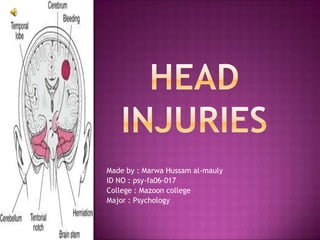
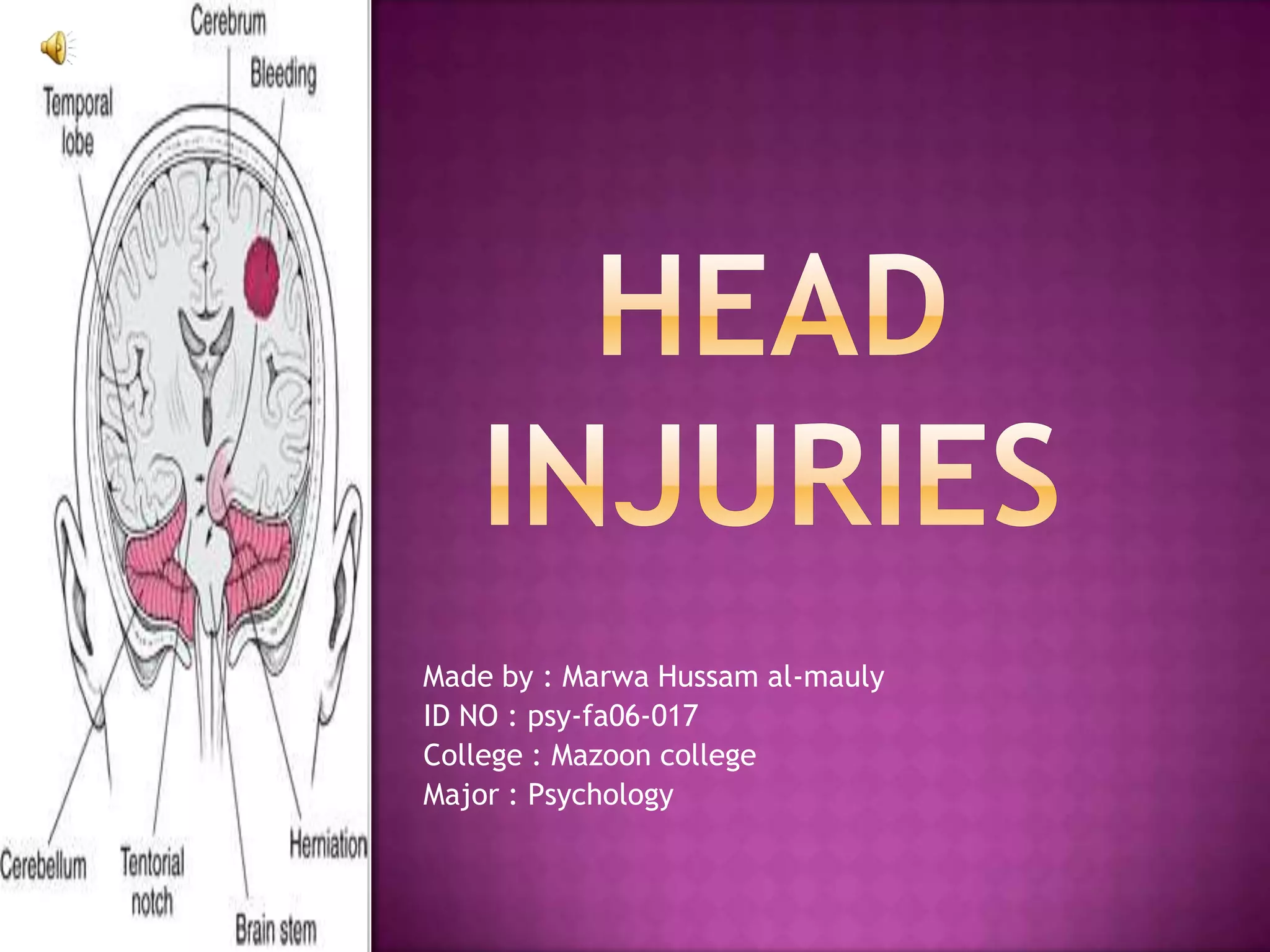
 DefinitionHead injury refers to trauma to the head. This may or may not include injury to the brain. However, the terms traumatic brain injury and head injury are often used interchangeably in the medical literature. Traumatic brain injury is an insult to the brain, not of a degenerative or congenital nature but caused by an external physical force, that may produce a diminished or altered state of consciousness, which results in an impairment of cognitive abilities or physical functioning
causesA traumatic brain injury occurs when an outside force impacts the head hard enough to cause the brain to move within the skull or if the force causes the skull to break and directly hurts the brain.A direct blow to the head can be great enough to injure the brain inside the skull. A direct force to the head can also break the skull and directly hurt the brain. This type of injury can occur from motor vehicle crashes, firearms, falls, sports, and physical violence, such as hitting or striking with an object.A rapid acceleration and deceleration of the head can force the brain to move back and forth across the inside of the skull. The stress from the rapid movements pulls apart nerve fibers and causes damage to brain tissue. This type of injury often occurs as a result of motor vehicle crashes and physical violence, such as Shaken Baby Syndrome.
SymptomsSpinal fluid (thin water-looking liquid) coming out of the ears or noseLoss of consciousness; however, loss of consciousness may not occur in some concussion casesDilated (the black center of the eye is large and does not get smaller in light)or unequal size of pupilsVision changes (blurred vision or seeing double, not able to tolerate bright light, loss of eye movement, blindness) Dizziness, balance problemsRespiratory failure (not breathing)Coma (not alert and unable to respond to others) or semi comatose stateParalysis, difficulty moving body parts, weakness, poor coordinationSlow pulseSlow breathing rate, with an increase in blood pressureVomitingLethargy (sluggish, sleepy, gets tired easily)HeadacheConfusionRinging in the ears, or changes in ability to hear
TypesA. Diffuse Axonal Injury:A Diffuse Axonal Injury can be caused by shaking or strong rotation of the head, as with Shaken Baby Syndrome, or by rotational forces, such as with a car accident.Injury occurs because the unmoving brain lags behind the movement of the skull, causing brain structures to tear.There is extensive tearing of nerve tissue throughout the brain. This can cause brain chemicals to be released, causing additional injury.The tearing of the nerve tissue disrupts the brain’s regular communication and chemical processes.This disturbance in the brain can produce temporary or permanent widespread brain damage, coma, or death.A person with a diffuse axonal injury could present a variety of functional impairments depending on where the shearing (tears) occurred in the brain.
TypesB. ConcussionA concussion can be caused by direct blows to the head, gunshot wounds, violent shaking of the head, or force from a whiplash type injury.Both closed and open head injuries can produce a concussion. A concussion is the most common type of traumatic brain injury.A concussion is caused when the brain receives trauma from an impact or a sudden momentum or movement change. The blood vessels in the brain may stretch and cranial nerves may be damaged.A person may or may not experience a brief loss of consciousness (not exceeding 20 minutes). A person may remain conscious, but feel “dazed” or “punch drunk”.A concussion may or may not show up on a diagnostic imaging test, such as a CAT Scan.Skull fracture, brain bleeding, or swelling may or may not be present. Therefore, concussion is sometimes defined by exclusion and is considered a complex neurobehavioral syndrome.A concussion can cause diffuse axonal type injury resulting in permanent or temporary damage.A blood clot in the brain can occur occasionally and be fatal.It may take a few months to a few years for a concussion to heal.
TypesC. ContusionA contusion can be the result of a direct impact to the head.A contusion is a bruise (bleeding) on the brain.Large contusions may need to be surgically removed.
TypesD. Coup-Countercoup InjuryCoup- Contrecoup Injury describes contusions that are both at the site of the impact and on the complete opposite side of the brain.This occurs when the force impacting the head is not only great enough to cause a contusion at the site of impact, but also is able to move the brain and cause it to slam into the opposite side of the skull, which causes the additional contusion.
TypesE. Penetration InjuryPenetrating injury to the brain occurs from the impact of a bullet, knife or other sharp object that forces hair, skin, bone and fragments from the object into the brain.Objects traveling at a low rate of speed through the skull and brain can ricochet within the skull, which widens the area of damage.A "through-and-through" injury occurs if an object enters the skull, goes through the brain, and exits the skull. Through-and-through traumatic brain injuries include the effects of penetration injuries, plus additional shearing, stretching and rupture of brain tissue.The devastating traumatic brain injuries caused by bullet wounds result in a 91% firearm-related death rate overall.Firearms are the single largest cause of death from traumatic brain injury
General InformationShaken Baby SyndromeShaken Baby Syndrome is a violent criminal act that causes traumatic brain injury. Shaken Baby Syndrome occurs when the perpetrator aggressively shakes a baby or young child. The forceful whiplash-like motion causes the brain to be injured.Blood vessels between the brain and skull rupture and bleed.The accumulation of blood causes the brain tissue to compress while the injury causes the brain to swell. This damages the brain cells.Shaken Baby Syndrome can cause seizures, lifelong disability, coma, and death.Irritability, changes in eating patterns, tiredness, difficulty breathing, dilated pupils, seizures, and vomiting are signs of Shaken Baby Syndrome. A baby experiencing such symptoms needs immediate emergency medical attention.
General InformationDID YOU KNOWThe degree of external head injury may have little to do with the degree of brain injury. Skull x-rays are rarely helpful for diagnosing a head injury.In a person with a severe head injury, the neck should not be moved because it may be broken.Acetaminophen Some Trade Names TYLENOL is the best analgesic to take after a head injury.
THANK YOU SO  MUCH FOR PAYING ATTENTION

Head Injuries

  • 1.
    Head InjuriesMade by: Marwa Hussam al-maulyID NO : psy-fa06-017College : Mazoon collegeMajor : Psychology
  • 2.
    IndexIts definitionIts causesIts symptomsIts typesGeneral info (did you know)
  • 3.
    DefinitionHead injuryrefers to trauma to the head. This may or may not include injury to the brain. However, the terms traumatic brain injury and head injury are often used interchangeably in the medical literature. Traumatic brain injury is an insult to the brain, not of a degenerative or congenital nature but caused by an external physical force, that may produce a diminished or altered state of consciousness, which results in an impairment of cognitive abilities or physical functioning
  • 4.
    causesA traumatic braininjury occurs when an outside force impacts the head hard enough to cause the brain to move within the skull or if the force causes the skull to break and directly hurts the brain.A direct blow to the head can be great enough to injure the brain inside the skull. A direct force to the head can also break the skull and directly hurt the brain. This type of injury can occur from motor vehicle crashes, firearms, falls, sports, and physical violence, such as hitting or striking with an object.A rapid acceleration and deceleration of the head can force the brain to move back and forth across the inside of the skull. The stress from the rapid movements pulls apart nerve fibers and causes damage to brain tissue. This type of injury often occurs as a result of motor vehicle crashes and physical violence, such as Shaken Baby Syndrome.
  • 5.
    SymptomsSpinal fluid (thinwater-looking liquid) coming out of the ears or noseLoss of consciousness; however, loss of consciousness may not occur in some concussion casesDilated (the black center of the eye is large and does not get smaller in light)or unequal size of pupilsVision changes (blurred vision or seeing double, not able to tolerate bright light, loss of eye movement, blindness) Dizziness, balance problemsRespiratory failure (not breathing)Coma (not alert and unable to respond to others) or semi comatose stateParalysis, difficulty moving body parts, weakness, poor coordinationSlow pulseSlow breathing rate, with an increase in blood pressureVomitingLethargy (sluggish, sleepy, gets tired easily)HeadacheConfusionRinging in the ears, or changes in ability to hear
  • 6.
    TypesA. Diffuse AxonalInjury:A Diffuse Axonal Injury can be caused by shaking or strong rotation of the head, as with Shaken Baby Syndrome, or by rotational forces, such as with a car accident.Injury occurs because the unmoving brain lags behind the movement of the skull, causing brain structures to tear.There is extensive tearing of nerve tissue throughout the brain. This can cause brain chemicals to be released, causing additional injury.The tearing of the nerve tissue disrupts the brain’s regular communication and chemical processes.This disturbance in the brain can produce temporary or permanent widespread brain damage, coma, or death.A person with a diffuse axonal injury could present a variety of functional impairments depending on where the shearing (tears) occurred in the brain.
  • 7.
    TypesB. ConcussionA concussioncan be caused by direct blows to the head, gunshot wounds, violent shaking of the head, or force from a whiplash type injury.Both closed and open head injuries can produce a concussion. A concussion is the most common type of traumatic brain injury.A concussion is caused when the brain receives trauma from an impact or a sudden momentum or movement change. The blood vessels in the brain may stretch and cranial nerves may be damaged.A person may or may not experience a brief loss of consciousness (not exceeding 20 minutes). A person may remain conscious, but feel “dazed” or “punch drunk”.A concussion may or may not show up on a diagnostic imaging test, such as a CAT Scan.Skull fracture, brain bleeding, or swelling may or may not be present. Therefore, concussion is sometimes defined by exclusion and is considered a complex neurobehavioral syndrome.A concussion can cause diffuse axonal type injury resulting in permanent or temporary damage.A blood clot in the brain can occur occasionally and be fatal.It may take a few months to a few years for a concussion to heal.
  • 8.
    TypesC. ContusionA contusioncan be the result of a direct impact to the head.A contusion is a bruise (bleeding) on the brain.Large contusions may need to be surgically removed.
  • 9.
    TypesD. Coup-Countercoup InjuryCoup-Contrecoup Injury describes contusions that are both at the site of the impact and on the complete opposite side of the brain.This occurs when the force impacting the head is not only great enough to cause a contusion at the site of impact, but also is able to move the brain and cause it to slam into the opposite side of the skull, which causes the additional contusion.
  • 10.
    TypesE. Penetration InjuryPenetratinginjury to the brain occurs from the impact of a bullet, knife or other sharp object that forces hair, skin, bone and fragments from the object into the brain.Objects traveling at a low rate of speed through the skull and brain can ricochet within the skull, which widens the area of damage.A "through-and-through" injury occurs if an object enters the skull, goes through the brain, and exits the skull. Through-and-through traumatic brain injuries include the effects of penetration injuries, plus additional shearing, stretching and rupture of brain tissue.The devastating traumatic brain injuries caused by bullet wounds result in a 91% firearm-related death rate overall.Firearms are the single largest cause of death from traumatic brain injury
  • 11.
    General InformationShaken BabySyndromeShaken Baby Syndrome is a violent criminal act that causes traumatic brain injury. Shaken Baby Syndrome occurs when the perpetrator aggressively shakes a baby or young child. The forceful whiplash-like motion causes the brain to be injured.Blood vessels between the brain and skull rupture and bleed.The accumulation of blood causes the brain tissue to compress while the injury causes the brain to swell. This damages the brain cells.Shaken Baby Syndrome can cause seizures, lifelong disability, coma, and death.Irritability, changes in eating patterns, tiredness, difficulty breathing, dilated pupils, seizures, and vomiting are signs of Shaken Baby Syndrome. A baby experiencing such symptoms needs immediate emergency medical attention.
  • 12.
    General InformationDID YOUKNOWThe degree of external head injury may have little to do with the degree of brain injury. Skull x-rays are rarely helpful for diagnosing a head injury.In a person with a severe head injury, the neck should not be moved because it may be broken.Acetaminophen Some Trade Names TYLENOL is the best analgesic to take after a head injury.
  • 13.
    THANK YOU SO MUCH FOR PAYING ATTENTION