Decision Making in Business Higher/Int 2 Business Management 2009-2010
Decisions? Managers? Whatever a manager does, he  does through making decisions.  These decisions may be a  matter of routine .  Indeed he may not even realise that he is making them.  Or they  may affect the future existence of the enterprise  and require years of systematic analysis.  But management is always a decision-making process Peter F Drucker
Personal Decisions How many decisions have you made today? 2 minutes to write down as many as possible
Business Decisions In order to achieve the organisations aims and objectives managers must make decisions … …  but what about? 2 minutes to write down as many as possible
Decision Types There are 3 main types … But due to popular demand they  are not be listed here!
Strategic Decisions Long term decisions  – looking towards the future Set the  aims of the organisation Made by  SMT  (CE and BoD)/owners No detail  about how to achieve eg  major policy statements
Examples of Strategic Decisions What  products  will we produce  in the future? Increase market share  by 25% in ten years Maximise sales To have  100% customer satisfaction  (or delight)
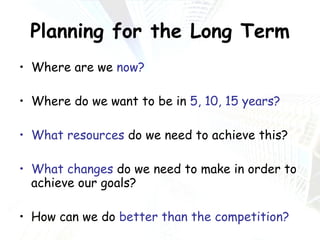
Planning for the Long Term Where are we  now? Where do we want to be in  5, 10, 15 years? What resources  do we need to achieve this? What changes  do we need to make in order to achieve our goals? How can we do  better than the competition?
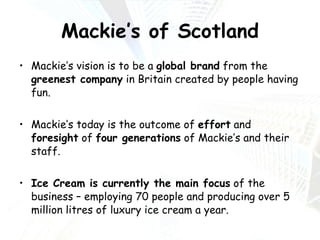
Mackie’s of Scotland Mackie’s vision is to be a  global brand  from the  greenest company  in Britain created by people having fun. Mackie’s today is the outcome of  effort  and  foresight  of  four generations  of Mackie’s and their staff. Ice Cream is currently the main focus  of the business – employing 70 people and producing over 5 million litres of luxury ice cream a year.
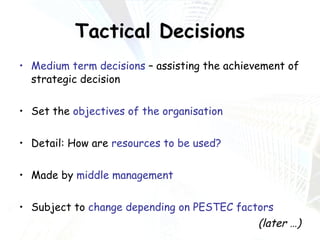
Tactical Decisions Medium term decisions  – assisting the achievement of strategic decision Set the  objectives of the organisation Detail: How are  resources to be used? Made by  middle management Subject to  change depending on PESTEC factors (later …)
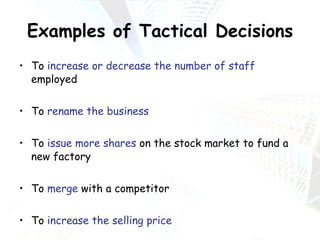
Examples of Tactical Decisions To  increase or decrease the number of staff  employed To  rename the business To  issue more shares  on the stock market to fund a new factory To  merge  with a competitor To  increase the selling price To  reduce costs
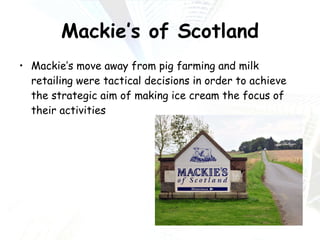
Mackie’s of Scotland Mackie’s move away from pig farming and milk retailing were tactical decisions in order to achieve the strategic aim of making ice cream the focus of their activities
Operational Decisions Day-to-day decisions  – made to achieve the objectives (tactical direction) Often made in  response to changes in circumstances  eg secretary is ill and won’t be coming into work Operational decision (in this case) might be to  transfer another member of the administrative staff to cover her duties
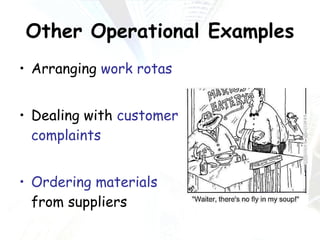
Other Operational Examples Arranging  work rotas Dealing with  customer complaints Ordering materials  from suppliers
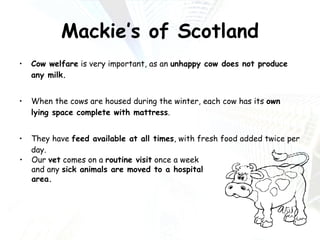
Mackie’s of Scotland Cow welfare  is very important, as an  unhappy cow does not produce any milk.  When the cows are housed during the winter, each cow has its  own lying space complete with mattress . They have  feed available at all times , with fresh food added twice per day. Our  vet  comes on a  routine visit  once a week and any  sick animals are moved to a hospital area.
On a Mission … A work force must be able to achieve targets and see relevance to their work. Why?
On a Mission … Otherwise they are  less productive Likely to be  demotivated May become  disruptive
Mission Statement A  written summary of strategic aims Well publicised Helps employees understand  what the company is working towards Often used in  marketing the company’s products
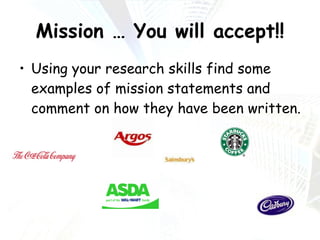
Mission … You will accept!! Using your research skills find some examples of mission statements and comment on how they have been written.
The Manager’s Role Describe a manager … 2 minutes to think about this
The Manager’s Role A manager: Gets  things done  (through  others ) Gets things done (with  resources ) Controls and supervises Makes  decisions In charge of  subordinates  and  department Is  accountable  to the owner(s)
Importance of Managers The quality and performance of the managers determine the success of a business, indeed they determine survival. Peter F Drucker
The Nature of Managerial Work A study of what managers do rather than what they ought to do (Mintzberg 1973) Interpersonal role Informational role Decisional role
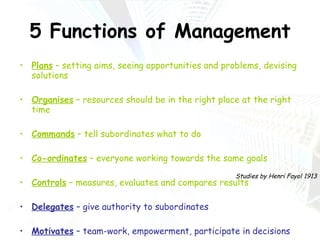
5 Functions of Management Plans  – setting aims, seeing opportunities and problems, devising solutions Organises  – resources should be in the right place at the right time Commands  – tell subordinates what to do Co-ordinates  – everyone working towards the same goals Controls  – measures, evaluates and compares results Delegates  – give authority to subordinates Motivates  – team-work, empowerment, participate in decisions Studies by Henri Fayol 1913
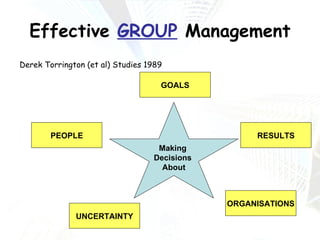
Effective  GROUP  Management Derek Torrington (et al) Studies 1989 Making  Decisions  About ORGANISATIONS RESULTS GOALS UNCERTAINTY PEOPLE
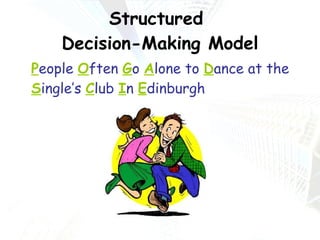
Structured  Decision-Making Model P eople  O ften  G o  A lone to  D ance at the  S ingle’s  C lub  I n  E dinburgh
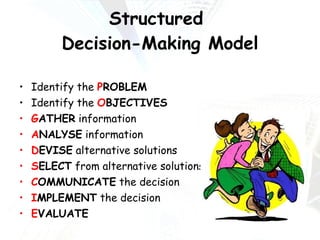
Structured  Decision-Making Model Identify the  P ROBLEM Identify the  O BJECTIVES G ATHER  information A NALYSE  information D EVISE  alternative solutions S ELECT  from alternative solutions C OMMUNICATE  the decision I MPLEMENT  the decision E VALUATE
Structured  Decision-Making Model (1) Identify the Problem Where do we want to go? Achieve? What is wrong? (2) Identify the Objectives What is it we want to achieve? (3) Gather Information Extensive collection of internal and external info
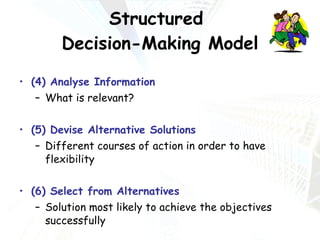
Structured  Decision-Making Model (4) Analyse Information What is relevant?  (5) Devise Alternative Solutions Different courses of action in order to have flexibility (6) Select from Alternatives Solution most likely to achieve the objectives successfully
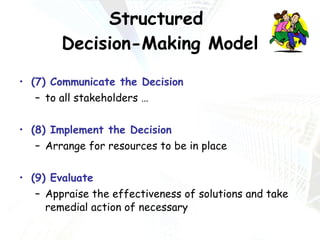
Structured  Decision-Making Model (7) Communicate the Decision to all stakeholders …  (8) Implement the Decision Arrange for resources to be in place (9) Evaluate Appraise the effectiveness of solutions and take remedial action of necessary
Example No. 1 –  Computer Games Industry The  problem  is a falling market share …
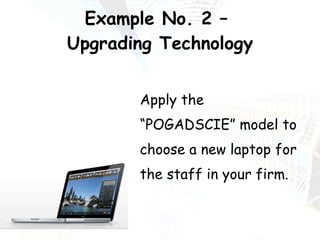
Example No. 2 –  Upgrading Technology Apply the “POGADSCIE” model to choose a new laptop for the staff in your firm.
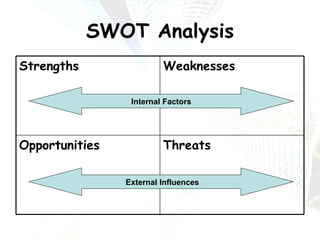
SWOT Analysis Internal Factors External Influences Strengths Weaknesses Opportunities Threats
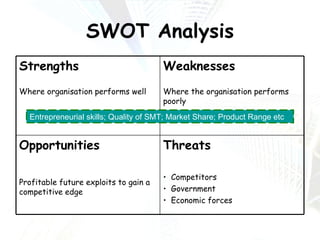
SWOT Analysis Entrepreneurial skills; Quality of SMT; Market Share; Product Range etc Strengths Where organisation performs well Weaknesses Where the organisation performs poorly Opportunities Profitable future exploits to gain a competitive edge Threats Competitors Government Economic forces
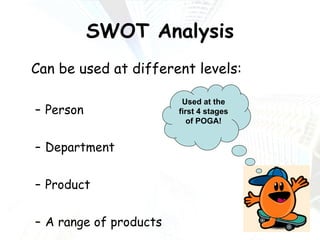
SWOT Analysis Can be used at different levels: Person Department Product A range of products Used at the first 4 stages of POGA!
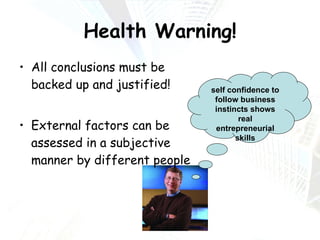
Health Warning! All conclusions must be backed up and justified! External factors can be assessed in a subjective manner by different people self confidence to follow business instincts shows real entrepreneurial skills
Costs and Benefits of POGADSCIE and SWOT Benefits No rash  decisions Decisions made with  all relevant facts Alternative  solutions considered Logical  process – enhances innovation Costs Ability to  collect info   (value of) Time consuming Range of  possible solutions difficult  in practice Can  stifle creativity  and  gut reactions
Constraints on  Effective Decisions Availability of  finance Existing  company policy Staff may resist  change (behaviour/attitude) Staff may have  tunnel vision, can’t handle complex decisions, fail to consult, indecisive) Lack of  technology Political (Government  and  EU legislation) Economic  environment Social  factors Technological  developments Environmental  changes Competitors’  behaviour
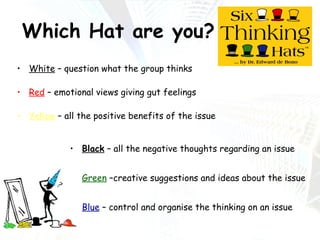
Which Hat are you? Black  – all the negative thoughts regarding an issue Green  –creative suggestions and ideas about the issue Blue  – control and organise the thinking on an issue White  – question what the group thinks Red  – emotional views giving gut feelings Yellow  – all the positive benefits of the issue
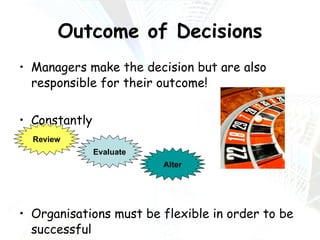
Outcome of Decisions Managers make the decision but are also responsible for their outcome! Constantly Organisations must be flexible in order to be successful Alter Evaluate Review
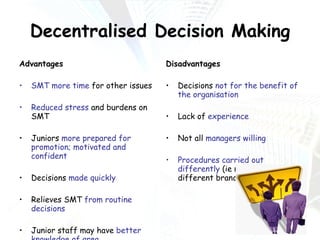
Decentralised Decision Making Advantages SMT more time  for other issues Reduced stress  and burdens on SMT Juniors  more prepared for promotion; motivated and confident Decisions  made quickly Relieves SMT  from routine decisions Junior staff may have  better knowledge of area improved quality decision Disadvantages Decisions  not for the benefit of the organisation Lack of  experience Not all  managers willing Procedures carried out differently  (ie not standard) in different branches
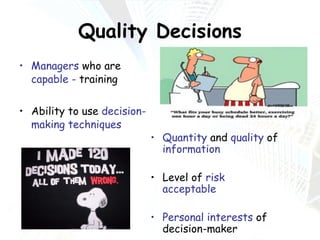
Quality Decisions Managers  who are  capable -  training Ability to use  decision-making techniques Quantity  and  quality  of  information Level of  risk acceptable Personal interests  of decision-maker
ICT in Decision Making Store ,  Retrieve ,  Process  and  Print ‘ What if?’  situations (Excel) Internet  – trends/competitors’ products Reporting  and  Presentation Packages Too much info?  (wheat from the chaff) Email  bombardment – easy to send to everyone!
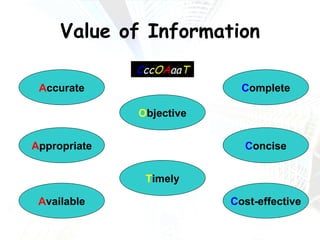
Value of Information T imely A ccurate A ppropriate A vailable C omplete C oncise C ost-effective O bjective C cc O A aa T
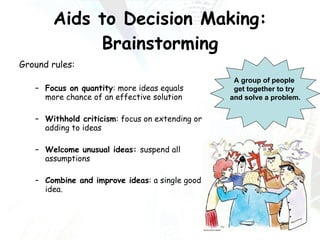
Aids to Decision Making: Brainstorming Ground rules: Focus on quantity : more ideas equals more chance of an effective solution Withhold criticism : focus on extending or adding to ideas Welcome unusual ideas:  suspend all assumptions Combine and improve ideas : a single good idea. A group of people  get together to try  and solve a problem.
Aids to Decision Making: PEST(EC) What do you mean by PEST?
Aids to Decision Making: PEST(EC) …  further detail of Opportunities and Threats!
Political Government type  and  stability Environmental/consumer protection legislation Levels of  bureaucracy  and  corruption Social  and  employment legislation Taxation  policy Changes in the  political environment
Economic Stage of the  business cycle Current/projected  economic growth, inflation  and  interest rates Unemployment  and labour supply Labour costs Disposable income  and distribution Globalisation
Social-Economic Population growth  rate and  age profile Population  health, education and social mobility Population  employment patterns, job market freedom  and  attitudes to work Social attitudes  and  social taboos Lifestyle  choices
Technological Impact of  emerging technologies Impact of  Internet , reduction in communications costs ( remote working ) Research and development  activity
Congratulations You have completed Decision Making in Business in Higher/Int 2 Business Management

HBM Decision Making CMD

  • 1.
    Decision Making inBusiness Higher/Int 2 Business Management 2009-2010
  • 2.
    Decisions? Managers? Whatevera manager does, he does through making decisions. These decisions may be a matter of routine . Indeed he may not even realise that he is making them. Or they may affect the future existence of the enterprise and require years of systematic analysis. But management is always a decision-making process Peter F Drucker
  • 3.
    Personal Decisions Howmany decisions have you made today? 2 minutes to write down as many as possible
  • 4.
    Business Decisions Inorder to achieve the organisations aims and objectives managers must make decisions … … but what about? 2 minutes to write down as many as possible
  • 5.
    Decision Types Thereare 3 main types … But due to popular demand they are not be listed here!
  • 6.
    Strategic Decisions Longterm decisions – looking towards the future Set the aims of the organisation Made by SMT (CE and BoD)/owners No detail about how to achieve eg major policy statements
  • 7.
    Examples of StrategicDecisions What products will we produce in the future? Increase market share by 25% in ten years Maximise sales To have 100% customer satisfaction (or delight)
  • 8.
    Planning for theLong Term Where are we now? Where do we want to be in 5, 10, 15 years? What resources do we need to achieve this? What changes do we need to make in order to achieve our goals? How can we do better than the competition?
  • 9.
    Mackie’s of ScotlandMackie’s vision is to be a global brand from the greenest company in Britain created by people having fun. Mackie’s today is the outcome of effort and foresight of four generations of Mackie’s and their staff. Ice Cream is currently the main focus of the business – employing 70 people and producing over 5 million litres of luxury ice cream a year.
  • 10.
    Tactical Decisions Mediumterm decisions – assisting the achievement of strategic decision Set the objectives of the organisation Detail: How are resources to be used? Made by middle management Subject to change depending on PESTEC factors (later …)
  • 11.
    Examples of TacticalDecisions To increase or decrease the number of staff employed To rename the business To issue more shares on the stock market to fund a new factory To merge with a competitor To increase the selling price To reduce costs
  • 12.
    Mackie’s of ScotlandMackie’s move away from pig farming and milk retailing were tactical decisions in order to achieve the strategic aim of making ice cream the focus of their activities
  • 13.
    Operational Decisions Day-to-daydecisions – made to achieve the objectives (tactical direction) Often made in response to changes in circumstances eg secretary is ill and won’t be coming into work Operational decision (in this case) might be to transfer another member of the administrative staff to cover her duties
  • 14.
    Other Operational ExamplesArranging work rotas Dealing with customer complaints Ordering materials from suppliers
  • 15.
    Mackie’s of ScotlandCow welfare is very important, as an unhappy cow does not produce any milk. When the cows are housed during the winter, each cow has its own lying space complete with mattress . They have feed available at all times , with fresh food added twice per day. Our vet comes on a routine visit once a week and any sick animals are moved to a hospital area.
  • 16.
    On a Mission… A work force must be able to achieve targets and see relevance to their work. Why?
  • 17.
    On a Mission… Otherwise they are less productive Likely to be demotivated May become disruptive
  • 18.
    Mission Statement A written summary of strategic aims Well publicised Helps employees understand what the company is working towards Often used in marketing the company’s products
  • 19.
    Mission … Youwill accept!! Using your research skills find some examples of mission statements and comment on how they have been written.
  • 20.
    The Manager’s RoleDescribe a manager … 2 minutes to think about this
  • 21.
    The Manager’s RoleA manager: Gets things done (through others ) Gets things done (with resources ) Controls and supervises Makes decisions In charge of subordinates and department Is accountable to the owner(s)
  • 22.
    Importance of ManagersThe quality and performance of the managers determine the success of a business, indeed they determine survival. Peter F Drucker
  • 23.
    The Nature ofManagerial Work A study of what managers do rather than what they ought to do (Mintzberg 1973) Interpersonal role Informational role Decisional role
  • 24.
    5 Functions ofManagement Plans – setting aims, seeing opportunities and problems, devising solutions Organises – resources should be in the right place at the right time Commands – tell subordinates what to do Co-ordinates – everyone working towards the same goals Controls – measures, evaluates and compares results Delegates – give authority to subordinates Motivates – team-work, empowerment, participate in decisions Studies by Henri Fayol 1913
  • 25.
    Effective GROUP Management Derek Torrington (et al) Studies 1989 Making Decisions About ORGANISATIONS RESULTS GOALS UNCERTAINTY PEOPLE
  • 26.
    Structured Decision-MakingModel P eople O ften G o A lone to D ance at the S ingle’s C lub I n E dinburgh
  • 27.
    Structured Decision-MakingModel Identify the P ROBLEM Identify the O BJECTIVES G ATHER information A NALYSE information D EVISE alternative solutions S ELECT from alternative solutions C OMMUNICATE the decision I MPLEMENT the decision E VALUATE
  • 28.
    Structured Decision-MakingModel (1) Identify the Problem Where do we want to go? Achieve? What is wrong? (2) Identify the Objectives What is it we want to achieve? (3) Gather Information Extensive collection of internal and external info
  • 29.
    Structured Decision-MakingModel (4) Analyse Information What is relevant? (5) Devise Alternative Solutions Different courses of action in order to have flexibility (6) Select from Alternatives Solution most likely to achieve the objectives successfully
  • 30.
    Structured Decision-MakingModel (7) Communicate the Decision to all stakeholders … (8) Implement the Decision Arrange for resources to be in place (9) Evaluate Appraise the effectiveness of solutions and take remedial action of necessary
  • 31.
    Example No. 1– Computer Games Industry The problem is a falling market share …
  • 32.
    Example No. 2– Upgrading Technology Apply the “POGADSCIE” model to choose a new laptop for the staff in your firm.
  • 33.
    SWOT Analysis InternalFactors External Influences Strengths Weaknesses Opportunities Threats
  • 34.
    SWOT Analysis Entrepreneurialskills; Quality of SMT; Market Share; Product Range etc Strengths Where organisation performs well Weaknesses Where the organisation performs poorly Opportunities Profitable future exploits to gain a competitive edge Threats Competitors Government Economic forces
  • 35.
    SWOT Analysis Canbe used at different levels: Person Department Product A range of products Used at the first 4 stages of POGA!
  • 36.
    Health Warning! Allconclusions must be backed up and justified! External factors can be assessed in a subjective manner by different people self confidence to follow business instincts shows real entrepreneurial skills
  • 37.
    Costs and Benefitsof POGADSCIE and SWOT Benefits No rash decisions Decisions made with all relevant facts Alternative solutions considered Logical process – enhances innovation Costs Ability to collect info (value of) Time consuming Range of possible solutions difficult in practice Can stifle creativity and gut reactions
  • 38.
    Constraints on Effective Decisions Availability of finance Existing company policy Staff may resist change (behaviour/attitude) Staff may have tunnel vision, can’t handle complex decisions, fail to consult, indecisive) Lack of technology Political (Government and EU legislation) Economic environment Social factors Technological developments Environmental changes Competitors’ behaviour
  • 39.
    Which Hat areyou? Black – all the negative thoughts regarding an issue Green –creative suggestions and ideas about the issue Blue – control and organise the thinking on an issue White – question what the group thinks Red – emotional views giving gut feelings Yellow – all the positive benefits of the issue
  • 40.
    Outcome of DecisionsManagers make the decision but are also responsible for their outcome! Constantly Organisations must be flexible in order to be successful Alter Evaluate Review
  • 41.
    Decentralised Decision MakingAdvantages SMT more time for other issues Reduced stress and burdens on SMT Juniors more prepared for promotion; motivated and confident Decisions made quickly Relieves SMT from routine decisions Junior staff may have better knowledge of area improved quality decision Disadvantages Decisions not for the benefit of the organisation Lack of experience Not all managers willing Procedures carried out differently (ie not standard) in different branches
  • 42.
    Quality Decisions Managers who are capable - training Ability to use decision-making techniques Quantity and quality of information Level of risk acceptable Personal interests of decision-maker
  • 43.
    ICT in DecisionMaking Store , Retrieve , Process and Print ‘ What if?’ situations (Excel) Internet – trends/competitors’ products Reporting and Presentation Packages Too much info? (wheat from the chaff) Email bombardment – easy to send to everyone!
  • 44.
    Value of InformationT imely A ccurate A ppropriate A vailable C omplete C oncise C ost-effective O bjective C cc O A aa T
  • 45.
    Aids to DecisionMaking: Brainstorming Ground rules: Focus on quantity : more ideas equals more chance of an effective solution Withhold criticism : focus on extending or adding to ideas Welcome unusual ideas: suspend all assumptions Combine and improve ideas : a single good idea. A group of people get together to try and solve a problem.
  • 46.
    Aids to DecisionMaking: PEST(EC) What do you mean by PEST?
  • 47.
    Aids to DecisionMaking: PEST(EC) … further detail of Opportunities and Threats!
  • 48.
    Political Government type and stability Environmental/consumer protection legislation Levels of bureaucracy and corruption Social and employment legislation Taxation policy Changes in the political environment
  • 49.
    Economic Stage ofthe business cycle Current/projected economic growth, inflation and interest rates Unemployment and labour supply Labour costs Disposable income and distribution Globalisation
  • 50.
    Social-Economic Population growth rate and age profile Population health, education and social mobility Population employment patterns, job market freedom and attitudes to work Social attitudes and social taboos Lifestyle choices
  • 51.
    Technological Impact of emerging technologies Impact of Internet , reduction in communications costs ( remote working ) Research and development activity
  • 52.
    Congratulations You havecompleted Decision Making in Business in Higher/Int 2 Business Management