PART 2- DECISION-MAKING
   TO REALIZE GOALS


  S creening    A dded V alue
  I nitiatives


                                 1
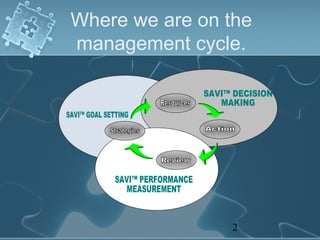
Where we are on the
management cycle.


                2
The Realities We Face
 Resources  are Limited
 There is a Competition for Funds
 Sometimes the Winner is the Best
  Sales Person
 Financial Decision Rules Don’t Always
  Match Operating Decision Rules
 Financial Returns And Efficiency Will
  Continue To Be Powerful.

                               3
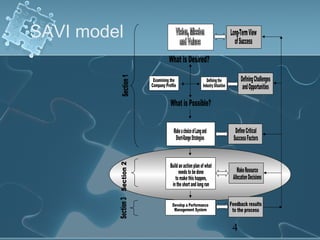
SAVI model


             4
Introduction to Chapter 6
 Two
    of the difficult issues facing today’s
 manager are:

     Finding
           the optimal solution to a problem
     Communicating the findings to a decision-maker.


 The framework for an integrated analysis in
          decision making is called
     Total Impact™ Business Case
                  Analysis

                                             5
LINKING BUSINESS CASES
  TO STRATEGIC PLANS
 As stated previously in the context of
 Total Impact the broad objectives are
 to improve performance in the areas of:
       Financial efficiency and effectiveness,
       Sustainability of the economic
        environment,
       Stewardship of the natural
        environment,
       Safety of employees and the public and
       Service to the customer.

                                      6
LINKING BUSINESS CASES
  TO STRATEGIC PLANS


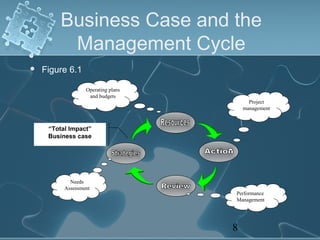
 The “Total Impact Business Case”
 follows the decision making path that
 has been created by the strategic
 phase of the management cycle.


                               7
Business Case and the
          Management Cycle
   Figure 6.1

                  Operating plans
                   and budgets
                                          Project
                                        management


     “Total Impact”
     Business case


            Needs
          Assessment
                                    Performance
                                    Management


                                    8
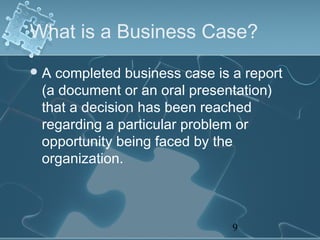
What is a Business Case?
A completed business case is a report
 (a document or an oral presentation)
 that a decision has been reached
 regarding a particular problem or
 opportunity being faced by the
 organization.


                              9
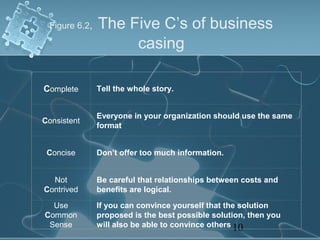
Figure 6.2,   The Five C’s of business
                    casing

Complete       Tell the whole story.


               Everyone in your organization should use the same
Consistent
               format


 Concise       Don’t offer too much information.


  Not          Be careful that relationships between costs and
Contrived      benefits are logical.
  Use          If you can convince yourself that the solution
Common         proposed is the best possible solution, then you
 Sense         will also be able to convince others 10
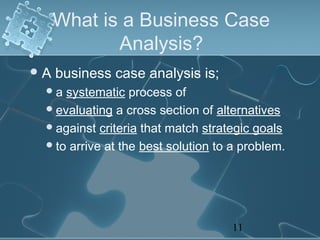
What is a Business Case
            Analysis?
A   business case analysis is;
 a  systematic process of
  evaluating a cross section of alternatives
  against criteria that match strategic goals
  to arrive at the best solution to a problem.


                                    11
Two Related Steps
 Step 1 is to find the best solution to a
  problem by preparing a complete
  business case analysis using a
  decision model.
 Step 2 is to put the findings of the
  analysis into a report that will be
  convincing for a decision-maker.

 We   begin with the first step.
                                    12
COMPONENTS OF A
        BUSINESS CASE
A   structured approach:

  Identifies   all aspects of a proposal in enough
     detail to give a decision-maker confidence that
     the analysis is complete.

  Provides    justification for the recommended
     solution by evaluating and choosing from
     alternative courses of action.


                                          13
Convince those with the
   authority to approve that:
 the  problem or opportunity is real
 the alternative chosen is the best
  available
 The investment makes the best use of
  limited resources.


                              14
consider some or all of the
       following factors:
 The  possibility of multiple goals that conflict
  with each other.
 The fact that projects have life cycles.
 The range of alternatives is getting wider as
  technology improves.
 Impact of the expenditure decision across
  organizational boundaries.
 Dynamics of the change process, and the
  need to address risks and uncertainty in a
  rapidly changing world.
                                        15
PROBLEM SOLVING
          PROCESS
 In practice, poorly defined problems are
  subjected to faulty analysis and people
  sit around arguing about which option
  to choose!


                                16
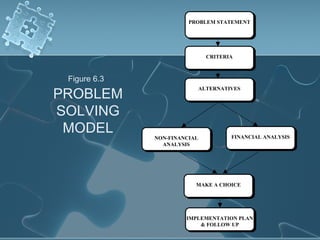
PROBLEM STATEMENT
                        PROBLEM STATEMENT


                              CRITERIA
                              CRITERIA


 Figure 6.3

PROBLEM
                          ALTERNATIVES
                          ALTERNATIVES


SOLVING
 MODEL                               FINANCIAL ANALYSIS
              NON-FINANCIAL
              NON-FINANCIAL           FINANCIAL ANALYSIS
                ANALYSIS
                 ANALYSIS


                         MAKE A CHOICE
                         MAKE A CHOICE


                       IMPLEMENTATION PLAN
                        IMPLEMENTATION PLAN
                                     17
                            & FOLLOW UP
                            & FOLLOW UP
DEFINING THE PROBLEM/
      OPPORTUNITY
 Proper  problem definition or
 identification of an opportunity is the
 most important, and often one of the
 most neglected elements of a business
 case preparation.

 The problem statement should guide a
 decision-maker to a full analysis of all
 logical alternative solutions.
                                18
Problem definition involves
the following steps:

    1.   Identify your present position
    2.   Identify why the present position is undesirable
    3.   Identify the position you would like to be in, (set
         an objective)
    4.   Identify why the new position is desirable

   A problem statement identifies, in future
    terms, the impact on the organization if the
    problem is solved.

                                               19
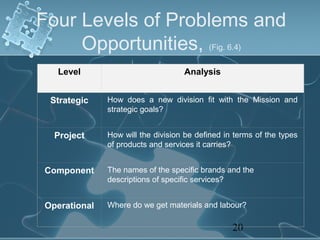
Four Levels of Problems and
     Opportunities, (Fig. 6.4)
   Level                            Analysis


  Strategic    How does a new division fit with the Mission and
               strategic goals?


   Project     How will the division be defined in terms of the types
               of products and services it carries?


 Component     The names of the specific brands and the
               descriptions of specific services?


 Operational   Where do we get materials and labour?

                                                  20
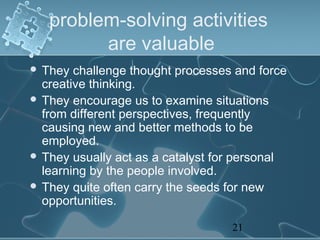
problem-solving activities
         are valuable
 They  challenge thought processes and force
  creative thinking.
 They encourage us to examine situations
  from different perspectives, frequently
  causing new and better methods to be
  employed.
 They usually act as a catalyst for personal
  learning by the people involved.
 They quite often carry the seeds for new
  opportunities.

                                   21
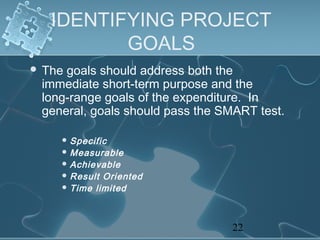
IDENTIFYING PROJECT
          GOALS
 Thegoals should address both the
 immediate short‑term purpose and the
 long‑range goals of the expenditure. In
 general, goals should pass the SMART test.

     Specific
     Measurable
     Achievable
     Result Oriented
     Time limited


                                 22
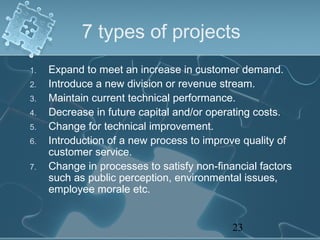
7 types of projects
1.   Expand to meet an increase in customer demand.
2.   Introduce a new division or revenue stream.
3.   Maintain current technical performance.
4.   Decrease in future capital and/or operating costs.
5.   Change for technical improvement.
6.   Introduction of a new process to improve quality of
     customer service.
7.   Change in processes to satisfy non-financial factors
     such as public perception, environmental issues,
     employee morale etc.


                                            23
Strategies for defining goals
   Seek:

   Avoid:

   Build:

   Restore:

                       24
Summary
 Theproblem/opportunity statement is
 the most important element of the
 decision model.

 Perhaps  the best way to summarize the
 findings of his chapter is to use a
 “Problem Statement Checklist”, (figure 6.7).


                                  25
Closing Remarks
 This   chapter begins a four part
  discussion of problem solving.
 Chapters 7, 8 & 9 will walk you through
  the remainder of the decision making
  model.
 Remember that the primary purpose of
  this model is to S creen A dded V alue
  I nitiatives.
                                26

Savi chapter6

  • 1.
    PART 2- DECISION-MAKING TO REALIZE GOALS  S creening A dded V alue I nitiatives 1
  • 2.
    Where we areon the management cycle. 2
  • 3.
    The Realities WeFace  Resources are Limited  There is a Competition for Funds  Sometimes the Winner is the Best Sales Person  Financial Decision Rules Don’t Always Match Operating Decision Rules  Financial Returns And Efficiency Will Continue To Be Powerful. 3
  • 4.
  • 5.
    Introduction to Chapter6  Two of the difficult issues facing today’s manager are:  Finding the optimal solution to a problem  Communicating the findings to a decision-maker.  The framework for an integrated analysis in decision making is called  Total Impact™ Business Case Analysis 5
  • 6.
    LINKING BUSINESS CASES TO STRATEGIC PLANS  As stated previously in the context of Total Impact the broad objectives are to improve performance in the areas of: Financial efficiency and effectiveness, Sustainability of the economic environment, Stewardship of the natural environment, Safety of employees and the public and Service to the customer. 6
  • 7.
    LINKING BUSINESS CASES TO STRATEGIC PLANS  The “Total Impact Business Case” follows the decision making path that has been created by the strategic phase of the management cycle. 7
  • 8.
    Business Case andthe Management Cycle  Figure 6.1 Operating plans and budgets Project management “Total Impact” Business case Needs Assessment Performance Management 8
  • 9.
    What is aBusiness Case? A completed business case is a report (a document or an oral presentation) that a decision has been reached regarding a particular problem or opportunity being faced by the organization. 9
  • 10.
    Figure 6.2, The Five C’s of business casing Complete Tell the whole story. Everyone in your organization should use the same Consistent format Concise Don’t offer too much information. Not Be careful that relationships between costs and Contrived benefits are logical. Use If you can convince yourself that the solution Common proposed is the best possible solution, then you Sense will also be able to convince others 10
  • 11.
    What is aBusiness Case Analysis? A business case analysis is; a systematic process of  evaluating a cross section of alternatives  against criteria that match strategic goals  to arrive at the best solution to a problem. 11
  • 12.
    Two Related Steps Step 1 is to find the best solution to a problem by preparing a complete business case analysis using a decision model.  Step 2 is to put the findings of the analysis into a report that will be convincing for a decision-maker.  We begin with the first step. 12
  • 13.
    COMPONENTS OF A BUSINESS CASE A structured approach:  Identifies all aspects of a proposal in enough detail to give a decision-maker confidence that the analysis is complete.  Provides justification for the recommended solution by evaluating and choosing from alternative courses of action. 13
  • 14.
    Convince those withthe authority to approve that:  the problem or opportunity is real  the alternative chosen is the best available  The investment makes the best use of limited resources. 14
  • 15.
    consider some orall of the following factors:  The possibility of multiple goals that conflict with each other.  The fact that projects have life cycles.  The range of alternatives is getting wider as technology improves.  Impact of the expenditure decision across organizational boundaries.  Dynamics of the change process, and the need to address risks and uncertainty in a rapidly changing world. 15
  • 16.
    PROBLEM SOLVING PROCESS  In practice, poorly defined problems are subjected to faulty analysis and people sit around arguing about which option to choose! 16
  • 17.
    PROBLEM STATEMENT PROBLEM STATEMENT CRITERIA CRITERIA Figure 6.3 PROBLEM ALTERNATIVES ALTERNATIVES SOLVING MODEL FINANCIAL ANALYSIS NON-FINANCIAL NON-FINANCIAL FINANCIAL ANALYSIS ANALYSIS ANALYSIS MAKE A CHOICE MAKE A CHOICE IMPLEMENTATION PLAN IMPLEMENTATION PLAN 17 & FOLLOW UP & FOLLOW UP
  • 18.
    DEFINING THE PROBLEM/ OPPORTUNITY  Proper problem definition or identification of an opportunity is the most important, and often one of the most neglected elements of a business case preparation.  The problem statement should guide a decision-maker to a full analysis of all logical alternative solutions. 18
  • 19.
    Problem definition involves thefollowing steps: 1. Identify your present position 2. Identify why the present position is undesirable 3. Identify the position you would like to be in, (set an objective) 4. Identify why the new position is desirable  A problem statement identifies, in future terms, the impact on the organization if the problem is solved. 19
  • 20.
    Four Levels ofProblems and Opportunities, (Fig. 6.4) Level Analysis Strategic How does a new division fit with the Mission and strategic goals? Project How will the division be defined in terms of the types of products and services it carries? Component The names of the specific brands and the descriptions of specific services? Operational Where do we get materials and labour? 20
  • 21.
    problem-solving activities are valuable  They challenge thought processes and force creative thinking.  They encourage us to examine situations from different perspectives, frequently causing new and better methods to be employed.  They usually act as a catalyst for personal learning by the people involved.  They quite often carry the seeds for new opportunities. 21
  • 22.
    IDENTIFYING PROJECT GOALS  Thegoals should address both the immediate short‑term purpose and the long‑range goals of the expenditure. In general, goals should pass the SMART test.  Specific  Measurable  Achievable  Result Oriented  Time limited 22
  • 23.
    7 types ofprojects 1. Expand to meet an increase in customer demand. 2. Introduce a new division or revenue stream. 3. Maintain current technical performance. 4. Decrease in future capital and/or operating costs. 5. Change for technical improvement. 6. Introduction of a new process to improve quality of customer service. 7. Change in processes to satisfy non-financial factors such as public perception, environmental issues, employee morale etc. 23
  • 24.
    Strategies for defininggoals  Seek:  Avoid:  Build:  Restore: 24
  • 25.
    Summary  Theproblem/opportunity statementis the most important element of the decision model.  Perhaps the best way to summarize the findings of his chapter is to use a “Problem Statement Checklist”, (figure 6.7). 25
  • 26.
    Closing Remarks  This chapter begins a four part discussion of problem solving.  Chapters 7, 8 & 9 will walk you through the remainder of the decision making model.  Remember that the primary purpose of this model is to S creen A dded V alue I nitiatives. 26