Routine Decision
 People usually make hundreds of decisions
everyday. Rather than thinking a lot for
each, people instead rely on routines.
 These are decisions which need an
introduction and identification then it
becomes your regular activity.
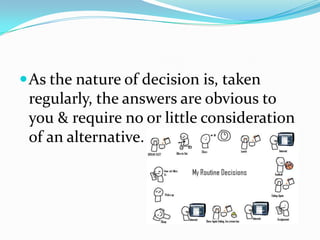
As the nature of decision is, taken
regularly, the answers are obvious to
you & require no or little consideration
of an alternative.
These decisions are usually sufficient,
but they do occasionally fail. The
failures provide an opportunity to
improve decision making.
Example
Which way to turn your car as you leave work to head
home,
Where to put the spoons when you take them out of the
dishwasher,
Which button to push to switch on your personal
computer,
How many buns to buy to go with a package of eight
sausages,
Which hand you write with.
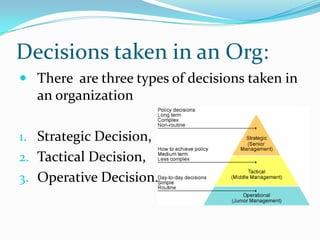
Decisions taken in an Org:
 There are three types of decisions taken in
an organization
1. Strategic Decision,
2. Tactical Decision,
3. Operative Decision.
Strategic Decision
 One of the essential parts of creating and running a
business is creating a mission or vision for the business
and a set of goals the company aims to achieve.
 Strategic decision making, or strategic planning,
describes the process of creating a company's mission
and objectives and deciding upon the courses of action
a company should pursue to achieve those goals.
Strategic decisions :
 are taken by top management
 have long term horizon
are future oriented
 are non-repetitive
 are centralized
affect long term prosperity of the firm
are concerned with the allocation of total resources
among product-market opportunities.
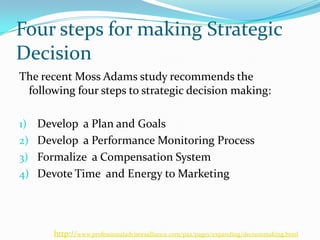
Four steps for making Strategic
Decision
The recent Moss Adams study recommends the
following four steps to strategic decision making:
1) Develop a Plan and Goals
2) Develop a Performance Monitoring Process
3) Formalize a Compensation System
4) Devote Time and Energy to Marketing
http://www.professionaladvisorsalliance.com/paa/pages/expanding/decisonmaking.html
Individual Decisions
 The main factor behind the
decision taken by individual is
Perception. Individual analysis
and rationale are also affected
by perception.
Perception
 A process by which individuals organize and
interpret their sensory impressions in order
to give meaning to their environment.
“We do not see things as they are,
but we see things as we are.”
Individual Decision Making
 We generally make decisions under impression of
facts and figures, comparison, perception or belief and
personal intuition. Perception plays an important role
while making intuition.
 As an individual can not go through diverse data to
analyze and interpret each and every thing, so the
decision made by him can be good on the ground
where he is good and vice versa.
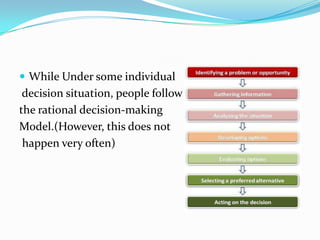
 While Under some individual
decision situation, people follow
the rational decision-making
Model.(However, this does not
happen very often)
So, what can managers do to
improve their decision making?
 Analyze the situation.
 Be aware of biases.
 Combine rational analysis with intuition.
 Don’t assume that your specific decision style is
appropriate for every job.
 Try to enhance your creativity
Group or Collaborative Decisions
 Group Decisions are called when a problem is
encountered or to determine the future direction of
the organization.
 Using tools like the SWOT
(Strengths, Weaknesses, Opportunities, Threats)
model, the current direction of
the organization is assessed.
Types of Group Decision Making
Consensus Decision Making:tries to
avoid "winners" and "losers". Consensus requires
that a majority approve a given course of action,
but that the minority agree to go along with the
course of action. In other words, if the minority
opposes the course of action, consensus requires
that the course of action be modified to remove
objectionable features.
Voting Based Methods :
 Majority : requires support from more than 50% of
the members of the group. Thus, the bar for action
is lower than with unanimity and a group of "losers"
is implicit to this rule
Plurality : where the largest block in a group
decides, even if it falls short of a majority.
 Dotmocracy : is a facilitation method that relies on
the use of special forms called Dotmocracy Sheets to
allow large groups to collectively brainstorm and
recognize agreement on an unlimited number of ideas
they have authored.
Blank Dotmocracy Sheet-----Filled Dotmocracy Sheet
Query Session
?
Routine & strategic decisions,

Routine & strategic decisions,

  • 2.
    Routine Decision  Peopleusually make hundreds of decisions everyday. Rather than thinking a lot for each, people instead rely on routines.  These are decisions which need an introduction and identification then it becomes your regular activity.
  • 3.
    As the natureof decision is, taken regularly, the answers are obvious to you & require no or little consideration of an alternative.
  • 4.
    These decisions areusually sufficient, but they do occasionally fail. The failures provide an opportunity to improve decision making.
  • 5.
    Example Which way toturn your car as you leave work to head home, Where to put the spoons when you take them out of the dishwasher, Which button to push to switch on your personal computer, How many buns to buy to go with a package of eight sausages, Which hand you write with.
  • 6.
    Decisions taken inan Org:  There are three types of decisions taken in an organization 1. Strategic Decision, 2. Tactical Decision, 3. Operative Decision.
  • 8.
    Strategic Decision  Oneof the essential parts of creating and running a business is creating a mission or vision for the business and a set of goals the company aims to achieve.  Strategic decision making, or strategic planning, describes the process of creating a company's mission and objectives and deciding upon the courses of action a company should pursue to achieve those goals.
  • 9.
    Strategic decisions : are taken by top management  have long term horizon are future oriented  are non-repetitive  are centralized affect long term prosperity of the firm are concerned with the allocation of total resources among product-market opportunities.
  • 10.
    Four steps formaking Strategic Decision The recent Moss Adams study recommends the following four steps to strategic decision making: 1) Develop a Plan and Goals 2) Develop a Performance Monitoring Process 3) Formalize a Compensation System 4) Devote Time and Energy to Marketing http://www.professionaladvisorsalliance.com/paa/pages/expanding/decisonmaking.html
  • 11.
    Individual Decisions  Themain factor behind the decision taken by individual is Perception. Individual analysis and rationale are also affected by perception.
  • 12.
    Perception  A processby which individuals organize and interpret their sensory impressions in order to give meaning to their environment. “We do not see things as they are, but we see things as we are.”
  • 13.
    Individual Decision Making We generally make decisions under impression of facts and figures, comparison, perception or belief and personal intuition. Perception plays an important role while making intuition.  As an individual can not go through diverse data to analyze and interpret each and every thing, so the decision made by him can be good on the ground where he is good and vice versa.
  • 14.
     While Undersome individual decision situation, people follow the rational decision-making Model.(However, this does not happen very often)
  • 15.
    So, what canmanagers do to improve their decision making?  Analyze the situation.  Be aware of biases.  Combine rational analysis with intuition.  Don’t assume that your specific decision style is appropriate for every job.  Try to enhance your creativity
  • 16.
    Group or CollaborativeDecisions  Group Decisions are called when a problem is encountered or to determine the future direction of the organization.  Using tools like the SWOT (Strengths, Weaknesses, Opportunities, Threats) model, the current direction of the organization is assessed.
  • 17.
    Types of GroupDecision Making Consensus Decision Making:tries to avoid "winners" and "losers". Consensus requires that a majority approve a given course of action, but that the minority agree to go along with the course of action. In other words, if the minority opposes the course of action, consensus requires that the course of action be modified to remove objectionable features.
  • 18.
    Voting Based Methods:  Majority : requires support from more than 50% of the members of the group. Thus, the bar for action is lower than with unanimity and a group of "losers" is implicit to this rule Plurality : where the largest block in a group decides, even if it falls short of a majority.
  • 19.
     Dotmocracy :is a facilitation method that relies on the use of special forms called Dotmocracy Sheets to allow large groups to collectively brainstorm and recognize agreement on an unlimited number of ideas they have authored.
  • 20.
  • 21.