Introduction to  Ratio Analysis Higher/Int 2 Business Management 2009-2010
Why Do We Need Ratios? Taken on their own , figures from final accounts can be  confusing . However, when  financial ratios  are used to  analyse the information  more closely, the  figures become clearer . Accounting ratios are used as a  tool in the decision-making process  and as an aid to financial  interpretation and planning .
Analysis is the Key! Ratios are no use on their own. They  must be compared  to: Previous ratios , in order to see  trends . Competitors , to check  competitiveness .
Types of Ratio Ratios can  inform us  about  three main areas  of final accounts: Profitability Liquidity Efficiency
Types of Ratio Profitability Is the organisation  earning more than it is paying in costs ? Liquidity Does the organisation have  enough money to pay its bills ? Efficiency Is the organisation making  best use of its resources ?
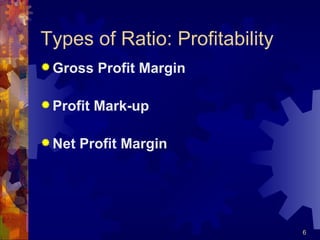
Types of Ratio: Profitability Gross Profit Margin Profit Mark-up Net Profit Margin
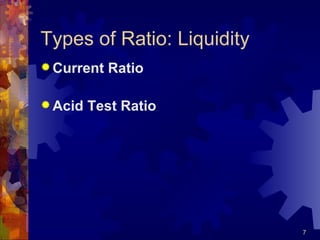
Types of Ratio: Liquidity Current Ratio Acid Test Ratio
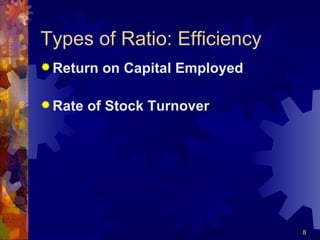
Types of Ratio: Efficiency Return on Capital Employed Rate of Stock Turnover
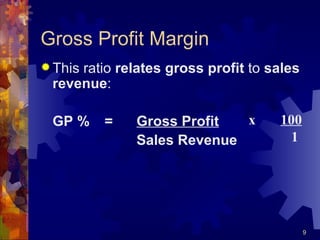
Gross Profit Margin This ratio  relates gross profit  to  sales revenue : GP % = Gross Profit Sales Revenue x  100   1
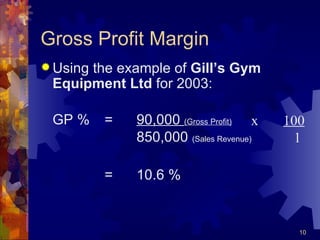
Gross Profit Margin Using the example of  Gill’s Gym Equipment Ltd  for 2003: GP % = 90,000  (Gross Profit) 850,000  (Sales Revenue) = 10.6 % x  100   1
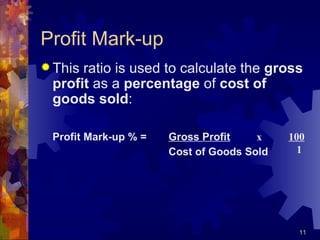
Profit Mark-up This ratio is used to calculate the  gross profit  as a  percentage  of  cost of goods sold : Profit Mark-up % = Gross Profit Cost of Goods Sold x  100   1
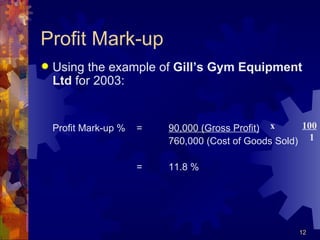
Profit Mark-up Using the example of  Gill’s Gym Equipment Ltd  for 2003: Profit Mark-up %  = 90,000 (Gross Profit) 760,000 (Cost of Goods Sold) = 11.8 % x  100   1
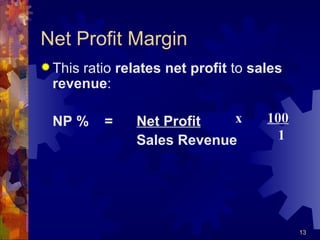
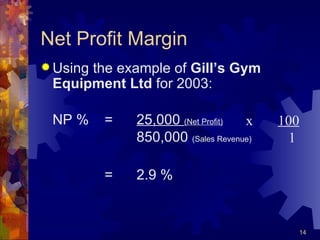
Net Profit Margin This ratio  relates net profit  to  sales revenue : NP % = Net Profit Sales Revenue x  100   1
Net Profit Margin Using the example of  Gill’s Gym Equipment Ltd  for 2003: NP % = 25,000  (Net Profit) 850,000  (Sales Revenue) = 2.9 % x  100   1
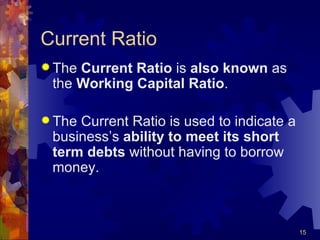
Current Ratio The  Current Ratio  is  also known  as the  Working Capital Ratio . The Current Ratio is used to indicate a business’s  ability to meet its short term debts  without having to borrow money.
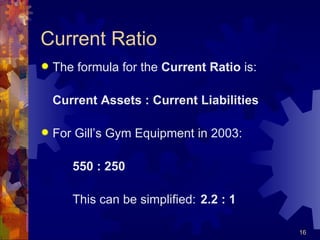
Current Ratio The formula for the  Current Ratio  is: Current Assets : Current Liabilities For Gill’s Gym Equipment in 2003: 550 : 250 This can be simplified: 2.2 : 1
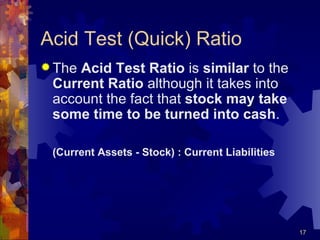
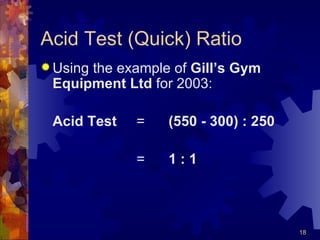
Acid Test (Quick) Ratio The  Acid Test Ratio  is  similar  to the  Current Ratio  although it takes into account the fact that  stock may take some time to be turned into cash . (Current Assets - Stock) : Current Liabilities
Acid Test (Quick) Ratio Using the example of  Gill’s Gym Equipment Ltd  for 2003: Acid Test   = (550 - 300) : 250 = 1 : 1
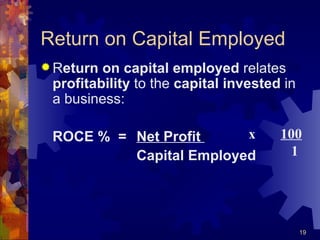
Return on Capital Employed R eturn on capital employed  relates  profitability  to the  capital   invested  in a business: ROCE %  =  Net Profit  Capital Employed x  100   1
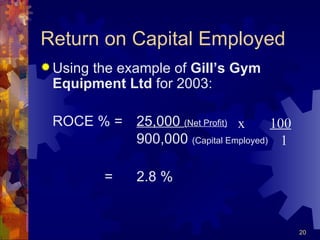
Return on Capital Employed Using the example of  Gill’s Gym Equipment Ltd  for 2003: ROCE % =  25,000  (Net Profit)   900,000  (Capital Employed) = 2.8 % x  100   1
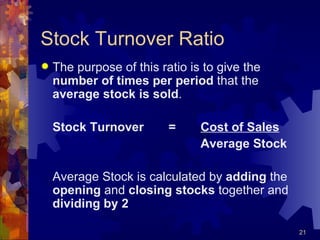
Stock Turnover Ratio The purpose of this ratio is to give the  number of times per period  that the  average stock is sold . Stock Turnover = Cost of Sales Average Stock Average Stock is calculated by  adding  the  opening  and  closing stocks  together and  dividing by 2
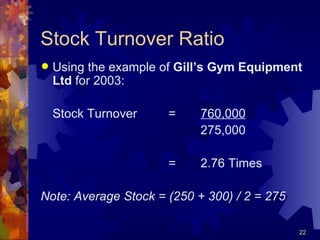
Stock Turnover Ratio Using the example of  Gill’s Gym Equipment Ltd  for 2003: Stock Turnover = 760,000 275,000 = 2.76 Times Note: Average Stock = (250 + 300) / 2 = 275
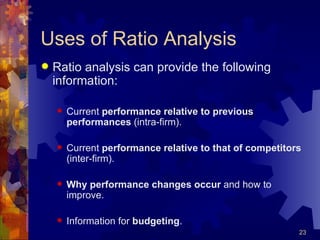
Uses of Ratio Analysis Ratio analysis can provide the following information: Current  performance relative to previous performances  (intra-firm). Current  performance relative to that of competitors  (inter-firm). Why performance changes occur  and how to improve. Information for  budgeting .
Limitations of Ratio Analysis Accounting information used is  historical  and so  can be irrelevant  to the future. Any comparisons must be made with firms of  similar size  in the  same industry . Findings may not take into account  external factors . Different stock valuation methods  can result in different figures. Ratios do not show other elements such as  staff morale  or  staff turnover .
Task Calculate the ratios that we have covered today for  Gill’s Gym Equipment Ltd  in 2004.

Ratio Introduction 100 CMD

  • 1.
    Introduction to Ratio Analysis Higher/Int 2 Business Management 2009-2010
  • 2.
    Why Do WeNeed Ratios? Taken on their own , figures from final accounts can be confusing . However, when financial ratios are used to analyse the information more closely, the figures become clearer . Accounting ratios are used as a tool in the decision-making process and as an aid to financial interpretation and planning .
  • 3.
    Analysis is theKey! Ratios are no use on their own. They must be compared to: Previous ratios , in order to see trends . Competitors , to check competitiveness .
  • 4.
    Types of RatioRatios can inform us about three main areas of final accounts: Profitability Liquidity Efficiency
  • 5.
    Types of RatioProfitability Is the organisation earning more than it is paying in costs ? Liquidity Does the organisation have enough money to pay its bills ? Efficiency Is the organisation making best use of its resources ?
  • 6.
    Types of Ratio:Profitability Gross Profit Margin Profit Mark-up Net Profit Margin
  • 7.
    Types of Ratio:Liquidity Current Ratio Acid Test Ratio
  • 8.
    Types of Ratio:Efficiency Return on Capital Employed Rate of Stock Turnover
  • 9.
    Gross Profit MarginThis ratio relates gross profit to sales revenue : GP % = Gross Profit Sales Revenue x 100 1
  • 10.
    Gross Profit MarginUsing the example of Gill’s Gym Equipment Ltd for 2003: GP % = 90,000 (Gross Profit) 850,000 (Sales Revenue) = 10.6 % x 100 1
  • 11.
    Profit Mark-up Thisratio is used to calculate the gross profit as a percentage of cost of goods sold : Profit Mark-up % = Gross Profit Cost of Goods Sold x 100 1
  • 12.
    Profit Mark-up Usingthe example of Gill’s Gym Equipment Ltd for 2003: Profit Mark-up % = 90,000 (Gross Profit) 760,000 (Cost of Goods Sold) = 11.8 % x 100 1
  • 13.
    Net Profit MarginThis ratio relates net profit to sales revenue : NP % = Net Profit Sales Revenue x 100 1
  • 14.
    Net Profit MarginUsing the example of Gill’s Gym Equipment Ltd for 2003: NP % = 25,000 (Net Profit) 850,000 (Sales Revenue) = 2.9 % x 100 1
  • 15.
    Current Ratio The Current Ratio is also known as the Working Capital Ratio . The Current Ratio is used to indicate a business’s ability to meet its short term debts without having to borrow money.
  • 16.
    Current Ratio Theformula for the Current Ratio is: Current Assets : Current Liabilities For Gill’s Gym Equipment in 2003: 550 : 250 This can be simplified: 2.2 : 1
  • 17.
    Acid Test (Quick)Ratio The Acid Test Ratio is similar to the Current Ratio although it takes into account the fact that stock may take some time to be turned into cash . (Current Assets - Stock) : Current Liabilities
  • 18.
    Acid Test (Quick)Ratio Using the example of Gill’s Gym Equipment Ltd for 2003: Acid Test = (550 - 300) : 250 = 1 : 1
  • 19.
    Return on CapitalEmployed R eturn on capital employed relates profitability to the capital invested in a business: ROCE % = Net Profit Capital Employed x 100 1
  • 20.
    Return on CapitalEmployed Using the example of Gill’s Gym Equipment Ltd for 2003: ROCE % = 25,000 (Net Profit) 900,000 (Capital Employed) = 2.8 % x 100 1
  • 21.
    Stock Turnover RatioThe purpose of this ratio is to give the number of times per period that the average stock is sold . Stock Turnover = Cost of Sales Average Stock Average Stock is calculated by adding the opening and closing stocks together and dividing by 2
  • 22.
    Stock Turnover RatioUsing the example of Gill’s Gym Equipment Ltd for 2003: Stock Turnover = 760,000 275,000 = 2.76 Times Note: Average Stock = (250 + 300) / 2 = 275
  • 23.
    Uses of RatioAnalysis Ratio analysis can provide the following information: Current performance relative to previous performances (intra-firm). Current performance relative to that of competitors (inter-firm). Why performance changes occur and how to improve. Information for budgeting .
  • 24.
    Limitations of RatioAnalysis Accounting information used is historical and so can be irrelevant to the future. Any comparisons must be made with firms of similar size in the same industry . Findings may not take into account external factors . Different stock valuation methods can result in different figures. Ratios do not show other elements such as staff morale or staff turnover .
  • 25.
    Task Calculate theratios that we have covered today for Gill’s Gym Equipment Ltd in 2004.