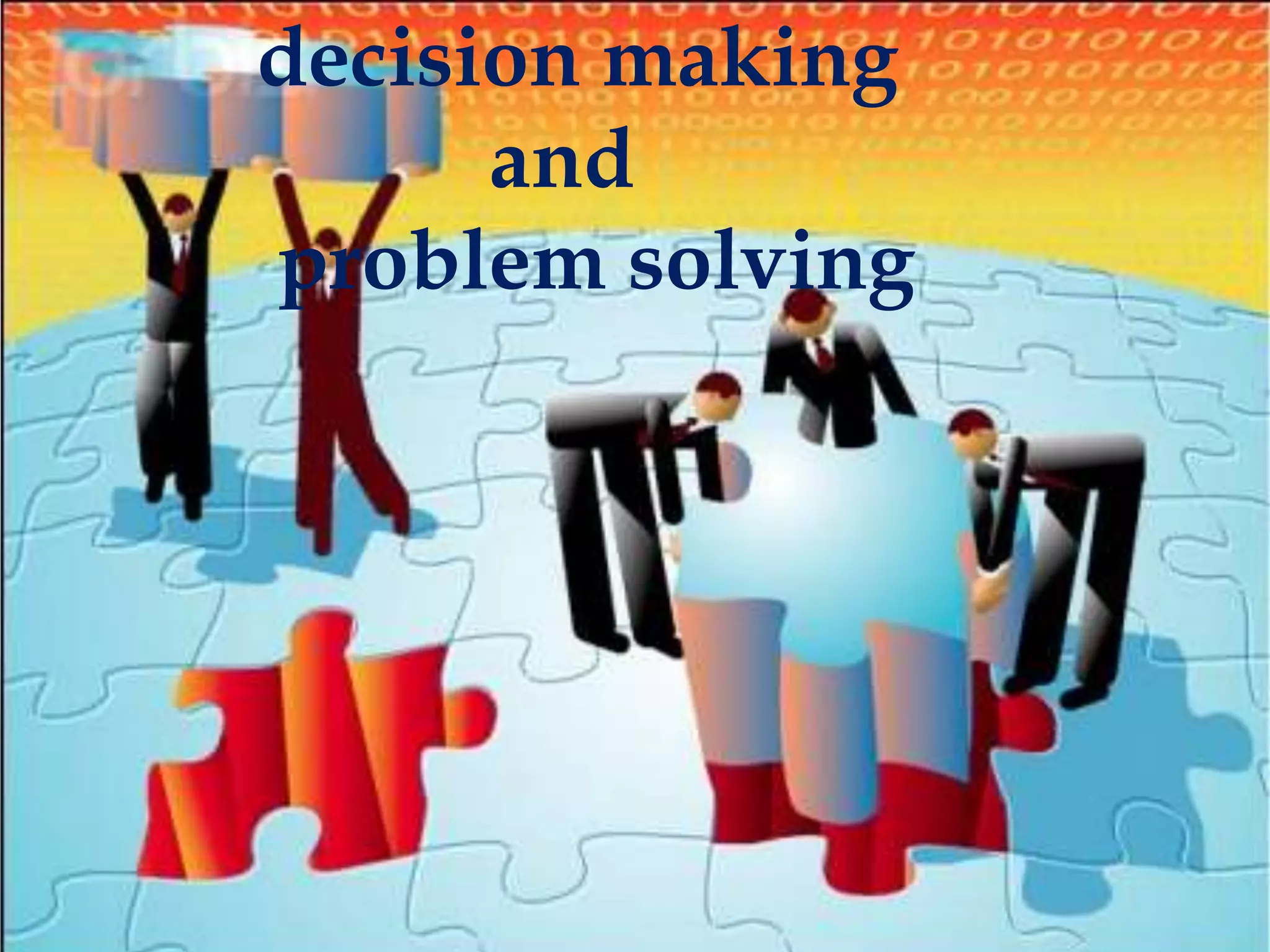
decision making
      and
problem solving
   Decision making is the selection from among
    alternatives of a course of action.


Acc MC FARLAND
  A decision is an act where in an executive forms
  a conclusion about what must be done in a
  given situation
   Decision are taken for fulfillment off
    predetermined objectives.
   Decision may be positive or negative.
   Decision are not end but they are means to the
    end.
   Decision is done by the concerned officers or
    by a committee.
   Time is an important factor of decision making.
   It is a basis of business policies.

   It facilitates efficient performance of
    managerial function.

   It helps in maintaining cordial industrial
    relations.
   Understand the problem
   Analysis the problem
   Determining and developing the possible
    alternatives
   Evaluation of alternatives
   Selection of the best alternatives
   Execution of decision
   Review and revision
   Principle of participation

   Principle of alternatives

   Principle of limiting factor

   Mathematical theory

   Psychological theory

   Marginal theory
 Traditional techniques
1:-Programmed decision

    habits
   standard operating procedures
   organizational structure

2:-Non programmed decision
   Programmed decision

   Defining the objectives
   Defining the problem
   Designing the hypothesis
   Collection of facts
   Working on different alternatives
   Taking decision
   Non programmed decision

   Creative technique
   Participative technique
What?
Where?
How?
When?
With whom?
Why?
Problem-solving is a mental process that involves
discovering, analyzing and solving problems.

Problem solving is concerned with overcoming
obstacles in the path toward an objective.

 Problem solving may or may not require action.
   Structured problems
   Goals are well defined.
   Information about the problem is available and
    complete.
   Unstructured problems
   Problems that are new or unusual and for
    which information is ambiguous or incomplete.
    Problems that will require custom-made
    solutions.
   Brainstorming
   Hypothesis testing
   Trial and error
   Reduction
   Identifying the problem
   Defining the problem
   Identifying Possible Solutions
   Selecting the Best Solutions
   Evaluating Solutions
   Develop an Action Plan
   Implement the Solution

Decision making

  • 1.
    decision making and problem solving
  • 2.
    Decision making is the selection from among alternatives of a course of action. Acc MC FARLAND A decision is an act where in an executive forms a conclusion about what must be done in a given situation
  • 3.
    Decision are taken for fulfillment off predetermined objectives.  Decision may be positive or negative.  Decision are not end but they are means to the end.  Decision is done by the concerned officers or by a committee.  Time is an important factor of decision making.
  • 4.
    It is a basis of business policies.  It facilitates efficient performance of managerial function.  It helps in maintaining cordial industrial relations.
  • 5.
    Understand the problem  Analysis the problem  Determining and developing the possible alternatives  Evaluation of alternatives  Selection of the best alternatives  Execution of decision  Review and revision
  • 6.
    Principle of participation  Principle of alternatives  Principle of limiting factor  Mathematical theory  Psychological theory  Marginal theory
  • 7.
     Traditional techniques 1:-Programmeddecision  habits  standard operating procedures  organizational structure 2:-Non programmed decision
  • 8.
    Programmed decision  Defining the objectives  Defining the problem  Designing the hypothesis  Collection of facts  Working on different alternatives  Taking decision
  • 9.
    Non programmed decision  Creative technique  Participative technique
  • 10.
  • 11.
    Problem-solving is amental process that involves discovering, analyzing and solving problems. Problem solving is concerned with overcoming obstacles in the path toward an objective. Problem solving may or may not require action.
  • 12.
    Structured problems  Goals are well defined.  Information about the problem is available and complete.  Unstructured problems  Problems that are new or unusual and for which information is ambiguous or incomplete.  Problems that will require custom-made solutions.
  • 13.
    Brainstorming  Hypothesis testing  Trial and error  Reduction
  • 14.
    Identifying the problem  Defining the problem  Identifying Possible Solutions  Selecting the Best Solutions  Evaluating Solutions  Develop an Action Plan  Implement the Solution