ADVANCE
   DISCUSSION IN
STRATEGIC DECISION
      MAKING
5 Ps of strategic decisions
1.Plans -the decision is an intended course
  of action carried out in advance with a
  clear purpose
2.Ploys- set of actions designed to outwit the
  competition, which may not be the
  ‘obvious’ content of the decision
3.Pattern -decisions taken over time form a
  pattern. It is this pattern of resulting
  (emergent) behaviour that we call the
  strategy of the firm.
4.Position- a match between the organization and its
  environment.
5.Perspective- How strategists percieve their environment
  and themselves
For example –
• strategic perspective of Nokia is one of continuous and
  sometimes radical change (Nokia began as a paper and
  pulp company)
• Hewlett-Packard favours an engineering excellence
  perspective
• Nokia started by making paper – the original
  communications technology
• The history of Nokia goes back to 1865. That was when
  Fredrik Idestam built a wood pulp mill on the banks of the
  Tammerkoski rapids, in southern Finland. A few years
  later, he built a second mill by the Nokianvirta river – the
  place that gave Nokia its name.
• Idestam named his company Nokia Ab in 1871
• Nokia Ab added electricity generation to its business
  activities in 1902
Different type of strategic
Decision makers
• Rational Decision makers
• Behavioral decision makers
• Adaptive decision makers use frugal
  heuristics that best suits the demand and
  information structure of environment. This
  is ecological rationality
• Politically aware decision makers-
  influence of multiple contending
  stakeholders and coliations
• Natural decision makers- use of laboratory
  methods to understand and context and
  issue
• Intuitive decision makers
Context of decision making
• Boom and bust behavior
Boom – firms expand their capacities
Bust – limited operations
• Information overload situation – decision
  depends on ability to interpret and
  interpretation
• Decision making with unreliable data-
Seek more data, use ideology.
• Hazardous situations- analysing small
  failures, mobilizing support, using local
  expertise to mitigate risk
POLITICS IN STRATEGIC DECISION
MAKING

What is politics?
• occurrence of certain forms of behaviour( conflict
  on scarce resources) associated with the use of
  power or influence,
• consciously self-serving behaviours against others
  in the organization.
Organizations Are Political Arena
Sharing Of Scarce
  Resources/positions/privileges.

1.Between Individuals

2.Organizational units -
  SBUs, Departments, Business zones

3. External Parties- government
   agencies, unions, and customers
• Strategic Decisions change the
Structure- distribution of authority
Process- Technology, rules and policies
Culture

So politics is inevitable .
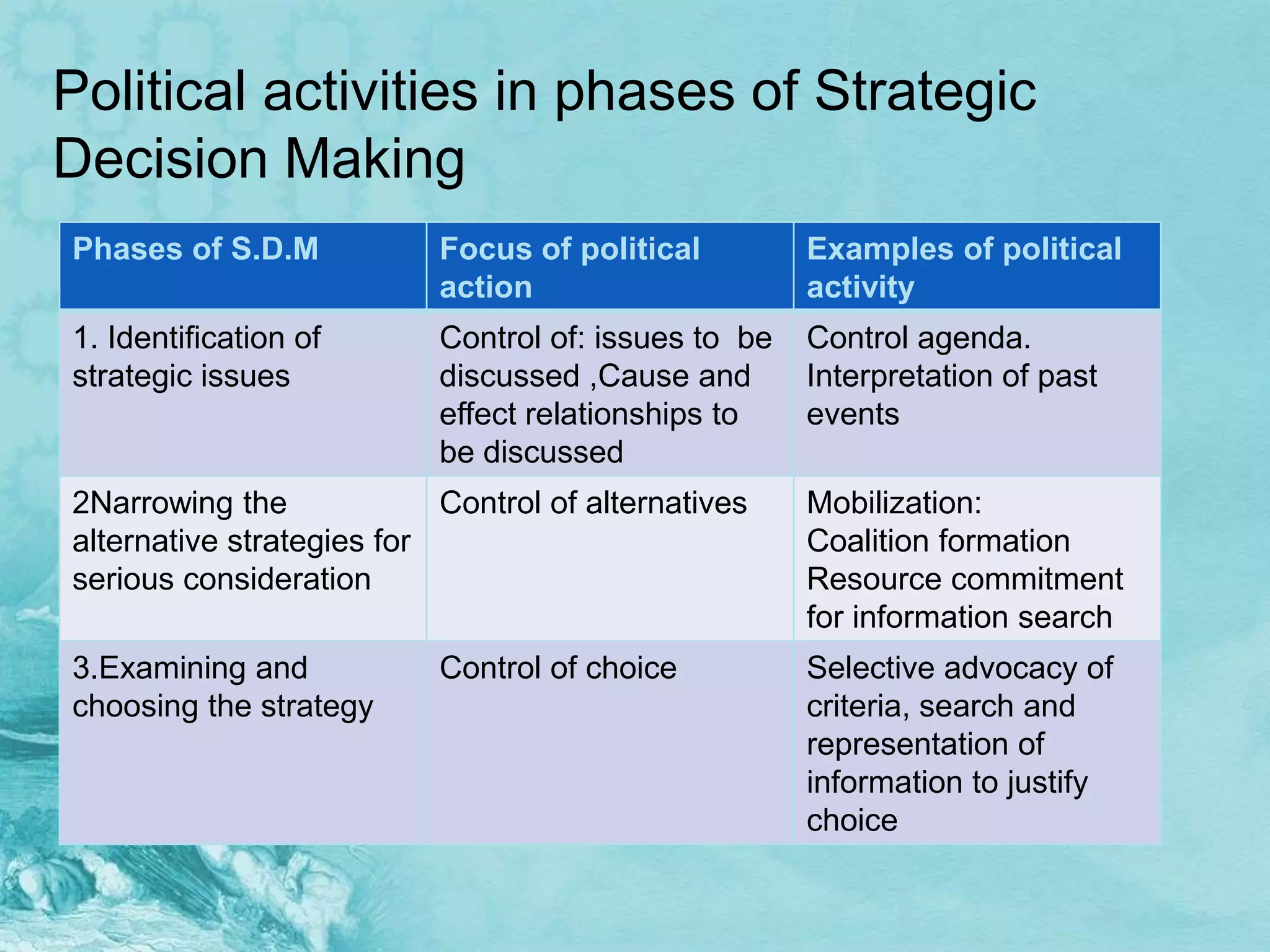
Political activities in phases of Strategic
Decision Making
Phases of S.D.M            Focus of political         Examples of political
                           action                     activity
1. Identification of       Control of: issues to be   Control agenda.
strategic issues           discussed ,Cause and       Interpretation of past
                           effect relationships to    events
                           be discussed
2Narrowing the             Control of alternatives    Mobilization:
alternative strategies for                            Coalition formation
serious consideration                                 Resource commitment
                                                      for information search
3.Examining and            Control of choice          Selective advocacy of
choosing the strategy                                 criteria, search and
                                                      representation of
                                                      information to justify
                                                      choice
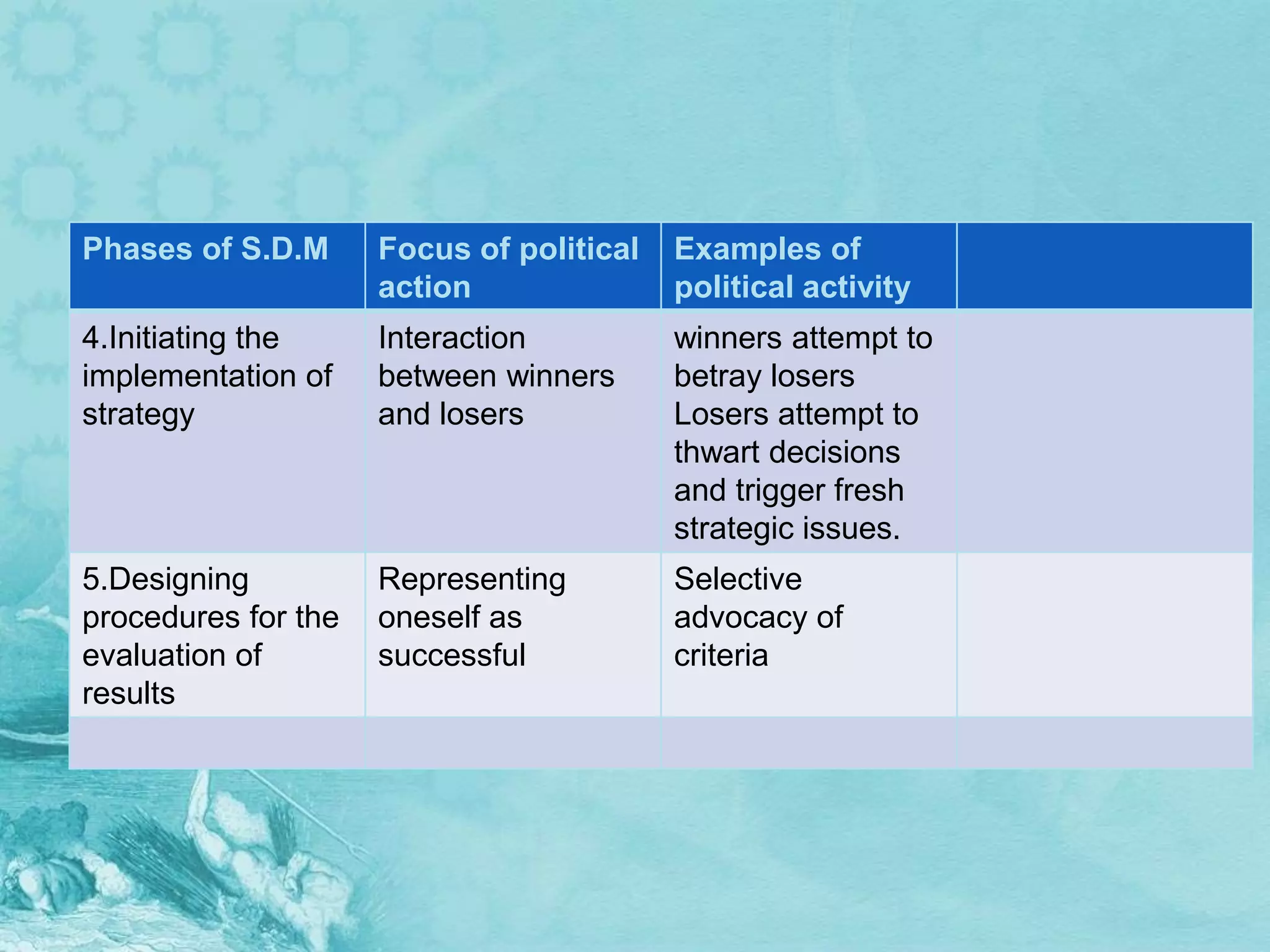
Phases of S.D.M      Focus of political   Examples of
                     action               political activity
4.Initiating the     Interaction          winners attempt to
implementation of    between winners      betray losers
strategy             and losers           Losers attempt to
                                          thwart decisions
                                          and trigger fresh
                                          strategic issues.
5.Designing          Representing         Selective
procedures for the   oneself as           advocacy of
evaluation of        successful           criteria
results

Advance discussion in strategic decision making

  • 1.
    ADVANCE DISCUSSION IN STRATEGIC DECISION MAKING
  • 2.
    5 Ps ofstrategic decisions 1.Plans -the decision is an intended course of action carried out in advance with a clear purpose 2.Ploys- set of actions designed to outwit the competition, which may not be the ‘obvious’ content of the decision 3.Pattern -decisions taken over time form a pattern. It is this pattern of resulting (emergent) behaviour that we call the strategy of the firm.
  • 3.
    4.Position- a matchbetween the organization and its environment. 5.Perspective- How strategists percieve their environment and themselves For example – • strategic perspective of Nokia is one of continuous and sometimes radical change (Nokia began as a paper and pulp company) • Hewlett-Packard favours an engineering excellence perspective
  • 4.
    • Nokia startedby making paper – the original communications technology • The history of Nokia goes back to 1865. That was when Fredrik Idestam built a wood pulp mill on the banks of the Tammerkoski rapids, in southern Finland. A few years later, he built a second mill by the Nokianvirta river – the place that gave Nokia its name. • Idestam named his company Nokia Ab in 1871 • Nokia Ab added electricity generation to its business activities in 1902
  • 5.
    Different type ofstrategic Decision makers • Rational Decision makers • Behavioral decision makers • Adaptive decision makers use frugal heuristics that best suits the demand and information structure of environment. This is ecological rationality • Politically aware decision makers- influence of multiple contending stakeholders and coliations
  • 6.
    • Natural decisionmakers- use of laboratory methods to understand and context and issue • Intuitive decision makers
  • 7.
    Context of decisionmaking • Boom and bust behavior Boom – firms expand their capacities Bust – limited operations • Information overload situation – decision depends on ability to interpret and interpretation • Decision making with unreliable data- Seek more data, use ideology. • Hazardous situations- analysing small failures, mobilizing support, using local expertise to mitigate risk
  • 8.
    POLITICS IN STRATEGICDECISION MAKING What is politics? • occurrence of certain forms of behaviour( conflict on scarce resources) associated with the use of power or influence, • consciously self-serving behaviours against others in the organization.
  • 9.
    Organizations Are PoliticalArena Sharing Of Scarce Resources/positions/privileges. 1.Between Individuals 2.Organizational units - SBUs, Departments, Business zones 3. External Parties- government agencies, unions, and customers
  • 10.
    • Strategic Decisionschange the Structure- distribution of authority Process- Technology, rules and policies Culture So politics is inevitable .
  • 11.
    Political activities inphases of Strategic Decision Making Phases of S.D.M Focus of political Examples of political action activity 1. Identification of Control of: issues to be Control agenda. strategic issues discussed ,Cause and Interpretation of past effect relationships to events be discussed 2Narrowing the Control of alternatives Mobilization: alternative strategies for Coalition formation serious consideration Resource commitment for information search 3.Examining and Control of choice Selective advocacy of choosing the strategy criteria, search and representation of information to justify choice
  • 12.
    Phases of S.D.M Focus of political Examples of action political activity 4.Initiating the Interaction winners attempt to implementation of between winners betray losers strategy and losers Losers attempt to thwart decisions and trigger fresh strategic issues. 5.Designing Representing Selective procedures for the oneself as advocacy of evaluation of successful criteria results