Budgets Higher/Int 2 Business Management 2009-2010
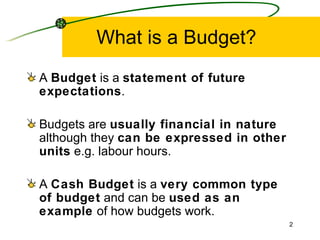
What is a Budget? A  Budget  is a  statement of future expectations . Budgets are  usually financial in nature  although they  can be expressed in other units  e.g. labour hours. A  Cash Budget  is a  very common type of budget  and can be  used as an example  of how budgets work.
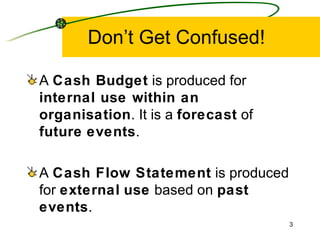
Don’t Get Confused! A  Cash Budget  is produced for  internal use within an organisation . It is a  forecast  of  future   events . A  Cash Flow Statement  is produced for  external   use  based on  past events .
Why Budget? The  main uses of budgets  are: Monitoring and Control  - setting the budget then making comparisons with actual performance. Gain Information  - lets managers see how well the business is performing. Set Targets  - giving managers and employees limits to reach. Delegate Authority  - the use of budgets allows managers to give responsibility to employees.
Cash Budgets The  information  contained in a Cash Budget  represents estimated figures  of the  cash position of an organisation  at a  particular point in time .
Uses of Cash Budgets Monitoring  the  cash position  of a  particular   department . As a  decision-making tool  to  assess  the  validity  of a particular  project  or scenario. As part of a  submission  to a  lender  to secure  finance . Using a  spreadsheet , changes can be made to the budget and the  effects of these changes  will  automatically be updated  in the rest of the budget.
Management Benefits The  main benefits  to management of using cash budgets are: Planning Organisation Command Co-ordinate Control Delegation Motivation
Benefit - Planning Management  can look ahead  to set  aims  and  strategies . This allows  problem-solving to be planned  rather  than having to react to situations  as they happen. As an  example ,  plan  for when an  additional loan or overdraft is required .
Benefit - Organisation Budgets allow  management  to  ensure  that the  right resources  are in the  right place  at the  right time . Management must ensure that it can  afford the resources  that they require and are able to  take advantage of any discounts  available from suppliers.
Benefit - Command When management are able to make  informed decisions , enabling them to  instruct   their   subordinates . Each  departmental manager  must also  know the department’s limits for requesting additional finance .
Benefit - Co-ordinate Management  can give  instructions  to those in charge of departmental budgets and  keep a clear overview of the business  as a whole. Making sure that  everyone  is  working  towards the  same goals .
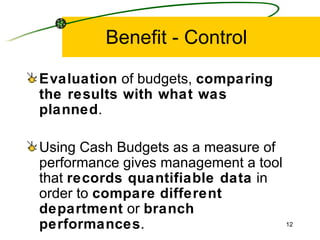
Benefit - Control Evaluation  of budgets,  comparing the results with what was planned . Using Cash Budgets as a measure of performance gives management a tool that  records quantifiable data  in order to  compare   different   department  or  branch   performances .
Benefit - Delegation Management  should make  subordinates responsible  for a suitable  range of tasks  and give them the  authority  to carry them out.
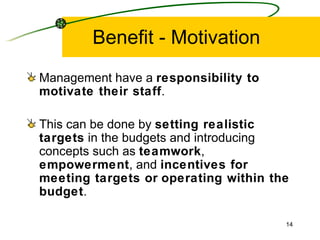
Benefit - Motivation Management have a  responsibility to motivate their staff . This can be done by  setting realistic targets  in the budgets and introducing concepts such as  teamwork ,  empowerment , and  incentives for meeting targets or   operating within the budget .

Budgets CMD

  • 1.
    Budgets Higher/Int 2Business Management 2009-2010
  • 2.
    What is aBudget? A Budget is a statement of future expectations . Budgets are usually financial in nature although they can be expressed in other units e.g. labour hours. A Cash Budget is a very common type of budget and can be used as an example of how budgets work.
  • 3.
    Don’t Get Confused!A Cash Budget is produced for internal use within an organisation . It is a forecast of future events . A Cash Flow Statement is produced for external use based on past events .
  • 4.
    Why Budget? The main uses of budgets are: Monitoring and Control - setting the budget then making comparisons with actual performance. Gain Information - lets managers see how well the business is performing. Set Targets - giving managers and employees limits to reach. Delegate Authority - the use of budgets allows managers to give responsibility to employees.
  • 5.
    Cash Budgets The information contained in a Cash Budget represents estimated figures of the cash position of an organisation at a particular point in time .
  • 6.
    Uses of CashBudgets Monitoring the cash position of a particular department . As a decision-making tool to assess the validity of a particular project or scenario. As part of a submission to a lender to secure finance . Using a spreadsheet , changes can be made to the budget and the effects of these changes will automatically be updated in the rest of the budget.
  • 7.
    Management Benefits The main benefits to management of using cash budgets are: Planning Organisation Command Co-ordinate Control Delegation Motivation
  • 8.
    Benefit - PlanningManagement can look ahead to set aims and strategies . This allows problem-solving to be planned rather than having to react to situations as they happen. As an example , plan for when an additional loan or overdraft is required .
  • 9.
    Benefit - OrganisationBudgets allow management to ensure that the right resources are in the right place at the right time . Management must ensure that it can afford the resources that they require and are able to take advantage of any discounts available from suppliers.
  • 10.
    Benefit - CommandWhen management are able to make informed decisions , enabling them to instruct their subordinates . Each departmental manager must also know the department’s limits for requesting additional finance .
  • 11.
    Benefit - Co-ordinateManagement can give instructions to those in charge of departmental budgets and keep a clear overview of the business as a whole. Making sure that everyone is working towards the same goals .
  • 12.
    Benefit - ControlEvaluation of budgets, comparing the results with what was planned . Using Cash Budgets as a measure of performance gives management a tool that records quantifiable data in order to compare different department or branch performances .
  • 13.
    Benefit - DelegationManagement should make subordinates responsible for a suitable range of tasks and give them the authority to carry them out.
  • 14.
    Benefit - MotivationManagement have a responsibility to motivate their staff . This can be done by setting realistic targets in the budgets and introducing concepts such as teamwork , empowerment , and incentives for meeting targets or operating within the budget .