The Role of the Finance Department Higher/Int 2  Business Management 2009-2010
Financial Objectives Different  types of organisation  have different  financial objectives : e.g. Vodafone : aim to make a large profit. Charities : aim to get many donations and help people as best they can. Clubs : aim to use funds to give the best possible service to their members.
Good Financial Management All of these different types of organisation share the  need to have good financial management . The  efficient management of finance  is vitally important to the  success  or  failure  of an organisation.
Good Financial Management Every organisation must make sure that it has enough money: to pay  wages and salaries . to pay  bills  (e.g. suppliers, electricity, advertising). to develop  new products and services . Organisations must also check how much they are spending - organisations which have  high costs, are often unsuccessful .
The Financial Function Ensures that: There are  adequate funds   available  to acquire the  resources  needed to help the organisation to  achieve its objectives . Costs are controlled through  monitoring  of  budgets .
The Financial Function Ensures that: Not only that adequate funds are available, but that  they are available at the right  time. The  cash flow  of an organisation is also important. Profitability  of the organisation is controlled, ensuring that the  agreed profitability targets  are being met.
The Need for Planning The  care and planning of the financial needs  of an organisation are as  necessary  as the  planning  for  operations ,  marketing ,  human resources  and  administration .
The Main Tasks of the  Finance Department The Finance Department has  three main tasks  to help the organisation achieve its objectives: Payment of  wages  and  salaries . Payment of  accounts . Maintenance  of  financial records  and  accounts .
Payment of Wages and Salaries Organisations need to keep their  staff   happy , one way that this can be achieved is by ensuring that they are  paid the right amount at the right time . The Finance Department will make necessary  deductions  for  tax  and  National   Insurance . They will also provide  information  to the  Revenue and Customs  to make sure that taxes paid have been  correctly calculated .
Payment of Accounts The Finance Department needs to ensure that it  makes payment  to its  suppliers  on time, as well as  collecting money  owed by  customers . Payment to suppliers fall into  two different categories : Cash Credit
Maintenance of  Financial Records The Finance Department will  record financial transactions , so that at the end of the year or period it can  prepare final accounts . Financial records are a  history  of the organisation’s activities. Under the Companies Acts of 1985 and 1989,  it is an offence  for limited companies  not to maintain proper financial records.
Business Decisions Without proper financial records , organisations are  unable  to operate  efficiently  or  effectively : How much  money has the  business spent ? How much  has the  business sold ? What is the value  of the  business’s assets ?
Answering Questions The job of an accountant is to use the  information from the accounts  to answer questions such as: How is the company  performing ? Have we done  better than last year ? How much tax  will we have to pay? Can we  afford to expand  or buy  new equipment ?
Identifying Appropriate  Financial Information One of the major roles of the Finance Department is to  identify appropriate financial information , before  communicating  this information to  managers  or  decision makers . By  communicating  this information the Finance Department ensures that  informed judgments and decisions  can be made.
Different Forms of  Financial Records Financial Records can take several forms: Daily  record keeping. Manual  record keeping. Electronic  record keeping. Information for  internal decision making . Information for  internal reporting . Information for  external reporting . Information as a  requirement of law .
The Main Financial Statements The Balance Sheet The Trading Profit & Loss Account The Cash Flow Statement
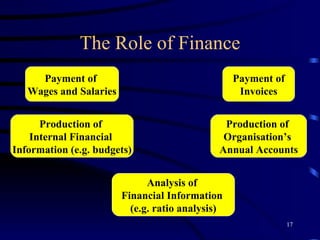
The Role of Finance Payment of  Wages and Salaries Production of  Internal Financial  Information (e.g. budgets) Production of  Organisation’s  Annual Accounts Payment of Invoices Analysis of  Financial Information  (e.g. ratio analysis)
The Next Few Weeks … You will develop your knowledge in: Financial statements and reporting. Financial analysis (i.e. ratio analysis). Cash flow. Preparing budgets. The uses of financial information. The users of financial information.
Task Read pages 176-178 from the textbook “Higher Business Management” Using the  knowledge gained  from this presentation and the  relevant pages  in the textbook,  answer the questions  on the Role of the Finance Department. The questions are on the pupil server.

Role of Finance CMD

  • 1.
    The Role ofthe Finance Department Higher/Int 2 Business Management 2009-2010
  • 2.
    Financial Objectives Different types of organisation have different financial objectives : e.g. Vodafone : aim to make a large profit. Charities : aim to get many donations and help people as best they can. Clubs : aim to use funds to give the best possible service to their members.
  • 3.
    Good Financial ManagementAll of these different types of organisation share the need to have good financial management . The efficient management of finance is vitally important to the success or failure of an organisation.
  • 4.
    Good Financial ManagementEvery organisation must make sure that it has enough money: to pay wages and salaries . to pay bills (e.g. suppliers, electricity, advertising). to develop new products and services . Organisations must also check how much they are spending - organisations which have high costs, are often unsuccessful .
  • 5.
    The Financial FunctionEnsures that: There are adequate funds available to acquire the resources needed to help the organisation to achieve its objectives . Costs are controlled through monitoring of budgets .
  • 6.
    The Financial FunctionEnsures that: Not only that adequate funds are available, but that they are available at the right time. The cash flow of an organisation is also important. Profitability of the organisation is controlled, ensuring that the agreed profitability targets are being met.
  • 7.
    The Need forPlanning The care and planning of the financial needs of an organisation are as necessary as the planning for operations , marketing , human resources and administration .
  • 8.
    The Main Tasksof the Finance Department The Finance Department has three main tasks to help the organisation achieve its objectives: Payment of wages and salaries . Payment of accounts . Maintenance of financial records and accounts .
  • 9.
    Payment of Wagesand Salaries Organisations need to keep their staff happy , one way that this can be achieved is by ensuring that they are paid the right amount at the right time . The Finance Department will make necessary deductions for tax and National Insurance . They will also provide information to the Revenue and Customs to make sure that taxes paid have been correctly calculated .
  • 10.
    Payment of AccountsThe Finance Department needs to ensure that it makes payment to its suppliers on time, as well as collecting money owed by customers . Payment to suppliers fall into two different categories : Cash Credit
  • 11.
    Maintenance of Financial Records The Finance Department will record financial transactions , so that at the end of the year or period it can prepare final accounts . Financial records are a history of the organisation’s activities. Under the Companies Acts of 1985 and 1989, it is an offence for limited companies not to maintain proper financial records.
  • 12.
    Business Decisions Withoutproper financial records , organisations are unable to operate efficiently or effectively : How much money has the business spent ? How much has the business sold ? What is the value of the business’s assets ?
  • 13.
    Answering Questions Thejob of an accountant is to use the information from the accounts to answer questions such as: How is the company performing ? Have we done better than last year ? How much tax will we have to pay? Can we afford to expand or buy new equipment ?
  • 14.
    Identifying Appropriate Financial Information One of the major roles of the Finance Department is to identify appropriate financial information , before communicating this information to managers or decision makers . By communicating this information the Finance Department ensures that informed judgments and decisions can be made.
  • 15.
    Different Forms of Financial Records Financial Records can take several forms: Daily record keeping. Manual record keeping. Electronic record keeping. Information for internal decision making . Information for internal reporting . Information for external reporting . Information as a requirement of law .
  • 16.
    The Main FinancialStatements The Balance Sheet The Trading Profit & Loss Account The Cash Flow Statement
  • 17.
    The Role ofFinance Payment of Wages and Salaries Production of Internal Financial Information (e.g. budgets) Production of Organisation’s Annual Accounts Payment of Invoices Analysis of Financial Information (e.g. ratio analysis)
  • 18.
    The Next FewWeeks … You will develop your knowledge in: Financial statements and reporting. Financial analysis (i.e. ratio analysis). Cash flow. Preparing budgets. The uses of financial information. The users of financial information.
  • 19.
    Task Read pages176-178 from the textbook “Higher Business Management” Using the knowledge gained from this presentation and the relevant pages in the textbook, answer the questions on the Role of the Finance Department. The questions are on the pupil server.