Human Resource Management Higher/Int 2 Business Management 2009-2010
What are Human Resources? The entire workforce  - Managing Director to part-time Cleaner Each person being employed to perform  specific functions  which play a part in the  success  or  failure  of the organisation
Human Resource Management Human Resource Management refers to that part of an organisation’s activities designed to: Attract Train Develop Maintain an effective workforce HRM more strategic and integrated than previous ‘Personnel Management’
Objectives of HRM Promote a policy of  continuous learning and staff development Recruit ,  develop  and  retain  people with appropriate skills and attitudes Manage  employee relations  (one to one and collective) Design, implement and manage  remuneration systems  to motive staff Maintain and improve the  physical and mental well-being  of the workforce (conditions and H&S) Take account of all  government legislation  relevant to HRM
Management of People Theory X  - Workers are motivated by money, they are lazy, selfish, ignore the needs of the organisation, avoid responsibility, lack ambition. They need controlled and directed by management. Theory Y  - Workers have different needs, they can enjoy work. If motivated they can organise themselves and take responsibility. Managers should allow creativity to be shown.
Abraham Maslow’s Hierarchy Self-actualisation  - needs filled through self-fulfillment, more responsibility, ownership shares, self-employment Esteem  - self-respect, recognition, promotion, awards, title, size office/desk Emotional  - love, belonging, teams Safety  - job security, trade unions, laws Physiological  - food, clothing, shelter, warmth
Workers need to feel safe and secure. An unsafe working environment will not motivate workers to work, and to work well, nor will the possibility of being made redundant.  What’s the point of working, I’m going to lose my job anyway I’m no gonna work for  this firm again, cos a goat a sair heid.
Increasing Motivation Quality Circles  - meet regularly to identify, analyse and attempt to solve work-related problems Job Enlargement  - increased number of tasks, jobs less repetitive, organised into groups and trained to be multi-skilled - job rotation Job Enrichment  - giving workers opportunities to choose how to complete a particular task, usually as part of a team
The HRM Function (1) The Executive Role :  the expert department in matters related to HR – legal requirements, information provision The Audit Role :  monitors organisation activities The Facilitator Role :  helps others to acquire HR skills eg grievances, equal opportunities, planning The Consultancy Role :  providing advice and guidance The Service Role :  provider of useful information eg changes in legislation
The HRM Function (2) Levels of Management Strategic:  long-term planning  policies, guidelines, culture of organisation Tactical:  pathways to strategic objectives  planning, recruitment, training, development, industrial relations Operational:  day-to-day (training)  identify possible employees, select suitable employee, arrange cover, develop materials
HRM Planning Current Employment Trends Staffing Requirements Future Supply of Workers Labour Turnover Satisfy and Motivate Employees Organisation Culture Training and Development Release Surplus Staff New Staff Potential Staff Existing Staff Departing Staff
Changing Patterns of Employment (1) Increase in part-time work full time staff led to inflexible workforce Increase in service sector employment coal, steel and shipbuilding no longer significant Increase in public sector employment 30% of Scottish workers employed in this sector Increase in women working Special arrangements: flexi-time, job-share, child-care Increase in home/teleworking Improvement in communications
Changing Patterns of Employment (2) Part-time work  - in most cases voluntary decision Variable hours  - overtime or flexi-time systems Temporary work  - fixed-term, seasonal, casual or agency work Downsized  - now bringing workers back on a fixed-term or project basis for experience Self-employment  - now represent about 13% of workforce, route for those in unemployment and low pay and source of jobs for others
3 ‘Types of Workforce’ Core workforce  - those essential to the business, giving the expertise. They are given good terms and conditions of employment Flexible Labour force  - part-time or temporary basis eg during peaks in activity. Not employed when there is no demand for services  Contractual fringe  - sub-contractors eg cleaners, consultants, component suppliers. No need to pay for pensions, holidays etc
Advantages  (Non-Traditional Workforce Only employ those contributing to  core activities Saves  salaries Saves  office space Reduces need to pay  sickness/holiday benefits, redundancy payments, NI contributions Flexible staffing numbers  relating to the market
Disadvantages (Non-Traditional Workforce) Cost of  Recruitment and Selection Staff shortages  in certain areas Less commitment  from workforce Increased  training  (esp induction) High  staff turnover Lack of  continuity in personnel
Recruitment  - Stage 1 Is there a vacancy? Someone leaving? Extra worker required? Large organisation complex process - liaison between departments or Senior Management
Job Analysis - Stage (2) Identifies the main features of the job: Physical requirements and tasks Mental requirements and tasks Skill requirements and specific skill tasks Areas of responsibility Areas of accountability Physical environment Hazards specific to the job Where is the information found? Current occupant of the job Superiors and Subordinates Specialist observers
Job Description - Stage 3 (1) ‘ Word picture of the job’ Tells candidates what is expected of them and allows qualities to be set for candidates Disputes settled later based on the Job Description
Job Description - Stage 3 (2) Title Relationships Purpose of the Job Duties and Responsibilities Authority Resources Available Location Qualifications
Person Specification - Stage 4 Profile of the person required -  essential  and  desirable   skills  and  qualities Physical Make-up -  health, energy, appearance Attainments -  education, training, expertise General Intelligence -  thinking skills and mental effort Special Aptitudes -  specialist skills required? Interests -  personal interests Disposition -  personality Circumstances -  special requirements
Internal Recruitment May be a promotion or change of job or location Applicant is  known to the organisation The  organisation has trained  this employee Applicant will be aware of the culture   and rules  of the organisations Can  enhance employee morale However: a  limited pool of applicants Another vacancy  is usually created
External Recruitment Local and National Newspapers Journals (eg British Medical Journal) Recruitment Days Recruitment Agencies Internet Websites (Company or Recruitment Agency) Job Centres / Careers Service Skill Seekers and New Deal Schools, Colleges or Universities (Milk Round)
The Selection
The Selection Process Application Forms/CVs Interviews Testing Candidate Selected
Application Forms/CVs Content of  Application Form same information, same order, comparisons Curriculum Vitae summary or listing of relevant work experience and education and other accomplishments Checked against  the Person Specification Short List Created : Seems suitable (interview) Possibly suitable (maybe) Unsuitable (polite letter of rejection)
Interviews (Planning) Date, time and place agreed Waiting area Tour around premises? Refreshments? Time for interview (30 mins)? When Notified of Outcome? Travelling Expenses? All Candidates Informed?
The Good Interview Be  open-minded  and unbiased Be  prepared Welcome  the interviewee Control  the interview Supply  information Close  the interview Follow-up
Types of Interview One-to-one Successive Interviews (eg Apprentice) Panel Interviews (eg Bear Factory)
Testing
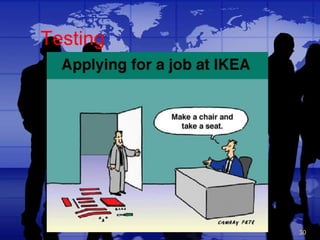
Testing Attainment Tests Demonstrating skills eg WPM Intelligence Tests (IQ) Mental reasoning - numeracy, literacy, problem solving Aptitude Tests Tests of innate skills eg mechanical Psychometric (Personality) Tests Personality tests - extrovert or an introvert Medical Tests Army, police and airlines
Assessment Centres Candidates may complete team-building and role-playing exercises Monitoring of social skills, leadership qualities, personality Can be at a large Assessment Centre or at offices or a hired venue
Training To teach  new  skills or  improve  their existing skills Staff development to improve skills for  now  and in the  future Training and Staff Development is very similar, however, staff development is  long-term
Costs and Benefits of Training Financial cost Training staff Loss of output Flexibility Promotion of change Upgrading skills Improved employee satisfaction Improved image of the organisation Motivation and productivity
Types of Training Induction training – given to  new  recruits.  Designed to give information about the organisation. On-the-job training – ‘sitting next to Nellie’.  This is carried out while the employee is  doing their job . Off-the-job training – carried out  away  from the organisation ie college.
Staff development – based on a plan of work.  May involve a  combination  of on-the-job and off-the-job training Appraisal – a  report  on how well an employee is doing.  Carried out at  regular intervals .  Should be positive with only constructive criticism.
Equal Opportunities Discrimination  – choosing one person over another Applies to selection, training, promotion, and wages Equal Opportunities  means that  everyone  has the  same chance
Reasons for Discrimination Women   (home, married, children) Ethnic   Minorities   (eg religious holidays) Disabled   People   (less capable) Older   People   (slow, new technology) Unproven ideas or Stereotypes
Women at Work Average Wages Men £11.31/hour Women £9.82/hour Full-time Work Men 91% Women 57% Flexible workforce , increasingly women fill vacancies, crèches, homeworking, Remaining in education longer  – management posts
Legislation Equal Pay Act 1970  –  “ broadly similar’ work = equal pay Sex Discrimination Act 1975 Direct  eg harassment (treating someone less favourably) Indirect  eg must be 6’ tall Applies to job adverts eg salesperson, cashier Selection – not restricted unless essential Interview – structured prevents bias Promotion Training Dismissal Employment Tribunal
Ethnic Minorities Race Relations Act 1976  – colour, race, nationality, ethnic background Direct :  eg racial groups are unreliable Indirect :  eg not allowing turbans (Sikhs) Selection tests  may discriminate as not in some ethnic groups culture
Disabled People “ those with a long-term health problem/disability that limits the kind or amount of paid work they can do” Disability Discrimination Act 1995 >15 employees must comply Reasonable adjustments eg fixtures, fittings, telephone, work station, access, building features (lifts), work conditions, extra training Direct : eg translator one person in wheelchair Indirect : eg requirement for driving licence
Older People Employment rates fall as people get older: 80% employed aged 54 vs 40% aged 64 could be through choice less training offered Some argue that there are advantages in recruiting older people: >40 experience and judgement >40 concentrate more on job responsibilities (less on salary and status) >40 greater social intelligence Examples are B&Q and Asda The Employment Equality (Age) Regulations 2006
Sexual Orientation Employment Equality (Sexual Orientation) Regulations 2003 Outlaws discrimination  in employment based on sexual orientation towards people of the same sex, opposite sex, or the same sex and the opposite sex Some exceptions  eg where employer applies a particular sexual orientation to avoid conflict with religious convictions
Health & Safety at Work Raising the standard of safety and health  for all individuals at work and the public as far as ‘reasonably practicable’ Employer’s Duties: Written statement of general policy prepared Negligence proceedings can be taken against management Providing training, information, instruction and supervision Ensuring that all equipment is safe and risk associated with handling, storing and transportation of articles are minimised
Health & Safety at Work Employee’s Duties: Take reasonable care of themselves and others Co-operate with the employer Not intentionally or recklessly interfere or misuse anything in relation to H&S Carry out duties in accordance with training or instructions Report any dangerous situations Health & Safety Executive: Power to enter employer’s premises and carry out investigations and examine materials
Trade Union and Employment Rights Act 1993 Employees cannot be dismissed for: Taking steps to protect themselves in circumstances of danger Performing H&S responsibilities Leaving a dangerous part of a workplace Bringing a H&S concern to employer’s attention Performing functions as a H&S representative
Employment Protection Employment Relations Act 1999 one year = no unfair dismissal Parental leave (adoption) Remove limits on awards for unfair dismissal Reasons (which are unfair): Membership of trade unions Pregnancy (being able to do job) Redundancy (without correct procedures) As a result of transfer of business Sunday Trading Act 1994
Employment Protection Reasons (which are fair): Incapable of doing job Unqualified ‘ Misconduct’ – minor or major If unable to employ – eg lost driving licence False details given – eg application form Redundancy Redundancy Job must have disappeared Must consult with trade unions Period of notice Redundancy payment
Wage Act 1986 Wages are any sums paid to the worker in connection with the job: Fees, bonuses, commission, sick pay, gift tokens, vouchers Redundancy payments, expenses, loans are not included Deductions NI, shown in contract, agreed in writing eg Trade Unions If an employer doesn’t pay – employee can complain to a tribunal
National Minimum Wage Act 1999 21+  £5.80 18-21 £4.83 16-17 £3.57 (figures correct 01/10/09) Why? Prevent poverty Reduce inequality between men and women Greater equality and fairness should motivate employees, reduce staff turnover and improve productivity
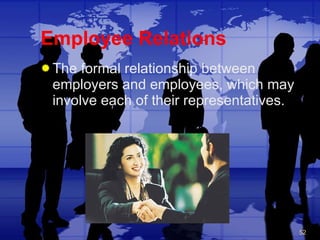
Employee Relations The formal relationship between employers and employees, which may involve each of their representatives.
Main Groups Trade Unions Employers Employers’ Associations ACAS
Trade Unions An organisation that represents employees: Rates of  pay  and  bonuses Work facilities  and  conditions Breaks Job security Redundancy  /  Dismissal Grievance Negotiating  job descriptions  and  person specifications Collective   Bargaining
Employers A duty of care to undertake a  process of negotiation  and  consultation  with their employees and keep them  informed of changes
Employers’ Associations Organisations which  represent employers Often useful for a  small firm negotiating  with a large union eg  COSLA  (Convention of Scottish Local Authorities) CBI  (Confederation of British Industry) Meat Marketing Board
Professional Associations Similar to Trade Unions -  include  setting and maintaining standards/monitoring of qualifications BMA (British Medical Association) Police Federation Professional Footballers Association GTCS (General Teaching Council Scotland)
Advisory, Conciliation and Arbitration Service Best way to improve industrial relations is for  employers  and  employees  to  work together
ACAS Preventing or resolving  employment disputes Conciliating  in actual/potential complaints before industrial tribunal Providing  information and advice Promoting  good practice
Negotiation Consultation Arbitration
Worker Directors: Elected by co-workers  to sit on the Board of Directors No voting powers  but  express employee views  directly to BoD Works Councils: Equal number  of employees and managers Discuss suggestions for change  and  changes being introduced Legal right of access  to information on employee matters Joint decision making  powers
Industrial Action Official industrial action has the backing of a Trade Union: Trying to force the employer to take action  on a particular issue – lost output, lost sales, poor image Employers can also take action: Lost earnings Threaten redundancy
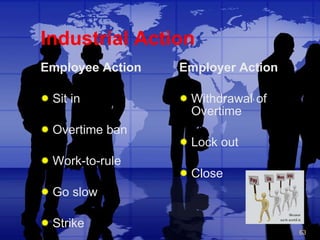
Industrial Action Employee Action Sit in Overtime ban Work-to-rule Go slow Strike Employer Action Withdrawal of Overtime Lock out Close
Policies and Procedures Appraisal  – performance of employees is monitored at regular intervals setting targets, identify training needs, identify promotion opportunities Grievance  – what should employees do if they have been badly treated Discipline  – if the employee is in breach of organisation’s rules Health and Safety  – safety precautions, accident procedures etc
Personnel Information and Record Keeping Records normally kept: Basic employee data Training Absence Applicants – comply with EO Legislation Holidays Wages and Salaries Labour Turnover Occupational Health
Congratulations You have completed Human Resources in Higher Business Management

HBM Human Resources CMD SM

  • 1.
    Human Resource ManagementHigher/Int 2 Business Management 2009-2010
  • 2.
    What are HumanResources? The entire workforce - Managing Director to part-time Cleaner Each person being employed to perform specific functions which play a part in the success or failure of the organisation
  • 3.
    Human Resource ManagementHuman Resource Management refers to that part of an organisation’s activities designed to: Attract Train Develop Maintain an effective workforce HRM more strategic and integrated than previous ‘Personnel Management’
  • 4.
    Objectives of HRMPromote a policy of continuous learning and staff development Recruit , develop and retain people with appropriate skills and attitudes Manage employee relations (one to one and collective) Design, implement and manage remuneration systems to motive staff Maintain and improve the physical and mental well-being of the workforce (conditions and H&S) Take account of all government legislation relevant to HRM
  • 5.
    Management of PeopleTheory X - Workers are motivated by money, they are lazy, selfish, ignore the needs of the organisation, avoid responsibility, lack ambition. They need controlled and directed by management. Theory Y - Workers have different needs, they can enjoy work. If motivated they can organise themselves and take responsibility. Managers should allow creativity to be shown.
  • 6.
    Abraham Maslow’s HierarchySelf-actualisation - needs filled through self-fulfillment, more responsibility, ownership shares, self-employment Esteem - self-respect, recognition, promotion, awards, title, size office/desk Emotional - love, belonging, teams Safety - job security, trade unions, laws Physiological - food, clothing, shelter, warmth
  • 7.
    Workers need tofeel safe and secure. An unsafe working environment will not motivate workers to work, and to work well, nor will the possibility of being made redundant. What’s the point of working, I’m going to lose my job anyway I’m no gonna work for this firm again, cos a goat a sair heid.
  • 8.
    Increasing Motivation QualityCircles - meet regularly to identify, analyse and attempt to solve work-related problems Job Enlargement - increased number of tasks, jobs less repetitive, organised into groups and trained to be multi-skilled - job rotation Job Enrichment - giving workers opportunities to choose how to complete a particular task, usually as part of a team
  • 9.
    The HRM Function(1) The Executive Role : the expert department in matters related to HR – legal requirements, information provision The Audit Role : monitors organisation activities The Facilitator Role : helps others to acquire HR skills eg grievances, equal opportunities, planning The Consultancy Role : providing advice and guidance The Service Role : provider of useful information eg changes in legislation
  • 10.
    The HRM Function(2) Levels of Management Strategic: long-term planning policies, guidelines, culture of organisation Tactical: pathways to strategic objectives planning, recruitment, training, development, industrial relations Operational: day-to-day (training) identify possible employees, select suitable employee, arrange cover, develop materials
  • 11.
    HRM Planning CurrentEmployment Trends Staffing Requirements Future Supply of Workers Labour Turnover Satisfy and Motivate Employees Organisation Culture Training and Development Release Surplus Staff New Staff Potential Staff Existing Staff Departing Staff
  • 12.
    Changing Patterns ofEmployment (1) Increase in part-time work full time staff led to inflexible workforce Increase in service sector employment coal, steel and shipbuilding no longer significant Increase in public sector employment 30% of Scottish workers employed in this sector Increase in women working Special arrangements: flexi-time, job-share, child-care Increase in home/teleworking Improvement in communications
  • 13.
    Changing Patterns ofEmployment (2) Part-time work - in most cases voluntary decision Variable hours - overtime or flexi-time systems Temporary work - fixed-term, seasonal, casual or agency work Downsized - now bringing workers back on a fixed-term or project basis for experience Self-employment - now represent about 13% of workforce, route for those in unemployment and low pay and source of jobs for others
  • 14.
    3 ‘Types ofWorkforce’ Core workforce - those essential to the business, giving the expertise. They are given good terms and conditions of employment Flexible Labour force - part-time or temporary basis eg during peaks in activity. Not employed when there is no demand for services Contractual fringe - sub-contractors eg cleaners, consultants, component suppliers. No need to pay for pensions, holidays etc
  • 15.
    Advantages (Non-TraditionalWorkforce Only employ those contributing to core activities Saves salaries Saves office space Reduces need to pay sickness/holiday benefits, redundancy payments, NI contributions Flexible staffing numbers relating to the market
  • 16.
    Disadvantages (Non-Traditional Workforce)Cost of Recruitment and Selection Staff shortages in certain areas Less commitment from workforce Increased training (esp induction) High staff turnover Lack of continuity in personnel
  • 17.
    Recruitment -Stage 1 Is there a vacancy? Someone leaving? Extra worker required? Large organisation complex process - liaison between departments or Senior Management
  • 18.
    Job Analysis -Stage (2) Identifies the main features of the job: Physical requirements and tasks Mental requirements and tasks Skill requirements and specific skill tasks Areas of responsibility Areas of accountability Physical environment Hazards specific to the job Where is the information found? Current occupant of the job Superiors and Subordinates Specialist observers
  • 19.
    Job Description -Stage 3 (1) ‘ Word picture of the job’ Tells candidates what is expected of them and allows qualities to be set for candidates Disputes settled later based on the Job Description
  • 20.
    Job Description -Stage 3 (2) Title Relationships Purpose of the Job Duties and Responsibilities Authority Resources Available Location Qualifications
  • 21.
    Person Specification -Stage 4 Profile of the person required - essential and desirable skills and qualities Physical Make-up - health, energy, appearance Attainments - education, training, expertise General Intelligence - thinking skills and mental effort Special Aptitudes - specialist skills required? Interests - personal interests Disposition - personality Circumstances - special requirements
  • 22.
    Internal Recruitment Maybe a promotion or change of job or location Applicant is known to the organisation The organisation has trained this employee Applicant will be aware of the culture and rules of the organisations Can enhance employee morale However: a limited pool of applicants Another vacancy is usually created
  • 23.
    External Recruitment Localand National Newspapers Journals (eg British Medical Journal) Recruitment Days Recruitment Agencies Internet Websites (Company or Recruitment Agency) Job Centres / Careers Service Skill Seekers and New Deal Schools, Colleges or Universities (Milk Round)
  • 24.
  • 25.
    The Selection ProcessApplication Forms/CVs Interviews Testing Candidate Selected
  • 26.
    Application Forms/CVs Contentof Application Form same information, same order, comparisons Curriculum Vitae summary or listing of relevant work experience and education and other accomplishments Checked against the Person Specification Short List Created : Seems suitable (interview) Possibly suitable (maybe) Unsuitable (polite letter of rejection)
  • 27.
    Interviews (Planning) Date,time and place agreed Waiting area Tour around premises? Refreshments? Time for interview (30 mins)? When Notified of Outcome? Travelling Expenses? All Candidates Informed?
  • 28.
    The Good InterviewBe open-minded and unbiased Be prepared Welcome the interviewee Control the interview Supply information Close the interview Follow-up
  • 29.
    Types of InterviewOne-to-one Successive Interviews (eg Apprentice) Panel Interviews (eg Bear Factory)
  • 30.
  • 31.
    Testing Attainment TestsDemonstrating skills eg WPM Intelligence Tests (IQ) Mental reasoning - numeracy, literacy, problem solving Aptitude Tests Tests of innate skills eg mechanical Psychometric (Personality) Tests Personality tests - extrovert or an introvert Medical Tests Army, police and airlines
  • 32.
    Assessment Centres Candidatesmay complete team-building and role-playing exercises Monitoring of social skills, leadership qualities, personality Can be at a large Assessment Centre or at offices or a hired venue
  • 33.
    Training To teach new skills or improve their existing skills Staff development to improve skills for now and in the future Training and Staff Development is very similar, however, staff development is long-term
  • 34.
    Costs and Benefitsof Training Financial cost Training staff Loss of output Flexibility Promotion of change Upgrading skills Improved employee satisfaction Improved image of the organisation Motivation and productivity
  • 35.
    Types of TrainingInduction training – given to new recruits. Designed to give information about the organisation. On-the-job training – ‘sitting next to Nellie’. This is carried out while the employee is doing their job . Off-the-job training – carried out away from the organisation ie college.
  • 36.
    Staff development –based on a plan of work. May involve a combination of on-the-job and off-the-job training Appraisal – a report on how well an employee is doing. Carried out at regular intervals . Should be positive with only constructive criticism.
  • 37.
    Equal Opportunities Discrimination – choosing one person over another Applies to selection, training, promotion, and wages Equal Opportunities means that everyone has the same chance
  • 38.
    Reasons for DiscriminationWomen (home, married, children) Ethnic Minorities (eg religious holidays) Disabled People (less capable) Older People (slow, new technology) Unproven ideas or Stereotypes
  • 39.
    Women at WorkAverage Wages Men £11.31/hour Women £9.82/hour Full-time Work Men 91% Women 57% Flexible workforce , increasingly women fill vacancies, crèches, homeworking, Remaining in education longer – management posts
  • 40.
    Legislation Equal PayAct 1970 – “ broadly similar’ work = equal pay Sex Discrimination Act 1975 Direct eg harassment (treating someone less favourably) Indirect eg must be 6’ tall Applies to job adverts eg salesperson, cashier Selection – not restricted unless essential Interview – structured prevents bias Promotion Training Dismissal Employment Tribunal
  • 41.
    Ethnic Minorities RaceRelations Act 1976 – colour, race, nationality, ethnic background Direct : eg racial groups are unreliable Indirect : eg not allowing turbans (Sikhs) Selection tests may discriminate as not in some ethnic groups culture
  • 42.
    Disabled People “those with a long-term health problem/disability that limits the kind or amount of paid work they can do” Disability Discrimination Act 1995 >15 employees must comply Reasonable adjustments eg fixtures, fittings, telephone, work station, access, building features (lifts), work conditions, extra training Direct : eg translator one person in wheelchair Indirect : eg requirement for driving licence
  • 43.
    Older People Employmentrates fall as people get older: 80% employed aged 54 vs 40% aged 64 could be through choice less training offered Some argue that there are advantages in recruiting older people: >40 experience and judgement >40 concentrate more on job responsibilities (less on salary and status) >40 greater social intelligence Examples are B&Q and Asda The Employment Equality (Age) Regulations 2006
  • 44.
    Sexual Orientation EmploymentEquality (Sexual Orientation) Regulations 2003 Outlaws discrimination in employment based on sexual orientation towards people of the same sex, opposite sex, or the same sex and the opposite sex Some exceptions eg where employer applies a particular sexual orientation to avoid conflict with religious convictions
  • 45.
    Health & Safetyat Work Raising the standard of safety and health for all individuals at work and the public as far as ‘reasonably practicable’ Employer’s Duties: Written statement of general policy prepared Negligence proceedings can be taken against management Providing training, information, instruction and supervision Ensuring that all equipment is safe and risk associated with handling, storing and transportation of articles are minimised
  • 46.
    Health & Safetyat Work Employee’s Duties: Take reasonable care of themselves and others Co-operate with the employer Not intentionally or recklessly interfere or misuse anything in relation to H&S Carry out duties in accordance with training or instructions Report any dangerous situations Health & Safety Executive: Power to enter employer’s premises and carry out investigations and examine materials
  • 47.
    Trade Union andEmployment Rights Act 1993 Employees cannot be dismissed for: Taking steps to protect themselves in circumstances of danger Performing H&S responsibilities Leaving a dangerous part of a workplace Bringing a H&S concern to employer’s attention Performing functions as a H&S representative
  • 48.
    Employment Protection EmploymentRelations Act 1999 one year = no unfair dismissal Parental leave (adoption) Remove limits on awards for unfair dismissal Reasons (which are unfair): Membership of trade unions Pregnancy (being able to do job) Redundancy (without correct procedures) As a result of transfer of business Sunday Trading Act 1994
  • 49.
    Employment Protection Reasons(which are fair): Incapable of doing job Unqualified ‘ Misconduct’ – minor or major If unable to employ – eg lost driving licence False details given – eg application form Redundancy Redundancy Job must have disappeared Must consult with trade unions Period of notice Redundancy payment
  • 50.
    Wage Act 1986Wages are any sums paid to the worker in connection with the job: Fees, bonuses, commission, sick pay, gift tokens, vouchers Redundancy payments, expenses, loans are not included Deductions NI, shown in contract, agreed in writing eg Trade Unions If an employer doesn’t pay – employee can complain to a tribunal
  • 51.
    National Minimum WageAct 1999 21+ £5.80 18-21 £4.83 16-17 £3.57 (figures correct 01/10/09) Why? Prevent poverty Reduce inequality between men and women Greater equality and fairness should motivate employees, reduce staff turnover and improve productivity
  • 52.
    Employee Relations Theformal relationship between employers and employees, which may involve each of their representatives.
  • 53.
    Main Groups TradeUnions Employers Employers’ Associations ACAS
  • 54.
    Trade Unions Anorganisation that represents employees: Rates of pay and bonuses Work facilities and conditions Breaks Job security Redundancy / Dismissal Grievance Negotiating job descriptions and person specifications Collective Bargaining
  • 55.
    Employers A dutyof care to undertake a process of negotiation and consultation with their employees and keep them informed of changes
  • 56.
    Employers’ Associations Organisationswhich represent employers Often useful for a small firm negotiating with a large union eg COSLA (Convention of Scottish Local Authorities) CBI (Confederation of British Industry) Meat Marketing Board
  • 57.
    Professional Associations Similarto Trade Unions - include setting and maintaining standards/monitoring of qualifications BMA (British Medical Association) Police Federation Professional Footballers Association GTCS (General Teaching Council Scotland)
  • 58.
    Advisory, Conciliation andArbitration Service Best way to improve industrial relations is for employers and employees to work together
  • 59.
    ACAS Preventing orresolving employment disputes Conciliating in actual/potential complaints before industrial tribunal Providing information and advice Promoting good practice
  • 60.
  • 61.
    Worker Directors: Electedby co-workers to sit on the Board of Directors No voting powers but express employee views directly to BoD Works Councils: Equal number of employees and managers Discuss suggestions for change and changes being introduced Legal right of access to information on employee matters Joint decision making powers
  • 62.
    Industrial Action Officialindustrial action has the backing of a Trade Union: Trying to force the employer to take action on a particular issue – lost output, lost sales, poor image Employers can also take action: Lost earnings Threaten redundancy
  • 63.
    Industrial Action EmployeeAction Sit in Overtime ban Work-to-rule Go slow Strike Employer Action Withdrawal of Overtime Lock out Close
  • 64.
    Policies and ProceduresAppraisal – performance of employees is monitored at regular intervals setting targets, identify training needs, identify promotion opportunities Grievance – what should employees do if they have been badly treated Discipline – if the employee is in breach of organisation’s rules Health and Safety – safety precautions, accident procedures etc
  • 65.
    Personnel Information andRecord Keeping Records normally kept: Basic employee data Training Absence Applicants – comply with EO Legislation Holidays Wages and Salaries Labour Turnover Occupational Health
  • 66.
    Congratulations You havecompleted Human Resources in Higher Business Management