
Department of Metallurgical Engineering
Gandhi Institute of Engineering and
Technology, Gunupur - 765022
Supervisor
Dr. Ajaya Kumar Pradhan
Presented By
Hariballabha Mahanta
Introduction:
 Metal Casting is one of the oldest materials
shaping methods known. Casting means
pouring molten metal into a mold with a
cavity of the shape to be made, and allowing
it to solidify. The solidified object is called
the casting.
 The mold, into which the metal is poured, is
made of some heat resisting material. Sand
is most often used as it resists the high
temperature of the molten metal.
Permanent molds of metal can also be used
to cast products.
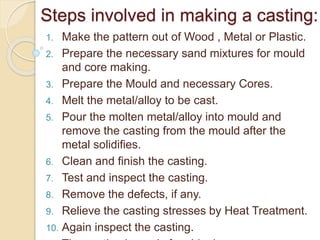
Steps involved in making a casting:
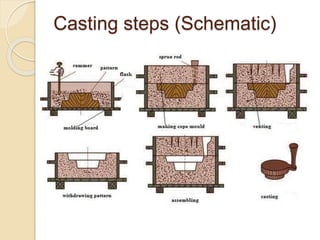
1. Make the pattern out of Wood , Metal or Plastic.
2. Prepare the necessary sand mixtures for mould
and core making.
3. Prepare the Mould and necessary Cores.
4. Melt the metal/alloy to be cast.
5. Pour the molten metal/alloy into mould and
remove the casting from the mould after the
metal solidifies.
6. Clean and finish the casting.
7. Test and inspect the casting.
8. Remove the defects, if any.
9. Relieve the casting stresses by Heat Treatment.
10. Again inspect the casting.
Casting steps (Schematic)
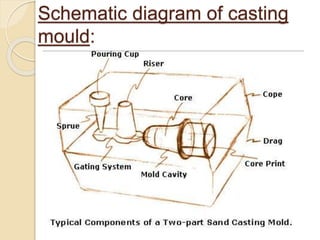
Schematic diagram of casting
mould:
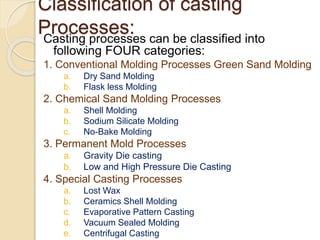
Classification of casting
Processes:Casting processes can be classified into
following FOUR categories:
1. Conventional Molding Processes Green Sand Molding
a. Dry Sand Molding
b. Flask less Molding
2. Chemical Sand Molding Processes
a. Shell Molding
b. Sodium Silicate Molding
c. No-Bake Molding
3. Permanent Mold Processes
a. Gravity Die casting
b. Low and High Pressure Die Casting
4. Special Casting Processes
a. Lost Wax
b. Ceramics Shell Molding
c. Evaporative Pattern Casting
d. Vacuum Sealed Molding
e. Centrifugal Casting
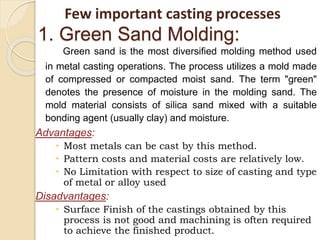
1. Green Sand Molding:
Green sand is the most diversified molding method used
in metal casting operations. The process utilizes a mold made
of compressed or compacted moist sand. The term "green"
denotes the presence of moisture in the molding sand. The
mold material consists of silica sand mixed with a suitable
bonding agent (usually clay) and moisture.
Advantages:
 Most metals can be cast by this method.
 Pattern costs and material costs are relatively low.
 No Limitation with respect to size of casting and type
of metal or alloy used
Disadvantages:
 Surface Finish of the castings obtained by this
process is not good and machining is often required
to achieve the finished product.
Few important casting processes
2. Dry Sand Molding:
When it is desired that the gas forming materials
are lowered in the molds, air-dried molds are
sometimes preferred to green sand molds. Two
types of drying of molds are often required.
 Skin drying and
 Complete mold drying.
In skin drying a firm mold face is produced.
Shakeout of the mold is almost as good as that
obtained with green sand molding. The most
common method of drying the refractory mold
coating uses hot air, gas or oil flame. Skin drying
of the mold can be accomplished with the aid of
torches, directed at the mold surface.
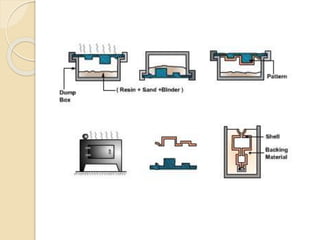
3. Shell Molding Process:
 It is a process in which, the sand mixed with a
thermosetting resin is allowed to come in contact with a
heated pattern plate (200 oC), this causes a skin (Shell) of
about 3.5 mm of sand/plastic mixture to adhere to the
pattern..
 Then the shell is removed from the pattern. The cope and
drag shells are kept in a flask with necessary backup
material and the molten metal is poured into the mold.
 This process can produce complex parts with good surface
finish 1.25 µm to 3.75 µm, and dimensional tolerance of
0.5 %.
 A good surface finish and good size tolerance reduce the
need for machining. The process overall is quite cost
effective due to reduced machining and cleanup costs.
 The materials that can be used with this process are cast
irons, and aluminum and copper alloys.
4. Sodium Silicate Molding
Process
 In this process, the refractory material is coated with
a sodium silicate-based binder. For molds, the sand
mixture can be compacted manually, jolted or
squeezed around the pattern in the flask.
 After compaction, CO2 gas is passed through the
core or mold. The CO2 chemically reacts with the
sodium silicate to cure, or harden, the binder. This
cured binder then holds the refractory in place
around the pattern. After curing, the pattern is
withdrawn from the mold.
 The sodium silicate process is one of the most
environmentally acceptable of the chemical
processes available.
 The major disadvantage of the process is that
the binder is very hygroscopic and readily
absorbs water, which causes a porosity in the
castings.. Also, because the binder creates such
a hard, rigid mold wall, shakeout and
collapsibility characteristics can slow down
production.
 Some of the advantages of the process are:
 A hard, rigid core and mold are typical of the
process, which gives the casting good
dimensional tolerances;
 good casting surface finishes are readily
obtainable;
Advantages of metal casting:
 Casting is one of the most versatile
manufacturing process.
 Casting provides the greatest freedom of
design in terms of shape, size and the
product quantity.
 Casting imparts uniform directional
properties and better vibration capacity to
the cast parts.
 Casting produces machinable parts.
 Shapes difficult and uneconomic to obtain
otherwise may be achieved through casting
process.
 A product may be cast as one piece, there by
eliminating the need of metal joining
processes.
 Very heavy and bulky parts which are
otherwise difficult to get fabricated may be
cast.
 Metals (like cast iron) difficult to be shaped by
other manufacturing processes may be cast.
 Casting can be designed for equal distribution
of loads and for minimum stress concentration
in order to achieve more strength and
increased service life.
 Casting process can be mechanized and
usefully employed for mass production of
Limitations of metal casting:
 Dimensional accuracy and surface finish of the
castings made by sand casting processes are a
limitation to this technique.
 Many new casting processes have been
developed which can take into consideration the
aspects of dimensional accuracy and surface
finish.
 Some of these processes are die casting process,
investment casting process, vacuum-sealed
molding process, and shell molding process.
 The metal casting process is a labor intensive
process
Applications of Casting:
Transportation vehicles
Turbine vanes
Power generators
Railway crossings
Agricultural parts
Aircraft jet engine parts
Sanitary fittings
Communication, Construction and
Atomic Energy applications, etc..
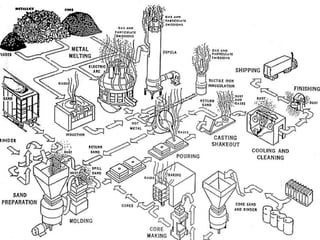
Different Sections in Foundry:
1) Pattern making
2) Sand mixing & preparation
3) Mould and core making
4) Mould assembly & handling
5) Melting
6) Pouring
7) Shaking out
8) Fettling & finishing
9) Heat treatment
10)Inspection & testing
Reference:
1. A text book of Production Technology Vol. I /
O.P. Khanna / Dhanpat Rai Publications
2. A text book of Production Technology
(Manufacturing Processes) / P. C. Sharma / S.
Chand & Company Ltd
3. Manufacturing Technology (Second Edition) / P
N Rao / Tata McGraw-Hill Publishing Company
Ltd
&
http://nptel.iitm.ac.in/
Hari ppt
Hari ppt

Hari ppt

  • 1.
    Department of MetallurgicalEngineering Gandhi Institute of Engineering and Technology, Gunupur - 765022 Supervisor Dr. Ajaya Kumar Pradhan Presented By Hariballabha Mahanta
  • 2.
    Introduction:  Metal Castingis one of the oldest materials shaping methods known. Casting means pouring molten metal into a mold with a cavity of the shape to be made, and allowing it to solidify. The solidified object is called the casting.  The mold, into which the metal is poured, is made of some heat resisting material. Sand is most often used as it resists the high temperature of the molten metal. Permanent molds of metal can also be used to cast products.
  • 3.
    Steps involved inmaking a casting: 1. Make the pattern out of Wood , Metal or Plastic. 2. Prepare the necessary sand mixtures for mould and core making. 3. Prepare the Mould and necessary Cores. 4. Melt the metal/alloy to be cast. 5. Pour the molten metal/alloy into mould and remove the casting from the mould after the metal solidifies. 6. Clean and finish the casting. 7. Test and inspect the casting. 8. Remove the defects, if any. 9. Relieve the casting stresses by Heat Treatment. 10. Again inspect the casting.
  • 4.
  • 5.
    Schematic diagram ofcasting mould:
  • 6.
    Classification of casting Processes:Castingprocesses can be classified into following FOUR categories: 1. Conventional Molding Processes Green Sand Molding a. Dry Sand Molding b. Flask less Molding 2. Chemical Sand Molding Processes a. Shell Molding b. Sodium Silicate Molding c. No-Bake Molding 3. Permanent Mold Processes a. Gravity Die casting b. Low and High Pressure Die Casting 4. Special Casting Processes a. Lost Wax b. Ceramics Shell Molding c. Evaporative Pattern Casting d. Vacuum Sealed Molding e. Centrifugal Casting
  • 7.
    1. Green SandMolding: Green sand is the most diversified molding method used in metal casting operations. The process utilizes a mold made of compressed or compacted moist sand. The term "green" denotes the presence of moisture in the molding sand. The mold material consists of silica sand mixed with a suitable bonding agent (usually clay) and moisture. Advantages:  Most metals can be cast by this method.  Pattern costs and material costs are relatively low.  No Limitation with respect to size of casting and type of metal or alloy used Disadvantages:  Surface Finish of the castings obtained by this process is not good and machining is often required to achieve the finished product. Few important casting processes
  • 8.
    2. Dry SandMolding: When it is desired that the gas forming materials are lowered in the molds, air-dried molds are sometimes preferred to green sand molds. Two types of drying of molds are often required.  Skin drying and  Complete mold drying. In skin drying a firm mold face is produced. Shakeout of the mold is almost as good as that obtained with green sand molding. The most common method of drying the refractory mold coating uses hot air, gas or oil flame. Skin drying of the mold can be accomplished with the aid of torches, directed at the mold surface.
  • 9.
    3. Shell MoldingProcess:  It is a process in which, the sand mixed with a thermosetting resin is allowed to come in contact with a heated pattern plate (200 oC), this causes a skin (Shell) of about 3.5 mm of sand/plastic mixture to adhere to the pattern..  Then the shell is removed from the pattern. The cope and drag shells are kept in a flask with necessary backup material and the molten metal is poured into the mold.  This process can produce complex parts with good surface finish 1.25 µm to 3.75 µm, and dimensional tolerance of 0.5 %.  A good surface finish and good size tolerance reduce the need for machining. The process overall is quite cost effective due to reduced machining and cleanup costs.  The materials that can be used with this process are cast irons, and aluminum and copper alloys.
  • 11.
    4. Sodium SilicateMolding Process  In this process, the refractory material is coated with a sodium silicate-based binder. For molds, the sand mixture can be compacted manually, jolted or squeezed around the pattern in the flask.  After compaction, CO2 gas is passed through the core or mold. The CO2 chemically reacts with the sodium silicate to cure, or harden, the binder. This cured binder then holds the refractory in place around the pattern. After curing, the pattern is withdrawn from the mold.  The sodium silicate process is one of the most environmentally acceptable of the chemical processes available.
  • 12.
     The majordisadvantage of the process is that the binder is very hygroscopic and readily absorbs water, which causes a porosity in the castings.. Also, because the binder creates such a hard, rigid mold wall, shakeout and collapsibility characteristics can slow down production.  Some of the advantages of the process are:  A hard, rigid core and mold are typical of the process, which gives the casting good dimensional tolerances;  good casting surface finishes are readily obtainable;
  • 13.
    Advantages of metalcasting:  Casting is one of the most versatile manufacturing process.  Casting provides the greatest freedom of design in terms of shape, size and the product quantity.  Casting imparts uniform directional properties and better vibration capacity to the cast parts.  Casting produces machinable parts.  Shapes difficult and uneconomic to obtain otherwise may be achieved through casting process.
  • 14.
     A productmay be cast as one piece, there by eliminating the need of metal joining processes.  Very heavy and bulky parts which are otherwise difficult to get fabricated may be cast.  Metals (like cast iron) difficult to be shaped by other manufacturing processes may be cast.  Casting can be designed for equal distribution of loads and for minimum stress concentration in order to achieve more strength and increased service life.  Casting process can be mechanized and usefully employed for mass production of
  • 15.
    Limitations of metalcasting:  Dimensional accuracy and surface finish of the castings made by sand casting processes are a limitation to this technique.  Many new casting processes have been developed which can take into consideration the aspects of dimensional accuracy and surface finish.  Some of these processes are die casting process, investment casting process, vacuum-sealed molding process, and shell molding process.  The metal casting process is a labor intensive process
  • 16.
    Applications of Casting: Transportationvehicles Turbine vanes Power generators Railway crossings Agricultural parts Aircraft jet engine parts Sanitary fittings Communication, Construction and Atomic Energy applications, etc..
  • 17.
    Different Sections inFoundry: 1) Pattern making 2) Sand mixing & preparation 3) Mould and core making 4) Mould assembly & handling 5) Melting 6) Pouring 7) Shaking out 8) Fettling & finishing 9) Heat treatment 10)Inspection & testing
  • 19.
    Reference: 1. A textbook of Production Technology Vol. I / O.P. Khanna / Dhanpat Rai Publications 2. A text book of Production Technology (Manufacturing Processes) / P. C. Sharma / S. Chand & Company Ltd 3. Manufacturing Technology (Second Edition) / P N Rao / Tata McGraw-Hill Publishing Company Ltd & http://nptel.iitm.ac.in/